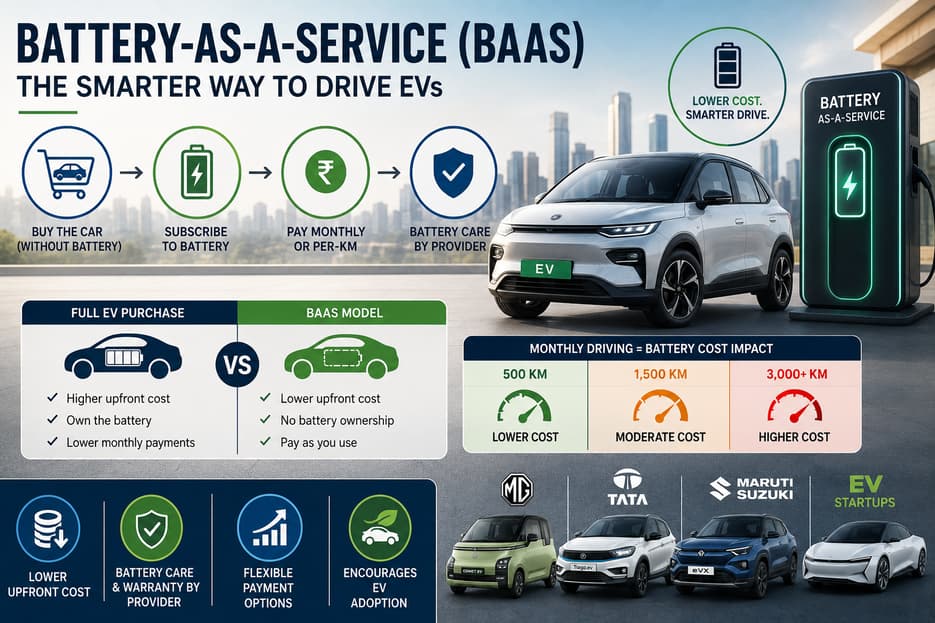

In August 2026, India has 8 brands offering BaaS EVs. Entry prices range from ₹4.69 lakh (Tata Tiago EV) to ₹12.88 lakh (Kia Carens Clavis EV), with subscription fees between ₹2.26 and ₹4.5 per km.
Complete Guide to Battery-as-a-Service (BaaS) EVs in India 2026: Which Models Offer the Lowest Entry Price?
Battery-as-a-Service (BaaS) is a financing structure in which the battery pack is separated from the vehicle chassis and financed independently — typically over a longer loan tenure — so that the buyer's upfront cost and monthly EMI are both significantly lower than a conventional EV purchase. As of August 2026, eight mass-market brands — Tata, JSW-MG, Citroen, Kia, Hyundai, Maruti Suzuki, Mahindra, and Toyota — offer BaaS schemes in India, with BaaS entry prices ranging from ₹4.69 lakh (Tata Tiago EV) to ₹12.88 lakh (Kia Carens Clavis EV).
The table below captures every BaaS-enabled model currently on sale, ranked by BaaS entry price, so you can see at a glance where each vehicle sits before diving into the details.
| Model | Segment | BaaS Entry Price | Subscription Fee | Non-BaaS Price | Upfront Saving |
|---|---|---|---|---|---|
| Tata Tiago EV | Hatchback | ₹4.69 lakh | ₹2.60/km | ₹6.99 lakh | ₹2.30 lakh |
| MG Comet EV | Mini EV | ₹4.99 lakh | ₹3.20/km | ₹7.80 lakh | ₹2.81 lakh |
| Tata Punch EV | Compact SUV | ₹6.49 lakh | ₹4,688/month | ₹9.69 lakh | ₹3.20 lakh |
| Citroen eC3X | Compact SUV | ₹6.89 lakh | ₹2.26/km | ₹11.99 lakh | ₹5.10 lakh |
| Kia Syros EV | Compact SUV | ₹7.99 lakh | ₹3.30/km | ₹13.50 lakh | ₹5.51 lakh |
| MG Windsor EV | Mid-size SUV | ₹9.99 lakh | ₹3.99/km | ₹14.70 lakh | ₹4.71 lakh |
| Hyundai Creta Electric | Mid-size SUV | ₹10.99 lakh | ₹3.90/km | ₹18.03 lakh | ₹7.04 lakh |
| Maruti Suzuki e Vitara | Mid-size SUV | ₹10.99 lakh | ₹3.99/km | ₹16.19 lakh | ₹5.20 lakh |
| Mahindra BE 6 Sporteq | Sports SUV | ₹11.45 lakh | ₹3.75/km | ₹19.45 lakh | ₹8.00 lakh |
| Kia Carens Clavis EV | MPV | ₹12.88 lakh | ₹3.30/km | TBA | TBA |
Prices ex-showroom; subscription fees per km unless stated otherwise. Data as of August 2026.
What exactly is BaaS and how does it work in India?
Battery-as-a-Service treats the battery pack — typically the single most expensive component of an electric vehicle, accounting for 30–50% of the total vehicle cost — as a separate financial asset from the chassis. The buyer purchases or finances the chassis at a lower price and then pays for the battery either through a per-kilometre subscription fee or through a separate EMI on a longer loan tenure.
Two distinct BaaS structures operate in India:
Per-kilometre subscription model: MG Windsor EV, MG Comet EV, Hyundai Creta Electric, Maruti Suzuki e Vitara, Kia Syros EV, Kia Carens Clavis EV, Citroen eC3X, and Tata Tiago EV all use this approach. The buyer pays a fixed rate per kilometre driven, regardless of volume (subject to any minimum usage commitments). The Citroen eC3X, for instance, has a minimum monthly commitment of 2,000 km at ₹2.26/km, working out to ₹4,520 per month.
Dual-loan EMI model: Tata Punch EV and Mahindra BE 6 Sporteq structure the battery as a separate loan — typically over 8 years versus the standard 5-year chassis loan — bringing down the combined monthly EMI. For the Tata Punch EV Smart 30kWh, the battery EMI works out to ₹4,688 per month, which at an assumed 1,800 km/month translates to ₹2.60 per km.
This distinction matters for buyers: a per-km model rewards low-mileage drivers (you pay less if you drive less), while a fixed EMI model gives predictability regardless of how much you drive.
Finance partners currently active in India's BaaS space include Bajaj Finance (offering 100% LTV on the battery at 9.0% interest) and Kotak Mahindra Prime (100% LTV on battery, 90% LTV on chassis at 9.25%), at least for Tata's Punch EV BaaS programme. Other brands work with their own NBFC and banking partners.
Which BaaS EV offers the lowest entry price in India?
The Tata Tiago EV holds the title of India's most affordable BaaS EV, with an entry price of ₹4.69 lakh + ₹2.60/km — a saving of ₹2.30 lakh over the standard ₹6.99 lakh price. It is also the most affordable electric car in India outright, with or without BaaS.
Close behind is the MG Comet EV at ₹4.99 lakh + ₹3.20/km, though the Comet's subscription fee is higher than the Tiago EV's. When MG first introduced BaaS for the Comet in 2024, the subscription fee was ₹2.50/km — it has since risen to ₹3.20/km, a 28% increase that buyers should factor into long-term cost projections.
For buyers seeking a proper sub-compact SUV under ₹7 lakh on BaaS, the Tata Punch EV (₹6.49 lakh chassis) and Citroen eC3X (₹6.89 lakh) are the two options. The eC3X stands out for having the lowest per-km subscription fee of any BaaS vehicle currently on sale — ₹2.26/km — though it requires a minimum 2,000 km monthly commitment.
How does the Maruti Suzuki e Vitara's BaaS pricing compare to its mid-size SUV rivals?
The mid-size electric SUV segment is where BaaS pricing gets genuinely interesting for family car buyers, and the Maruti Suzuki e Vitara sits right at the heart of this battle.
The e Vitara's BaaS pricing starts at ₹10.99 lakh for the Delta 49kWh variant, with a subscription fee of ₹3.99/km. The larger 61kWh variants — Zeta and Alpha — carry a higher subscription fee of ₹4.39/km, reflecting the bigger battery's cost. Across all variants, BaaS saves buyers between ₹5.20 lakh and ₹5.65 lakh upfront.
Here is how the e Vitara stacks up against its direct BaaS rivals in the mid-size SUV space:
| Model | BaaS Entry Price | Subscription Fee (entry) | Non-BaaS Entry Price | Upfront Saving |
|---|---|---|---|---|
| MG Windsor EV | ₹9.99 lakh | ₹3.99/km (38kWh) | ₹14.70 lakh | ₹4.71 lakh |
| Hyundai Creta Electric | ₹10.99 lakh | ₹3.90/km (42kWh) | ₹18.03 lakh | ₹7.04 lakh |
| Maruti Suzuki e Vitara | ₹10.99 lakh | ₹3.99/km (49kWh) | ₹16.19 lakh | ₹5.20 lakh |
| Mahindra BE 6 Sporteq | ₹11.45 lakh | ₹3.75/km (59kWh) | ₹19.45 lakh | ₹8.00 lakh |
The MG Windsor EV has the lowest BaaS entry price in this segment at ₹9.99 lakh, but its 38kWh battery is considerably smaller than the e Vitara's 49kWh entry battery — a meaningful difference for buyers planning longer drives. The Hyundai Creta Electric matches the e Vitara's ₹10.99 lakh entry price but has a slightly lower subscription fee (₹3.90/km vs ₹3.99/km) and offers the largest absolute upfront saving in this group at ₹7.04 lakh.
The Mahindra BE 6 Sporteq, despite its higher BaaS entry price of ₹11.45 lakh, offers the largest absolute upfront saving overall — ₹8 lakh — because its non-BaaS price of ₹19.45 lakh is substantially higher. It also has a relatively competitive subscription fee of ₹3.75/km for a 59kWh battery.
For a buyer doing 1,500 km per month, the monthly battery subscription cost works out as follows:
- MG Windsor EV (38kWh): ₹5,985/month
- Hyundai Creta Electric (42kWh): ₹5,850/month
- Maruti Suzuki e Vitara (49kWh): ₹5,985/month
- Mahindra BE 6 Sporteq (59kWh): ₹5,625/month
At that mileage, the Mahindra BE 6 Sporteq is cheapest per month on the battery subscription, while the Hyundai Creta Electric edges out the e Vitara by ₹135/month. The e Vitara's advantage over the Creta is its lower non-BaaS price (₹16.19 lakh vs ₹18.03 lakh), which means buyers who eventually want to exit BaaS and own the battery outright face a lower total cost.
Is BaaS actually cheaper than buying the full EV outright?
This is the question most buyers get wrong, and the answer depends heavily on how many kilometres you drive and over what time horizon.
Take the Tata Punch EV Smart 30kWh as a worked example. Under BaaS, the chassis costs ₹6.49 lakh and the battery ₹3.20 lakh — totalling ₹9.69 lakh, identical to the non-BaaS price. BaaS does not reduce the total cost of the vehicle; it restructures when and how you pay for it.
The real benefit is in monthly cash flow. By stretching the battery loan to 8 years instead of the standard 5-year chassis tenure, the battery EMI drops to ₹4,688/month for the Smart 30kWh variant. The combined chassis + battery EMI is designed to be comparable to the EMI of a petrol or diesel vehicle in the same segment — making the EV accessible to buyers who were previously priced out.
Two costs require careful attention:
-
Interest on the longer battery loan tenure: A battery loan at 9.0–9.25% over 8 years will cost more in total interest than the same amount financed over 5 years. This is the hidden cost of BaaS.
-
Rising subscription fees over time: The MG Comet EV's per-km fee rose from ₹2.50 to ₹3.20/km between 2024 and 2026. There is no guarantee that subscription fees remain fixed for the life of ownership.
For low-mileage drivers (under 1,000 km/month), the per-km model can be genuinely cheaper than a full EMI. For high-mileage drivers (over 2,500 km/month), the per-km costs can exceed what a standard loan EMI would have been. The Citroen eC3X's minimum 2,000 km/month commitment means high-mileage drivers pay for exactly what they use, while low-mileage drivers are locked into a minimum spend of ₹4,520/month regardless.
Which BaaS model offers the best value for money overall?
Value depends on your use case. Here are three buyer profiles and the best BaaS match for each:
Budget city commuter (under ₹6 lakh upfront, under 1,500 km/month): The Tata Tiago EV at ₹4.69 lakh + ₹2.60/km is the clear winner. At 1,000 km/month, the battery subscription costs ₹2,600/month — lower than any other option on this list.
Family compact SUV buyer (₹6–9 lakh upfront, 1,500–2,000 km/month): The Citroen eC3X at ₹6.89 lakh + ₹2.26/km offers the lowest per-km rate of any BaaS vehicle in India. At 2,000 km/month (the minimum commitment), the monthly battery cost is ₹4,520. The Tata Punch EV is the alternative for buyers who prefer a fixed EMI structure.
Mid-size SUV buyer (₹10–13 lakh upfront, 1,500–2,000 km/month): The Hyundai Creta Electric edges ahead of the Maruti Suzuki e Vitara on per-km cost (₹3.90 vs ₹3.99), but the e Vitara's 49kWh entry battery is larger than the Creta's 42kWh entry battery, which matters for range. Buyers who prioritise range per rupee of subscription fee will find the e Vitara competitive. The Mahindra BE 6 Sporteq offers the lowest subscription fee in this group (₹3.75/km) with the largest battery (59kWh), but its non-BaaS price is the highest.
What are the risks and limitations of BaaS in India?
BaaS is a relatively new concept in the Indian market — MG Windsor EV pioneered it in September 2024 — and there are legitimate concerns buyers should weigh before committing.
Resale value uncertainty: When you sell a BaaS vehicle, the buyer inherits the battery subscription obligation (or the battery loan). This is an unfamiliar concept for most used-car buyers in India, and it may suppress resale values until the market matures.
Battery ownership at end of loan: Under the dual-EMI model (Tata, Mahindra), once the battery loan is paid off, you own the battery outright. Under the per-km subscription model, the terms of battery ownership at end-of-contract vary by brand and are not always clearly disclosed upfront. Buyers should ask their dealer explicitly about what happens to the battery subscription after a set number of years.
Subscription fee revisions: As noted with the MG Comet EV, per-km fees can change. Buyers on long-term per-km contracts should check whether their subscription fee is locked in or subject to periodic revision.
Minimum usage commitments: Citroen's 2,000 km/month minimum is the most explicit example, but other brands may have similar conditions buried in the fine print. Low-mileage drivers should read subscription agreements carefully.
Limited variant availability: Several brands — including Hyundai, Kia, and Mahindra — have launched BaaS for only select variants at the time of writing. Hyundai has revealed BaaS pricing only for the Creta Electric Executive 42kWh; Kia only for the Syros EV HTK 42kWh; Mahindra only for the BE 6 Sporteq One and Two 59kWh trims. Buyers interested in higher-spec variants will need to wait for full variant-wise pricing.
How does Kia's BaaS approach differ from Tata's and MG's?
Kia India's BaaS programme is positioned as a tool to "democratise EV ownership" — a phrase the brand uses explicitly. For the Syros EV, BaaS reduces the entry price from ₹13.50 lakh to ₹7.99 lakh, a saving of ₹5.51 lakh — one of the largest percentage reductions in the market. The Carens Clavis EV starts at ₹12.88 lakh under BaaS.
Kia uses a per-km subscription fee of ₹3.30/km across both the Syros EV and Carens Clavis EV, which is competitive in the mid-range. The brand has yet to reveal BaaS pricing for the larger 51.4kWh battery variants of the Syros EV.
Tata's approach is the most transparent in terms of total cost breakdown. The Punch EV BaaS structure explicitly publishes the chassis price, battery price, chassis EMI, and battery EMI for every variant — making it easy for buyers to calculate their exact monthly outgo. Tata also specifies its finance partners (Bajaj Finance and Kotak Mahindra Prime) and their interest rates upfront.
MG's approach with the Windsor EV was the market pioneer, and the brand has since extended BaaS to the Comet EV. MG uses a pure per-km model with no published minimum monthly commitment, though the subscription fee for the Windsor EV's larger 52.9kWh pack (₹4.50/km) is the highest in the market for any single variant.
Should you wait for more BaaS options before buying?
The BaaS market in India is expanding rapidly. In the span of two years (2024–2026), the number of BaaS-enabled models has grown from one (MG Windsor EV) to at least ten across eight brands. Several brands have announced BaaS for only a subset of their variant lineup, with full variant-wise pricing expected soon.
If you are considering a mid-size SUV, the Maruti Suzuki e Vitara's BaaS pricing is already live across all three variants (Delta, Zeta, Alpha), making it one of the more complete BaaS offerings in the segment. The Hyundai Creta Electric's BaaS pricing, by contrast, covers only the entry Executive 42kWh variant at this stage — buyers interested in higher-spec Creta Electric trims or the 51.4kWh battery will need to wait.
For buyers in the compact SUV space, the Kia Syros EV's BaaS pricing for the 51.4kWh variants is also pending. If range is a priority, it may be worth waiting a few weeks for Kia to publish those numbers before making a decision.
The broader trend is clear: BaaS is becoming a standard feature of the Indian EV market rather than a niche offering. Brands that have not yet introduced BaaS — or have done so only partially — are likely to expand their programmes in the coming months as competitive pressure builds.
What should you check before signing a BaaS agreement?
Before committing to a BaaS plan, run through this checklist with your dealer:
Total cost of ownership: Add up the chassis price + total battery subscription cost over your expected ownership period (typically 5–7 years). Compare this to the non-BaaS total cost (vehicle price + standard loan interest). BaaS should not cost more in total unless the lower monthly outgo is genuinely worth the premium to you.
Subscription fee lock-in: Ask whether the per-km rate is fixed for the duration of your contract or subject to annual revision. Get this in writing.
Battery ownership terms: Clarify what happens at the end of the battery loan or subscription period. Do you own the battery? Can you buy it out early? What are the foreclosure charges? (For Tata's Punch EV, no foreclosure charges apply on the battery loan after 5 years.)
Minimum usage commitment: Understand whether there is a minimum monthly kilometre requirement and what happens if you drive less.
Resale implications: Ask your dealer how BaaS is handled in a resale scenario. Is the battery loan transferable to the new owner? Does the subscription transfer automatically?
Insurance and maintenance: Confirm whether the battery subscription includes any warranty or maintenance coverage, or whether standard EV battery warranty terms apply separately.
For buyers comparing the Maruti Suzuki e Vitara against the Hyundai Creta Electric or Mahindra BE 6 Sporteq on BaaS, these questions are especially important because the subscription fees and total costs over a 5-year period can differ by ₹1–2 lakh depending on mileage patterns.
The bottom line: BaaS in India 2026
India's BaaS market has matured significantly in two years. What began as a single model's experiment (MG Windsor EV, September 2024) is now a mainstream financing option across hatchbacks, compact SUVs, mid-size SUVs, and MPVs. The lowest entry price in the market — ₹4.69 lakh for the Tata Tiago EV — puts an electric car within reach of buyers who previously could not consider one.
In the mid-size SUV segment, the Maruti Suzuki e Vitara's BaaS pricing at ₹10.99 lakh + ₹3.99/km is competitive with the Hyundai Creta Electric and undercuts the Mahindra BE 6 Sporteq on entry price. Its 49kWh entry battery is larger than the Creta Electric's 42kWh entry option, which gives it a range advantage at the same BaaS entry price point.
The Citroen eC3X deserves a special mention for having the lowest per-km subscription fee in the market (₹2.26/km), though its minimum monthly commitment and relatively niche brand positioning may limit its appeal. The Mahindra BE 6 Sporteq offers the largest absolute upfront saving (₹8 lakh) and a competitive ₹3.75/km fee for a 59kWh battery.
BaaS is not a discount — it is a restructuring of when you pay. Buyers who understand that distinction, do their total-cost maths, and read the subscription terms carefully will find it a genuinely useful tool for making EV ownership more accessible in 2026.
For a broader look at which EVs are worth buying this year, see our best electric cars to buy in India in 2026 guide, or if budget is the primary constraint, our best electric cars under ₹20 lakhs roundup covers the full field.
Sources
- All EVs available with a BaaS scheme in India | Autocar India
- Tata Punch EV BaaS: Price, EMI & Running Cost | Tata Motors EV
- Kia India Introduces Battery-as-a-Service (BaaS) | Kia India
- Hyundai Creta Electric prices now start at Rs 10.99 lakh with BaaS | Autocar India
- MG Windsor launched at Rs 9.99 lakh, battery rental extra | Autocar India
- MG Windsor EV Pro price starts at Rs 17.49 lakh | Autocar India
- Maruti Suzuki e Vitara | Autocar India
- Which Electric Cars Offer Battery as a Service (BaaS) in India and Are They Worth Buying? | EV Index India
- Best Electric SUVs in India in 2026 | EV Index India