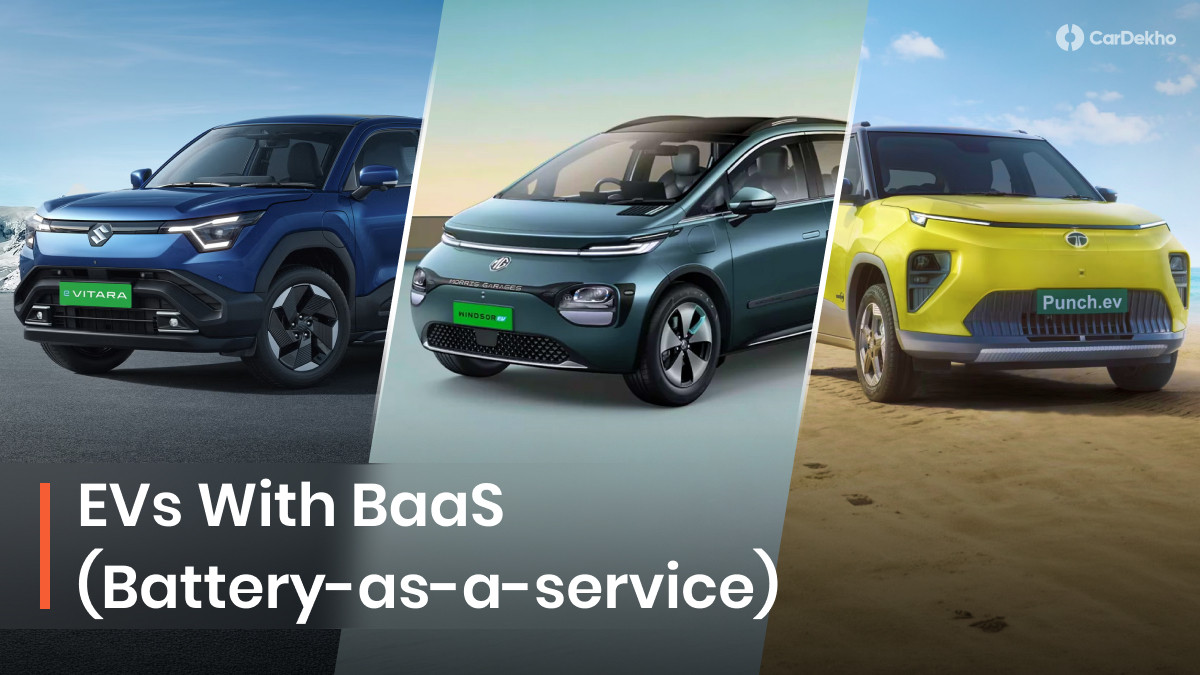

Eight EVs from five brands — Tata, MG, Maruti, Kia, and Toyota — offer BaaS in India in 2026, with BaaS prices starting as low as ₹4.69 lakh plus ₹2.6 per km for the Tata Tiago EV.
Battery-as-a-Service (BaaS) in India: Complete Guide to Pricing, Models & Ownership
Battery-as-a-Service (BaaS) is an ownership model in which the buyer purchases the electric vehicle body and drivetrain outright while subscribing to the battery pack separately, typically paying a per-kilometre rental fee instead of the full battery cost upfront. As of June 2026, eight electric vehicles across five mass-market brands offer BaaS in India — Tata, JSW-MG, Maruti Suzuki, Kia, and Toyota — with BaaS entry prices ranging from ₹4.69 lakh to ₹15.25 lakh (ex-showroom) and per-km rental fees between ₹2.6 and ₹4.99.
The table below summarises every BaaS-eligible EV available in India right now, making it easy to compare upfront savings against the ongoing per-km cost:
| Model | Segment | BaaS Starting Price | Per-km Rental | Non-BaaS Starting Price | Max Upfront Saving |
|---|---|---|---|---|---|
| Tata Tiago EV | Hatchback | ₹4.69 lakh | ₹2.6 | ₹6.99 lakh | ₹2.30 lakh |
| MG Comet EV | City EV | ₹4.99 lakh | ₹3.2 | ₹7.63 lakh | ₹2.64 lakh |
| Tata Punch EV | Compact SUV | ₹6.49 lakh | ₹2.6 | ₹9.69 lakh | ₹3.20 lakh |
| MG Windsor EV | Midsize SUV | ₹9.99 lakh | ₹3.9–₹4.5 | ₹14.10 lakh | ₹5.00 lakh |
| Maruti Suzuki e Vitara | Midsize SUV | ₹10.99 lakh | ₹3.99–₹4.39 | ₹15.99 lakh | ₹5.50 lakh |
| Kia Carens Clavis EV | MPV | ₹12.84 lakh | ₹3.3 | ₹17.99 lakh | ₹6.05 lakh |
| MG ZS EV | Midsize SUV | ₹13.00 lakh | ₹4.5 | ₹17.99 lakh | ₹5.24 lakh |
| Toyota Urban Cruiser Ebella | Midsize SUV | ₹15.25 lakh | ₹4.99 | ₹23.60 lakh | ₹8.35 lakh |
All prices ex-showroom, India. Per-km fees vary by battery pack size where multiple packs are offered.
What exactly is Battery-as-a-Service (BaaS) and how does it work in India?
Battery-as-a-Service is a financing and ownership structure that decouples the cost of the battery — the single most expensive component in any electric vehicle — from the cost of the car itself. Under a BaaS arrangement, the buyer pays a lower ex-showroom price for the vehicle (excluding the battery), and then pays a usage-linked rental fee, typically expressed in rupees per kilometre driven, to the manufacturer or a designated battery-leasing partner.
The model addresses one of the most persistent barriers to EV adoption in India: sticker shock. A mid-range EV battery pack can account for 30–50% of the vehicle's total cost, and BaaS effectively converts that capital expenditure into an operational one. Several automakers selling electric cars in India have started selling EVs with battery rental schemes, which not only bring down the upfront cost significantly but also offer customers the ability to select their preferred rental plans as per their driving habits and requirements.
The per-km fee is tracked through the vehicle's odometer or a connected telematics system and billed monthly. Brands typically bundle battery warranty and replacement coverage into the subscription, which removes the anxiety around long-term battery degradation — a concern that frequently deters first-time EV buyers.
MG Windsor EV is widely credited as the car that introduced BaaS to the Indian passenger vehicle market when it launched in September 2024. Since then, the model has spread rapidly across segments, from sub-₹5 lakh city EVs to ₹23 lakh premium SUVs.
Which is the most affordable BaaS EV in India right now?
The Tata Tiago EV holds the title of India's most affordable BaaS electric car on two counts: it has the lowest BaaS entry price at ₹4.69 lakh (ex-showroom) for the Smart 19 variant, and it charges the lowest per-km rental fee of ₹2.6 — the cheapest battery subscription rate for any car in India. Without BaaS, the same variant costs ₹6.99 lakh, meaning the scheme saves the buyer ₹2.30 lakh upfront.
The MG Comet EV is a close second, with a BaaS starting price of ₹4.99 lakh, though its per-km fee of ₹3.2 is higher than Tata's ₹2.6. For a city commuter covering 30 km a day, the difference works out to ₹18 extra per day with the Comet — roughly ₹540 per month more than the Tiago EV's subscription cost. Over a year, that gap compounds to about ₹6,480, which is worth factoring into the total cost of ownership calculation.
The Tata Punch EV, also at ₹2.6/km, starts at ₹6.49 lakh under BaaS — saving ₹3.20 lakh versus its non-BaaS price of ₹9.69 lakh. For buyers who need a compact SUV rather than a hatchback but still want the lowest per-km battery cost, the Punch EV is the logical step up from the Tiago EV.
Evaluating purely on per-km cost, Tata's two BaaS models are the clear leaders. On absolute entry price, the Tiago EV wins outright.
How does the Maruti Suzuki e Vitara's BaaS scheme compare to competitors?
The Maruti Suzuki e Vitara is Maruti's first electric vehicle, and its adoption of BaaS from launch signals that India's largest carmaker sees the model as essential for mainstream EV acceptance. The e Vitara's BaaS scheme is structured around its two battery options: ₹3.99 per km for the 49kWh pack and ₹4.39 per km for the 61kWh pack. BaaS pricing starts at ₹10.99 lakh for the Delta 49kWh variant (down from ₹15.99 lakh), saving ₹5 lakh upfront, and goes up to ₹14.51 lakh for the Alpha 61kWh (down from ₹20.01 lakh), saving ₹5.5 lakh.
Compared to its closest BaaS rival in the midsize SUV segment, the MG Windsor EV, the e Vitara's per-km fees are slightly higher: Windsor charges ₹3.9/km for its 38kWh pack versus e Vitara's ₹3.99/km for the 49kWh pack. The e Vitara, however, offers a meaningfully larger battery and a claimed range of over 500 km, which contextualises the marginally higher rental cost.
Against the Toyota Urban Cruiser Ebella — which shares the same 61kWh battery platform as the e Vitara's larger pack — the e Vitara is notably cheaper on the subscription side: ₹4.39/km versus the Ebella's ₹4.99/km. That ₹0.60/km difference adds up to ₹6,570 per year for someone driving 30 km a day.
The Kia Carens Clavis EV offers an interesting counterpoint: its ₹3.3/km fee is the second-lowest among all BaaS cars in India, and it applies uniformly to both its 42kWh and 51.4kWh battery options. For buyers who need MPV practicality and want a competitive per-km rate, the Clavis EV undercuts the e Vitara on running cost, though the e Vitara's SUV form factor and Maruti's unmatched service network are real differentiators.
For buyers who trust Maruti's 4,000+ dealer and service touchpoints across India — a network no other EV brand currently matches — the e Vitara's BaaS scheme represents a genuinely competitive proposition, even if it isn't the cheapest per-km option in its price band. You can explore how the e Vitara stacks up on other ownership factors in our guide to the best electric cars under ₹20 lakhs in India in 2026.
What are the full BaaS price lists for each model?
Tata Tiago EV — ₹4.69 lakh + ₹2.6/km
The Tiago EV is India's most affordable electric car at ₹6.99 lakh (non-BaaS), and under BaaS it drops to ₹4.69 lakh for the Smart 19 variant. Tata has yet to reveal the full variant-wise BaaS prices of the Tiago EV at the time of writing, so only the entry variant is confirmed. The ₹2.6/km fee is the lowest battery rental rate for any passenger car in India.
MG Comet EV — ₹4.99 lakh + ₹3.2/km onwards
MG's city EV is available across five variants under BaaS, with the upfront saving fixed at ₹2.64 lakh across all trims. The full variant-wise breakdown:
| Variant | Non-BaaS Price | BaaS Price | Saving |
|---|---|---|---|
| Executive 17.3kWh | ₹7.63 lakh | ₹4.99 lakh + ₹3.2/km | ₹2.64 lakh |
| Excite 17.3kWh | ₹8.73 lakh | ₹6.09 lakh + ₹3.2/km | ₹2.64 lakh |
| Excite 17.4kWh | ₹9.00 lakh | ₹6.36 lakh + ₹3.2/km | ₹2.64 lakh |
| Exclusive 17.3kWh | ₹9.73 lakh | ₹7.09 lakh + ₹3.2/km | ₹2.64 lakh |
| Exclusive 17.4kWh | ₹10.00 lakh | ₹7.36 lakh + ₹3.2/km | ₹2.64 lakh |
When MG first introduced BaaS for the Comet EV in 2024, the subscription fee was ₹2.5/km — the current ₹3.2/km represents a 28% increase in the running cost component.
Tata Punch EV — ₹6.49 lakh + ₹2.6/km
The Punch EV facelift is the newest entrant in Tata's BaaS lineup. The 2026 Tata Punch EV facelift is priced from ₹6.49 lakh under BaaS, with the same ₹2.6/km rate as the Tiago EV. Only the Smart 30kWh variant's BaaS price is confirmed so far; pricing for the 40kWh variants is yet to be announced. The 30kWh pack offers a claimed range of 375 km, while the 40kWh unit promises up to 468 km.
MG Windsor EV — ₹9.99 lakh + ₹3.9/km onwards
MG Windsor EV is the car that started the BaaS movement in India, launching in September 2024. It now spans two battery options under BaaS:
| Variant | Non-BaaS Price | BaaS Price | Saving |
|---|---|---|---|
| Excite 38kWh | ₹14.10 lakh | ₹9.99 lakh + ₹3.9/km | ₹4.11 lakh |
| Exclusive 38kWh | ₹15.53 lakh | ₹11.42 lakh + ₹3.9/km | ₹4.11 lakh |
| Essence 38kWh | ₹16.53 lakh | ₹12.42 lakh + ₹3.9/km | ₹4.11 lakh |
| Exclusive Pro 52.9kWh | ₹17.38 lakh | ₹12.38 lakh + ₹4.5/km | ₹5.00 lakh |
| Essence Pro 52.9kWh | ₹18.60 lakh | ₹13.60 lakh + ₹4.5/km | ₹5.00 lakh |
The Windsor EV Pro variants with the 52.9kWh pack offer a claimed range of up to 449 km and carry the same ₹4.5/km fee as the MG ZS EV.
Maruti Suzuki e Vitara — ₹10.99 lakh + ₹3.99/km onwards
| Variant | Non-BaaS Price | BaaS Price | Saving |
|---|---|---|---|
| Delta 49kWh | ₹15.99 lakh | ₹10.99 lakh + ₹3.99/km | ₹5.00 lakh |
| Zeta 61kWh | ₹17.49 lakh | ₹11.99 lakh + ₹4.39/km | ₹5.50 lakh |
| Alpha 61kWh | ₹20.01 lakh | ₹14.51 lakh + ₹4.39/km | ₹5.50 lakh |
The e Vitara's 61kWh pack promises over 500 km of claimed range — among the highest in its segment. The BaaS scheme offers the largest absolute rupee savings (up to ₹5.5 lakh) of any Maruti product, and the brand's service network gives it a practical ownership advantage that pure-play EV brands cannot easily replicate.
Kia Carens Clavis EV — ₹12.84 lakh + ₹3.3/km onwards
Kia introduced BaaS for the Carens Clavis EV in May 2026, making it the newest addition to this list and the only MPV in the BaaS category. The ₹3.3/km fee applies uniformly across both battery options — 42kWh and 51.4kWh — an unusually buyer-friendly structure compared to MG's tiered pricing. Confirmed BaaS prices so far:
| Variant | Non-BaaS Price | BaaS Price | Saving |
|---|---|---|---|
| HTK+ 42kWh | ₹17.99 lakh | ₹12.84 lakh + ₹3.3/km | ₹5.15 lakh |
| HTX E ER 51.4kWh | ₹21.99 lakh | ₹15.94 lakh + ₹3.3/km | ₹6.05 lakh |
The Clavis EV's ₹3.3/km rate is the second-lowest among all BaaS cars in India, beaten only by Tata's ₹2.6/km. For families needing a 7-seat MPV, this is currently the only BaaS option available.
MG ZS EV — ₹13 lakh + ₹4.5/km onwards
MG's first EV in India received BaaS pricing in September 2024 alongside the Windsor EV. The ZS EV comes with a 50.3kWh battery pack and a claimed range of 461 km.
| Variant | Non-BaaS Price | BaaS Price | Saving |
|---|---|---|---|
| Executive 50.3kWh | ₹17.99 lakh | ₹13.00 lakh + ₹4.5/km | ₹4.99 lakh |
| Excite Pro 50.3kWh | ₹18.75 lakh | ₹13.51 lakh + ₹4.5/km | ₹5.24 lakh |
| Exclusive Pro 50.3kWh | ₹19.75 lakh | ₹14.51 lakh + ₹4.5/km | ₹5.24 lakh |
| Essence 50.3kWh | ₹20.75 lakh | ₹15.51 lakh + ₹4.5/km | ₹5.24 lakh |
At ₹4.5/km, the ZS EV carries the joint-highest per-km fee alongside the Windsor EV Pro. Buyers choosing the ZS EV over the Windsor EV Pro are essentially paying the same running rate for a slightly larger, more feature-rich SUV with a longer claimed range.
Toyota Urban Cruiser Ebella — ₹15.25 lakh + ₹4.99/km
Toyota's first EV for India, the Urban Cruiser Ebella was revealed in January 2026 and the top-spec E3 variant was priced in May 2026 at ₹23.60 lakh. Under BaaS, prices start at ₹15.25 lakh — an upfront saving of ₹8.35 lakh, the largest absolute saving of any BaaS car in India. The ₹4.99/km rental fee is also the highest in the market. The E3 variant is powered by a 61kWh battery with a claimed range of 543 km.
Toyota has not yet confirmed which specific variant the ₹15.25 lakh BaaS price applies to, or the full variant-wise BaaS price list. Given that only the E3's pricing has been announced, the BaaS entry price likely corresponds to that variant.
Is BaaS actually cheaper than buying the battery outright?
This is the question every prospective BaaS buyer should ask, and the answer depends entirely on how many kilometres you drive per year.
The break-even calculation is straightforward: divide the upfront saving by the per-km rental fee to find the number of kilometres at which the BaaS scheme becomes more expensive than the outright purchase.
For the Tata Tiago EV (Smart variant): ₹2.30 lakh saving ÷ ₹2.6/km = approximately 88,462 km. If you drive less than ~88,000 km over the ownership period, BaaS is cheaper overall. At 30 km/day, that's roughly 8 years of driving — a reasonable ownership horizon for most Indian buyers.
For the MG Windsor EV (Excite 38kWh): ₹4.11 lakh saving ÷ ₹3.9/km = approximately 1,05,385 km. At 40 km/day, that's about 7.2 years.
For the Maruti Suzuki e Vitara (Delta 49kWh): ₹5.00 lakh saving ÷ ₹3.99/km = approximately 1,25,313 km. At 40 km/day, that's about 8.6 years.
For moderate urban drivers (30–50 km/day), BaaS is financially neutral to slightly advantageous over a typical 7–10 year ownership cycle. The real value lies in the lower EMI burden at the point of purchase — a ₹5 lakh reduction in the financed amount translates to roughly ₹8,000–₹10,000 lower monthly EMI on a 7-year loan, which is significant for first-time EV buyers.
There are also non-financial factors: BaaS schemes typically include battery health monitoring and replacement coverage, which removes the risk of a large out-of-pocket battery replacement cost (which can run ₹3–6 lakh for a mid-size pack) later in the vehicle's life. This is a meaningful benefit that the break-even calculation above does not capture.
One caveat worth flagging: as the MG Comet EV example shows, per-km fees can increase over time — the Comet's fee rose from ₹2.5/km at launch in 2024 to ₹3.2/km currently. Buyers should check whether their BaaS contract locks in the per-km rate or allows the manufacturer to revise it.
Which BaaS EV should you buy based on your driving profile?
City commuter, budget under ₹6 lakh upfront: The Tata Tiago EV at ₹4.69 lakh with ₹2.6/km is the clear choice. The MG Comet EV at ₹4.99 lakh is a viable alternative if you prefer MG's connected-car features, but the higher ₹3.2/km fee makes it more expensive to run.
Compact SUV buyer, budget under ₹8 lakh upfront: The Tata Punch EV at ₹6.49 lakh + ₹2.6/km is the only option in this category right now. Its 30kWh pack (375 km claimed range) is adequate for mixed city and highway use, and the per-km fee matches the Tiago EV.
Midsize SUV buyer, budget under ₹12 lakh upfront: The MG Windsor EV (from ₹9.99 lakh) and Maruti Suzuki e Vitara (from ₹10.99 lakh) are the primary contenders. Windsor wins on absolute entry price; e Vitara wins on battery size, claimed range, and service network depth. For buyers who prioritise long-distance capability and resale value, the e Vitara's 49kWh or 61kWh pack is a stronger proposition. See our best electric SUVs in India in 2026 guide for a fuller comparison.
MPV buyer: The Kia Carens Clavis EV is the only BaaS MPV in India. Its ₹3.3/km fee is competitive, and the ₹6.05 lakh saving on the 51.4kWh variant is the largest in the MPV segment. If you need 7-seat practicality with BaaS flexibility, there is currently no alternative.
Premium SUV buyer: The Toyota Urban Cruiser Ebella offers the largest absolute upfront saving (up to ₹8.35 lakh) but carries the highest per-km fee at ₹4.99. For high-mileage drivers, the MG ZS EV or e Vitara Alpha are more cost-efficient over time. For buyers who prioritise Toyota's reliability reputation and the 543 km claimed range, the Ebella's BaaS scheme makes a ₹23.60 lakh car accessible at ₹15.25 lakh — a psychologically significant threshold.
What should buyers watch out for before signing a BaaS agreement?
Rate revision clauses: As noted above, MG has already revised the Comet EV's per-km fee upward since launch. Before signing, confirm whether the contract fixes the rate for the ownership period or allows periodic revisions. A rate that starts at ₹3.9/km but rises to ₹4.5/km after three years changes the break-even calculation materially.
Minimum kilometre commitments: Some BaaS contracts include minimum monthly kilometre thresholds. If you drive less than the minimum, you may still be billed for the floor amount. Clarify this with the dealer before purchase.
Battery swap and upgrade rights: One of the theoretical advantages of BaaS is the ability to upgrade to a newer, better battery in the future. In practice, no Indian manufacturer has yet offered a mid-ownership battery upgrade under BaaS. This is worth asking about explicitly.
Resale value implications: A BaaS vehicle sold second-hand transfers the battery subscription obligation to the new owner. This can complicate the resale process, as the new buyer must agree to take over the subscription. The used-car market for BaaS vehicles in India is still nascent, and resale values are not yet well-established. Our guide on EV after-sales service networks covers related ownership considerations.
Total cost of ownership vs. outright purchase: Run the break-even calculation for your specific driving pattern before deciding. For high-mileage drivers (80+ km/day), outright purchase may be cheaper over a 5-year period. For moderate urban drivers (30–50 km/day), BaaS is typically neutral to slightly advantageous, with the added benefit of lower EMIs and battery replacement coverage.
Is BaaS the future of EV ownership in India?
The rapid expansion of BaaS from a single model (MG Windsor EV, September 2024) to eight models across five brands in under two years suggests strong market validation. As electric vehicle adoption rises in India, high upfront costs continue to remain a major concern for buyers, and the BaaS model helps reduce the initial purchase cost while customers pay separately through subscription, lease, or usage-based plans.
The model also aligns well with India's urban driving patterns: most city commuters drive 30–60 km per day, which means the per-km fee is predictable and manageable. The psychological barrier of a ₹15–20 lakh sticker price is meaningfully reduced when the same car is available for ₹10–12 lakh upfront.
What remains uncertain is whether BaaS will extend to higher-volume, lower-price segments — sub-₹10 lakh EVs — or whether it will remain concentrated in the ₹10–25 lakh band where battery costs represent the largest share of vehicle price. Tata's decision to offer BaaS on the Tiago EV (India's cheapest EV) is an encouraging signal that the model can work at the entry level too.
For buyers currently evaluating their first EV purchase, BaaS removes two of the biggest objections: the high upfront cost and the long-term battery replacement risk. Whether you're looking at a ₹4.69 lakh Tiago EV or a ₹15.25 lakh Toyota Ebella, there is now a BaaS option at almost every price point in the Indian EV market. For a broader view of which EVs make sense across segments, our best electric cars to buy in India in 2026 guide is a useful companion read.
Sources
- All EVs available with BaaS schemes in India — Autocar India
- MG Windsor EV to Tata Punch EV: Top 5 electric cars in India with BaaS — Mint
- Affordable EVs with BaaS schemes in India: MG Comet, Clavis EV & more — Times of India
- Cheapest Electric Cars Available With Battery As A Service In India — 91Wheels
- Toyota Urban Cruiser Ebella revealed in India — Autocar India
- Maruti Suzuki e Vitara — Official Model Page
- MG Windsor EV — Official Model Page
- Best Electric Cars Under ₹20 Lakhs in India in 2026 — EV Index India
- Best Electric SUVs in India in 2026 — EV Index India
- Best Electric Cars to Buy in India in 2026 — EV Index India