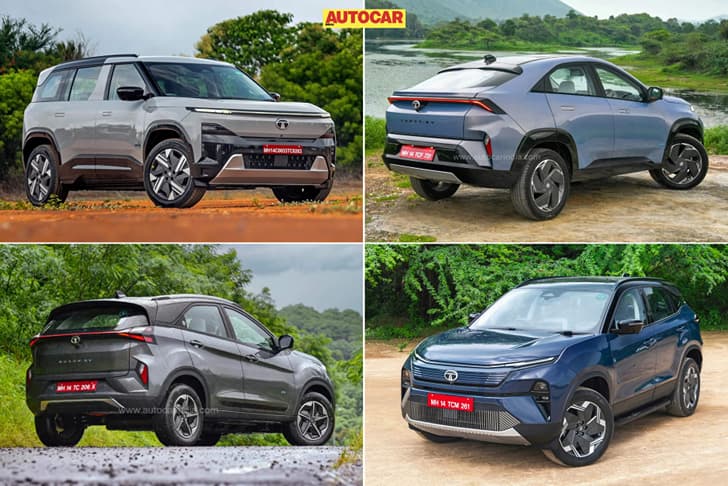

Tata Motors has expanded BaaS to its full six-model EV lineup, slashing upfront prices by up to Rs 7.30 lakh by separating battery costs from the vehicle price.
Tata Nexon, Sierra, Harrier & Curvv EVs Now Available With BaaS in India 2026: How Battery-as-a-Service Expands Across Tata's EV Range
As of 28 September 2026, Tata Motors has extended its Battery-as-a-Service (BaaS) scheme to cover its entire six-model electric vehicle lineup — the Tiago EV, Punch EV, Nexon EV, Curvv EV, Sierra EV, and Harrier EV — with upfront price reductions ranging from Rs 2.30 lakh to Rs 7.30 lakh depending on the model, according to Autocar India.
Previously, BaaS was restricted to the entry-level Tiago EV and Punch EV. Expanding to the Nexon EV, Curvv EV, Sierra EV, and Harrier EV marks a significant shift in how Tata positions affordability across its premium and near-premium EV segments. For buyers watching the Nexon EV from the sidelines at Rs 14.34 lakh, a BaaS entry point of Rs 8.99 lakh changes the calculus entirely.
Tata EV BaaS: Full Price Comparison Table (2026)
The table below covers all six Tata EVs under BaaS, with the Maruti Suzuki e Vitara included as a key market reference point for buyers considering alternatives in the Rs 17–22 lakh segment. All Tata prices are entry-trim, ex-showroom, excluding road tax, insurance, and TCS. Battery usage costs are based on 60 km/day (44 km/day for the Tiago EV), excluding charging costs.
| Model | Battery | Standard Price | BaaS Price | Upfront Saving | Battery Usage Cost |
|---|---|---|---|---|---|
| Tata Tiago EV | 19 kWh | Rs 6.99 lakh | Rs 4.69 lakh | Rs 2.30 lakh | Rs 2.6/km |
| Tata Punch EV | 30 kWh | Rs 9.79 lakh | Rs 6.59 lakh | Rs 3.20 lakh | Rs 2.6/km |
| Tata Nexon EV | 45 kWh | Rs 14.34 lakh | Rs 8.99 lakh | Rs 5.35 lakh | Rs 4.4/km |
| Tata Curvv EV | 55 kWh | Rs 17.19 lakh | Rs 10.99 lakh | Rs 6.20 lakh | Rs 5.0/km |
| Tata Sierra EV | 63 kWh | Rs 18.79 lakh | Rs 11.99 lakh | Rs 6.80 lakh | Rs 5.5/km |
| Tata Harrier EV | 65 kWh | Rs 21.79 lakh | Rs 14.49 lakh | Rs 7.30 lakh | Rs 5.9/km |
| Maruti Suzuki e Vitara | 49 kWh / 61 kWh | ~Rs 17.49 lakh (est.) | No BaaS offered | — | — |
Sources: Autocar India; Maruti e Vitara pricing is indicative based on segment positioning.
The Maruti Suzuki e Vitara, which competes directly with the Tata Sierra EV and Curvv EV in the Rs 17–22 lakh band, does not currently offer a BaaS or battery-separation financing option. For a buyer comparing the two, the Sierra EV's BaaS entry price of Rs 11.99 lakh versus the e Vitara's standard pricing represents a meaningful psychological and financial gap at the point of purchase — even accounting for the ongoing battery usage cost.
What exactly is Battery-as-a-Service (BaaS)?
Battery-as-a-Service separates the cost of the battery pack from the cost of the vehicle, allowing a buyer to purchase or finance the car at a lower upfront price while paying for the battery through a separate, usage-linked or EMI-based payment structure.
Tata structures BaaS as a dual-loan finance product: one loan covers the vehicle without the battery, and a second loan or payment plan covers the battery. The battery EMI varies based on three factors — the size of the battery pack, the down payment made, and the loan tenure chosen. Tata quotes a per-kilometre usage cost as the headline battery payment figure, calculated assuming a fixed daily running distance (60 km for most models, 44 km for the Tiago EV).
The BaaS battery payment does not cover charging costs, maintenance, repairs, or other associated expenses. These remain the buyer's responsibility, just as they would under standard full-ownership purchase. The car itself — its chassis, motor, electronics, and cabin — is owned outright from day one. The battery sits in a separate financial arrangement.
Customers retain the option to buy any Tata EV with the battery included in the vehicle price. BaaS is an alternative financing path, not a mandatory subscription.
Which Tata EVs now have BaaS, and what are the savings?
All six models in Tata's electric lineup now carry the BaaS option as confirmed by Autocar India on 28 September 2026. The four newly added models — Nexon EV, Curvv EV, Sierra EV, and Harrier EV — represent Tata's mid-to-upper EV range, where battery packs are significantly larger and account for a greater share of the vehicle's total cost.
Nexon EV (45 kWh): The Nexon EV drops from Rs 14.34 lakh to Rs 8.99 lakh under BaaS — a saving of Rs 5.35 lakh. At under Rs 9 lakh, it enters price territory previously occupied only by ICE compact SUVs. The battery usage cost is Rs 4.4/km. For buyers driving 60 km daily, this translates to a daily battery cost of Rs 264, or roughly Rs 7,920 per month — before charging.
Curvv EV (55 kWh): The coupe-SUV falls from Rs 17.19 lakh to Rs 10.99 lakh, saving Rs 6.20 lakh. Battery usage is charged at Rs 5/km. The Curvv EV competes against the Hyundai Creta Electric and Maruti Suzuki e Vitara, and a BaaS entry point under Rs 11 lakh makes it considerably more accessible than its sticker price suggests.
Sierra EV (63 kWh): Positioned between the Curvv EV and Harrier EV, the Sierra EV drops from Rs 18.79 lakh to Rs 11.99 lakh — a saving of Rs 6.80 lakh. Battery usage is Rs 5.5/km. Debuting on June 30, 2026, it was positioned as Tata's answer to the Mahindra BE 6, Hyundai Creta Electric, MG ZS EV, and Maruti Suzuki e Vitara. With BaaS, its effective entry point undercuts all of those rivals' standard prices.
Harrier EV (65 kWh): The Harrier EV sees the largest absolute saving — Rs 7.30 lakh — dropping from Rs 21.79 lakh to Rs 14.49 lakh. Battery usage is charged at Rs 5.9/km. This flagship electric SUV's BaaS price of Rs 14.49 lakh puts it in a very different conversation than its Rs 21.79 lakh sticker price, though buyers need to factor in the ongoing battery cost carefully.
How does the BaaS dual-loan structure actually work?
Tata's BaaS uses two separate financial instruments executed at purchase. The first finances the vehicle minus the battery. The second finances the battery separately, with the EMI or per-kilometre charge determined by the battery's capacity, the buyer's chosen down payment, and the loan tenure.
The per-kilometre usage costs published by Tata — Rs 2.6/km for the Tiago EV and Punch EV, up to Rs 5.9/km for the Harrier EV — are calculated on assumed daily usage (60 km for most models). These figures give buyers a headline number to compare, but the actual monthly battery payment depends on the specific financing terms agreed at the dealership.
Government levies, road tax, insurance, TCS, charging costs, maintenance, and repair costs are explicitly excluded from BaaS pricing. Buyers should budget for these separately. The BaaS prices quoted are for entry-level variants and personal (non-commercial) use only.
One practical consideration: since the battery is financed separately, buyers should clarify with their lender and Tata's financial partners what happens to the battery loan in the event of a vehicle resale. This area is still developing market norms, and prospective buyers should get clarity in writing before signing.
For a broader look at how BaaS compares across all available options in India, see our guide on which electric cars offer Battery-as-a-Service in India and whether they're worth buying.
Is BaaS actually cheaper than buying the battery outright?
The honest answer is: it depends on how much you drive and how long you plan to own the vehicle.
BaaS reduces the upfront cost significantly — by up to Rs 7.30 lakh in the case of the Harrier EV. However, the ongoing per-kilometre battery usage cost means that over time, a high-mileage user could end up paying more in total than if they had purchased the battery outright.
Take the Nexon EV as an example. The upfront saving is Rs 5.35 lakh. At Rs 4.4/km battery usage cost and 60 km/day, the monthly battery payment works out to approximately Rs 7,920. Over five years, that amounts to roughly Rs 4.75 lakh — close to but still below the upfront saving. At seven years, the cumulative battery cost would exceed the upfront saving. For buyers planning to keep the car for three to four years, BaaS is likely to be financially advantageous. For those planning to hold the vehicle for a decade, the standard purchase may work out cheaper in total cost of ownership.
For the Harrier EV, the Rs 7.30 lakh saving is the largest in the range. At Rs 5.9/km and 60 km/day, the monthly battery cost is approximately Rs 10,620. Over five years, that totals around Rs 6.37 lakh — still below the upfront saving, making BaaS look attractive for medium-term ownership.
These calculations are approximate and exclude charging costs, which are the buyer's responsibility regardless of whether they choose BaaS or standard purchase. The actual break-even point will vary based on the specific EMI structure negotiated.
How does this affect Tata's competitive position against rivals like the Maruti e Vitara?
Tata's BaaS expansion is a direct competitive lever in the Rs 10–22 lakh EV segment, where the most intense competition is playing out in 2026. The Hyundai Creta Electric, Mahindra BE 6, MG ZS EV, and Maruti Suzuki e Vitara are all vying for the same pool of buyers ready to go electric but sensitive to upfront cost.
The Maruti Suzuki e Vitara, positioned in the Rs 17–22 lakh band with 49 kWh and 61 kWh battery options, does not currently offer a BaaS or battery-separation financing model. Maruti Suzuki's approach has historically leaned on its service network breadth and brand trust rather than financing innovation. With Tata now offering the Sierra EV at Rs 11.99 lakh under BaaS — a model that competes directly with the e Vitara — the pressure on Maruti to respond with a comparable affordability mechanism is real.
The Maruti Suzuki e Vitara benefits from Suzuki's global EV platform and Maruti's unmatched dealer and service network across India. For buyers in smaller cities where Tata's charging infrastructure may be thinner, the e Vitara's service accessibility remains a genuine advantage. But on pure entry-price optics, the BaaS-equipped Tata lineup now has a significant edge. If Maruti were to adopt a similar BaaS strategy for the e Vitara, it could bring the electric SUV's entry point down by Rs 5–6 lakh, making it a formidable competitor in the sub-Rs 13 lakh EV space.
For buyers currently shortlisting the e Vitara against the Tata Sierra EV or Curvv EV, the BaaS pricing shift is a material factor that warrants re-evaluation. Our guide on the best electric cars under Rs 20 lakh in India in 2026 covers this comparison in detail.
What is the Sierra EV, and why does its BaaS inclusion matter?
The Tata Sierra EV is a mid-size electric SUV built on Tata's acti.ev+ architecture, positioned between the Curvv EV and Harrier EV in the brand's lineup, and launched on June 30, 2026. It was first shown as a concept at Auto Expo 2020 and again at Auto Expo 2023 before reaching production form.
The Sierra EV's inclusion in BaaS is particularly significant because it is Tata's newest and most aspirational mid-size EV, and its standard price of Rs 18.79 lakh placed it firmly in premium territory. At Rs 11.99 lakh under BaaS, it becomes one of the most feature-rich EVs available under Rs 12 lakh in India — at least on paper, before accounting for the ongoing battery usage cost.
The Sierra EV is expected to offer a 63 kWh battery in its entry configuration, with RWD as standard and AWD available on higher trims as confirmed by Tata's chief commercial officer Vivek Srivastava in an interview with Autocar India. Top-spec variants are expected to feature a triple-screen setup (10.25-inch instrument cluster, 12.3-inch touchscreen, 12.3-inch passenger display), panoramic sunroof, ventilated front seats, Level 2 ADAS, and a premium audio system.
For buyers wanting a large, feature-loaded electric SUV and comfortable with the BaaS payment structure, the Sierra EV at Rs 11.99 lakh represents a genuinely new value in the Indian EV market.
Who should consider BaaS, and who should stick with standard purchase?
BaaS suits buyers who:
- Want to minimise the upfront financial outlay and prefer to spread costs over time
- Drive moderate distances (around 40–70 km/day) and can predict their usage reasonably well
- Plan to own the vehicle for three to five years rather than a decade
- Are buying their first EV and want to limit initial financial exposure while the technology matures
- Are financing the vehicle anyway and are comfortable managing two EMIs
Standard purchase (battery included) suits buyers who:
- Drive high daily distances (above 80–100 km/day), where per-kilometre battery costs accumulate quickly
- Plan to keep the vehicle for seven years or more, where total BaaS payments could exceed the upfront battery cost
- Prefer a simpler financial structure with a single loan
- Are concerned about resale value implications of a separately financed battery
BaaS is not inherently better or worse than outright purchase — it is a financing tool that shifts cost from upfront to ongoing. The right choice depends on individual usage patterns, financial preferences, and ownership horizon.
For safety-conscious buyers evaluating Tata's EVs, several models in this lineup carry strong safety credentials. Our guide on 5-star Bharat NCAP electric cars in India worth buying in 2026 covers the relevant ratings.
What does TATA.ev's BaaS expansion signal about the broader EV market?
The Economic Times reported on 28 September 2026 that TATA.ev — the electric vehicle sub-brand Tata Motors unveiled alongside its broader Tata.Cars rebrand in August 2026 — is positioning BaaS as a core affordability pillar across its entire EV portfolio, not just an entry-level tool.
This represents a meaningful strategic signal. When BaaS was limited to the Tiago EV and Punch EV, it read as a tool to bring EVs into the sub-Rs 5 lakh and sub-Rs 7 lakh price brackets — essentially competing with ICE hatchbacks on upfront cost. Extending it to the Harrier EV at Rs 14.49 lakh suggests Tata is now using BaaS to compete with mid-size and premium ICE SUVs on upfront price, not just with other EVs.
The Harrier EV at Rs 14.49 lakh (BaaS) is cheaper at the point of purchase than many petrol-powered SUVs in the Rs 15–20 lakh segment. That framing — EV cheaper than petrol upfront — is new territory for the Indian market, and it could meaningfully accelerate EV adoption among buyers hesitant primarily because of sticker price.
The rebranding of Tata's EV business as TATA.ev (alongside Tata.Cars for the broader passenger vehicle business) also signals a more deliberate separation of the EV identity, which may allow for more targeted marketing and financing products going forward.
Key things to check before choosing BaaS for any Tata EV
Before committing to BaaS, buyers should verify the following with their Tata dealership and financing partner:
- The exact EMI for the battery loan, based on their specific down payment and chosen tenure — the per-kilometre figures are indicative, not contractual EMI amounts.
- What happens to the battery loan if the vehicle is sold before the loan tenure ends — whether the loan can be transferred to the new owner or must be settled at the time of sale.
- Whether the battery warranty terms differ under BaaS versus standard purchase.
- The total cost of ownership over their expected ownership period, factoring in battery usage payments, charging costs, insurance, and maintenance.
- Whether their preferred variant (not just the entry trim) is available under BaaS, since the published prices apply to entry-level trims only.
For buyers evaluating long-distance usability alongside the BaaS decision, our guide on the best electric cars for long trips in India in 2026 provides useful range and charging infrastructure context.
Tata's BaaS expansion to its full EV lineup is one of the more consequential pricing moves in the Indian EV market in 2026. It does not make EVs free or even cheap in total cost of ownership terms, but it removes the single biggest barrier most buyers cite — the upfront price — across a range that now spans from Rs 4.69 lakh (Tiago EV, BaaS) to Rs 14.49 lakh (Harrier EV, BaaS). Whether competitors like Maruti Suzuki, with the e Vitara, or Hyundai, with the Creta Electric, respond with similar financing innovations will be one of the defining storylines of the Indian EV market through 2027.
Sources
- Tata Nexon, Sierra, Harrier and Curvv EVs now available with BaaS | Autocar India
- Tata Sierra EV to debut on June 30 | Autocar India
- TATA.ev extends Battery-as-a-Service offering across its electric vehicle portfolio | Economic Times
- Tata Sierra EV India Launch on June 30: Here's What to Expect | Times Drive
- Tata Harrier EV | Tata Motors Official
- Which Electric Cars Offer Battery as a Service (BaaS) in India and Are They Worth Buying? | EV Index India
- Best Electric Cars Under ₹20 Lakhs in India in 2026 | EV Index India
- Which 5-Star Bharat NCAP Electric Cars in India Are Worth Buying in 2026? | EV Index India
- Best Electric Cars for Long Trips in India in 2026 | EV Index India