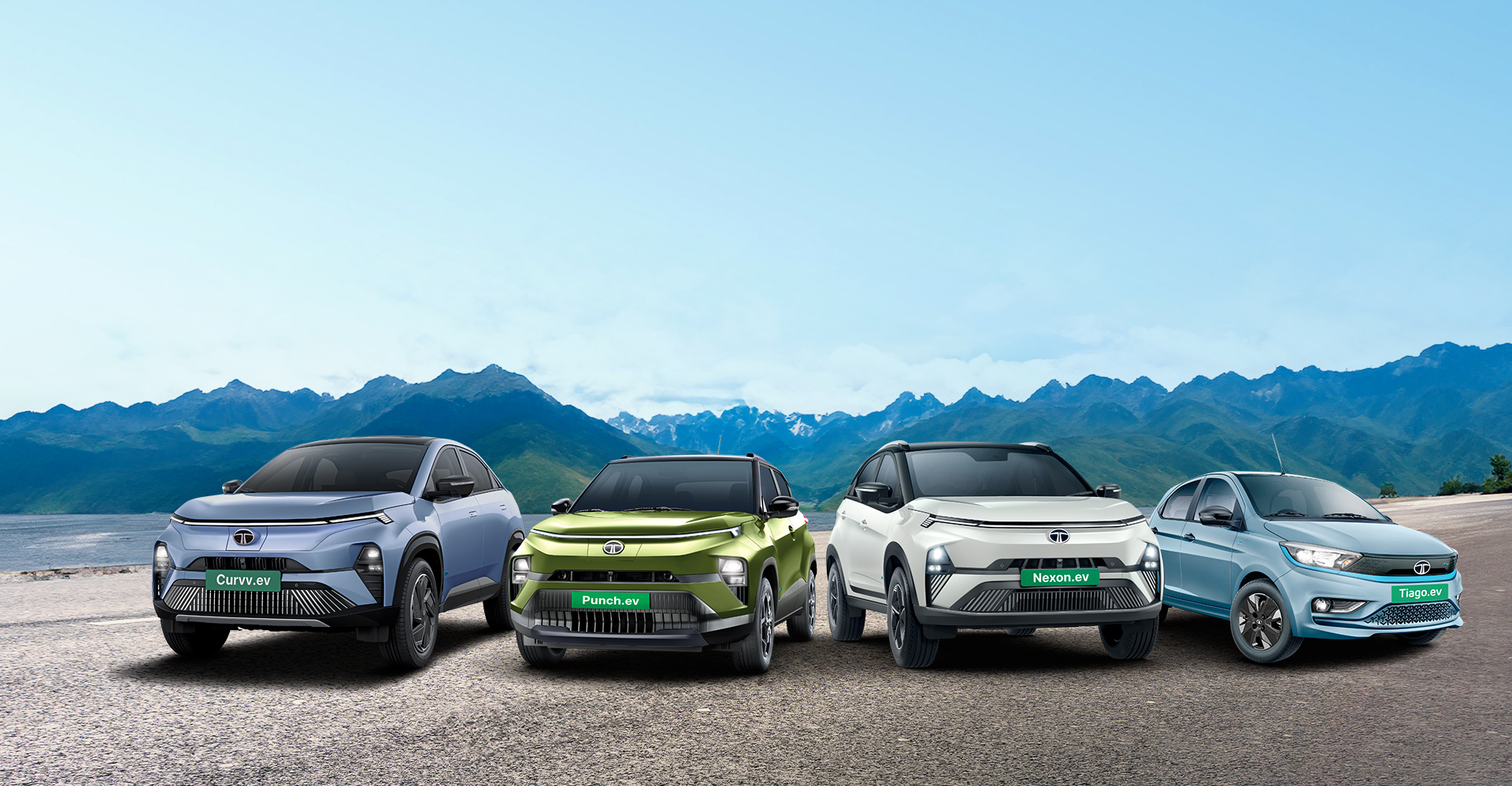

Tata Motors is tuning ADAS algorithms for India's chaotic roads—two-wheelers, unmarked lanes, stray animals—while a MoRTH mandate from April 2026 forces heavy-vehicle OEMs to follow suit.
How Tata Motors Is Tuning ADAS for Indian Roads—What It Means for EV Safety in 2026
Tata Motors is actively recalibrating its Advanced Driver Assistance Systems (ADAS) for Indian road conditions—a process that goes far beyond simply importing Western-tuned software. The company's Chief Product Officer Mohan Savarkar says the industry is now "leading the world in Localised Sensor Fusion" as a direct result of that effort. Meanwhile, a Ministry of Road Transport and Highways (MoRTH) mandate requiring ADAS on all newly introduced heavy-vehicle models from 1 April 2026 is forcing every OEM in India—from incumbents like Tata to newcomers like Maruti Suzuki with its e Vitara—to rethink how safety technology is validated and deployed on Indian tarmac.
The stakes are concrete. India recorded an estimated 168,000 road-crash deaths in 2022, with trucks and buses involved in more than 25% of those fatalities. Children account for roughly 10% of all road-crash deaths—approximately 45 child deaths every day—a figure that is around five times higher than the 2% rate seen in the EU and the US. ADAS, defined as the suite of electronic systems that perceive the vehicle's environment and either warn the driver or intervene autonomously to prevent a collision, is now the most scalable tool available to close that gap.
How Tata's ADAS Approach Compares With Other OEMs Entering India
Before diving into the technical details, it helps to see how Tata's localisation strategy sits alongside what other major players are bringing to market in 2026. The table below maps three key dimensions across four vehicles that buyers are actively comparing.
| Model | ADAS Level | Key India-Specific Tuning | Sensor Hardware | Price Range (ex-showroom) |
|---|---|---|---|---|
| Tata Nexon EV (2025–26) | Level 2 | Localised sensor fusion for two-wheelers, rickshaws, stray animals; urban & highway calibration | Front camera, front radar, rear cross-traffic radar (HL Klemove / Aptiv) | ₹14.49 – ₹19.99 lakh |
| Tata Harrier EV (2025–26) | Level 2 | Same localised fusion stack; blindspot tuned for dense urban traffic | Front camera, multiple radars | ₹21.49 – ₹25.99 lakh |
| Maruti Suzuki e Vitara (2026) | Level 2 | Suzuki global ADAS platform; India validation ongoing | Front camera + radar (Suzuki/Toyota supply chain) | ₹17.49 – ₹27.99 lakh (est.) |
| Hyundai Creta Electric (2025–26) | Level 2 | Hyundai's India-tuned ADAS via Mobis; highway-biased calibration | Front camera, front radar, rear radar | ₹17.99 – ₹23.50 lakh |
Prices are indicative ex-showroom figures as of May 2026. ADAS feature sets vary by variant.
Level 2 ADAS is now standard across the ₹15–28 lakh EV segment. The real differentiator is not the label but the quality of local calibration—and that is precisely where Tata is making its most deliberate investment.
What Exactly Is "Localised Sensor Fusion" and Why Does It Matter?
Localised Sensor Fusion is the process of combining data from multiple onboard sensors—cameras, radars, ultrasonic sensors—using algorithms that have been specifically trained and calibrated on the traffic patterns, road geometries, and road-user behaviours of a target market, rather than relying on a generic global dataset.
In Western markets, ADAS systems are primarily trained on scenarios involving cars, trucks, and pedestrians on well-marked, well-lit roads with predictable lane discipline. India's reality is fundamentally different. Savarkar describes the challenge as involving "mixed traffic, unmarked lanes, and unpredictable elements like stray animals and jaywalkers," as well as non-standard vehicle shapes such as auto-rickshaws and e-rickshaws that no global training dataset adequately covers.
The consequence of deploying an untuned system in this environment is not merely reduced effectiveness—it is active danger. A system that generates too many false positives (braking unnecessarily for a two-wheeler filtering through traffic, for example) trains drivers to distrust or disable it. A system that generates false negatives (failing to detect a pedestrian stepping off a median) provides false confidence. Both failure modes increase accident risk rather than reducing it.
Tata's approach involves calibrating detection algorithms to specifically recognise high-density two-wheeler movement and the silhouettes of non-standard vehicles. This is not a software patch applied at the end of development—it requires dedicated data collection on Indian roads, local validation loops, and supplier partners who can iterate on both hardware and software in-country.
Who Makes the Hardware, and How Much of It Is Built in India?
Tata Motors sources its ADAS hardware from global Tier-1 suppliers, but the localisation of that supply chain is already underway. Partners including HL Klemove and Aptiv have established design offices in India and are manufacturing some components locally, with a stated plan to localise the full required parts list at Indian facilities.
This matters for three reasons:
Cost trajectory. Locally manufactured sensors and camera modules reduce import duties and logistics costs, which eventually feeds into variant pricing. As our guide to the best electric cars with ADAS in India notes, ADAS is still predominantly a mid-to-upper variant feature in India; local manufacturing is the primary lever to push it into base trims.
Calibration speed. When the supplier's engineering team is in the same time zone—ideally the same city—the iteration cycle for algorithm tuning compresses dramatically. A bug found during validation in Pune can be addressed by the supplier's Pune design office within days rather than weeks.
Regulatory compliance. The MoRTH mandate links each ADAS technology to a specific Automotive Industry Standard (AIS). For example, Advanced Emergency Braking must comply with AIS-162, Lane Departure Warning with AIS-188, and Blind Spot Information Systems with AIS-186. Meeting these standards requires documented test evidence, which is far easier to generate when hardware and software can be iterated locally.
The broader ADAS hardware space in India is still maturing. The AB Dynamics analysis of the MoRTH mandate notes that "supply chain readiness and aftermarket capability also present challenges, particularly where advanced sensors require precise calibration and specialist repair processes." A radar module that is miscalibrated after a minor front-end collision can render the AEBS system either non-functional or dangerously overactive, and India currently has very few workshops with the equipment and training to recalibrate ADAS sensors correctly.
Which ADAS Features Do Indian Drivers Actually Use?
Usage data from Tata's fleet tells a story that should inform how every OEM—including Maruti Suzuki as it rolls out the e Vitara—thinks about feature prioritisation.
The features that deliver "the most consistent value" in the Indian context are those focused on collision avoidance and driver assistance:
- Autonomous Emergency Braking (AEB)
- Forward Collision Warning (FCW)
- Lane Departure Warning (LDW)
- Blind Spot Monitoring (BSM)
On highways, drivers engage Adaptive Cruise Control (ACC) and lane-centring functions more frequently because the operating environment is more structured. In urban and semi-urban settings, alert-based and intervention-focused features dominate because dense, unpredictable traffic makes sustained ACC use impractical.
This urban/highway split has a direct implication for how ADAS should be tuned and marketed. A system calibrated primarily for highway use—which describes many globally developed ADAS stacks—will underperform in the stop-start, mixed-traffic conditions of a Bengaluru ring road or a Mumbai arterial. Tata's stated priority of deploying ADAS increasingly in urban environments "as sensing, software, and AI maturity improve" reflects a deliberate roadmap rather than a current capability claim.
For buyers evaluating EVs right now, this means asking not just whether a car has ADAS, but whether the specific variant they are buying includes the urban-relevant features (AEB, FCW, BSM) and not just the highway-relevant ones (ACC, lane-centring). Our comparison of the best electric SUVs in India in 2026 breaks down which features are available at which price points across the major models.
How Does Tata Tune ADAS for Roads Without Lane Markings?
This is the hardest technical problem in Indian ADAS development. Savarkar describes the challenge as one of "high complexity and low predictability"—conditions that "place significant demands on perception, interpretation, and decision-making systems."
The specific challenges India presents that Western-developed systems are not designed for include:
Unmarked or inconsistently marked lanes. Lane Departure Warning systems rely on detecting painted lane markings via front cameras. On a significant proportion of Indian roads—particularly state highways and urban arterials outside major metros—lane markings are absent, faded, or inconsistent. A system that cannot detect a lane cannot warn about departing from it. Tata's approach involves tuning the system to use road-edge detection and vehicle-flow inference as proxies when lane markings are absent, though this remains an imperfect solution.
Two-wheeler density. India has the world's largest two-wheeler fleet, and two-wheelers behave in ways that confuse systems trained on car-dominated traffic: they filter between lanes, appear and disappear from sensor fields of view rapidly, and travel at highly variable speeds. Tata's localised sensor fusion specifically targets the detection of high-density two-wheeler movement as a priority classification task.
Non-standard vehicle shapes. Auto-rickshaws, e-rickshaws, cycle-rickshaws, and overloaded goods vehicles present silhouettes and radar cross-sections that differ substantially from the passenger cars and trucks that dominate global ADAS training datasets. Misclassification of these objects—or failure to classify them at all—is a genuine safety risk.
Stray animals and jaywalkers. Pedestrian detection in Western ADAS systems is trained primarily on people using designated crossings or walking on footpaths. In India, pedestrians cross at arbitrary points, and stray cattle, dogs, and other animals are a real obstacle on both urban and rural roads.
The MoRTH mandate analysis echoes this concern directly: "Indian roads and traffic conditions are highly complex, with mixed road users, unpredictable behaviour and variable infrastructure. ADAS systems will need careful tuning to local conditions; if systems generate too many false positives or are overly intrusive, there is a real risk that drivers may switch them off, undermining their safety benefit."
The solution Tata is pursuing—localised sensor fusion with India-specific algorithm calibration—is the right direction. The honest caveat is that the quality of this calibration is difficult for a buyer to assess from a spec sheet. The most reliable proxy currently available is real-world user feedback and, where available, independent ADAS performance testing.
What Does the MoRTH 2026 Mandate Actually Require?
The MoRTH mandate is defined as a regulatory requirement that, from 1 April 2026, all newly introduced models of passenger vehicles with more than eight seats, buses, and trucks (M2, M3, N2, and N3 categories) must be equipped with a specified package of ADAS technologies. From 1 October 2026, the mandate extends to existing production models in these categories.
The mandated technologies and their corresponding AIS standards are:
- Advanced Emergency Braking System — AIS-162
- Driver Drowsiness and Attention Warning System — AIS-184
- Lane Departure Warning System — AIS-188
- Blind Spot Information System — AIS-186
- Moving Off Information System — AIS-187
The AIS standards set precise performance thresholds. For AEBS under AIS-162, the system must be active from 25 km/h up to the vehicle's maximum design speed; collision warning must activate no later than 0.8–1.4 seconds before emergency braking begins; and the system must achieve no impact with the target in the emergency braking test scenario.
Critically, this mandate currently covers heavy vehicles (M2, M3, N2, N3) and not passenger cars (M1 category). No ADAS technologies are yet mandated for passenger cars in India. This means that ADAS in passenger EVs—including the Tata Nexon EV, Harrier EV, Maruti Suzuki e Vitara, and Hyundai Creta Electric—remains a voluntary, market-driven feature rather than a regulatory requirement. The competitive pressure to include it is real, but the regulatory floor has not yet been set for this segment.
Savarkar's comment that "the focus in India will remain on safety-first deployment and regulatory alignment rather than rapid autonomy adoption" reflects this reality. Incremental deployment of Level 1 and Level 2 ADAS features will dominate the Indian passenger car market through at least 2027–28, with more advanced autonomous functions remaining a distant prospect.
Will Entry-Level EVs Like the Tata Punch EV Get ADAS?
This is the question most relevant to the largest share of Indian EV buyers, since the Punch EV and similarly priced models represent the volume end of the market. Savarkar's answer is measured: the priority is "safety-first deployment and regulatory alignment," with Level 1 and Level 2 features likely to dominate before more advanced functions become mainstream.
Reading between the lines, this suggests that full ADAS suites will remain reserved for mid-to-upper variants of higher-priced models in the near term. The Tata Punch EV, priced from approximately ₹10 lakh, does not currently offer ADAS. The Nexon EV, starting around ₹14.49 lakh, offers ADAS on select variants. The Harrier EV, from approximately ₹21.49 lakh, offers a more full suite.
The path to democratising ADAS in India runs through local manufacturing (reducing sensor costs), software maturity (reducing calibration complexity), and regulatory pressure (creating a compliance floor). All three are moving in the right direction, but none will deliver sub-₹12 lakh ADAS in the immediate term.
For buyers in the ₹10–14 lakh EV segment, passive crash safety is the more relevant metric right now. Tata's track record here is strong, as reflected in Bharat NCAP 5-star ratings for multiple models. ADAS is the next layer of protection, but it is not yet accessible at every price point.
How Does the Maruti Suzuki e Vitara's ADAS Approach Compare?
The Maruti Suzuki e Vitara is an instructive counterpoint to Tata's approach. Where Tata has spent years building an in-house ADAS calibration capability and developing supplier relationships with local engineering depth, Maruti Suzuki is entering the ADAS-equipped EV space with the e Vitara using a platform developed jointly with Toyota—a global architecture that brings proven hardware and software but raises legitimate questions about India-specific tuning depth.
The e Vitara's ADAS suite, drawn from the Suzuki/Toyota global platform, includes features comparable to Tata's Level 2 offering: forward collision warning, autonomous emergency braking, lane departure warning, and adaptive cruise control. The hardware supply chain—primarily from the Toyota/Suzuki space—is mature and reliable. The open question is how thoroughly the system has been validated against India-specific scenarios: the two-wheeler filtering behaviour, the unmarked rural highway, the auto-rickshaw cutting across three lanes of traffic.
Maruti Suzuki has not publicly detailed its India-specific ADAS calibration process to the same degree that Tata has through Savarkar's interview. This may simply reflect different communication strategies rather than evidence of a gap. The e Vitara's ADAS performance in real Indian conditions will become clearer as independent reviews and owner feedback accumulate post-launch.
What the e Vitara does bring is Maruti Suzuki's unmatched service network—a factor that is directly relevant to ADAS, since sensor recalibration after repairs requires trained technicians and specialised equipment. A wider service network with ADAS-capable workshops is a genuine safety advantage over the ownership lifetime of the vehicle. Our analysis of after-sales service networks for electric SUVs covers this dimension in detail.
The broader point is that the Indian ADAS space in 2026 is not a single-OEM story. Different manufacturers are making different trade-offs between global platform maturity and local calibration depth, and buyers benefit from understanding those trade-offs rather than treating "ADAS" as a binary yes/no feature.
What Are the Biggest Remaining Challenges for ADAS in India?
Even with Tata's localisation work and the MoRTH mandate creating regulatory momentum, several structural challenges remain.
Aftermarket calibration capability. ADAS sensors require precise recalibration after any front-end impact, windscreen replacement, or suspension work. India's workshop space is not yet equipped to handle this at scale. A car with a miscalibrated radar is more dangerous than a car without ADAS, because the driver may trust a system that is no longer functioning correctly.
Fleet age and penetration rate. The AB Dynamics analysis notes that the average age of medium and heavy commercial vehicles in India is around 10 years. Even with the MoRTH mandate, fleet-wide penetration of ADAS-equipped vehicles will be gradual—the safety benefits will take years to materialise at the population level.
Driver education. ADAS is defined as a driver assistance system, not an autonomous driving system. It requires drivers to understand what the system can and cannot do, to remain attentive, and to not over-rely on automation. In a market where many drivers have limited familiarity with electronic safety systems, the risk of over-trust is real. OEMs and the government both have a role to play in driver education, and this is an area where investment is currently thin.
False positive management. In India's complex traffic environment, any ADAS system will generate more false positives than it would on a European motorway. Managing these false positives—reducing them through better calibration while not suppressing genuine warnings—is an ongoing engineering challenge. A system that beeps or brakes unnecessarily multiple times per trip will be disabled by drivers within weeks.
What Should EV Buyers Look for in ADAS Right Now?
For buyers evaluating EVs in 2026, ADAS is a meaningful safety differentiator—but only if the right questions are asked. The best electric cars with ADAS in India guide covers the full feature-by-feature comparison, but the key evaluative framework is:
Feature completeness at your target variant. ADAS suites are often split across variants. AEB and FCW may be available from a mid variant, while ACC and lane-centring are reserved for the top trim. Confirm which features are included at the price you are actually paying.
Urban vs. highway calibration. Ask dealers or check owner forums for real-world feedback on how the system behaves in city traffic. A system that brakes unnecessarily for two-wheelers or generates constant false lane-departure warnings in an unmarked urban environment is a nuisance that will be switched off.
Service network ADAS capability. Before buying, check whether your nearest authorised service centre has ADAS sensor calibration equipment. This is particularly important if you are buying in a Tier-2 or Tier-3 city.
OTA update capability. ADAS software improves over time. A vehicle that can receive over-the-air software updates will benefit from calibration improvements without requiring a workshop visit. Tata's newer EVs support OTA updates; confirm this capability for any model you are considering.
Crash safety as the baseline. ADAS is a prevention layer on top of passive crash safety. For buyers in the ₹10–15 lakh segment where ADAS may not be available, prioritising a 5-star Bharat NCAP rated vehicle remains the most reliable safety investment.
The Bigger Picture: India as a Global ADAS Innovation Hub
There is a genuinely optimistic dimension to this story that deserves acknowledgment. The AB Dynamics analysis notes that "India is already a global centre for ADAS and automotive software development, and regulatory momentum is likely to accelerate further innovation in the region." Tata's localised sensor fusion work, if it delivers on its promise, is not just a solution for Indian roads—it is a template for any market with complex, mixed-traffic conditions: Southeast Asia, sub-Saharan Africa, Latin America.
The MoRTH mandate, while currently limited to heavy vehicles, signals a regulatory trajectory. Passenger car ADAS mandates are a logical next step, and OEMs that have already built local calibration capability—as Tata has—will be better positioned to comply quickly and cost-effectively when that mandate arrives.
For Indian EV buyers in 2026, the practical implication is that ADAS quality is improving faster in India than the spec sheets suggest. The gap between a globally-tuned system and a locally-calibrated one is narrowing, and the competitive pressure from multiple OEMs—Tata, Maruti Suzuki, Hyundai, Mahindra, and others—is accelerating that convergence. The question is not whether ADAS will become standard on Indian EVs, but how quickly the calibration quality will reach a level where it reliably saves lives on the specific roads where Indian drivers actually drive.
That is the work Tata Motors, through Mohan Savarkar's team, is doing right now. And it is work that matters.
Sources
- Tata Motors CPO Mohan Savarkar on tuning ADAS for Indian roads, usage patterns - Autocar India
- What does India's 2026 heavy vehicle ADAS mandate mean for testing? - AB Dynamics
- Best Electric Cars with ADAS in India in 2026 - EV Index India
- Which 5-Star Bharat NCAP Electric Cars in India Are Worth Buying in 2026? - EV Index India
- Best Electric SUVs in India in 2026 - EV Index India
- Which Electric SUV Has the Best After-Sales Service Network in India? - EV Index India
- Tata Motors Official Website