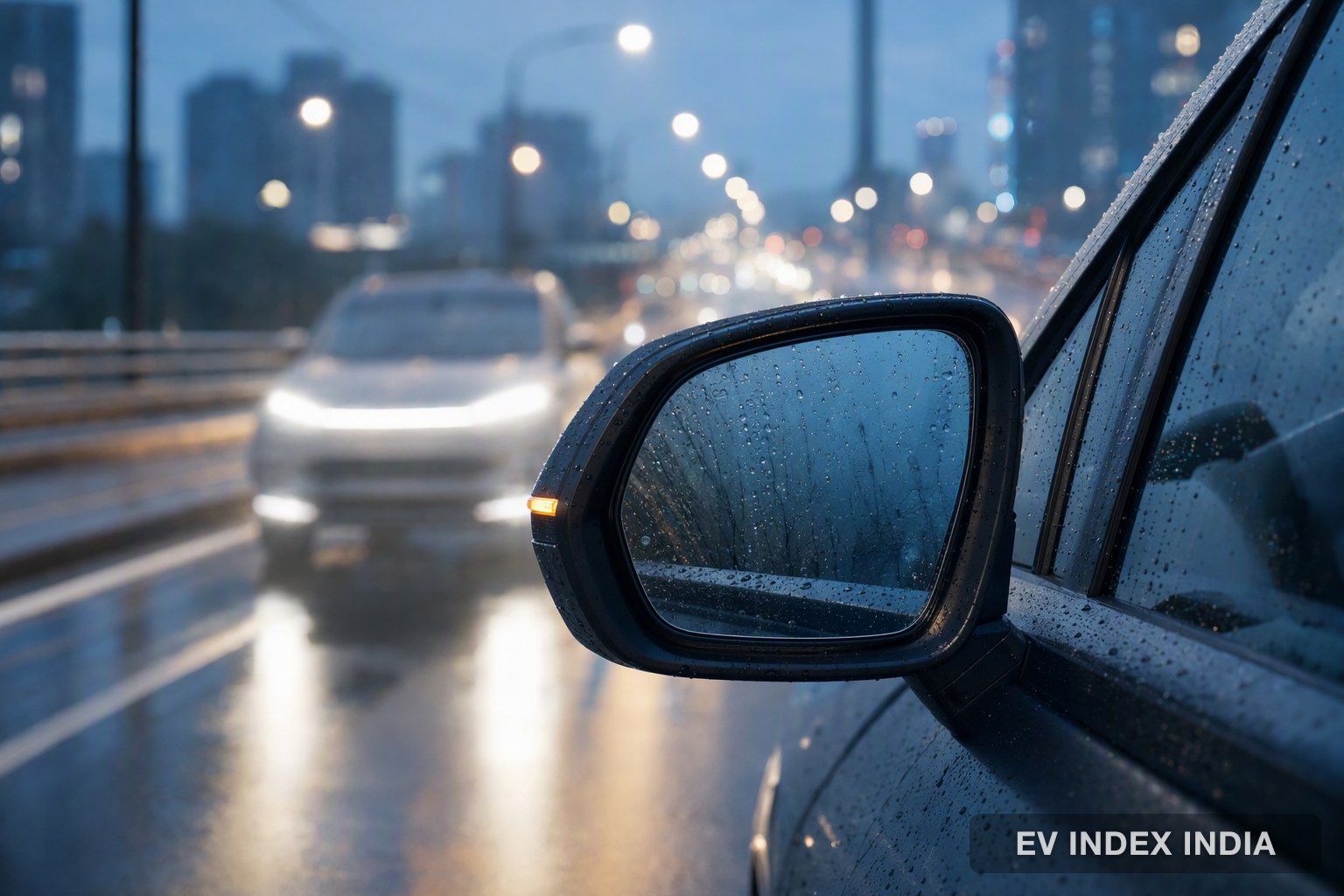
Electric SUVs With Lane Keep Assist and Blind Spot Monitoring
Two different things get sold as blind spot monitoring. Radar blind spot detection watches the adjacent lane continuously and warns you whether or not you indicate. A blind spot view monitor is a door mirror camera that shows a feed in the cluster only when you indicate. Tata's Curvv.ev brochure is the one document that labels them separately. Four electric SUVs offer lane keep assist and no radar warning at any price: the Tata Nexon.ev, MG Windsor EV, Kia Syros EV and Mahindra XUV 3XO EV. On the Mahindra XEV 9e and XEV 9S the radar warning is what forces you to the top variant, at Rs 30,50,000 and Rs 27,85,000.
Seven electric SUVs in India pair lane keep assist with a blind spot system that actually watches the lane beside you. The cheapest is the Tata Curvv.ev Empowered X 55 at Rs 19,39,000 ex-showroom, then the Maruti Suzuki e Vitara Alpha at Rs 19,99,000, the MG ZS EV Essence at Rs 20,74,600, the Tata Sierra.ev Empowered A 75 at Rs 24,79,000, the Tata Harrier.ev Empowered 75 at Rs 27,79,000, the Mahindra XEV 9S Pack Three 79 kWh at Rs 27,85,000 and the Mahindra XEV 9e Pack Three 79 kWh at Rs 30,50,000. The Hyundai Creta Electric belongs on that list from the Excellence trim, but Hyundai does not publish a price for it.
Four electric SUVs give you lane keep assist and never a blind spot warning at any price: the Tata Nexon.ev, MG Windsor EV, Kia Syros EV and Mahindra XUV 3XO EV. Three of the four offer a camera that shows the blind spot when you indicate, which is not the same thing and is often sold as if it were.
All prices are ex-showroom, checked on 15 October 2026.
Two different things are both called blind spot monitoring
Tata's Curvv.ev brochure is the only one in this group that spells the distinction out, and it is worth borrowing its language. Tata lists "Blind Spot Detection (BSD) - Radar based" and, on a separate line, "Blind Spot View Monitor (BSM) - Camera based".
The radar sits behind the rear bumper corners and watches the adjacent lanes continuously. It lights a warning in the door mirror when something is where you cannot see it, whether or not you have touched the indicator stalk, and on most of these cars it also feeds rear cross traffic alert when you reverse out of a bay.
The camera is a lens in the door mirror housing that puts a video feed into the cluster when you indicate. It is passive, and it does nothing if you change lanes without indicating, which is the exact situation a blind spot warning exists for. Both get written up as blind spot monitoring. On the Tata Punch.ev, Tata Nexon.ev and Mahindra XUV 3XO EV, the camera is all you can buy.
What each electric SUV actually offers
| Electric SUV | Lane keep assist from | Radar blind spot warning from | Camera blind spot view from | Cheapest variant with lane keep assist and the radar |
|---|---|---|---|---|
| Tata Curvv.ev | Empowered X 55 | Empowered X 55 | Accomplished X 55 | Rs 19,39,000 |
| Maruti Suzuki e Vitara | Alpha | Alpha | Not offered | Rs 19,99,000 |
| MG ZS EV | Essence | Exclusive Plus | Not offered | Rs 20,74,600 |
| Tata Sierra.ev | Empowered A 75 | Empowered A 75 | Empowered A 75 | Rs 24,79,000 |
| Tata Harrier.ev | Empowered 75 | Empowered 75 | Empowered 75 | Rs 27,79,000 |
| Mahindra XEV 9S | Pack Two Above 70 kWh | Pack Three 79 kWh | Pack Two Above 70 kWh | Rs 27,85,000 |
| Mahindra XEV 9e | Pack Two 59 kWh | Pack Three 79 kWh | Pack Three Select | Rs 30,50,000 |
| Hyundai Creta Electric | Excellence | Excellence | Not offered | Not published by Hyundai |
| Mahindra BE 6 | Three+ 70 kWh | Not itemised by Mahindra | Not itemised | See below |
| Kia Syros EV | X-Line ER | Not offered | X-Line ER | None |
| Tata Nexon.ev | Empowered +A 45 | Not offered | Empowered 45 | None |
| MG Windsor EV | Essence Pro | Not offered | Not offered | None |
| Mahindra XUV 3XO EV | Not named by Mahindra | Not offered | AX7L | None |
| Tata Punch.ev | Not offered | Not offered | Empowered 40 | None |
The ones that give you both, cheapest first
Tata Curvv.ev Empowered X 55, Rs 19,39,000
The cheapest route to the pair, and the most thorough list in the group. On this one variant Tata gives radar blind spot detection, the camera blind spot view monitor, lane change alert, rear cross traffic alert, rear collision warning, lane keep assist, lane departure warning, adaptive steering assist and a door open alert in the mirror, alongside adaptive cruise control with stop and go and four kinds of autonomous emergency braking. The Accomplished X 55 below it, at Rs 17,19,000, gets the camera and nothing else. That Rs 2,20,000 step is the difference between seeing your blind spot on request and being warned about it.
Maruti Suzuki e Vitara Alpha, Rs 19,99,000
Rs 60,000 behind the Curvv.ev, and that gap buys a 61 kWh battery instead of 55 kWh. Maruti lists blind spot monitor with lane change alert, and rear cross traffic alert on its own line, both on the Alpha. The rear cross traffic function is the tell that this is sensing hardware rather than a camera feed, since the 360-degree view camera is a separate row in the same grid. Lane keep assist, lane departure prevention, lane departure warning and vehicle sway warning are on the Alpha too.
Nothing on the Delta at Rs 16,19,000 or the Zeta at Rs 17,94,000. With three variants there is no halfway house: you buy the top car or none of it. Seven airbags are standard on all three.
What Maruti's documentation does not settle is whether the blind spot monitor only warns or also intervenes. Hyundai separates blind-spot collision warning from blind-spot collision avoidance assist in its grid. Maruti gives one line.
A pricing caveat: NEXA's compare tool prices the Alpha at Rs 19,99,000, while the e Vitara price page heads the same card with the dual-tone paint at Rs 20,21,000.
MG ZS EV Essence, Rs 20,74,600
MG keeps its blind spot group separate from its ADAS group, and the split is unusual. Blind spot detection, rear cross traffic alert and lane change assist sit under "Rear Drive Assist" and start on the Exclusive Plus at Rs 19,99,600. Lane keep assist, emergency lane keep, lane departure warning, automatic emergency braking and adaptive cruise control sit under ADAS and start one trim higher, on the Essence.
So the ZS EV is the only electric SUV here where the blind spot radar is buyable before the lane assistance, and getting both costs Rs 75,000 more than the radar alone.
Tata Sierra.ev Empowered A 75, Rs 24,79,000
ADAS L2+ with 22 features arrives on the Empowered A, which Tata prices at Rs 24,79,000 and at Rs 25,99,000 in all-wheel drive. Blind spot detection, the camera blind spot view monitor, lane keep assist, adaptive cruise control with stop and go and the full autonomous emergency braking set are all in that block. Everything below it, including the Empowered 75 at Rs 23,79,000, gets none of it. The jump is Rs 1,00,000 and the assistance pack is the only thing that changes.
Tata Harrier.ev Empowered 75, Rs 27,79,000
Same architecture, bigger car, and the pack sits at the top of Tata's price ladder. Blind spot detection and the camera monitor both land on the Empowered 75, with lane keep assist, adaptive cruise control with stop and go, autonomous emergency braking for car, pedestrian and cyclist, low speed AEB and rear collision warning. The Fearless+ 65 at Rs 24,29,000 has the 360-degree camera and the knee airbag and no driver assistance at all.
Mahindra XEV 9S Pack Three 79 kWh, Rs 27,85,000
Mahindra's grid shows why radar count matters. On the XEV 9S, Pack Two Above 70 kWh at Rs 25,05,000 runs one radar and one vision camera, and that buys lane keep assist, automatic emergency braking, adaptive cruise control and the camera blind view monitor. Blind spot detection and emergency lane keep assist wait until Pack Three 79 kWh at Rs 27,85,000, where the hardware becomes five radars and one camera.
The XEV 9e follows the same logic and costs more to get there. Lane keep assist and adaptive cruise from Pack Two 59 kWh at Rs 24,90,000 with one radar and one camera, the camera blind view monitor from Pack Three Select, and blind spot detection only on Pack Three 79 kWh at Rs 30,50,000, the variant Mahindra lists as one radar, one vision camera and four corner radars.
Where the Mahindra BE 6 sits, and why we cannot place it
The BE 6 SPORTEQ brochure dated 3 September 2026 never uses the words blind spot. Against the Three+ variant it prints "L2 ADAS (1 Radar & 1 Vision Camera)" and against Four, Launch Edition and FE Four it prints "L2+ ADAS (5 Radar & 1 Vision Camera)". There is no feature list under either.
Going by Mahindra's own XEV 9e and XEV 9S grids, one-radar hardware does not support blind spot detection and five-radar hardware does, which would put the BE 6's blind spot warning on the Four at Rs 26,95,000 rather than the Three+ at Rs 23,95,000. That is an inference from a sister car, not something Mahindra states, so the BE 6 stays out of the ranked list.
Lane keep assist, no blind spot warning, at any price
Four electric SUVs here will steer you back into your lane and will never tell you a car is sitting beside you.
The MG Windsor EV is the starkest case. Its Level 2 pack on the Essence Pro at Rs 19,14,800 covers traffic jam assist, adaptive cruise control, lane departure prevention, lane keep assist and automatic emergency braking, and the brochure does not contain the words blind spot on any variant, camera or radar.
The Tata Nexon.ev gives the camera blind spot view monitor from the Empowered 45 at Rs 16,34,000 and the lane and braking functions from the Empowered +A 45 at Rs 17,69,000, with no radar at either. The Kia Syros EV packs ADAS Level 2 with 16 features into the X-Line ER including lane keeping assist and lane following assist, and the blind spot provision in that list is a blind view monitor in the cluster. Kia's own page gives a Rs 13,49,900 starting price and does not price the X-Line ER.
The Mahindra XUV 3XO EV AX7L at Rs 14,95,999 carries a Level 2 badge, a 360-degree surround view system with blind view monitor and, per Mahindra's product page, auto emergency braking, forward collision warning, traffic sign recognition, adaptive cruise control and smart pilot assist. Mahindra names lane keep assist in its petrol and diesel XUV 3XO material and not for the electric car, which is why it is marked unconfirmed above.
Below all of these, the Tata Punch.ev offers the camera monitor from Rs 12,69,000 and no lane or braking assistance on any trim.
How this list was built
Every feature claim comes from the manufacturer's current brochure grid, or from its own product page where the brochure is silent. Prices came from each manufacturer's price page on 15 October 2026, Mahindra's being the no-charger configurations it lists by default. Nothing is taken from a review, a dealer listing or a specification aggregator. Maruti's ex-showroom feed publishes only a model range for the e Vitara, Rs 16,19,000 to Rs 20,21,000, so the Alpha figure comes from NEXA's compare tool.
Hyundai publishes no variant price list for the Creta Electric, only a Rs 18,02,800 starting price, so the Excellence trim is unpriced here. Kia publishes none for the Syros EV either. We have written "not published" rather than borrow a figure.
We also did not rank how well these systems work. Brochures tell you what is fitted, not how early a warning arrives or how often it misfires in Indian traffic, and no Indian agency tests that.
For the same cars sorted by charging speed, see electric SUVs with ADAS and fast charging. For the 360-degree camera question, which overlaps with the blind spot camera on several of these variants, see electric SUVs with a 360-degree camera under Rs 25 lakh. For long-distance use of the cruise functions, see electric SUVs for highway touring.
Frequently asked questions
Which is the cheapest electric SUV with lane keep assist and blind spot monitoring?
The Tata Curvv.ev Empowered X 55 at Rs 19,39,000 ex-showroom, counting a radar blind spot warning rather than a camera feed. If a camera is enough for you, the Mahindra XUV 3XO EV AX7L at Rs 14,95,999 has a blind view monitor, although Mahindra does not name lane keep assist on the electric version.
Does the Maruti e Vitara have blind spot monitoring?
Yes, on the Alpha variant only. Maruti lists blind spot monitor with lane change alert and rear cross traffic alert on that trim, along with lane keep assist, lane departure prevention and adaptive cruise control. The Delta and Zeta have none of it.
Is a blind spot view monitor the same as blind spot detection?
No. A blind spot view monitor is a camera in the door mirror that shows a video feed in the cluster when you indicate. Blind spot detection uses rear corner radar to watch the adjacent lane continuously and warns you whether or not you indicate. Tata's Curvv.ev brochure lists them as two separate features because the car has both.
Which electric SUVs have lane keep assist but no blind spot warning?
The Tata Nexon.ev, the MG Windsor EV, the Kia Syros EV and the Mahindra XUV 3XO EV. The Nexon.ev, the Syros EV and the XUV 3XO EV offer a camera blind spot view instead. The Windsor EV offers neither.
Why does the Mahindra BE 6 not appear in the ranking?
Because Mahindra's BE 6 brochure does not itemise what is inside its driver assistance pack. It gives a label and a radar count, one radar and one camera on the Three+ at Rs 23,95,000, five radars and one camera on the Four at Rs 26,95,000. Blind spot detection is never named, so we have not placed it.
Do I need the top variant to get both?
On most of these, yes or close to it. The MG ZS EV is the odd one out: its radar arrives one trim before the lane assistance rather than after it.
Last verified: 2026-10-15
Sources
- Tata.ev: Curvv.ev Series X brochure
- Tata.ev: Curvv.ev variant prices
- Maruti Suzuki e Vitara brochure, September 2026: NEXA
- NEXA: e Vitara price and variants
- JSW MG Motor India: ZS EV brochure
- JSW MG Motor India: ZS EV variants and prices
- Tata.ev: Sierra.ev brochure
- Tata.ev: Harrier.ev brochure, October 2026
- JSW MG Motor India: Windsor EV brochure
- Mahindra: XEV 9S brochure
- Mahindra: XEV 9e brochure
- Hyundai India: Creta Electric brochure