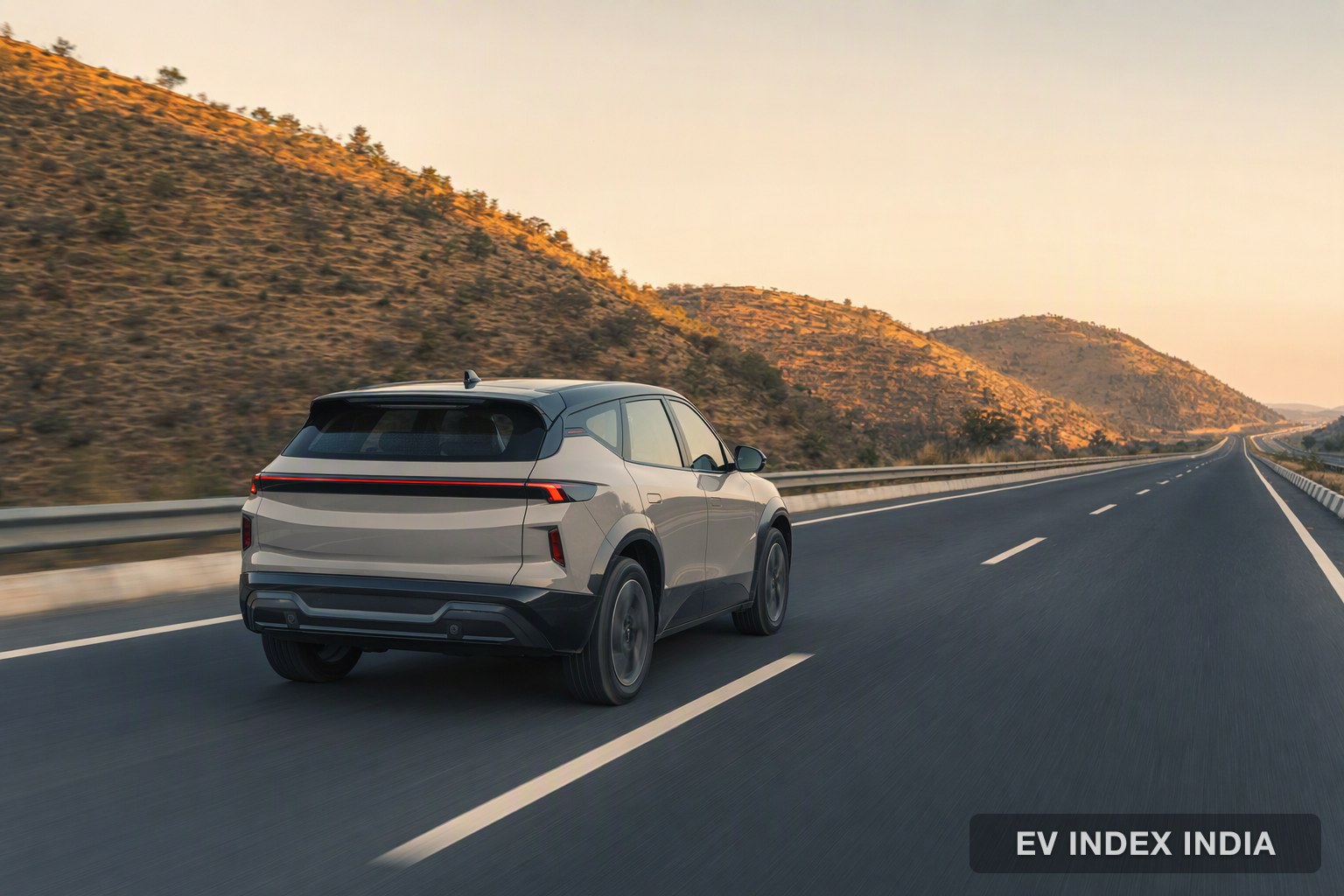
Best Electric SUV for Highway Touring With ADAS and Cruise Control
Certified range comes from the MIDC cycle, which has little sustained fast driving, and no maker or agency certifies a highway figure. Tata prints a C75 real-world estimate about a fifth below certified; Mahindra quotes 500 km plus for metro driving. Adaptive cruise is trim-locked: XEV 9e from Pack Two, Harrier.ev Empowered, e Vitara Alpha, Creta Electric Excellence, Curvv.ev Empowered X. The e Vitara has lane keep assist, not lane centering. A PIB annexure from August 2025 lists 29,277 public charging stations but gives no highway or fast-charger split.
For highway touring with adaptive cruise control, the strongest electric SUVs in India are the Mahindra BE 6 Three+ 79 kWh (708 km certified, Level 2 assistance, Rs 24.95 lakh), the Mahindra XEV 9e Pack Three (656 km, Rs 30.50 lakh) and the Tata Harrier.ev Empowered 75 (627 km, Rs 27.79 lakh). All three quote a 20 to 80 percent charge in 20 to 25 minutes. Under Rs 20 lakh the tourer to look at is the Maruti Suzuki e Vitara Alpha at Rs 19.99 lakh: 543 km certified, adaptive cruise with stop keeping, blind spot monitoring, and a navigation app on every variant that adds charging stops to the route. Its stop is longer at 45 minutes for 10 to 80 percent.
One caution before the numbers. None of those range figures tells you how far the car goes at 100 km/h, and nobody publishes one that does.
Range at highway speed is not certified by anyone
The range in every Indian EV brochure comes from the MIDC test, run in two parts. Part 1 is an urban cycle and Part 2 an extra-urban one that peaks at 90 km/h for a short spell. Maruti's footnote calls its figure a certification under Rule 124 of the Central Motor Vehicles Rules; Tata, Hyundai, Mahindra and MG all cite MIDC Part 1 plus Part 2. It is a legal number for comparing cars, and it contains very little sustained fast driving. Aerodynamic drag rises steeply with speed, so an expressway run at a steady 100 to 120 km/h with the air conditioning on will fall short of it. By how much depends on speed, load, wind and temperature, and no manufacturer or agency in India certifies that figure.
Two makers print their own estimates, and it helps to know what they are. Tata publishes a C75 range, which it describes as what 75 percent of customers can expect: 480 to 505 km for the Harrier.ev 75 against 627 km certified, and 400 to 425 km for the Curvv.ev against 502 km. That is roughly a fifth lower than the certified figure, and it is a mixed-use estimate, not a highway one. Mahindra's XEV 9e brochure claims 500 km and more in real-world use for the 79 kWh pack, and states the condition: metro driving with the air conditioning on. Maruti, Hyundai and MG print no real-world estimate at all.
So plan a tour on your own evidence. Drive the first leg conservatively, note what the car's range readout does at your cruising speed, and build the rest of the day around that.
What decides a touring day: the leg between stops
On a long drive you do not use the whole battery. You arrive with some charge in reserve and leave at 80 percent, because charging slows sharply above that. The useful measure is the distance the quoted fast-charge window buys. The table works that out on the certified range, which makes it a ceiling; your highway figure will be lower for every car, and by a similar proportion.
| Model and variant | Price | Certified range | Quoted DC stop | Charger it assumes | Certified km in that window (our arithmetic) |
|---|---|---|---|---|---|
| Mahindra BE 6 Three+ 79 kWh | Rs 24.95 lakh | 708 km | 20 to 80% in 20 min | 180 kW | 425 km |
| Mahindra XEV 9e Pack Three 79 kWh | Rs 30.50 lakh | 656 km | 20 to 80% in 20 min | 180 kW | 394 km |
| Tata Harrier.ev Empowered 75 | Rs 27.79 lakh | 627 km | 20 to 80% in about 25 min | 120 kW | 376 km |
| Maruti Suzuki e Vitara Alpha | Rs 19.99 lakh | 543 km | 10 to 80% in 45 min | 70 kW minimum | 380 km |
| Hyundai Creta Electric Excellence LR | Rs 23.67 lakh | 510 km | 10 to 80% in 39 min | Above 100 kW | 357 km |
| Tata Curvv.ev Empowered X 55 | Rs 19.39 lakh | 502 km | 10 to 80% in 40 min | 70 kW or more | 351 km |
Prices are ex-showroom from each maker's own price page or feed, October 2026; Mahindra's exclude the charger. Ranges and charging times are from the manufacturers' brochures. The last column multiplies the certified range by the share of the battery in the quoted window (60 or 70 percent).
Read across the last two columns together. The e Vitara's window buys about as many certified kilometres as the Harrier.ev's, because Maruti quotes from 10 percent and the pack is efficient on the test cycle. The difference is the wait: 45 minutes against 25. Over a 900 km day with two stops, that is 40 minutes more at chargers. Whether that matters depends on whether you would have stopped for a meal anyway.
Adaptive cruise control: who has it, and on which variant
Cruise control and adaptive cruise control are different things, and brochures list both under the same heading. Plain cruise holds a set speed. Adaptive cruise uses a radar to hold a gap to the vehicle ahead, slowing and speeding up with traffic. On Indian highways, where a truck pulls out every few minutes, only the adaptive kind stays switched on for long.
Mahindra XEV 9e. Pack One has standard cruise control. Adaptive cruise control arrives on Pack Two (Rs 24.90 lakh with the 59 kWh battery) along with lane centering and lane keep assist. Pack Three adds highway assist with driver-initiated lane change, blind spot detection and rear cross traffic alert through four extra corner radars.
Mahindra BE 6. The brochure lists cruise control from the One pack and L2 ADAS, with one radar and one camera, from the Three+ pack. It does not itemise the functions the way the XEV 9e brochure does, so check for adaptive cruise on the car. The Four pack at Rs 26.95 lakh has the five-radar L2+ set.
Tata Harrier.ev. Adaptive cruise control with stop and go comes only on the Empowered trims, bundled with lane centering, blind spot detection and rear cross traffic alert. Adventure and Fearless+ have ordinary cruise control.
Maruti Suzuki e Vitara. Alpha only. Maruti describes it as adaptive cruise control with all-speed following, stop keeping and curve speed reduction, so it works down to a halt in a queue and eases off for bends. The Delta and Zeta brochures list no cruise control of either kind, which matters if you were planning to tour in a Zeta for its identical 543 km range.
Hyundai Creta Electric. Every variant has cruise control, and Hyundai's brochure notes that the Excellence trims replace it with smart cruise control with stop and go. Those trims also get lane following assist. The Excellence LR at Rs 23,67,200 is the one with the 51.4 kWh pack.
Tata Curvv.ev. Adaptive cruise control with stop and go on the Empowered X 55; standard cruise on the Accomplished X 55.
Two popular electric SUVs are missing from the table for this reason. The Tata Nexon.ev has ADAS on its top variant but no adaptive cruise control on any, and the MG Windsor EV has it only on the Essence Pro, with a 449 km certified range and a 20 to 80 percent stop of about 50 minutes that make it a slower tourer than the six above.
Lane keeping or lane centering
This is the second feature that changes how tired you are after four hours. Lane keep assist acts at the edge: when the car drifts onto a marking it steers you back. Lane centering works continuously to hold the middle of the lane.
On the brochures, the XEV 9e (from Pack Two), the Harrier.ev Empowered and the Creta Electric Excellence, where Hyundai calls it lane following assist, have a centering function. The Curvv.ev lists lane keep assist plus adaptive steering assist. The e Vitara lists lane keep assist, lane departure prevention and a vehicle sway warning, and Maruti does not claim centering. If lane centering is high on your list, that is the e Vitara's main shortfall as a tourer, and the reason the more expensive cars sit above it here.
Both types read painted lines. On stretches where markings are worn, missing or doubled up by roadworks, expect either system to drop out, and keep your hands where they would be without it. Every maker's brochure says the same in its small print.
Charger density on the corridors
The public network is denser than it was and very uneven. The most recent state-wise count we could trace to a primary document is a Press Information Bureau annexure from August 2025, compiled from Ministry of Power inputs, which lists 29,277 public EV charging stations in India. Karnataka has 6,097 of them and Maharashtra 4,155, followed by Uttar Pradesh (2,326), Delhi (1,967), Tamil Nadu (1,781) and Rajasthan (1,531). At the other end, Bihar has 521, Uttarakhand 223 and Himachal Pradesh 137.
That table has limits for a touring driver. It counts stations, not connectors. It does not separate slow AC points from DC fast chargers, or say how many sit on highways, or how many work. We did not find a government document that breaks chargers down by corridor, so we are not quoting a per-highway figure.
Power matters as much as count. The 20-minute Mahindra claims assume a 180 kW charger for the 79 kWh pack and the Harrier.ev's assumes 120 kW. Plug either into a 60 kW unit and the stop grows to something much closer to the e Vitara's or Curvv.ev's, both of which reach their quoted time on a 70 kW charger. A big-battery car's advantage is real only on routes where high-power chargers exist, so check the rated output of the stations on your route, not only their location.
The cars can help with this. Maruti's Suzuki Navigation app, standard on all three e Vitara variants through Android Auto and Apple CarPlay, has a trip planner that adds charging stations along the route, and Maruti says its e for me app gives access to more than 2,000 charging points at its dealers and over 10,000 partner chargers. Those are the company's own counts. Our guide to charging infrastructure for electric SUVs covers the networks in more detail.
Which one for which kind of trip
If you regularly drive 500 km or more in a day on expressways with high-power chargers, the BE 6 Three+ 79 kWh gives the most range for the money and the XEV 9e Pack Three the most assistance. Choose the Harrier.ev Empowered 75 if you want lane centering, blind spot detection and stop-and-go cruise without stepping up to a top pack, or need its all-wheel-drive option at Rs 29.29 lakh.
For a few long trips a year on a budget under Rs 20 lakh, the e Vitara Alpha is the one we would take. It has the longest certified range of any sub-Rs 20 lakh variant with adaptive cruise control, the trip planner, and adaptive cruise that handles stop-start traffic. You accept 45-minute stops and lane keeping in place of centering. The Curvv.ev Empowered X 55 is Rs 60,000 cheaper with a five-minute shorter quoted stop and 41 km less certified range.
How this guide was built and what was not verified
Features, ranges and charging times come from each manufacturer's current brochure, and prices from the makers' own price pages in October 2026. The charger count is from the PIB annexure named above. We compared the six mainstream electric SUVs that have adaptive cruise control and a certified range of 500 km or more on at least one variant; premium models above Rs 40 lakh are outside this piece.
Not verified: highway-speed range for any car, because no certified figure exists; how well each adaptive cruise or lane system copes with Indian traffic; the BE 6's ADAS function list, which Mahindra's brochure does not print; and the number, power or uptime of chargers on any specific corridor. This article does not repeat crash-test scores and airbag counts. Those are in our guide to highway safety features on electric SUVs.
Frequently asked questions
Which electric SUV is best for highway touring with adaptive cruise control?
On range and charging time, the Mahindra BE 6 Three+ 79 kWh, the XEV 9e Pack Three and the Tata Harrier.ev Empowered 75. Under Rs 20 lakh, the Maruti e Vitara Alpha, which pairs a 543 km certified range with adaptive cruise control.
How far will an electric SUV go at 100 km/h?
There is no certified answer. Indian range figures come from the MIDC cycle, which has little sustained high-speed running. Expect less than the brochure number at motorway speeds and measure your own car on the first leg of a trip.
Does the Maruti e Vitara have cruise control on all variants?
No. Maruti's brochure lists adaptive cruise control on the Alpha only, and no cruise control function for the Delta or Zeta.
What is the difference between lane keep assist and lane centering?
Lane keep assist corrects the steering when the car reaches a lane marking. Lane centering holds the car in the middle of the lane continuously. The XEV 9e, Harrier.ev and Creta Electric have a centering function on their ADAS trims; the e Vitara has lane keep assist.
How many public EV charging stations does India have?
A PIB annexure from August 2025, based on Ministry of Power data, lists 29,277 public charging stations, led by Karnataka with 6,097 and Maharashtra with 4,155. It does not say how many are DC fast chargers or how many are on highways.
Do I need a 180 kW charger to tour in a Mahindra XEV 9e or BE 6?
No, but you need one to get the quoted 20 minutes on the 79 kWh pack. On a lower-power charger the car still charges, more slowly.
Last verified: 2026-10-13
Sources
- Maruti Suzuki e Vitara brochure (September 2026): NEXA
- NEXA: e Vitara price and variants
- Mahindra XEV 9e brochure
- Mahindra BE 6 SPORTEQ brochure
- Tata Harrier.ev brochure: Tata.ev
- Tata Curvv.ev Series X brochure: Tata.ev
- Hyundai Creta Electric brochure
- Tata.ev: driving range declaration (C75)
- Press Information Bureau: state-wise public EV charging stations (annexure, August 2025)