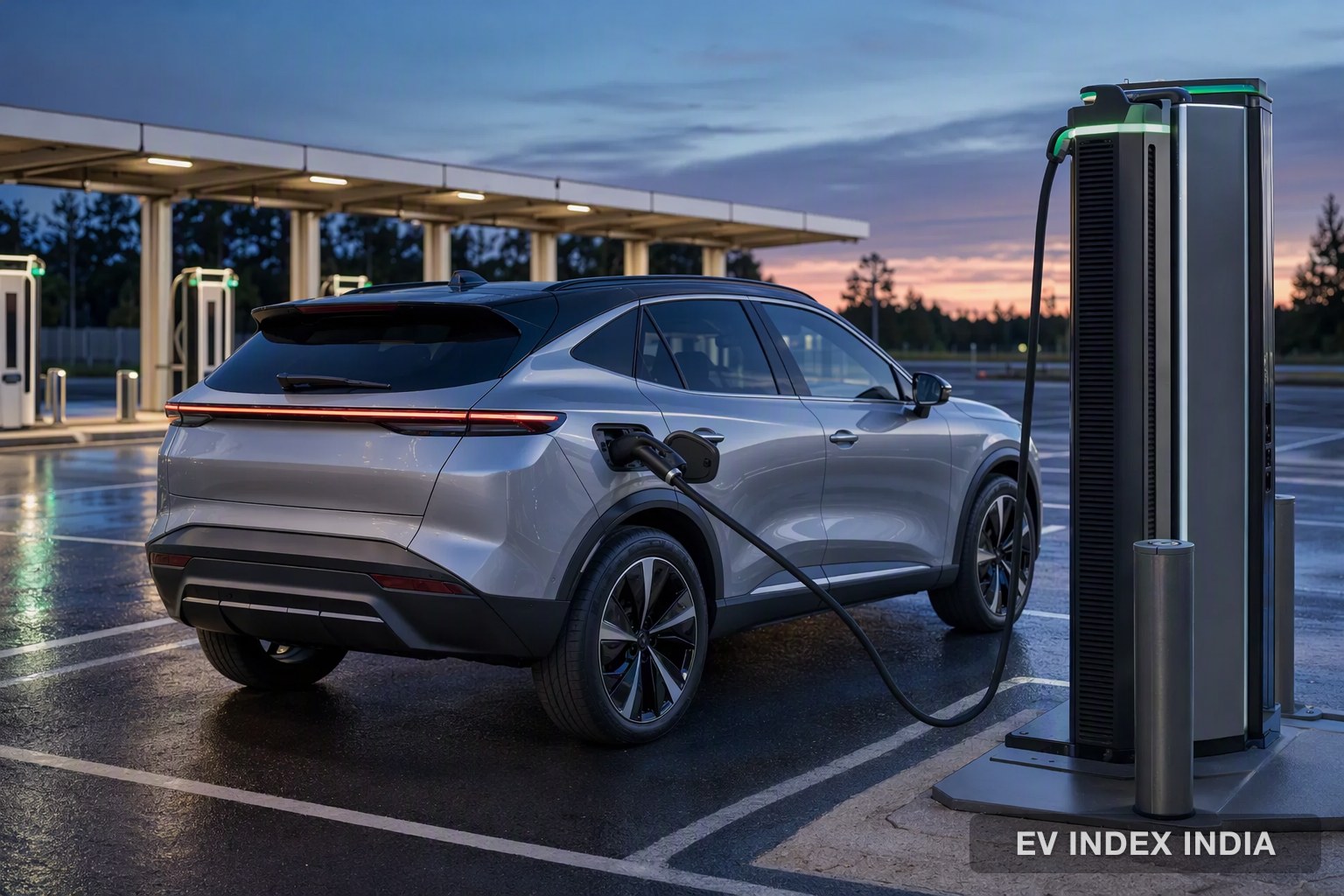
Best Electric SUV With ADAS and a Fast-Charging Battery in India
Makers quote charging over different windows (10 to 80, 20 to 80 or 0 to 80 percent) and on different chargers (50 kW to 180 kW), so the minutes are not comparable as printed. On an energy-per-minute estimate the Mahindra XEV 9e and BE 6 lead, then the Harrier.ev, with the Maruti e Vitara Alpha and Tata Curvv.ev level in mid-table and the MG Windsor slowest. ADAS is trim-locked on every model: only the e Vitara Alpha, Curvv.ev Empowered X, Creta Electric Excellence and Harrier.ev Empowered have it. The Tata Nexon.ev has ADAS but no adaptive cruise control.
The Mahindra XEV 9e and BE 6 are the best electric SUVs in India if you want adaptive cruise control and the shortest charging stop on the same variant: both quote 20 to 80 percent in 20 minutes, and the cheapest trims that pair that with Level 2 assistance are the BE 6 Three+ 70 kWh at Rs 23.95 lakh and the XEV 9e Pack Two at Rs 24.90 lakh. The Tata Harrier.ev Empowered 75 follows at Rs 27.79 lakh with about 25 minutes for the same window. Below Rs 20 lakh the pick is the Maruti Suzuki e Vitara Alpha at Rs 19.99 lakh, which quotes 10 to 80 percent in 45 minutes and adds blind spot monitoring and rear cross traffic alert, with the Tata Curvv.ev Empowered X 55 at Rs 19.39 lakh close behind.
Two things make this comparison harder than it looks. Assistance is tied to trim and charging speed to battery pack, so the car in the advertisement is rarely the car that has both. And the makers do not measure charging the same way, which the next section deals with before any ranking.
Why the charging times are not directly comparable
Every figure below is the manufacturer's own, taken from its brochure. They differ on three counts.
The window changes from brand to brand. Maruti, Hyundai and Tata (for the Curvv.ev and Nexon.ev) quote 10 to 80 percent. Mahindra and Tata's Harrier.ev quote 20 to 80 percent, and so does MG for the Windsor. MG quotes the ZS EV from 0 to 80 percent. A 20 to 80 claim covers 60 percent of the pack, a 10 to 80 claim covers 70 percent, so the shorter window flatters the number.
The charger behind the claim changes too. Mahindra's 20 minutes assumes a 140 kW charger on the 59 kWh pack, 160 kW on the 70 kWh pack and 180 kW on the 79 kWh pack. Hyundai's 39 minutes needs a charger above 100 kW. Maruti says its 45 minutes needs a DC charger of at least 70 kW, and Tata's 40 minutes for the Curvv.ev assumes 70 kW or more. On a 60 kW highway charger, none of the faster claims apply.
Peak acceptance in kW is mostly not published. MG prints a maximum for the Windsor (45 kW and 60 kW by pack). Maruti, Hyundai, Tata and Mahindra print the charger assumption instead, which is not the same thing, so this article does not carry a "maximum DC speed" column.
To put the cars on one scale we divided the energy in each quoted window by the quoted minutes, using the nominal pack size. That is our arithmetic, not a manufacturer figure, and it ignores the difference between gross and usable capacity. Treat it as a rough ordering.
ADAS and fast charging compared, by the variant that has both
| Model | Cheapest variant with adaptive cruise | Price | Blind spot and rear cross traffic | Quoted DC charge | Charger assumed | Energy per minute (our estimate) | Certified range |
|---|---|---|---|---|---|---|---|
| Mahindra XEV 9e | Pack Two 59 kWh | Rs 24.90 lakh | Pack Three only | 20 to 80% in 20 min | 140 kW (59), 180 kW (79) | 1.8 to 2.4 kWh | 522 km, 656 km |
| Mahindra BE 6 | Three+ 70 kWh | Rs 23.95 lakh | Not itemised in brochure | 20 to 80% in 20 min | 160 kW (70), 180 kW (79) | 2.1 to 2.4 kWh | 651 km, 708 km |
| Tata Harrier.ev | Empowered 75 | Rs 27.79 lakh | Yes | 20 to 80% in about 25 min | 120 kW | 1.8 kWh | 627 km |
| Maruti Suzuki e Vitara | Alpha 61 kWh | Rs 19.99 lakh | Yes | 10 to 80% in 45 min | 70 kW minimum | 0.95 kWh | 543 km |
| Tata Curvv.ev | Empowered X 55 | Rs 19.39 lakh | Yes, radar | 10 to 80% in 40 min | 70 kW or more | 0.96 kWh | 502 km |
| Hyundai Creta Electric | Excellence 42 kWh | Rs 21.31 lakh | Yes, with avoidance assist | 10 to 80% in 39 min | Above 100 kW | 0.75 kWh (42), 0.92 kWh (51.4) | 420 km, 510 km |
| MG ZS EV | Essence | Rs 20.75 lakh | Yes | 0 to 80% in 60 min | 50 kW | 0.67 kWh | 461 km |
| MG Windsor EV | Essence Pro 52.9 kWh | Rs 19.15 lakh | No | 20 to 80% in about 50 min | 60 kW | 0.63 kWh | 449 km |
| Tata Nexon.ev | None: no adaptive cruise on any variant | Rs 17.69 lakh for ADAS | Camera view only | 10 to 80% in 40 min | 60 kW | 0.79 kWh | 489 km |
Prices are ex-showroom, checked in October 2026 on each manufacturer's own price page or price feed (Delhi where the maker asks for a city). Mahindra's prices exclude the charger. Ranges are the makers' certified MIDC figures. The MG Windsor price is the one on MG's website; MG's brochure, dated 1 July 2026, lists the same variant Rs 15,000 lower.
The ranking
1. Mahindra XEV 9e
The XEV 9e brochure is the most explicit of the nine about what each pack gets. Pack One has no ADAS and standard cruise control. Pack Two, from Rs 24.90 lakh with the 59 kWh battery and Rs 26.50 lakh with the 79 kWh battery, adds one radar and one camera, and with them adaptive cruise control, lane keep assist, lane centering, autonomous emergency braking, traffic sign recognition and high beam assist. That is enough for a long motorway stint.
What Pack Two does not have is anything looking sideways or backwards. Blind spot detection, rear cross traffic alert, emergency lane keep assist and highway assist with driver-initiated lane change arrive only on Pack Three at Rs 30.50 lakh, which adds four corner radars. So the Rs 5.60 lakh between the cheapest ADAS car and the complete one buys the blind spot hardware, the 79 kWh pack and a seventh airbag.
On charging, Mahindra's 20 minutes for 20 to 80 percent is the shortest claim here, with the condition that the 79 kWh pack needs a 180 kW charger to do it and the 59 kWh pack a 140 kW unit. Certified range is 522 km on the smaller pack and 656 km on the larger.
2. Mahindra BE 6
The BE 6 is the cheaper way to the same charging hardware. Its September 2026 brochure puts L2 ADAS, with one radar and one vision camera, on the Three+ pack, Rs 23.95 lakh with the 70 kWh battery and Rs 24.95 lakh with 79 kWh, and L2+ ADAS, with five radars and one camera, on the Four at Rs 26.95 lakh. The 70 kWh pack is certified for 651 km and the 79 kWh pack for 708 km, the longest figure in this group.
It sits below the XEV 9e for one reason: the BE 6 brochure names the sensor set but does not list the functions, where the XEV 9e brochure lists every one. The single radar and camera match the XEV 9e Pack Two's hardware, which carries adaptive cruise, but we have not seen Mahindra print adaptive cruise control against the BE 6 Three+, so confirm it on the car before you sign. The BE 6 One at Rs 19.45 lakh has plain cruise control and no ADAS.
3. Tata Harrier.ev
Tata gives the Harrier.ev everything on one trim. The Empowered 75 at Rs 27.79 lakh has what the brochure calls ADAS Level 2 with 22 features: adaptive cruise control with stop and go, lane centering, lane keep assist, blind spot detection, rear cross traffic alert, and emergency braking that recognises cars, pedestrians and cyclists. There is no need to climb a further step for the blind spot radar, which is the XEV 9e's weak point.
Charging is quoted at about 25 minutes for 20 to 80 percent with a 120 kW charger, and the brochure separately claims up to 250 km of range in 15 minutes on the 75 kWh pack. Certified range is 627 km with rear-wheel drive. The trims below Empowered get ordinary cruise control and no ADAS, so the Rs 21.79 lakh starting price is a long way from the car described here.
4. Maruti Suzuki e Vitara
The e Vitara Alpha is the cheapest SUV in this ranking with adaptive cruise control, blind spot monitoring and rear cross traffic alert together. At Rs 19.99 lakh (Rs 20.21 lakh in dual tone) it carries Maruti's Level 2 suite: adaptive cruise with all-speed following and stop keeping, lane keep assist, lane departure prevention, vehicle sway warning, emergency braking that detects cars, motorcycles, pedestrians and bicycles, and an adaptive high beam system. The 61 kWh LFP pack is certified for 543 km.
Its limits are plain in the brochure. The Delta and Zeta have no ADAS at all, and no cruise control row of any kind appears for them, so the driver assistance is an Alpha-only purchase. The lane system keeps and corrects but is not described as lane centering. And 45 minutes for 10 to 80 percent is a mid-table charging time: the Mahindras put more than twice the energy into the pack per minute if you can find a charger big enough to feed them. Maruti's footnote also ties the 45 minutes to the 61 kWh battery specifically.
5. Tata Curvv.ev
The Curvv.ev Empowered X 55 costs Rs 60,000 less than the e Vitara Alpha and its Level 2 list is at least as long: adaptive cruise control with stop and go, lane keep assist, adaptive steering assist, radar blind spot detection, rear cross traffic alert and a driver doze-off alert. Charging is quoted at 40 minutes for 10 to 80 percent on a 70 kW or faster charger, which works out to almost exactly the e Vitara's rate once the smaller 55 kWh pack is accounted for.
We put it a place lower because the pack is smaller and the certified range shorter (502 km against 543 km). If the Rs 60,000 matters more to you than the 41 km, reverse the order. The Accomplished X 55 at Rs 17.19 lakh has the same battery and charging but only standard cruise control.
6. Hyundai Creta Electric
Hyundai's SmartSense Level 2 suite is among the most complete below Rs 25 lakh. From the Excellence trim (Rs 21,30,500 with the 42 kWh pack) it includes smart cruise control with stop and go, lane following assist, lane keeping assist, and blind-spot and rear cross-traffic systems that intervene and do not only warn. The lower trims have ordinary cruise control.
The charging claim reads well, 10 to 80 percent in 39 minutes, but it needs a charger above 100 kW and it is the same 39 minutes for both packs. On the 42 kWh Excellence that is less energy per minute than the e Vitara or Curvv.ev manage. The long-range Excellence LR with the 51.4 kWh pack and a 510 km certified range costs Rs 23,67,200, which is BE 6 Three+ money.
7. MG ZS EV
The ZS EV Essence at Rs 20.75 lakh has the full MG Level 2 package: adaptive cruise control, traffic jam assist, lane keep assist, emergency braking, blind spot detection and rear cross traffic alert. The Exclusive Plus has the rear-facing functions only. Charging is the oldest hardware here: MG's brochure quotes 60 minutes from 0 to 80 percent on a 50 kW charger, and a certified 461 km.
8. MG Windsor EV
Only the Essence Pro has ADAS, a 12-function Level 2 set with adaptive cruise control, traffic jam assist, lane keep assist and emergency braking, on the 52.9 kWh pack with a certified 449 km. MG's grid lists no blind spot detection or rear cross traffic alert on any Windsor. The brochure gives 20 to 80 percent in about 50 minutes and a 60 kW maximum, the slowest rate in this comparison. Its case is the cabin and the price, not the charging stop.
Not ranked: Tata Nexon.ev
The Nexon.ev Empowered+ A 45 at Rs 17.69 lakh is the cheapest electric SUV with ADAS, and it charges from 10 to 80 percent in 40 minutes on a 60 kW charger. But Tata's brochure lists lane centering, lane keep assist, emergency braking and plain cruise control. Adaptive cruise control is not offered on any Nexon.ev, and blind spot cover is a camera view, so it does not meet the test this list applies.
How this list was built and what was not verified
Every feature, range and charging figure comes from the current manufacturer brochure for each model, and prices from the maker's own price page or price feed, read in October 2026. The ranking orders cars by the charging rate available on a variant that also has adaptive cruise control, then by how complete the assistance suite is, then by price. We covered the nine volume electric SUVs listed in the table. The Kia Syros EV, the VinFast models and the BYD Sealion 7 were not checked against their brochures for this piece and are left out for that reason, not on merit.
Things we could not verify: peak DC acceptance for any Maruti, Hyundai, Tata or Mahindra model, since none publishes it; the function list of the BE 6's L2 ADAS; and how any of these systems behave on Indian roads, which no brochure can tell you. The energy-per-minute column is our own calculation. For crash-test results, which this article leaves aside, see our guide to highway safety features on electric SUVs, and for a wider list that includes cars above Rs 40 lakh, the fastest-charging electric cars in India.
Frequently asked questions
Which electric SUV has both ADAS and the fastest charging in India?
Among mainstream models, the Mahindra XEV 9e and BE 6. Both quote 20 to 80 percent in 20 minutes on a 140 kW to 180 kW charger, and Level 2 assistance starts at Rs 23.95 lakh on the BE 6 Three+ and Rs 24.90 lakh on the XEV 9e Pack Two.
Does every variant of the Maruti e Vitara have ADAS?
No. Maruti's brochure puts the whole Level 2 suite, including adaptive cruise control, on the Alpha only. The Delta and Zeta have seven airbags and the same DC charging inlet but no driver assistance functions.
How long does the e Vitara take to fast charge?
Maruti quotes 45 minutes from 10 to 80 percent for the 61 kWh battery and says this needs a DC charger of at least 70 kW. On a 7.4 kW AC home charger the 61 kWh pack takes about 9 hours from 10 to 100 percent, and the 49 kWh pack about 6.5 hours.
Is the Tata Nexon.ev's ADAS a Level 2 system?
Tata's Nexon.ev brochure calls it ADAS without a level and lists seven functions, lane centering and emergency braking among them. It does not include adaptive cruise control, which the Curvv.ev and Harrier.ev both have.
What is the cheapest electric SUV with adaptive cruise control and DC fast charging?
The MG Windsor EV Essence Pro at Rs 19.15 lakh, followed by the Tata Curvv.ev Empowered X 55 at Rs 19.39 lakh and the Maruti e Vitara Alpha at Rs 19.99 lakh. The Windsor is the slowest of the three to charge and has no blind spot detection.
Last verified: 2026-10-13
Sources
- Maruti Suzuki e Vitara brochure (September 2026): NEXA
- NEXA: e Vitara price and variants
- Mahindra XEV 9e brochure
- Mahindra BE 6 SPORTEQ brochure
- Mahindra Electric Origin SUVs: BE 6 variants and prices
- Tata Harrier.ev brochure: Tata.ev
- Tata Curvv.ev Series X brochure: Tata.ev
- Tata Nexon.ev brochure: Tata.ev
- Hyundai Creta Electric brochure
- Hyundai India: Creta Electric price
- MG Windsor EV brochure: JSW MG Motor India
- MG ZS EV brochure: JSW MG Motor India