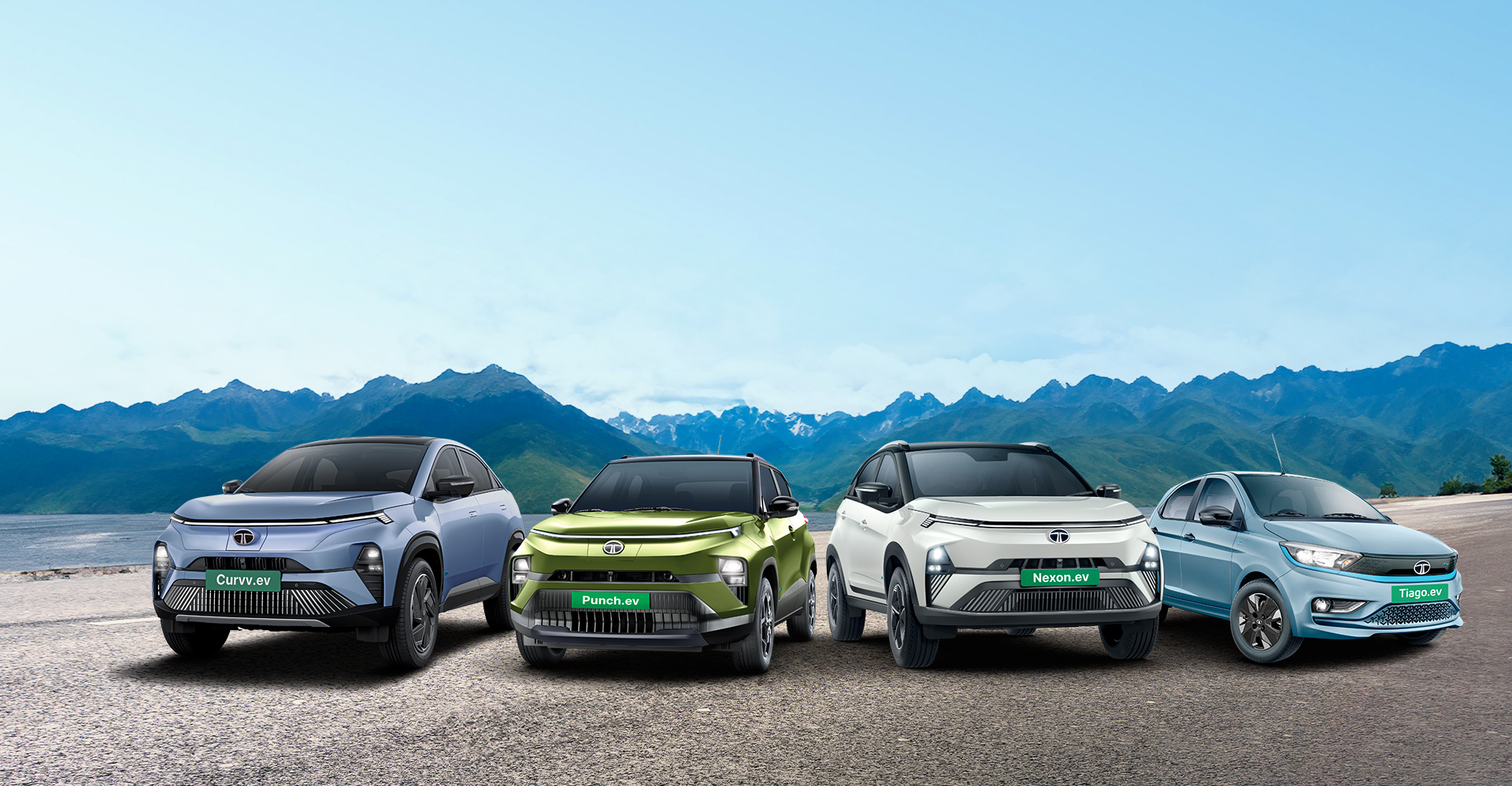

Tata Motors plans six FY27 launches — Sierra EV, Safari EV, Avinya SUV, and four facelifts — reshaping India's EV market from budget to premium segments.
What Will Tata's Safari EV and 5 Other FY27 Launches Mean for India's EV Market?
Tata Motors has confirmed six product launches before March 2027 — two all-new models and four facelifts — making FY27 the most product-intensive year in the company's recent electric vehicle history. The flagship of this pipeline is the Safari EV, expected to arrive during the festive season as Tata's premium electric SUV, while the Sierra EV is slated for Q2 FY27 and the Avinya SUV is pencilled in for late FY27 targeting the ₹40–50 lakh bracket.
This coordinated product offensive spans both ICE and EV segments, designed to defend Tata's dominant share in India's electric passenger vehicle market while simultaneously pushing into higher-margin premium territory. Here is how the full pipeline stacks up at a glance:
| Model | Type | Expected Timing | Target Segment | Approx. Price Bracket |
|---|---|---|---|---|
| Sierra EV | All-new EV | Q2 FY27 (Jul–Sep 2026) | Mid-size electric SUV | ₹25–35 lakh (est.) |
| Safari EV | All-new EV | Festive season FY27 | Premium electric SUV | ₹30–40 lakh (est.) |
| Avinya SUV | All-new EV | Late FY27 | Luxury electric SUV | ₹40–50 lakh |
| Nexon / Nexon EV | Facelift (ICE + EV) | FY27 | Compact SUV | ₹9–20 lakh (est.) |
| Tiago / Tiago EV | Facelift (ICE + EV) | FY27 | Entry hatchback/sedan | ₹6–14 lakh (est.) |
| Tigor / Tigor EV | Facelift (ICE + EV) | FY27 | Compact sedan | ₹8–14 lakh (est.) |
Pricing estimates are indicative based on current on-road ranges; official figures will be confirmed at launch.
By spanning entry-level facelifts to a ₹50 lakh luxury SUV, Tata is not simply defending its EV leadership but attempting to own every rung of the electric ladder before rivals can consolidate.
What exactly is the Safari EV, and why does it matter?
The Safari EV is Tata's first electric interpretation of its flagship three-row SUV nameplate, a vehicle that has carried strong brand equity in India since the original Safari debuted in 1998. The electric version is expected to sit on Tata's gen-2 EV architecture, likely sharing underpinnings with the Harrier EV that launched in early 2025, but with a longer wheelbase to accommodate the third row.
The strategic significance runs deep. The Safari nameplate commands premium positioning in the Indian market, and an electric version arriving during the festive season — when buyer sentiment and discounting cycles peak — gives Tata the best possible commercial window. Tata has outlined the Safari EV as its flagship electric model for the FY27 festive period, which typically runs from Navratri through Diwali (October–November).
At an estimated ₹30–40 lakh, the Safari EV will occupy a segment where competition is still thin but growing fast. The Hyundai Ioniq 5 and Kia EV6 operate above this band, while the MG ZS EV and BYD Atto 3 sit slightly below. Its three-row configuration, if confirmed, would make it virtually unique in the Indian electric SUV space at that price point.
For buyers comparing options in the ₹25–40 lakh range, the Safari EV's arrival will be a genuine inflection point. The key question is whether Tata prices it aggressively enough to undercut import-dependent rivals or targets margin preservation.
What is the Sierra EV, and when will it arrive?
The Sierra EV is the electric revival of Tata's iconic Sierra nameplate from the 1990s, reimagined as a modern electric SUV with a distinctive coupe-SUV silhouette. Its launch is confirmed for Q2 FY27, meaning the July–September 2026 quarter, making it the first of the two all-new models to reach showrooms.
The Sierra EV concept shown at the Bharat Mobility Expo 2024 featured a panoramic glass roof, a near-production-ready interior, and a design language that leaned heavily on nostalgia while incorporating modern EV proportions. The production version is expected to be a five-seater with a range of approximately 400–500 km on a single charge, though Tata has not officially confirmed battery specifications.
Positioned at an estimated ₹25–35 lakh, the Sierra EV will compete directly in the segment occupied by the Maruti Suzuki e Vitara — a mid-range electric SUV that Maruti launched in 2025 with a starting price around ₹17.49 lakh and a top-spec variant approaching ₹23 lakh. The e Vitara is Maruti's first mass-market electric SUV, built on the Suzuki-Toyota e-TNGA platform and offering two battery options (49 kWh and 61 kWh). While the e Vitara targets value-conscious buyers who trust the Maruti service network, the Sierra EV is likely to pitch itself on design differentiation and range. These two vehicles will not be identical competitors, but they will share a significant pool of buyers deciding between a proven brand's first EV and an established EV maker's nostalgic revival.
What is the Avinya SUV, and who is it for?
The Avinya SUV represents Tata's most ambitious FY27 launch in terms of positioning. It is slated for late FY27 and will be showcased at the 2027 Bharat Mobility Expo, targeting the ₹40–50 lakh premium SUV segment. Avinya is a dedicated EV sub-brand under Tata Motors, built on a purpose-designed electric platform that is distinct from the gen-1 and gen-2 EV architectures used in the Nexon EV, Harrier EV, and Safari EV.
At ₹40–50 lakh, the Avinya SUV enters territory currently occupied by the Hyundai Ioniq 5, Kia EV6, and the BYD Seal. It is a segment where Tata has no current presence, which means the Avinya launch is as much about brand elevation as it is about volume. The vehicle is expected to feature a lounge-style interior, Level 2+ ADAS, and a 500+ km range — specifications that would make it competitive with global EV benchmarks rather than just domestic ones.
The timing risk deserves attention. Late FY27 means a launch window of January–March 2027, which is not a peak buying season. Tata will need to generate enough pre-launch buzz through the Bharat Mobility Expo show to sustain consumer interest across the long gestation period.
Which four models are getting facelifts, and why does that matter?
The four facelift candidates are most likely the Nexon/Nexon EV and the Tiago/Tiago EV (and Tigor), as these models have remained largely unchanged for nearly three years. Tata has not officially confirmed which specific models are getting facelifts, so the following analysis is based on product cycle logic and industry reporting.
The Nexon EV is Tata's highest-volume electric vehicle and the car that essentially built the Indian EV market from 2020 onwards. A facelift would likely bring updated battery chemistry (moving to a higher-density cell format), revised front and rear styling, and an upgraded infotainment system. Given that the Nexon EV now faces serious competition from the MG Windsor EV, the Tata Punch EV, and the upcoming Maruti Suzuki e Vitara, a facelift is not cosmetic — it is competitive necessity.
The Tiago EV facelift matters for a different reason: it anchors Tata's presence in the sub-₹14 lakh EV segment, where price sensitivity is highest and government subsidies under PM E-DRIVE have the most impact. An updated Tiago EV with improved range (the current version offers 315 km ARAI-certified) and faster charging could re-energise a model that has seen sales soften as the Punch EV drew buyers upward.
Facelifts are often underestimated in product planning analysis, but in the Indian market — where a new model year refresh can command a 10–15% price premium and reset the depreciation curve — they carry real commercial weight.
How does this pipeline affect Tata's competitive position?
Tata Motors currently holds the largest share of India's electric passenger vehicle market, a position it has defended since the Nexon EV's launch in 2020. That dominance is under pressure. Maruti Suzuki's entry with the e Vitara, Hyundai's expanding EV lineup, MG's aggressive Windsor EV pricing, and BYD's growing dealership network have all chipped away at Tata's share in recent quarters.
The FY27 pipeline is Tata's most direct response to this competitive pressure. By launching six products across a single financial year — spanning entry-level facelifts, a mid-range revival (Sierra EV), a premium flagship (Safari EV), and a luxury play (Avinya) — Tata is attempting to ensure that no competitor can own a segment without facing a Tata product.
JM Financial upgraded Tata Motors Passenger Vehicles to 'Buy' with a target price of ₹415, citing the strong domestic launch pipeline alongside improving JLR demand. Not all analysts share this optimism: HDFC Securities maintained a 'Reduce' rating with a target of ₹375, citing demand uncertainty in China and the Middle East and concerns about FY27 supply-demand dynamics.
The stock has seen gains of up to 8% on the product strategy optimism, even as quarterly profits fell year-on-year — a sign that markets are pricing in future pipeline value rather than current earnings momentum.
What are the risks that could derail the FY27 plan?
Three structural risks deserve attention, even if the pipeline looks strong on paper.
Supply chain constraints remain the most immediate threat. India's EV supply chain — particularly for battery cells, power electronics, and semiconductor components — is still heavily import-dependent. Global trade disruptions, including tariff escalations and shipping bottlenecks, could delay component availability and push launch timelines into FY28. Nomura analysts flagged risks from the West Asia crisis and potential commodity inflation as margin risks for FY27.
Pricing pressure is the second risk. The ₹40–50 lakh Avinya SUV will need to justify its premium against well-established global EVs that are increasingly localising production in India. If Tata cannot achieve competitive pricing through localisation, the Avinya risks becoming a halo product with limited volume impact.
Execution bandwidth is the third and most underappreciated risk. Launching six products in a single financial year is operationally demanding — it requires simultaneous dealer training, spare parts stocking, marketing campaigns, and service network expansion across all six nameplates. Tata has the infrastructure to attempt this, but the quality of execution will determine whether each launch lands cleanly or gets cannibalised by the next announcement in the pipeline.
How does the e Vitara fit into this competitive space?
The Maruti Suzuki e Vitara is Maruti's first purpose-built electric SUV for the Indian market, co-developed with Toyota on the e-TNGA platform and available with 49 kWh and 61 kWh battery options delivering ARAI-certified ranges of approximately 400 km and 500 km respectively. It launched in 2025 at a starting price of approximately ₹17.49 lakh, positioning it squarely in the mid-range compact electric SUV segment.
The e Vitara's competitive relevance to Tata's FY27 pipeline is nuanced. It does not directly compete with the Safari EV (which will be larger and more expensive) or the Avinya (which targets a higher luxury bracket). Its most direct Tata competitor remains the Nexon EV — and the upcoming Nexon EV facelift will be Tata's primary answer to the e Vitara's challenge.
Where the e Vitara genuinely disrupts Tata is in the trust equation. Maruti's service network — over 4,000 outlets across India — is unmatched by any other automaker, including Tata. For buyers in Tier 2 and Tier 3 cities considering their first EV, the e Vitara offers the reassurance of a familiar service infrastructure that Tata's EV network, while growing, cannot yet replicate at the same scale. You can explore how service networks compare across electric SUVs in our guide to which electric SUV has the best after-sales service network in India.
The Sierra EV, when it arrives in Q2 FY27, will occupy a slightly higher price band than the e Vitara but will target a similar buyer profile — someone who wants a distinctive, modern electric SUV with strong range and is willing to pay a modest premium for design and brand story. That overlap in buyer psychology, even if not in spec sheet, makes the Sierra EV vs. e Vitara comparison one of the most interesting to watch in the second half of 2026.
What does this mean for India's broader EV market trajectory?
India's electric passenger vehicle market is at an inflection point. Penetration crossed 2% of total passenger vehicle sales in FY25, and the government's PM E-DRIVE scheme is providing demand-side support through subsidies on electric two-wheelers and buses, with passenger car incentives under discussion. The Tata FY27 pipeline lands at exactly the right moment to capitalise on this structural tailwind.
Six launches from a single dominant player in one financial year will have several second-order effects on the market:
First, it will accelerate price discovery in segments that currently have thin competition. The Safari EV's pricing, for instance, will effectively set the benchmark for premium three-row electric SUVs in India — a segment that does not yet have a domestic reference point.
Second, it will pressure competitors to accelerate their own timelines. Hyundai, Kia, MG, and BYD will all be watching the Safari EV and Sierra EV launches closely. If either vehicle sells strongly at launch, it will validate the ₹25–40 lakh EV segment and likely pull forward rival product plans.
Third, the Avinya's entry into the ₹40–50 lakh bracket will test whether Indian buyers are ready to pay luxury-car money for a domestic EV brand. This is uncharted territory for Tata, and the outcome will have implications beyond just one model — it will determine whether Indian EV brands can aspire to compete with global luxury EVs on home soil.
For buyers currently in the market, the practical implication is straightforward: if you are considering an electric SUV in the ₹20–40 lakh range, waiting until Q3 or Q4 FY27 (October 2026 onwards) will give you significantly more options than are available today. The Sierra EV will be on sale, the Safari EV will be launching, and the Nexon EV facelift will likely have refreshed the entry point of Tata's EV lineup. Our guide to the best electric SUVs in India in 2026 tracks the current space while these new entrants approach.
If safety ratings are a priority in your purchase decision, it is also worth noting that Tata has consistently performed well in Bharat NCAP assessments — a track record the Safari EV will need to maintain to justify its flagship positioning. See our analysis of 5-star Bharat NCAP electric cars worth buying in 2026 for context.
What should buyers do right now?
If you are actively shopping for an electric vehicle today, the FY27 pipeline creates a genuine "wait vs. buy now" dilemma. Here is a practical framework:
For buyers in the sub-₹15 lakh segment, the Tiago EV facelift is unlikely to represent a dramatic change — the current model is already competitively priced and well-specified. Waiting is only worthwhile if you specifically want updated styling or marginally improved range.
For buyers in the ₹15–25 lakh segment, the Nexon EV facelift and the e Vitara are the key variables. The Nexon EV facelift could arrive with meaningfully improved battery technology; if you can wait 6–9 months, it may be worth doing so. The e Vitara is available now and offers a compelling package, particularly for buyers who prioritise service network reach. Our guide to best electric cars under ₹20 lakhs in India covers the current options in detail.
For buyers in the ₹25–40 lakh segment, the Sierra EV and Safari EV launches make waiting the rational choice unless there is a specific time pressure. Both vehicles will offer configurations that do not exist in the market today, and their arrival will also likely prompt discounting on existing models like the Harrier EV and MG ZS EV.
For buyers above ₹40 lakh, the Avinya SUV is worth monitoring but is unlikely to be a near-term purchase decision given its late FY27 timeline and the inherent uncertainty around first-generation luxury EV launches from any brand.
The broader picture is that FY27 will be the year India's EV market grows up — moving from a market dominated by a single brand's entry-level offerings to a genuinely multi-segment, multi-brand competitive space. Tata's six-model pipeline is the driver of that transition, but the beneficiaries will include every buyer who gains more choice, more competition, and ultimately better value for money.
For a full view of what is worth buying right now while the FY27 pipeline matures, see our best electric cars to buy in India in 2026 guide, which is updated as new models launch and pricing is confirmed.
Sources
- Tata to launch 2 new models, 4 facelifts in FY2027 — Autocar India
- Tata Motors unveils six-model FY27 launch plan with EV focus — MSN / Copilot
- Maruti Suzuki e Vitara — Official Product Page
- Tata Motors Passenger Vehicles — Official Site
- Best Electric SUVs in India in 2026 — evindexindia.com
- Which Electric SUV Has the Best After-Sales Service Network in India? — evindexindia.com
- Which 5-Star Bharat NCAP Electric Cars in India Are Worth Buying in 2026? — evindexindia.com
- Best Electric Cars to Buy in India in 2026 — evindexindia.com
- Best Electric Cars Under ₹20 Lakhs in India in 2026 — evindexindia.com