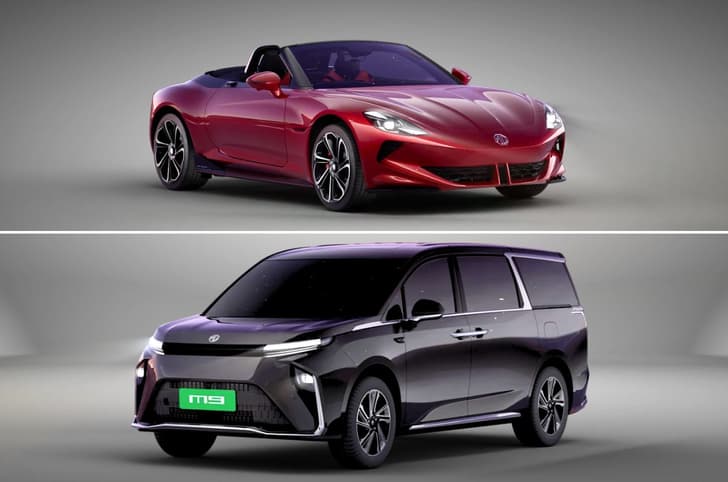

MG's BaaS scheme slashes the Cyberster's upfront price by ₹10.01 lakh to ₹72.49 lakh and the M9's by ₹9.96 lakh to ₹69.99 lakh, with a ₹8/km battery rental fee applied separately.
MG Cyberster and M9 Now Available With Battery-as-a-Service in India 2026: How BaaS Pricing Reshapes Premium EV Affordability
MG has extended its Battery-as-a-Service (BaaS) scheme to two of its most premium offerings — the Cyberster electric roadster and the M9 electric MPV — reducing upfront costs by up to ₹10.01 lakh as of September 17, 2026. Sold exclusively through MG Select, the brand's luxury retail channel, the Cyberster is now priced at ₹72.49 lakh and the M9 at ₹69.99 lakh under BaaS, with a battery rental fee of ₹8 per km charged on top. This marks the first time BaaS—a financing model long associated with mass-market EVs—has been applied to vehicles in the ₹70–90 lakh bracket in India.
The significance lies in what this signals about the market. BaaS is no longer just a tool to push entry-level EVs into the hands of first-time buyers. It is now being deployed as a premium affordability lever, one that could reshape how India's luxury EV segment prices itself going forward.
| Model | BaaS Price | Non-BaaS Price | Upfront Saving | Battery Rental | Battery Size | Claimed Range |
|---|---|---|---|---|---|---|
| MG Cyberster | ₹72.49 lakh | ₹82.50 lakh | ₹10.01 lakh | ₹8/km | 77 kWh | 580 km |
| MG M9 | ₹69.99 lakh | ₹79.95 lakh | ₹9.96 lakh | ₹8/km | 90 kWh | 548 km |
| Maruti Suzuki e Vitara | ~₹17–23 lakh (est.) | ~₹17–23 lakh | — | Not applicable | 49/61 kWh | ~500 km (est.) |
Prices are ex-showroom, India. Maruti Suzuki e Vitara pricing is indicative based on available pre-launch data. MG Cyberster and M9 savings do not account for the battery rental fee.
The Maruti Suzuki e Vitara sits in an entirely different price band, yet its relevance is real: as MG's BaaS scheme pulls the M9 and Cyberster closer to the ₹70 lakh entry point, the e Vitara represents the accessible mid-market alternative for buyers who want a credible electric SUV without the premium-segment complexity of per-kilometre rental accounting.
What exactly is Battery-as-a-Service, and how does MG's scheme work?
Battery-as-a-Service is a financing model in which the battery pack—typically the most expensive single component in an electric vehicle—is separated from the vehicle purchase and offered as a rental or subscription. Buyers pay a lower upfront price for the car body while covering battery costs through usage-linked or time-linked fees.
MG's implementation for the Cyberster and M9 is usage-linked: buyers pay ₹8 for every kilometre driven, with no fixed monthly floor disclosed at the time of writing. This is notably higher than the ₹2.6–₹4.5/km rates seen on mass-market BaaS EVs like the Tata Tiago EV or MG Windsor Pro, which reflects the larger, more expensive battery packs involved—77 kWh on the Cyberster and 90 kWh on the M9.
Both vehicles retain their full specifications, and the scheme is purely a financial restructuring of how the battery's cost is recovered. No mechanical or feature changes accompany the BaaS introduction.
For context on how BaaS works across India's broader EV market, our guide on which electric cars offer Battery-as-a-Service in India and whether they're worth buying covers the full space.
What do you get with the MG Cyberster under BaaS?
The MG Cyberster is a two-seat electric roadster with scissor doors, a dual-motor all-wheel-drive powertrain, and a performance-first brief—the only car of its kind sold in India at this price point. Under BaaS, it is priced at ₹72.49 lakh versus ₹82.50 lakh without the scheme, a saving of ₹10.01 lakh on the sticker.
Specifications remain unchanged:
- Battery: 77 kWh
- Powertrain: Dual-motor AWD
- Output: 510 hp, 725 Nm
- 0–100 km/h: ~3.2 seconds
- Claimed range: 580 km
- Doors: Electric scissor doors
The Cyberster's performance numbers—510 hp and a sub-3.5-second century sprint—put it in supercar territory for acceleration, even if its price sits well below European rivals. The BaaS scheme changes the capital commitment required on day one, but nothing else.
For a practical sense of the ongoing cost: at 1,500 km per month, battery rental works out to ₹12,000/month or ₹1.44 lakh per year. Over five years, cumulative rental costs reach ₹7.2 lakh—meaning total cost of ownership under BaaS approaches the non-BaaS price within roughly six to seven years of average usage. Buyers who drive significantly more will close that gap faster; those who drive less will benefit from BaaS longer.
The Cyberster also received a Couture Edition in August 2026 in collaboration with designer Gaurav Gupta, priced at ₹87.49 lakh—a limited run of 50 units adorned with Gupta's Serpent Infinity motif through hand embroidery and tonal layering. The BaaS scheme applies to the standard Cyberster, not the Couture Edition.
What do you get with the MG M9 under BaaS?
The MG M9 is a full-size electric MPV positioned for chauffeur-driven executives, hotel fleets, and buyers who prioritise three-row business-class seating over driving dynamics. It is sold through MG Select's 15 experience centres across 14 cities in India.
Under BaaS, the M9 is priced at ₹69.99 lakh, down from ₹79.95 lakh—a saving of ₹9.96 lakh upfront. The battery rental fee is the same ₹8/km as the Cyberster.
Specifications:
- Battery: 90 kWh
- Powertrain: Front-axle-mounted single motor (FWD)
- Output: 245 hp, 350 Nm
- Claimed range: 548 km
- Seating: Three rows
- Key features: Presidential Seats with 16-way adjustment, massage, ventilation and heating; dual sunroof; 13-speaker audio system
The M9's positioning differs from the Cyberster's. Where the roadster is a driver's car, the M9 is a passenger's car—designed to be experienced from the rear. Its 90 kWh battery is the largest in MG's current India lineup, and the 548 km claimed range makes it credible for intercity duty without range anxiety.
The Couture Edition of the M9 was also launched in August 2026 at ₹84.94 lakh, limited to 50 units and carrying the same Gaurav Gupta design language. BaaS applies to the standard M9 only.
How does the ₹8/km battery rental compare to other BaaS EVs in India?
The ₹8/km rental on the Cyberster and M9 is the highest in India's BaaS market by a significant margin. According to Autocar India's full BaaS listing, eight mass-market brands—Mahindra, Hyundai, Citroen, JSW-MG, Maruti, Kia, Tata and Toyota—now offer BaaS plans, with rates ranging from ₹2.26/km (Citroen eC3X) to ₹4.5/km (MG Windsor Pro).
| EV | BaaS Entry Price | Battery Rental | Upfront Saving | Battery Size |
|---|---|---|---|---|
| Tata Tiago EV | ₹4.69 lakh | ₹2.6/km | ₹2.30 lakh | 19.2 kWh |
| MG Comet EV | ₹4.99 lakh | ₹3.2/km | ₹2.81 lakh | 17.3 kWh |
| Citroen eC3X | ₹6.89 lakh | ₹2.26/km | ₹5.10 lakh | ~29 kWh |
| Kia Syros EV | ₹7.99 lakh | ₹3.3/km | ₹5.51 lakh | ~42 kWh |
| MG Cyberster | ₹72.49 lakh | ₹8/km | ₹10.01 lakh | 77 kWh |
| MG M9 | ₹69.99 lakh | ₹8/km | ₹9.96 lakh | 90 kWh |
The higher per-km rate on the Cyberster and M9 is proportionate to their battery sizes—a 77–90 kWh pack costs substantially more to manufacture, insure, and warranty than a 17–42 kWh unit. The ₹8/km figure also reflects the premium positioning of MG Select: this is not a scheme designed to maximise volume, but to offer an alternative entry point for buyers who are capital-constrained but not usage-constrained.
The critical difference between mass-market BaaS and this premium application is the buyer profile. A Tata Tiago EV BaaS buyer is often a first-time EV owner for whom the lower sticker price is the primary motivator. A Cyberster or M9 BaaS buyer is more likely someone who prefers to preserve liquidity—a business owner, a fleet operator, or a high-net-worth individual who would rather deploy capital elsewhere than lock ₹10 lakh into a battery.
Is BaaS financially worth it for the Cyberster and M9?
This depends entirely on annual mileage and the buyer's cost of capital. Here is a straightforward breakeven analysis:
MG Cyberster:
- Upfront saving under BaaS: ₹10.01 lakh
- Battery rental at ₹8/km
- Breakeven at 1,000 km/month: ₹8,000/month → ₹10.01 lakh recovered in ~125 months (~10.4 years)
- Breakeven at 2,000 km/month: ₹16,000/month → ₹10.01 lakh recovered in ~62 months (~5.2 years)
- Breakeven at 3,000 km/month: ₹24,000/month → ₹10.01 lakh recovered in ~42 months (~3.5 years)
MG M9:
- Upfront saving under BaaS: ₹9.96 lakh
- Battery rental at ₹8/km
- Breakeven at 1,000 km/month: ~10.4 years
- Breakeven at 2,000 km/month: ~5.2 years
- Breakeven at 3,000 km/month: ~3.5 years
BaaS is financially advantageous only if you drive less than the breakeven mileage over the ownership period, or if the opportunity cost of the ₹10 lakh upfront saving (invested elsewhere) exceeds the cumulative rental fees. For a fleet operator running the M9 at 4,000+ km per month, BaaS becomes expensive quickly. For a weekend-use Cyberster owner averaging 800–1,000 km per month, BaaS could make sense for the first several years of ownership.
There is also a risk-transfer dimension. Under BaaS, battery degradation, replacement costs, and end-of-life disposal are MG's responsibility, not the owner's. For a 77–90 kWh premium battery pack—which could cost ₹15–25 lakh to replace out of warranty—this is not a trivial consideration.
How does MG Select's BaaS compare to the broader luxury EV market?
MG Select currently operates 15 experience centres across 14 cities in India, and JSW MG Motor India has sold more than 1.5 lakh EVs in India cumulatively. The Select channel handles the brand's premium imports—the Cyberster, M9, and the upcoming IM6 SUV—separately from the mainstream MG dealership network.
No other luxury EV brand currently operating in India—including BMW, Mercedes-Benz, or Volvo—offers a comparable per-kilometre battery rental scheme. BaaS in the luxury segment is genuinely novel territory in India, and MG Select is the first to test whether premium buyers will accept the model.
The closest international parallel is NIO's battery swap and BaaS model in China and Europe, where buyers purchase the car body and subscribe to battery access. NIO's model is more sophisticated—it includes physical battery swaps at swap stations—but the underlying financial logic is similar: decouple the battery cost from the vehicle cost to lower the entry barrier.
For buyers evaluating the Cyberster or M9 against alternatives, the BaaS pricing creates a new consideration set. At ₹72.49 lakh (Cyberster, BaaS) or ₹69.99 lakh (M9, BaaS), both vehicles enter a price range where they compete more directly with upper-mid luxury options. However, the ongoing ₹8/km rental means the total cost of ownership calculation is more complex than a simple sticker comparison.
Where does the Maruti Suzuki e Vitara fit in this picture?
The Maruti Suzuki e Vitara occupies a different market position, but its relevance to this conversation deserves spelling out. As MG's BaaS scheme makes the Cyberster and M9 more accessible in headline price terms, it also sharpens the question of what buyers in the ₹17–25 lakh range are choosing instead.
The e Vitara is positioned as the accessible mid-market electric SUV from India's largest carmaker—a vehicle that brings Maruti Suzuki's service network, resale value reputation, and brand trust to the EV space. Where the Cyberster and M9 are premium imports sold through 15 select outlets, the e Vitara will be available through Maruti's extensive national dealership network, making it a genuinely different ownership proposition.
For buyers attracted to the idea of a premium EV but finding even the BaaS-adjusted ₹70–72 lakh price points out of reach, the e Vitara bridges the gap—offering a credible electric SUV with competitive range in a segment that is far more liquid in terms of resale and service access. It is not a competitor to the Cyberster or M9 in any direct sense, but it is the vehicle that captures the aspirational buyer watching the premium BaaS conversation with interest while making a more grounded purchase decision.
If you're evaluating the e Vitara against other options in its segment, our guide to the best electric cars under ₹20 lakhs in India in 2026 is a useful starting point.
What are the practical ownership considerations for BaaS at this price point?
Several questions remain unanswered in MG's current BaaS announcement for the Cyberster and M9, and buyers should seek clarity before committing:
Minimum monthly commitment: Mass-market BaaS schemes like the Citroen eC3X specify a minimum monthly usage (2,000 km/month for the eC3X). MG has not publicly disclosed whether a similar floor applies to the Cyberster and M9 BaaS scheme. If a floor exists, low-mileage owners could face charges even in months when they drive less.
Contract term: The duration of the BaaS agreement—whether it is a fixed-term contract or open-ended—has not been specified in available public disclosures. This matters significantly for resale: can a BaaS vehicle be sold to a new owner who takes over the rental agreement, or does the original buyer need to settle the battery cost before transfer?
Battery health guarantees: Under BaaS, the battery is MG's asset. Buyers should confirm what guarantees MG provides on battery health, minimum capacity retention, and replacement timelines if degradation exceeds specified thresholds.
Charging infrastructure: The Cyberster and M9 are capable of DC fast charging, and their large battery packs make public charging infrastructure relevant for long-distance use. Our guide to the best electric cars for long trips in India in 2026 covers charging network considerations in detail.
These are not reasons to dismiss the BaaS scheme—they are the right questions to ask at the MG Select experience centre before signing.
What does this mean for India's premium EV market in 2026?
India's premium EV segment—broadly defined as EVs priced above ₹50 lakh—has grown steadily through 2025 and 2026, driven by improving product quality, expanding charging infrastructure, and growing comfort with electric powertrains among high-net-worth buyers. The Cyberster and M9 have, according to MG, "quickly become the most sought-after luxury EVs in their segment" since launch.
The introduction of BaaS at this price point signals that MG Select is trying to expand the addressable market for both vehicles—not by discounting them, but by restructuring how their cost is presented and recovered. This is a meaningful distinction. A ₹10 lakh price cut would dilute the brand; a ₹10 lakh upfront saving with a per-km rental preserves the vehicle's perceived value while lowering the barrier to entry.
Whether other luxury EV brands follow is an open question. The model requires significant financial infrastructure—MG needs to carry the battery as an asset on its books, manage rental billing, and handle battery health monitoring across its fleet. For a brand with MG's scale and JSW Group's financial backing, this is manageable. For smaller luxury EV importers, it would be considerably harder to replicate.
The broader BaaS space in India—now spanning eight mass-market brands and, with this announcement, extending into the luxury segment—suggests that the model has found genuine traction. Autocar India's full BaaS listing documents how far the scheme has spread since Tata Motors first introduced it for the Tiago EV. The Cyberster and M9 BaaS launch represents the next chapter in that story, and the most premium one yet.
For buyers considering any BaaS EV in India, the decision framework is consistent regardless of price point: calculate your expected monthly mileage, run the breakeven math, understand the contract terms, and weigh the battery risk-transfer value against the cumulative rental cost. At ₹8/km, the Cyberster and M9 BaaS scheme rewards lower-mileage, capital-conscious buyers. At higher mileages, the standard purchase price becomes the better deal.
MG Select's 15 experience centres across 14 cities are the place to get variant-specific BaaS contract details. Given the complexity of the per-km model at this price point, an in-person conversation is worth the time before committing either way.
Sources
- MG Cyberster, M9 now available with BaaS | Autocar India
- MG Cyberster and M9 now available with battery rental: What the new BaaS scheme means | Mint
- MG SELECT launches the Couture Edition of M9 at INR 84.94 Lakh and Cyberster at INR 87.49 Lakh | MG Motor India
- All EVs available with a BaaS scheme in India | Autocar India
- MG Electric Cars in India 2026: Full Lineup, Prices, Range | MeraEV
- Which Electric Cars Offer Battery as a Service (BaaS) in India and Are They Worth Buying? | EV Index India
- Best Electric Cars for Long Trips in India in 2026 | EV Index India
- Best Electric Cars Under ₹20 Lakhs in India in 2026 | EV Index India