
Tata Motors is using Chery's EV platform to launch premium Avinya cars from 2027, reshaping India's EV hierarchy and opening the mid-premium space to rivals like the Maruti Suzuki e Vitara.
How Tata Motors' Chery Partnership Will Reshape India's Premium EV Segment in 2027
Tata Motors' first Avinya-branded electric vehicle, built on a platform licensed from China's Chery Automobile, is scheduled to reach Indian roads in 2027 — a date that marks both a strategic reset for India's largest EV maker and a structural shift in how the country's premium electric segment is defined.
The partnership, confirmed by Reuters on 3 June 2026, ends months of speculation about Avinya's future after Jaguar Land Rover shelved its plan to build EMA-platform EVs in India in early 2025. What replaces that plan carries deeper implications: a technology-licensing arrangement that gives Tata access to a proven Chinese EV architecture, accelerates its product roadmap by at least two years, and reveals how deeply Chinese EV technology is embedding itself in the Indian automotive supply chain — even as Chinese brands themselves remain largely locked out of the market.
For buyers, the ripple effects extend well beyond Tata's showrooms. A Tata pivot toward ₹40 lakh-plus ultra-premium territory creates a vacuum in the ₹17–25 lakh mid-premium segment that competitors are already moving to fill. The Maruti Suzuki e Vitara, positioned precisely in that accessible mid-premium band, is one of the most direct beneficiaries of that repositioning.
At a Glance: How the Key Players Stack Up
| Parameter | Tata Avinya (2027) | Maruti Suzuki e Vitara | Mahindra BE 6 |
|---|---|---|---|
| Expected / Current Price | ₹40 lakh+ (est.) | ~₹17–22 lakh | ₹18.9–26.9 lakh |
| Platform Origin | Chery Freelander (China-licensed) | Suzuki/Toyota (Japan) | Mahindra INGLO (in-house) |
| Launch Timeline | 2027 (India) | On sale 2025–26 | On sale 2024–25 |
| Assembly Location | Tamil Nadu (CKD from China) | India (Suzuki plant) | India (Pune) |
| Segment Positioning | Ultra-premium | Accessible mid-premium | Mid-premium performance |
| Second Model Planned | 2029 | TBA | Multiple confirmed |
| NCAP / Safety Rating | Not yet rated | Not yet rated | 5-star Bharat NCAP |
Each vehicle represents a different answer to a fundamental question: how much Chinese technology, Japanese engineering, or domestic R&D should power India's EV future?
What exactly is the Tata–Chery deal and why does it matter?
The arrangement is structured as a platform-licensing agreement rather than an equity joint venture. Tata Motors will use the Freelander platform — the same architecture Chery developed for JLR's resurrected Freelander brand in China — to underpin its Avinya EVs. Chery will act as a supplier to Tata Motors Passenger Vehicles, with each project governed by its own separate commercial agreement, according to Chery's statement to Reuters.
This distinction matters enormously in the Indian regulatory context. Since 2020, New Delhi has placed strict curbs on direct investment from neighbouring countries — a policy primarily aimed at China — effectively freezing large-scale Chinese equity participation in the auto sector. By structuring the arrangement as a supplier relationship, Tata sidesteps those restrictions while still gaining access to Chery's architecture, software stack, and manufacturing know-how.
The pattern is not isolated. JSW MG Motor has a similar platform-licensing deal with Chery, and the broader trend — Indian OEMs importing Chinese EV technology while avoiding deeper equity ties — is now a defining feature of the industry's competitive space.
For Tata specifically, the deal solves an urgent problem. Tata had originally planned to use JLR's electrified modular architecture (EMA) for Avinya models targeted for a 2025 launch. When JLR shelved those India plans, Tata was left with a premium brand concept — Avinya was unveiled as a concept at the 2025 Bharat Mobility Show — but no production-ready platform to put under it. The Chery deal closes that gap at the cost of some technological independence, at least in the near term.
Why did Tata's original JLR platform plan collapse?
The original Avinya roadmap called for building JLR's EMA-based EVs at Tata's Indian facilities, creating a shared platform that would serve both the JLR luxury segment and Tata's own premium aspirations. That plan collapsed in early 2025 when JLR decided not to proceed with EMA-based EV production in India, according to Reuters' earlier reporting.
The reasons behind JLR's withdrawal remain undisclosed, but the broader context is clear: JLR was recalibrating its EV ambitions globally amid slower-than-expected premium EV demand in key Western markets. Building a dedicated EMA production line in India for a nascent premium EV segment carried significant capital risk.
The collapse forced Tata into what one source described to Reuters as a "stopgap arrangement" — a characterisation that is both honest and slightly misleading. Stopgap implies temporary and inferior; the Chery Freelander platform is neither. It is the same architecture underpinning JLR's own Freelander revival in China, which means Tata is accessing technology that JLR itself has validated. The arrangement buys time for Tata to develop its own dedicated EV platform, which the company still intends to do over the longer term.
How will the first Avinya model actually reach Indian buyers?
The first Avinya EV is planned as a completely knocked down (CKD) import from China, assembled at Tata's newly opened factory in Tamil Nadu. In this manufacturing model, a vehicle is produced at an overseas facility, disassembled into major sub-assemblies, shipped to the destination country, and reassembled locally — allowing manufacturers to meet local assembly requirements and attract lower import duties than fully built-up (CBU) imports, while localising some content over time.
Reuters' sources confirm that efforts to source localised components are already underway, suggesting Tata intends to progressively increase Indian content in subsequent production runs. A second Avinya model is planned for 2029, with scope for two additional vehicles beyond that.
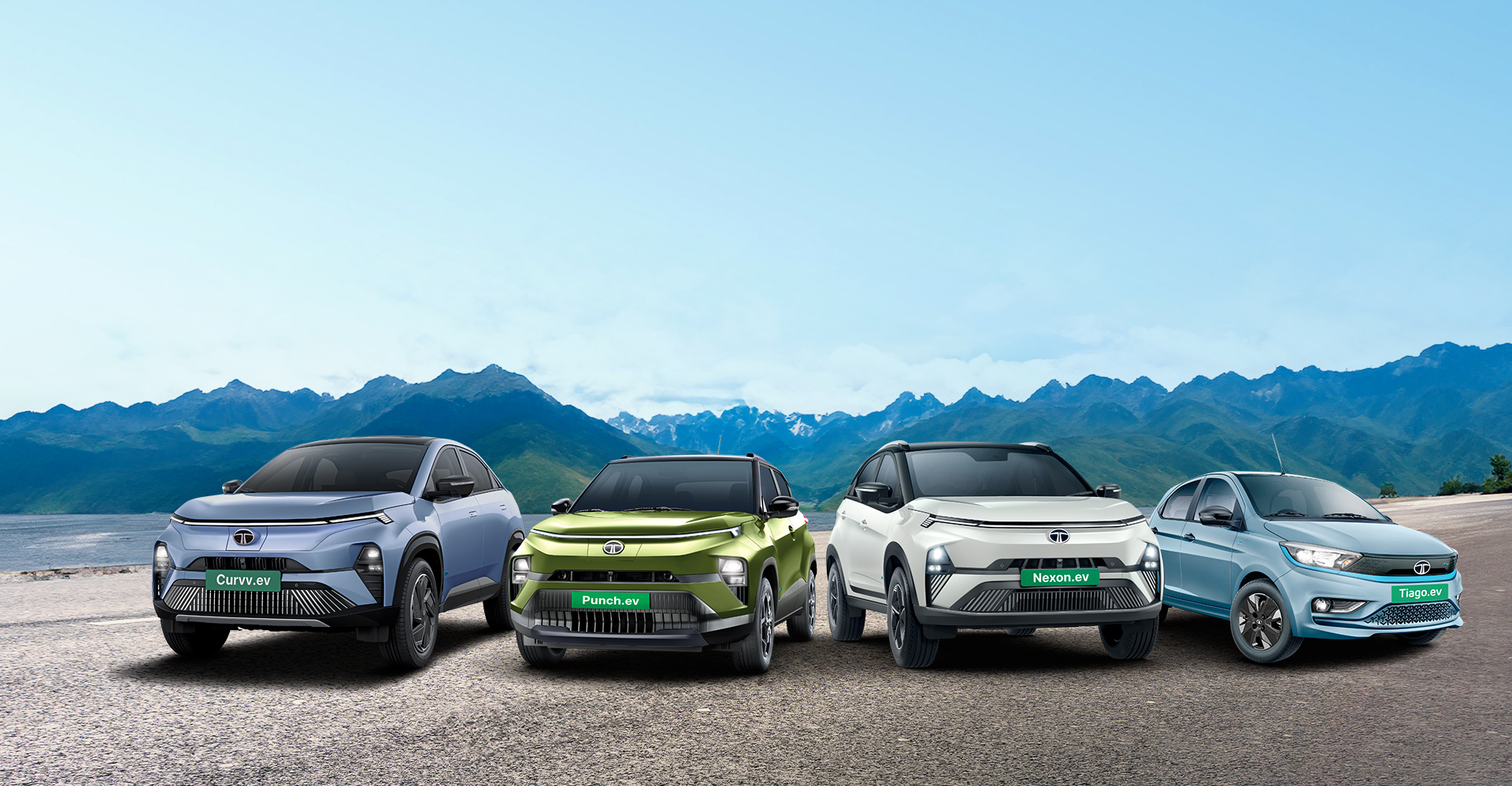
The Tamil Nadu plant is crucial to this strategy. Tata's investment in a dedicated EV manufacturing facility in the south gives it the production infrastructure to scale Avinya without cannibalising capacity at its existing plants in Pune and Sanand, which are occupied with Nexon EV, Punch EV, and Curvv EV production.
What does "premium" actually mean in India's EV market right now?
India's EV market splits sharply between the mass-market segment (below ₹15 lakh) and the emerging premium segment (₹15–30 lakh), with a nascent ultra-premium tier (above ₹30–40 lakh) that currently consists largely of imported luxury EVs from BMW, Mercedes-Benz, and Volvo.
Tata's existing EV lineup — Punch EV, Nexon EV, Curvv EV — occupies the ₹10–22 lakh band. Avinya is being positioned above all of these, as a global premium brand in Tata's own words. The company told Reuters: "Avinya is being developed as a global premium brand. Our collaboration with JLR and its partners will be an important pillar."
That positioning creates a clear gap. If Avinya targets ₹40 lakh and above, the ₹17–25 lakh mid-premium space — where buyers want more than a Nexon EV but cannot stretch to a luxury import — becomes a genuine battleground. This is precisely where the Maruti Suzuki e Vitara is positioned. Built on the Suzuki/Toyota Heartect-e platform and backed by Maruti's unmatched service network across India, the e Vitara offers mid-premium features, a recognisable SUV body style, and the brand trust that Maruti has built over four decades in India. For buyers who might have considered a Tata Curvv EV or a base-spec Avinya, the e Vitara is likely to be the default comparison.
Mahindra's BE 6 and XEV 9e are also competing in this space, with the INGLO platform delivering genuine performance credentials and 5-star Bharat NCAP safety ratings. The competitive intensity in the ₹18–28 lakh band is rising faster than in any other EV price segment in India right now.
Is Tata's EV market leadership actually at risk?
Electric models currently make up 14% of Tata's total sales, with a stated target to more than double that share to 30% by 2030, according to Reuters. Tata remains India's largest EV seller by volume, but the margin of that lead has been narrowing.
Mahindra & Mahindra's BE series has been gaining traction rapidly since its launch, and JSW MG Motor — itself using Chery technology — has been aggressive on pricing and feature content. Tata's concern is that without fresh premium products, it risks losing its EV lead as rivals close the gap in the mid-market while Tata has no answer at the top end.
The Avinya programme, even in its revised Chery-platform form, addresses the top-end gap. But it does nothing for the 2025–2027 window, during which Mahindra and MG will continue to attack Tata's core ₹15–25 lakh stronghold. Tata's response in that segment will likely depend on facelifts and range extensions of existing models — the Nexon EV, Punch EV, and Curvv EV — rather than entirely new platforms.
The strategic calculus becomes interesting here. Tata is essentially making a two-track bet: defend the mid-market with existing products while using Avinya to establish a new premium tier that none of its domestic rivals currently occupy. The risk is that the mid-market defence proves insufficient between now and 2027, and that Avinya's ultra-premium positioning means it competes with imported luxury EVs rather than with Mahindra or MG.
How does Chinese technology fit into India's EV strategy — and what are the political risks?
The Tata–Chery deal exemplifies a trend building quietly for several years: Indian automakers accessing Chinese EV technology through licensing and supplier arrangements rather than equity partnerships, specifically to navigate the investment restrictions introduced after the 2020 Galwan Valley border clash.
This model operates as technology nationalism by proxy — Indian brands on the badge, Chinese architecture under the skin. It allows Indian OEMs to remain competitive in a global EV race that China has largely been winning on cost and technology, without triggering the political sensitivities that a direct Chinese equity stake would provoke.
The risks are substantial. If geopolitical tensions between India and China escalate, supply chains built around Chinese platform components and CKD kits become vulnerable. The ongoing effort to localise components for the Avinya programme is partly a hedge against this risk, but localisation takes years and significant investment to achieve meaningful depth.
There is also a softer reputational risk. Indian consumers have historically been wary of Chinese brand associations in premium segments — a wariness that has kept BYD, Chery's own branded cars, and other Chinese OEMs from gaining significant traction despite competitive products. Whether that wariness extends to an Indian-branded car built on a Chinese platform remains an open question. Tata's marketing challenge with Avinya will be to make the JLR connection — not the Chery connection — the dominant narrative in consumers' minds.
What does this mean for buyers shopping in 2025–2026?
If you are buying an EV today or in the next 12–18 months, the Avinya is not a factor in your decision. The practical implications of the Tata–Chery deal for near-term buyers are indirect but meaningful.
Tata's focus on Avinya development means its existing lineup — Punch EV, Nexon EV, Curvv EV — is unlikely to see major platform-level updates before 2027. Buyers in the ₹12–22 lakh range should evaluate these models on their current merits rather than waiting for a near-term successor. If you're looking for the best electric cars to buy in India in 2026, Tata's existing range remains competitive but is no longer the only serious option.
The mid-premium segment is becoming genuinely competitive in a way it has not been before. The Maruti Suzuki e Vitara brings a new dimension to this space: Maruti's after-sales service network is the most extensive in India, which matters significantly for EV buyers anxious about after-sales support. For buyers who prioritise long-term ownership confidence over outright performance or feature density, the e Vitara represents a compelling proposition that did not exist 18 months ago.
The Mahindra BE 6 and XEV 9e are now the performance benchmarks in the ₹18–27 lakh segment, with ADAS features, 5-star Bharat NCAP ratings, and a proprietary platform that Mahindra controls entirely. For buyers who want the most technologically advanced mid-premium EV available today, Mahindra has a strong case.
Will the Avinya actually launch on time in 2027?
Tata's EV programme has a history of timeline slippage. The original Avinya concept was first shown in 2022, with a 2025 production target that was subsequently pushed back multiple times before the JLR platform plan collapsed entirely. The Chery deal resets the clock, but it does not eliminate execution risk.
The CKD assembly model reduces some risk — Tata is not building a new platform from scratch, and the Freelander architecture has already been validated in production. But localising components, establishing a supply chain, homologating the vehicle for Indian regulations, and building a premium retail experience around a brand that currently exists only as a concept are all non-trivial tasks.
Two people familiar with the matter confirmed the 2027 timeline to Reuters, and Tata's statement about using the Freelander platform suggests the company is publicly committed to this roadmap. Buyers should treat 2027 as a planning horizon rather than a firm delivery date, and should not defer current purchase decisions on the basis of Avinya's arrival.
How does this reshape the competitive space through 2030?
Looking at the full arc through 2030, the Tata–Chery deal is one of three major structural shifts reshaping India's premium EV segment simultaneously.
Tata's repositioning is the first. By moving Avinya to the ₹40 lakh-plus tier, Tata is effectively ceding the ₹20–35 lakh space to Mahindra, MG, and new entrants. This is a deliberate choice — Tata's management appears to have concluded that the mid-premium segment will be commoditised by 2027–28, and that sustainable margins require a genuine luxury positioning.
Mahindra's platform ambition is the second. The INGLO platform is designed to underpin multiple vehicles across a wide price range, and Mahindra has confirmed several additional models beyond the BE 6 and XEV 9e. If Mahindra executes well, it could occupy the ₹18–35 lakh band comprehensively, leaving Tata's existing models squeezed from above and below.
The entry of Japanese-origin platforms through Maruti Suzuki and Toyota is the third. The e Vitara and its Toyota Urban Cruiser EV sibling bring a different philosophy: proven reliability, conservative range estimates, and the backing of the world's largest automaker by volume. These vehicles are trust-based propositions — they may not lead on range or performance, but they offer the ownership confidence that many Indian buyers, particularly those upgrading from ICE vehicles, prioritise above all else.
Against this backdrop, Tata's 30% EV sales mix target for 2030 looks achievable only if Avinya genuinely establishes a new premium tier and the existing lineup holds its mid-market ground. The Chery deal makes the first condition more plausible; the second remains the harder challenge.
For buyers considering an EV purchase in the ₹15–25 lakh range today, the practical advice is straightforward: the competitive options available right now — from the Mahindra BE 6 to the Maruti e Vitara to the Tata Curvv EV — are strong enough that waiting for Avinya makes little sense unless your budget and aspirations are firmly in the ₹40 lakh-plus territory. If they are, 2027 is worth watching. If they are not, the mid-premium segment has never offered better choice than it does today.
The Tata–Chery partnership is ultimately a story about the cost of lost time. Tata's original 2025 Avinya plan, had it proceeded, would have given India's largest EV maker a two-year head start in the premium segment. Instead, the company is now racing to a 2027 launch using borrowed technology — technology that is excellent, but that also signals how quickly the global EV race is forcing even the most capable domestic players to reach beyond their borders for the tools they need to compete.
Sources
- Tata Motors rethinks its premium EV playbook — ETAuto
- Exclusive: India's Tata taps Chery for premium EV push — Reuters
- India's JSW warns of delay to first car launch over China parts licence — Reuters
- Maruti Suzuki e Vitara — Official Brand Page
- Which 5-Star Bharat NCAP Electric Cars in India Are Worth Buying in 2026? — EV Index India
- Best Electric SUVs in India in 2026 — EV Index India
- Best Electric Cars to Buy in India in 2026 — EV Index India
- Which Electric SUV Has the Best After-Sales Service Network in India? — EV Index India