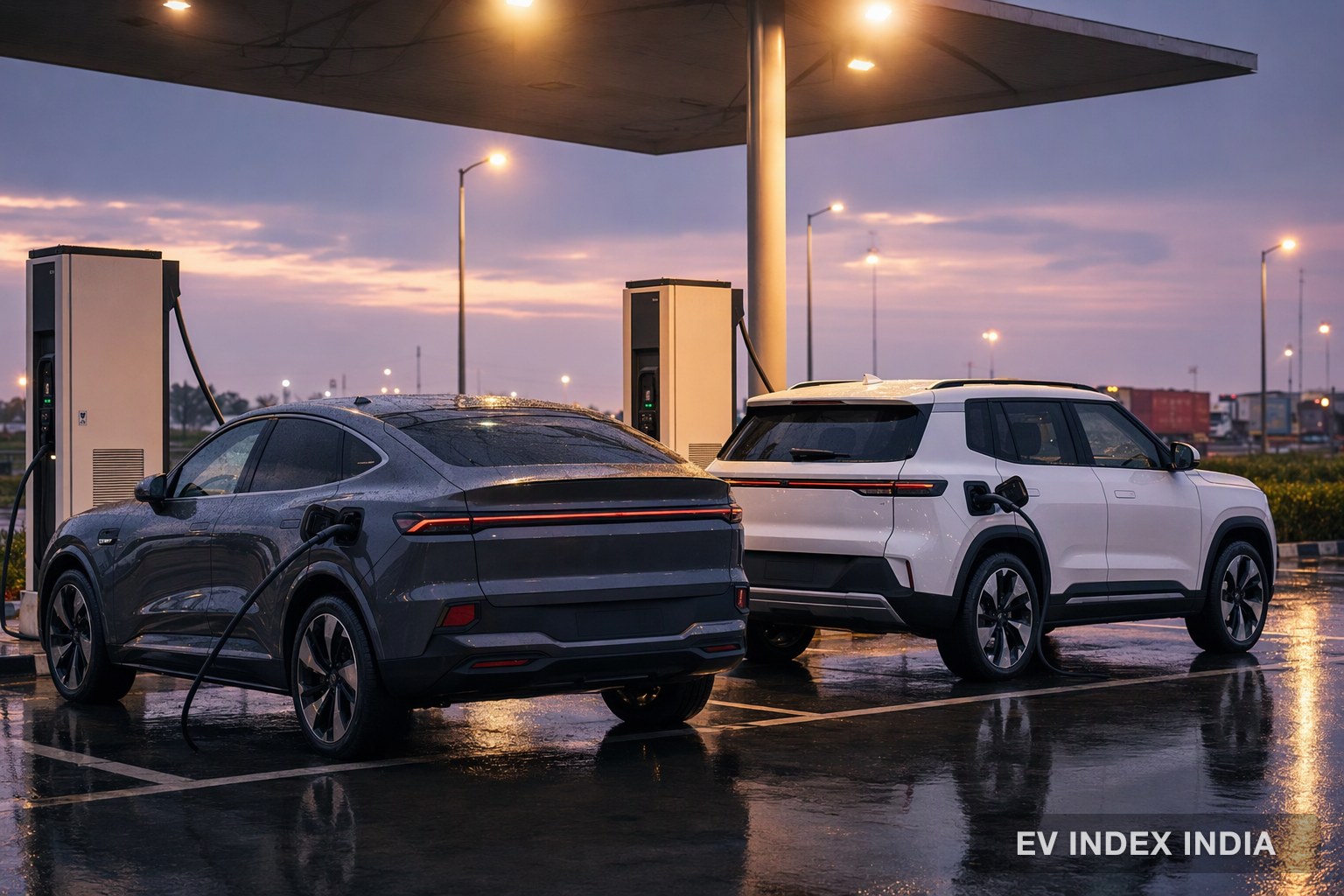
Tata Curvv.ev vs Hyundai Creta Electric: Prices, Range, Safety
Below ₹20 lakh the Curvv.ev gives more for less: its ₹17,19,000 entry version has a bigger battery, 82 km more certified range, a sunroof and a 360-degree camera than the ₹18,02,800 Creta Electric Executive. The Creta Electric's 51.4 kWh pack is rated at 510 km against the Curvv.ev's 502 km, but the cheapest long-range Creta costs ₹2,80,900 more. Only the Curvv.ev has a Bharat NCAP score (5 stars, covering all current versions) and a first-owner lifetime battery warranty, while Hyundai offers a 3-year unlimited-km vehicle warranty, far more variants and richer top versions. The Curvv.ev's coupe roof costs rear headroom for passengers over 6 feet, according to Autocar India.
The Tata Curvv.ev costs less and gives you more battery for the money. It is priced from ₹17,19,000 to ₹19,69,000 (ex-showroom, Delhi, checked 26 November 2026) and comes with a single 55 kWh pack rated at 502 km and a 5-star Bharat NCAP score. The Hyundai Creta Electric runs from ₹18,02,800 to ₹25,22,100 with a 42 kWh pack (420 km) or a 51.4 kWh pack (510 km), and Bharat NCAP has not rated it.
Below ₹20 lakh, the Curvv.ev is the stronger buy on paper. The Creta Electric offers more choice (29 price points against the three on Tata's price page), a 50 mm longer wheelbase, a vehicle warranty with no kilometre cap, and top versions with equipment unavailable on the Curvv.ev. Level 2 ADAS shows the gap most clearly: you pay ₹19,39,000 for it in the Curvv.ev and ₹21,30,500 in the Creta Electric.
Key takeaways
- The cheapest Curvv.ev (Accomplished X 55, ₹17,19,000) undercuts the cheapest Creta Electric (Executive 42 kWh, ₹18,02,800) by ₹83,800, and it has a bigger battery, 82 km more certified range, a panoramic sunroof and a 360-degree camera.
- Certified range is close: 510 km for the Creta Electric 51.4 kWh, 502 km for the Curvv.ev. The cheapest long-range Creta costs ₹2,80,900 more than the cheapest Curvv.ev.
- Of the two, only the Curvv.ev has a Bharat NCAP result: 5 stars, with scores of 30.81/32 for adults and 44.83/49 for children. The applicability grid covers all three versions now on sale.
- Tata's battery warranty is lifetime (defined as 15 years) with unlimited km for the first registered owner. Hyundai's is 8 years or 1,60,000 km, but Hyundai's 3-year vehicle warranty has no km cap, while Tata's stops at 1,25,000 km.
- Rear headroom is the Curvv.ev's known weak spot; Autocar India says the coupe roofline leaves passengers over 6 feet short of headroom.
Curvv.ev vs Creta Electric at a glance
| Tata Curvv.ev | Hyundai Creta Electric | |
|---|---|---|
| Ex-showroom, Delhi (26 Nov 2026) | ₹17,19,000 to ₹19,69,000 | ₹18,02,800 to ₹25,22,100 |
| Versions on the Delhi price list | 3 | 10 trims, 29 price points |
| Battery | 55 kWh | 42 kWh or 51.4 kWh |
| Certified range (MIDC Part 1 + Part 2) | 502 km | 420 km / 510 km |
| Motor power | 123 kW (167 PS) | 99 kW (135 PS) / 126 kW (171 PS) |
| Motor torque | 215 Nm | Not published |
| 0 to 100 km/h (maker's own testing) | 8.6 s | 7.9 s (51.4 kWh only) |
| DC fast charge, 10 to 80% | 40 min on a 70 kW+ charger | 39 min on a 100 kW+ / 400 V charger |
| AC charge, 10 to 100% | 7.6 h on 7.2 kW | 6 h / 7 h 15 min on 7.4 kW |
| Home wall box included | Empowered X and #DARK | HC versions only |
| Boot | 500 litres (without parcel shelf) | Not published by Hyundai |
| Frunk | 11.6 litres (Empowered X and #DARK only) | 22 litres (all except Executive, Executive Tech and Executive (O) LR) |
| Ground clearance | 186 mm unladen | Not published |
| Length x width x height | 4,310 x 1,810 x 1,637 mm | 4,340 x 1,790 x 1,655 mm (with roof rails) |
| Wheelbase | 2,560 mm | 2,610 mm |
| Airbags | 6, standard | 6, standard |
| Cheapest version with Level 2 ADAS | ₹19,39,000 | ₹21,30,500 |
| Bharat NCAP | 5 stars (AOP 30.81/32, COP 44.83/49) | Not rated |
| Battery warranty | Lifetime (15 years), unlimited km, first registration | 8 years / 1,60,000 km |
| Vehicle warranty | 3 years / 1,25,000 km | 3 years / unlimited km |
| BaaS starting price | ₹10.99 lakh + ₹5/km | ₹10.99 lakh + from ₹3.9/km |
Every version and price, ex-showroom Delhi
Tata Curvv.ev
Tata now sells the Curvv.ev only with the 55 kWh battery, under the SeriesX name. We read these prices from Tata's price list service on ev.tata.cars for Delhi. The entry figure matches the restOfIndiaPrice field on the Curvv.ev model page. Mumbai and Bengaluru returned the same three prices, so Tata appears to price the car nationally. The same service and Tata's spec page also list an "IB Emp+ A 55" at ₹21,99,000 that the price page does not show and carandbike's SeriesX launch report does not mention. We could not confirm that it is on sale, so we have left it out here.
| Version | Battery | Ex-showroom, Delhi |
|---|---|---|
| Accomplished X 55 | 55 kWh | ₹17,19,000 |
| Empowered X 55 | 55 kWh | ₹19,39,000 |
| Empowered X 55 #DARK | 55 kWh | ₹19,69,000 |
| The FAQ on that same page still quotes ₹16.99 lakh, ₹19.19 lakh and ₹19.49 lakh, the SeriesX launch prices carandbike reported on 4 May 2026 when the 45 kWh pack was dropped. The live list is ₹20,000 higher on every version, and Tata's own BaaS release of 28 September already uses ₹17.19 lakh, so the increase came some time between May and late September. Use the live price list. |
Hyundai Creta Electric
Hyundai's price service (model 48, city 1370, New Delhi) returned 29 entries. The rendered price page agrees on the ₹18,02,800 starting price, and Mumbai and Bengaluru gave identical figures. HC stands for Home Charger: since July 2026 these versions come with a 7.4 kW wall box, according to Hyundai's release.
| Version | Battery | Monotone | Dual tone | HC (wall box) |
|---|---|---|---|---|
| Executive | 42 kWh | ₹18,02,800 | Not listed | Not listed |
| Executive Tech | 42 kWh | ₹18,99,900 | Not listed | Not listed |
| Premium | 42 kWh | ₹19,99,900 | ₹20,15,500 | ₹20,73,500 |
| Excellence | 42 kWh | ₹21,30,500 | ₹21,45,500 | ₹22,03,500 |
| Excellence Knight | 42 kWh | ₹21,45,400 | ₹21,60,400 | ₹22,18,400 |
| Executive (O) LR | 51.4 kWh | ₹19,99,900 | Not listed | Not listed |
| Smart (O) LR | 51.4 kWh | ₹21,93,700 | Not listed | ₹22,26,700 |
| Excellence LR Knight | 51.4 kWh | ₹23,82,100 | ₹23,97,100 | ₹24,55,100 |
| Excellence LR | 51.4 kWh | ₹24,07,200 | ₹24,22,200 | ₹24,40,200 |
| Excellence LR Lounge | 51.4 kWh | ₹24,34,100 | ₹24,49,100 | ₹25,07,100 |
| HC dual-tone versions add another ₹15,000, which is how the range tops out at ₹25,22,100 (Excellence LR HC Lounge dual tone). The HC premium is only ₹33,000 on the Smart (O) LR and Excellence LR, against ₹73,000 to ₹73,600 elsewhere. The Excellence LR Knight is currently ₹25,100 cheaper than the plain Excellence LR, so it is the cheapest long-range Creta with ADAS. |
What the same money buys
Around ₹17 lakh to ₹18 lakh
The Curvv.ev Accomplished X 55 at ₹17,19,000 is the cheapest car in this comparison, and on paper it is the best-equipped entry version. Tata's October 2026 brochure lists a panoramic sunroof, a 360-degree camera with blind-spot view, front parking sensors, leatherette seats, a wireless phone charger, cruise control and six airbags for this version.
The Creta Electric Executive at ₹18,02,800 has a 42 kWh battery, a rear camera with rear sensors only, fabric seats and no sunroof or wireless charger, according to Hyundai's September 2026 brochure. It does have a 60:40 split rear seat with two-step recline. Tata's brochure lists both features as Empowered X additions over the Accomplished X, and carandbike's launch report also names reclining rear seats as an Empowered X extra, so the cheapest Curvv.ev goes without.
Spending ₹18,99,900 on the Creta Executive Tech adds a voice-controlled panoramic sunroof, ventilated front seats and leatherette upholstery. That is ₹1,80,900 more than the Curvv.ev Accomplished X for a car with 13 kWh less battery capacity.
Around ₹19.4 lakh to ₹20 lakh
The Curvv.ev Empowered X 55 at ₹19,39,000 has the longest equipment list of anything under ₹20 lakh in this comparison. It adds Level 2 ADAS, a 7.2 kW wall box, ventilated front seats, a 6-way powered driver's seat, the 31.24 cm (12.3-inch) Harman screen with nine JBL speakers, a gesture-powered tailgate, the frunk, a 60:40 split reclining rear seat, V2L and V2V. The #DARK version is ₹30,000 more for the black styling.
For ₹60,900 more, Hyundai offers two different versions at ₹19,99,900. The Creta Electric Premium keeps the 42 kWh pack but adds an 8-way powered driver's seat, an eight-speaker Bose system, a 22-litre frunk and V2L. It has no ADAS, and the wall box costs ₹73,600 extra as the HC version. The Executive (O) LR gets the 51.4 kWh pack and a sunroof, but no ventilated seats, wireless charger, frunk or V2L.
Above ₹21 lakh
Tata's price page has nothing above ₹19,69,000. The Creta Electric's ADAS starts on the 42 kWh Excellence at ₹21,30,500, which is ₹1,91,500 more than the Curvv.ev Empowered X. The cheapest Creta with the larger battery and ADAS is the Excellence LR Knight at ₹23,82,100, or ₹4,43,100 above the Curvv.ev Empowered X.
These prices include equipment the Curvv.ev's brochure does not list. Every Excellence version adds a powered front passenger seat and a memory driver's seat. The long-range Excellence versions also get a battery heater and a digital key, and the Lounge adds a 29.46 cm (11.6-inch) rear entertainment screen on the passenger side.
Battery, range and motor
The Curvv.ev uses one 55 kWh liquid-cooled pack with a 123 kW (167 PS), 215 Nm permanent magnet motor. Tata quotes 502 km of ARAI-certified range on the MIDC Part 1 + Part 2 cycle, and its brochure adds a "C75" real-world estimate of 400 to 425 km. Tata's own testing gives 0 to 100 km/h in 8.6 seconds (the model page header says 8.8) and a 160 km/h top speed.
The Creta Electric offers a 42 kWh pack with a 99 kW (135 PS) motor or a 51.4 kWh pack with a 126 kW (171 PS) motor. Certified ranges are 420 km and 510 km on the same MIDC cycle, according to the specification page. Hyundai quotes 7.9 seconds to 100 km/h for the 51.4 kWh car, based on its own testing. It does not publish motor torque, a 0 to 100 time for the 42 kWh car, or any real-world range estimate of its own.
Neither maker publishes a certified energy-consumption figure in Wh/km, so we used certified range per kWh of battery as a rough guide. That works out to 10.0 km per kWh for the Creta 42 kWh, 9.9 for the Creta 51.4 kWh and 9.1 for the Curvv.ev. On paper, the Creta travels further on each kWh, while the Curvv.ev's bigger pack keeps its range close.
Charging: DC and AC
| Curvv.ev 55 | Creta Electric 42 kWh | Creta Electric 51.4 kWh | |
|---|---|---|---|
| DC, 10 to 80% | 40 min | 39 min | 39 min |
| Charger the DC time assumes | 70 kW and above | Above 100 kW, 400 V | Above 100 kW, 400 V |
| AC, 10 to 100% | 7.6 h on 7.2 kW | 6 h on 7.4 kW | 7 h 15 min on 7.4 kW |
| 15A socket, 10 to 100% | 21 h | Not published | Not published |
| Wall box in the box | Empowered X, #DARK | HC versions | HC versions |
| Standard | CCS2 | CCS2 | CCS2 |
| The quoted times are almost identical, but Tata's 40 minutes assumes a 70 kW or bigger charger, while Hyundai's 39 minutes assumes one above 100 kW. If the fast chargers on your routes are 60 kW units, treat both numbers as optimistic. |
Using 70% of certified range to estimate the range added between 10% and 80%, the Curvv.ev adds about 351 km in 40 minutes (8.8 km a minute). The Creta 51.4 kWh adds about 357 km in 39 minutes (9.2 km a minute) and the 42 kWh car about 294 km (7.5 km a minute). These are paper figures, not measurements.
At home, the 7.2 kW and 7.4 kW wall boxes are effectively the same speed, so what matters is whether one comes with the car. The Curvv.ev Accomplished X gets a 15A portable cable (3.3 kW on Tata's spec page) that needs 21 hours from 10% to full. The cheapest Creta with a wall box is the Premium HC at ₹20,73,500; the Executive, Executive Tech and Executive (O) LR have no HC version.
Space, boot and practicality
Tata lists a 500-litre boot (without the parcel shelf), an 11.6-litre frunk on the Empowered X versions and 186 mm of unladen ground clearance. Hyundai's brochure lists the Creta Electric's 22-litre frunk, but neither the brochure nor the spec page gives a boot volume or ground clearance. Autocar India quotes a 433-litre boot; we could not find that figure on any Hyundai page, so treat the boot comparison as unconfirmed.
The bodies are close in size. The Creta Electric is 30 mm longer, 18 mm taller (Hyundai's height includes the roof rails) and has a 50 mm longer wheelbase. The Curvv.ev is 20 mm wider. Every Creta Electric and the Curvv.ev Accomplished X run 215/60 R17 tyres; the Curvv.ev Empowered X moves to 215/55 R18. Hyundai lists a full-size 215/60 R17 steel spare, while Tata's spec page lists a puncture repair kit and does not mention a spare wheel.
The Curvv.ev's coupe shape limits rear headroom. Autocar India wrote in August 2026 that the roofline "eats into rear-seat headroom, making it uncomfortable for taller passengers, especially those over 6 feet". It also noted weak under-thigh support from the raised battery floor. The Creta Electric shares that second problem: Autocar India's model page lists a "knees-up rear seat" from its raised floor. Neither maker publishes rear headroom, so try both with your tallest passenger before booking.
Safety: airbags, ADAS and crash tests
Both cars have six airbags, stability control, TPMS and four disc brakes as standard, according to their brochures.
Level 2 ADAS is on the Curvv.ev Empowered X 55 and #DARK only, so the cheapest Curvv.ev with it costs ₹19,39,000. On the Creta Electric, Hyundai SmartSense comes on the Excellence, Excellence Knight, Excellence LR, Excellence LR Knight and Lounge, from ₹21,30,500. Both makers list 20 items under their ADAS headings, though the lists differ. Tata's includes traffic sign recognition, which Hyundai's does not. Hyundai lists its blind-spot and rear cross-traffic systems as collision-avoidance assists, whereas Tata lists detection and alerts. That is a spec-sheet comparison, not a test of how well either system works.
The bigger difference is the 360-degree camera. Every Curvv.ev has one. On the Creta Electric, the surround-view monitor comes only with the ADAS versions, so you need ₹21,30,500 to get it.
Bharat NCAP
The Curvv.ev's Bharat NCAP page shows 5 stars for adult occupants (30.81 out of 32) and 5 stars for children (44.83 out of 49). Bharat NCAP tested an Empowered+ A 55 in September 2024. The applicability grid (Revision 03, June 2026) extends the rating to ACC X 55, ACC X DK 55, EMP X 55 and EMP X DK 55, added in March 2026, so the three versions on sale today are covered.
The Creta Electric has no Bharat NCAP result. The ratings list had 40 vehicles on 26 November 2026, and the only Hyundai entries were the Tucson, Venue and Verna. That does not make the Creta Electric unsafe; it means there is no independent Indian crash score to check. Our 5-star Bharat NCAP electric SUVs under ₹25 lakh list covers the rated alternatives.
Warranty and battery cover
| Tata Curvv.ev | Hyundai Creta Electric | |
|---|---|---|
| Battery, first owner | Lifetime (15 years from first registration), unlimited km | 8 years or 1,60,000 km, whichever is earlier |
| Battery, later owners | 8 years / 1.6 lakh km from first registration, if Tata is told of the transfer | No separate condition published |
| Motor | 8 years or 1,60,000 km | No separate figure published |
| Vehicle | 3 years or 1,25,000 km | 3 years, unlimited km, from delivery to the first purchaser |
| Tata's warranty page sets out the conditions of "lifetime" cover. It means 15 years from first registration, for cars registered to private individuals (or perk cars kept by the same employee), and "unlimited" assumes fair personal use. Commercial, fleet, taxi and demo cars get 8 years or 1,60,000 km. A second owner who does not tell Tata about the transfer loses the battery cover. Tata repairs or replaces the battery if its state of health falls below 70%. |
Hyundai's battery warranty term comes from the small print in its brochure, which gives no capacity threshold. Its warranty policy page lists 3 years with unlimited km for the Creta Electric. To keep that cover, you must service the car at an authorised Hyundai dealer. If you drive a lot in the first three years, Hyundai's lack of a km cap can matter more than Tata's battery cover.
Battery-as-a-Service on both
Both makers offer BaaS, where the battery is financed separately to cut the upfront price.
Tata extended BaaS to the Curvv.ev on 28 September 2026: ₹10.99 lakh for the car against a regular ₹17.19 lakh, plus battery financing of ₹5 per km. Tata's footnotes say the figures apply to entry trims, assume 60 km of driving a day, exclude charging costs and are for personal users only. BaaS is a dual-loan product subject to financier approval, and the battery EMI changes with down payment and tenure.
Hyundai's 2 July 2026 release quotes the Creta Electric from ₹10.99 lakh with battery EMI from ₹3.9 per km. The highlights page still advertises it, with up to 100% on-road funding (excluding the battery) and free charger installation. Hyundai does not say which version or daily distance its ₹3.9 figure assumes (its FAQ there says BaaS cuts the upfront price by "around ₹7 lakh", which fits the ₹18,02,800 Executive), so the two per-km figures are not directly comparable. At Tata's own 60 km a day, ₹5 per km comes to ₹300 a day before charging.
Honest weaknesses
Tata Curvv.ev
- Rear headroom is tight for tall adults, and Autocar India flags weak under-thigh support at the back.
- Tata's price page shows one battery and three versions. There is no cheaper, smaller-battery Curvv.ev any more, and nothing on that page above the Empowered X #DARK.
- The frunk is 11.6 litres and comes only on the Empowered X versions. Tata's brochure lists the 60:40 split rear seat and rear recline as Empowered X additions too, so the Accomplished X has neither.
- The Accomplished X has no ADAS and no wall box; a 15A socket takes 21 hours to charge it.
- Tata's vehicle warranty stops at 1,25,000 km in three years.
Hyundai Creta Electric
- It has no Bharat NCAP rating, so there is no independent Indian crash score to judge it by.
- Hyundai's current brochure and spec page give no motor torque, boot volume or ground clearance for the Creta Electric.
- ADAS and the 360-degree camera start at ₹21,30,500, nearly ₹2 lakh above the Curvv.ev's ADAS version.
- The base Executive is sparse: no sunroof, no wireless charger, fabric seats and rear sensors only.
- The 39-minute DC time assumes a charger above 100 kW; on a slower unit it will take longer.
- Autocar India found the steering heavier than the regular Creta's and the rear seating position knees-up.
Which one to buy
The choice depends on your priorities. These recommendations are based on published prices and equipment.
- If you want the most car for the least money, buy the Curvv.ev Accomplished X 55 at ₹17,19,000. It has 55 kWh, 502 km, a sunroof and a 360-degree camera, and it costs ₹83,800 less than the 42 kWh Creta Executive.
- If you want ADAS and a wall box under ₹20 lakh, the Curvv.ev Empowered X 55 at ₹19,39,000 is the only one of these two that offers both. The Creta needs ₹22,03,500 for ADAS with a wall box (Excellence HC).
- If tall adults ride in the back, try the Creta Electric first. Autocar India's rear-seat complaint about it is knee height; with the Curvv.ev it is knee height and headroom. The Creta's wheelbase is also 50 mm longer.
- If you want the longest certified range, the Creta Electric 51.4 kWh leads by 8 km (510 km against 502 km). That gap is small, and the cheapest long-range Creta costs ₹2,80,900 more than the cheapest Curvv.ev.
- If crash-test results matter to you, the Curvv.ev has a 5-star Bharat NCAP rating that covers every current version. The Creta Electric has none.
- If you plan to keep the car for 10 years or more as its first owner, Tata's lifetime battery cover offers stronger protection. If you will drive more than 1,25,000 km in three years, Hyundai's unlimited-km vehicle warranty fits better.
- If you want a powered passenger seat or a memory driver's seat, only the Creta Electric has them, from the Excellence at ₹21,30,500. For a battery heater, you need the Excellence LR Knight at ₹23,82,100; for the rear screen, you need the Lounge at ₹24,34,100.
More detail is on our Tata Curvv.ev and Hyundai Creta Electric model pages. If a Maruti is on your list, see Creta Electric vs e Vitara.
How we checked
We checked every figure on 26 November 2026. Tata prices came from the price-list service behind ev.tata.cars for Delhi, Mumbai and Bengaluru, and the model page's restOfIndiaPrice field. The service, Tata's spec page and the Bharat NCAP applicability grid also list an "IB Emp+ A 55" (₹21,99,000 in the price service) that the price page does not display; we could not confirm that it is on sale, so we left it out. Hyundai prices came from its price service for model 48 in New Delhi (city 1370), cross-checked against the rendered price page and two other cities.
Tata's spec page is less complete than its brochure (it lists no 360-degree camera or front parking sensors on any version, and no wireless charger on the Accomplished X), so Curvv.ev equipment comes from the October brochure. Specifications, features and warranty terms came from Tata's October 2026 SeriesX brochure, Hyundai's September 2026 brochure (the one its live pages link to), and each maker's specification and warranty pages. Crash ratings and the applicability grid came from bncap.in, and BaaS terms from each maker's own release.
Secondary sources are named where used: carandbike for the May 2026 launch prices and the Empowered X's reclining rear seat, Autocar India for rear-seat comfort and its 433-litre boot figure for the Creta Electric. Neither maker publishes rear headroom or certified Wh/km, and Hyundai does not publish torque, boot volume or ground clearance for this car. Prices can change without notice, so confirm with a dealer.
FAQ
Which is cheaper, the Tata Curvv.ev or the Hyundai Creta Electric?
The Curvv.ev. It starts at ₹17,19,000 against ₹18,02,800 for the Creta Electric (ex-showroom, Delhi, 26 November 2026) and tops out at ₹19,69,000, while the Creta Electric reaches ₹25,22,100. The cheapest Curvv.ev also has the bigger battery, 55 kWh against 42 kWh.
Which has more range, Curvv.ev or Creta Electric?
The Creta Electric 51.4 kWh, at 510 km certified, is 8 km ahead of the Curvv.ev's 502 km; the 42 kWh Creta is rated at 420 km. Tata also publishes a 400 to 425 km real-world estimate, and Hyundai has no equivalent.
Does the Hyundai Creta Electric have a Bharat NCAP rating?
No. On 26 November 2026, bncap.in listed 40 rated vehicles, and the Creta Electric was not one of them. The Curvv.ev has 5 stars (30.81/32 adult, 44.83/49 child), and the rating covers all current versions.
Which charges faster?
On paper, they are almost level: 40 minutes from 10% to 80% for the Curvv.ev on a 70 kW+ charger, 39 minutes for the Creta Electric on a charger above 100 kW. On a home wall box (10% to 100%), the Creta takes 6 hours (42 kWh) or 7 hours 15 minutes (51.4 kWh), and the Curvv.ev takes 7.6 hours.
Is the Curvv.ev's lifetime battery warranty really lifetime?
It means 15 years from first registration with unlimited km, for the first owner of a privately registered car, subject to fair personal use. Later owners get 8 years or 1.6 lakh km counted from first registration, and only if they tell Tata about the transfer. Hyundai's battery warranty is 8 years or 1,60,000 km.
Which is cheaper with Level 2 ADAS?
The Curvv.ev. The Empowered X 55 has Level 2 ADAS and a 7.2 kW wall box for ₹19,39,000. The cheapest Creta Electric with ADAS is the 42 kWh Excellence at ₹21,30,500; with the long-range pack it is the Excellence LR Knight at ₹23,82,100.
Can I buy either car on Battery-as-a-Service?
Yes. Tata lists the Curvv.ev at ₹10.99 lakh plus ₹5 per km, assuming 60 km a day on the entry trim and excluding charging. Hyundai quotes the Creta Electric from ₹10.99 lakh plus battery EMI from ₹3.9 per km, without stating the version or daily distance. Tata says its scheme is subject to financier approval.
Last verified: 2026-11-26
Sources
- Tata Curvv.ev price page (ev.tata.cars)
- Tata Curvv.ev model page (ev.tata.cars)
- Tata Curvv.ev specifications (ev.tata.cars)
- Tata Curvv.ev SeriesX brochure, October 2026
- TATA.ev lifetime HV battery warranty terms
- TATA.ev extends Battery-as-a-Service (28 Sep 2026)
- Hyundai price service, Creta Electric, New Delhi
- Hyundai Creta Electric price page
- Hyundai Creta Electric specification page
- Hyundai Creta Electric highlights page
- Hyundai Creta Electric brochure, September 2026
- Hyundai India warranty policy
- Hyundai introduces Battery-as-a-Service for Creta Electric (2 Jul 2026)
- Bharat NCAP: Tata Curvv.ev rating and applicability
- Bharat NCAP Curvv.ev fact sheet, Rev 3 June 2026
- Bharat NCAP vehicle safety ratings list
- carandbike: Curvv EV SeriesX launch, 45 kWh discontinued (4 May 2026)
- Autocar India: 3 reasons to buy the Tata Curvv EV and 2 reasons not to
- Autocar India: Hyundai Creta Electric model page