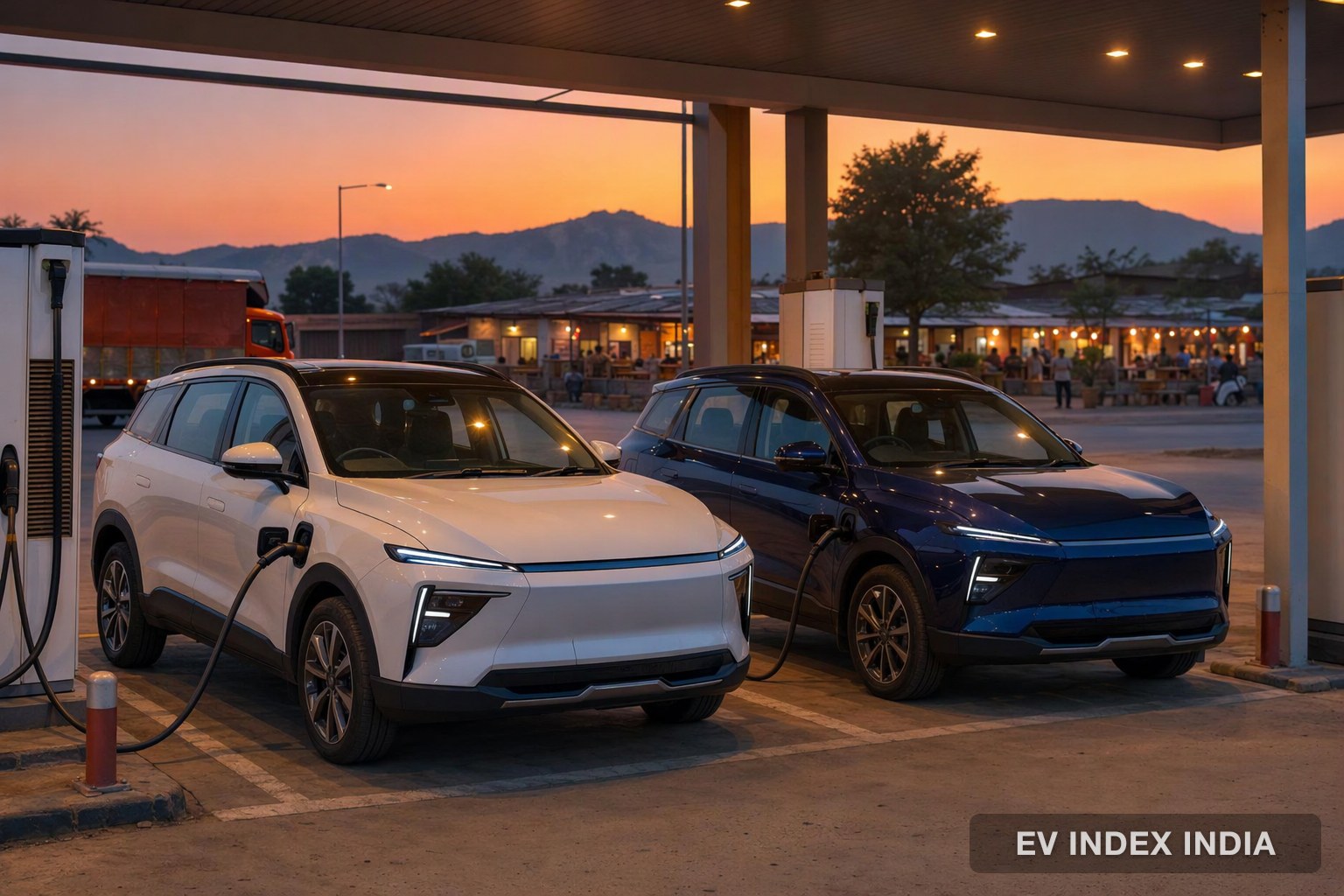
Creta Electric vs e Vitara: price, range and which to buy
At every matched pairing the e Vitara costs less and carries more battery: the Delta (₹16,19,000, 49 kWh, 440 km) undercuts the Creta Electric Executive (₹18,02,800, 42 kWh, 420 km) by ₹1,83,800, and the Zeta gives 61 kWh and 543 km for ₹17,94,000. Level 2 ADAS starts at ₹19,99,000 on the e Vitara Alpha against ₹21,30,500 on the Creta Electric Excellence, and ₹23,82,100 for a long-range Creta with ADAS. The e Vitara is rated 5 stars by Bharat NCAP across all variants, while the Creta Electric has no rating. The Creta Electric answers with an opening panoramic sunroof, V2L, a 22-litre front boot, powered and memory seats on higher trims, a quicker DC charge claim and a 3-year unlimited-km vehicle warranty.
The Maruti e Vitara is the cheaper car and gives you more battery for the money. It costs ₹16,19,000 to ₹20,21,000 (ex-showroom, Delhi, checked 23 November 2026), comes with a 49 kWh or 61 kWh pack rated for 440 km or 543 km, and has a 5-star Bharat NCAP rating that covers all three variants. The Hyundai Creta Electric costs ₹18,02,800 to ₹25,22,100 for a 42 kWh or 51.4 kWh pack rated for 420 km or 510 km. Hyundai claims a quicker DC charge (39 minutes against 45 for 10 to 80%, on a more powerful charger), and the Creta offers more comfort equipment and a much wider choice of variants, but Bharat NCAP has not rated it.
Pick the e Vitara if certified range per rupee and a published crash rating matter most to you. Pick the Creta Electric if you want an opening panoramic sunroof, V2L, a front boot and powered seats, and are willing to pay ₹1.8 lakh to ₹2.1 lakh more for the entry versions, ₹1.3 lakh more for the cheapest version with ADAS, and about ₹3.8 lakh more for long range with ADAS.
Key takeaways
- The cheapest e Vitara (Delta, ₹16,19,000, 49 kWh, 440 km) costs ₹1,83,800 less than the cheapest Creta Electric (Executive, ₹18,02,800, 42 kWh, 420 km) and still has the bigger battery.
- The e Vitara Zeta offers 61 kWh and 543 km for ₹17,94,000. The cheapest long-range Creta Electric, the Executive (O) LR, costs ₹19,99,900 for 51.4 kWh and 510 km.
- Level 2 ADAS starts at ₹19,99,000 on the e Vitara (Alpha only) and at ₹21,30,500 on the Creta Electric (Excellence, 42 kWh).
- Of the two, only the e Vitara has a Bharat NCAP result: 5 stars for adults and children. The rating applies to Delta, Zeta and Alpha. bncap.in has no Creta Electric listing.
- Hyundai's vehicle warranty has no kilometre cap for 3 years; Maruti's stops at 1,00,000 km. Both cover the battery for 8 years or 1,60,000 km.
Price-matched comparison
Prices are ex-showroom, Delhi, checked 23 November 2026, from the NEXA price feed behind the e Vitara price page and the Hyundai price service behind the Creta Electric price page.
| Pairing | Maruti e Vitara | Hyundai Creta Electric | Gap |
|---|---|---|---|
| Cheapest version | Delta, 49 kWh, 440 km: ₹16,19,000 | Executive, 42 kWh, 420 km: ₹18,02,800 | e Vitara ₹1,83,800 less |
| Cheapest big battery | Zeta, 61 kWh, 543 km: ₹17,94,000 | Executive (O) LR, 51.4 kWh, 510 km: ₹19,99,900 | e Vitara ₹2,05,900 less |
| Cheapest with Level 2 ADAS | Alpha, 61 kWh, 543 km: ₹19,99,000 | Excellence, 42 kWh, 420 km: ₹21,30,500 | e Vitara ₹1,31,500 less |
| Cheapest big battery with ADAS | Alpha, 61 kWh: ₹19,99,000 | Excellence LR Knight, 51.4 kWh: ₹23,82,100 | e Vitara ₹3,83,100 less |
| Most expensive version | Alpha dual tone: ₹20,21,000 | Excellence LR (HC) Lounge dual tone: ₹25,22,100 | e Vitara ₹5,01,100 less |
| At almost exactly ₹20 lakh, three versions are priced within ₹900 of each other: the e Vitara Alpha (₹19,99,000) and the Creta Electric Premium and Executive (O) LR (both ₹19,99,900). The features section compares them. |
Full variant prices
Maruti e Vitara, ex-showroom Delhi
| Variant | Battery | Certified range | Price |
|---|---|---|---|
| Delta | 49 kWh | 440 km | ₹16,19,000 |
| Zeta | 61 kWh | 543 km | ₹17,94,000 |
| Alpha | 61 kWh | 543 km | ₹19,99,000 |
| Alpha dual tone | 61 kWh | 543 km | ₹20,21,000 |
| These are higher than the launch prices. In February 2026, Autocar India reported ₹15.99 lakh, ₹17.49 lakh and ₹19.79 lakh for Delta, Zeta and Alpha. If a review or dealer quote still uses those numbers, it is out of date. |
Hyundai Creta Electric, ex-showroom New Delhi
Hyundai's list runs to 29 price points once Knight, Lounge, dual-tone and HC (home charger) versions are counted. Here are the single-colour versions, with the HC price where offered.
| Variant | Battery | Certified range | Price | HC version (7.4 kW wall box) |
|---|---|---|---|---|
| Executive | 42 kWh | 420 km | ₹18,02,800 | Not offered |
| Executive Tech | 42 kWh | 420 km | ₹18,99,900 | Not offered |
| Premium | 42 kWh | 420 km | ₹19,99,900 | ₹20,73,500 |
| Excellence | 42 kWh | 420 km | ₹21,30,500 | ₹22,03,500 |
| Excellence Knight | 42 kWh | 420 km | ₹21,45,400 | ₹22,18,400 |
| Executive (O) LR | 51.4 kWh | 510 km | ₹19,99,900 | Not offered |
| Smart (O) LR | 51.4 kWh | 510 km | ₹21,93,700 | ₹22,26,700 |
| Excellence LR Knight | 51.4 kWh | 510 km | ₹23,82,100 | ₹24,55,100 |
| Excellence LR | 51.4 kWh | 510 km | ₹24,07,200 | ₹24,40,200 |
| Excellence LR Lounge | 51.4 kWh | 510 km | ₹24,34,100 | ₹25,07,100 |
| Dual-tone paint adds ₹15,000 to ₹15,600. Two quirks stand out: the wall box adds only ₹33,000 on the Smart (O) LR and Excellence LR against ₹73,000 to ₹73,600 elsewhere, and the Excellence LR Knight costs ₹25,100 less than the plain Excellence LR, although the brochure gives it the same equipment plus a dashcam and a rear wireless charger. Both differences stem from the same price revision. In November 2026, Hyundai raised the plain Smart (O) LR, Excellence LR and Excellence LR dual tone by ₹40,000 each and left the HC and Knight versions unchanged. V3Cars reported the revision on 18 November 2026, and its earlier figures (₹21,53,700 and ₹23,67,200) match HT Auto's June 2026 list; both are secondary sources, and we found no Hyundai announcement. Each version appears once in Hyundai's price service, so these are current prices, not leftover entries. Hyundai says prices may change without prior notice, so confirm the exact version before you pay a booking amount. |
Battery-as-a-Service: same headline, different fine print
Both makers have quoted ₹10.99 lakh as a BaaS starting price: you pay for the car without the battery, then pay a battery EMI per km. Hyundai still advertises its figure; Maruti's was an introductory launch price that it no longer publishes.
Hyundai introduced BaaS for the Creta Electric in a press release dated 2 July 2026: ₹10.99 lakh ex-showroom plus a battery EMI from ₹3.9 per km. The live Creta Electric page still carries the offer with no end date and adds up to 100% on-road funding (excluding the battery) and free charger installation. Neither the release nor the page names the variant behind ₹10.99 lakh or the daily distance behind ₹3.9 per km.
Maruti's launch press release of 17 February 2026 called ₹10.99 lakh plus a battery EMI of ₹3.99 per km an introductory BaaS price for the 49 kWh model. Its footnote describes BaaS as "a dual-loan finance product". The per-km figure assumes 60 km a day and excludes charging costs. The offer is for personal use only, and road tax, insurance and TCS are extra. The release gave no figure for the 61 kWh versions; the widely quoted prices of ₹11.99 lakh (Zeta) and ₹14.29 lakh (Alpha), with ₹4.39 per km, came from Autocar India, not Maruti. The September 2026 brochure has a BaaS page with no figures, and we found no current BaaS price on NEXA's site, so treat the launch numbers as historical prices, not a current quote.
Under Maruti's own assumption, 60 km a day for 30 days at ₹3.99 per km is about ₹7,182 a month (our arithmetic). Because the plan is a loan expressed per km, driving less probably raises your real cost per km rather than lowering the EMI. Ask either dealer for the written EMI schedule and prepayment terms. Our BaaS explainer covers how these plans compare across brands.
Battery, range and motor
| e Vitara 49 kWh | e Vitara 61 kWh | Creta Electric 42 kWh | Creta Electric 51.4 kWh | |
|---|---|---|---|---|
| Cell chemistry | LFP | LFP | Liquid-cooled lithium-ion (chemistry not stated) | Same |
| Certified range | 440 km | 543 km | 420 km | 510 km |
| Maximum power | 105.8 kW | 128 kW | 99 kW (135 PS) | 126 kW (171 PS) |
| Maximum torque | 193 Nm | 193 Nm | Not published | Not published |
| 0 to 100 km/h | Not published | Not published | Not published | 7.9 seconds (Hyundai internal test) |
| Tyres | 225/55 R18 | 225/55 R18 | 215/60 R17 | 215/60 R17 |
| The e Vitara figures are from Maruti's September 2026 e Vitara brochure. The Creta Electric figures are from Hyundai's current brochure (dated September 2026) and its specification page. |
The e Vitara leads at both levels: by 7 kWh and 20 km of certified range on the smaller packs, and by 9.6 kWh and 33 km on the larger ones. Hyundai's certified range figures have also changed. Its January 2025 launch release quoted 390 km and 473 km; the September 2026 brochure quotes 420 km and 510 km under the MIDC Part 1 plus Part 2 cycle. Maruti cites certification under Rule 124 of the Central Motor Vehicles Rules without naming the cycle in its brochure. Neither maker publishes a real-world figure, and lab-cycle numbers usually overstate what you will see at highway speeds with the air-conditioning on.
Power outputs are close at both battery sizes. Hyundai publishes no torque figure, and Maruti gives no 0 to 100 km/h time. The Creta Electric's battery heater is fitted only to the Excellence LR, Excellence LR Knight and Lounge; the e Vitara lists battery preconditioning on all three variants.
Charging: times, chargers and what is in the box
| e Vitara | Creta Electric | |
|---|---|---|
| DC fast charge, 10 to 80% | 45 min (Maruti bases this on the 61 kWh pack and a charger of at least 70 kW) | 39 min (both packs, on a charger above 100 kW, 400 V) |
| Peak DC power | Not published | Not published |
| 7.4 kW AC, 10 to 100% | About 6.5 h (49 kWh), about 9 h (61 kWh) | 6 h (42 kWh), 7 h 15 min (51.4 kWh) |
| Charging cable supplied | 3 kW portable cable, all variants | Portable cable, all variants |
| Wall box | Free 7.4 kW wall box with installation was a launch offer, valid until 31 March 2026 | 7.4 kW wall box on HC versions only |
| Connector | CCS2 DC, Type 2 AC | CCS2 |
| On paper, the Creta Electric charges faster. As a rough calculation, 70% of the e Vitara 61 kWh's 543 km is about 380 km in 45 minutes, or 8.4 km per minute; 70% of the Creta LR's 510 km is 357 km in 39 minutes, or 9.2 km per minute. That assumes range is spread evenly across the charge, but the gap is small, and the e Vitara still has more certified range between stops. |
For home charging, the 61 kWh e Vitara takes about 9 hours on a 7.4 kW box against 7 hours 15 minutes for the 51.4 kWh Creta, so overnight charging covers both. Maruti's free wall box ended with its launch offer on 31 March 2026, and the current brochure lists only the 3 kW portable cable, so ask what is included now. Hyundai's wall box comes with HC versions, which cost ₹33,000 to ₹73,600 more, and is not offered on the Executive, Executive Tech or Executive (O) LR.
Size, space and practicality
| e Vitara | Creta Electric | |
|---|---|---|
| Length | 4,275 mm | 4,340 mm |
| Width | 1,800 mm | 1,790 mm |
| Height | 1,640 mm | 1,655 mm (with roof rails) |
| Wheelbase | 2,700 mm | 2,610 mm |
| Boot volume | Not published | Not published |
| Front boot | None listed | 22 litres (not on Executive, Executive Tech or Executive (O) LR) |
| Ground clearance | Not published | Not published |
| Rear seat | 60:40 slide and recline (10 steps), 40:20:40 split-folding backrests | 60:40 split, 2-step recline |
| Spare wheel | 225/55 R18 alloy | 215/60 R17 steel |
| Rear suspension | Multi-link | Coupled torsion beam |
| The Creta is 65 mm longer, but the e Vitara's wheelbase is 90 mm longer, which usually helps rear legroom, and its sliding rear bench trades legroom for luggage space. Hyundai lists no sliding rear seat. Neither company publishes a boot volume or ground clearance, so any figures you see do not come from the makers. The Creta's 22-litre front boot is suited to storing the charging cable; the e Vitara has a luggage box for the charger and tools. |
Safety: Bharat NCAP and airbags
The e Vitara's Bharat NCAP page shows 5 stars for adult occupant protection (31.49 out of 32) and 5 stars for child occupant protection (43.00 out of 49). The tested car was an Alpha 61 kWh, assessed in September 2025. The applicability grid lists Delta 49 kWh, Zeta 61 kWh and Alpha 61 kWh, so the rating covers every variant on sale. The weakest score is in the child "vehicle assessment" section, at 7 out of 13; the dynamic and seat-installation parts scored full marks. Seven airbags, including a driver's knee airbag, are standard.
The Creta Electric has no Bharat NCAP rating. The Bharat NCAP ratings list had 40 vehicles on 23 November 2026, and none was a Creta or Creta Electric. That does not mean the car is unsafe; it means there is no Indian crash-test result to compare. Every Creta Electric has six airbags, ESC, vehicle stability management, hill-start assist, hill descent control, a highline tyre-pressure monitor and disc brakes on all four wheels. Our list of 5-star Bharat NCAP electric SUVs under ₹25 lakh covers the rated alternatives.
ADAS: which trims get it
On the e Vitara, Level 2 ADAS is fitted only to the Alpha: automatic emergency braking for cars, motorcycles, pedestrians and bicycles, lane keep assist, lane departure prevention and warning, adaptive cruise control with all-speed following and stop keeping, adaptive high beam, blind spot monitoring, rear cross-traffic alert and a vehicle sway warning. The 360-degree camera is also Alpha only.
On the Creta Electric, Hyundai SmartSense Level 2 (Hyundai lists 20 features) comes on the Excellence, Excellence Knight, Excellence LR, Excellence LR Knight and Lounge. It adds forward collision avoidance including junction turning and direct oncoming traffic, blind-spot collision avoidance, a blind-spot view camera, safe exit warning, lane following assist, smart cruise control with stop and go, rear cross-traffic collision avoidance and a surround view monitor. Every Creta Electric without ADAS still gets conventional cruise control; Maruti's brochure lists only adaptive cruise, on the Alpha.
The Creta Electric's system lists more functions, while the e Vitara offers ADAS at a lower price.
Features at the same money
Around ₹18 lakh: e Vitara Zeta against Creta Electric Executive
The Zeta (₹17,94,000) costs ₹8,800 less than the Executive (₹18,02,800). It offers 19 kWh more battery capacity and 123 km more certified range, seven airbags against six, front and rear parking sensors with a reversing camera, a wireless phone charger and an auto-dimming mirror. The Executive has dual-zone climate control, cruise control and a reversing camera with dynamic guidelines, but it has rear sensors only and no wireless charger. Neither has a sunroof or ventilated seats. On these features and specifications, the Zeta is the better buy here.
If you can stretch by ₹1,05,900, the Creta Electric Executive Tech (₹18,99,900) adds an opening panoramic sunroof, which no e Vitara has, plus ventilated front seats and leatherette upholstery, which the e Vitara keeps for the Alpha. It retains the 42 kWh pack and 420 km of certified range, and still has no wireless charger, front boot or V2L.
Around ₹20 lakh: e Vitara Alpha against Creta Electric Premium and Executive (O) LR
The e Vitara Alpha (₹19,99,000) has the 61 kWh pack and 543 km, Level 2 ADAS, a 360-degree camera, ventilated front seats, a 10-way powered driver's seat, Infinity by Harman audio with a subwoofer, LED fog lamps and a sunroof. That sunroof is fixed glass: it does not open.
The Creta Electric Premium (₹19,99,900) has the 42 kWh pack, 420 km and no ADAS or 360-degree camera, but it has a voice-controlled panoramic sunroof that opens, ventilated front seats, an 8-way powered driver's seat, leatherette upholstery, an 8-speaker Bose system, the 22-litre front boot, a wireless charger and V2L for powering appliances inside and outside the car (the external adaptor is a paid accessory).
The Creta Electric Executive (O) LR (₹19,99,900) gets the 51.4 kWh pack and 510 km plus the panoramic sunroof, but has fabric seats with manual adjustment, no ventilated seats, no wireless charger, no front boot and no V2L.
If you want safety tech and range, the Alpha gives you both. If you want comfort and gadgets for city driving, the Premium has the better-equipped cabin. The Executive (O) LR suits a buyer who wants the Creta's opening roof and long-range pack at the lowest price and accepts a plain cabin.
Top versions
On Hyundai's current list, the cheapest option for the long-range Creta with its full equipment package is the Excellence LR Knight at ₹23,82,100; the plain Excellence LR costs ₹24,07,200. Both add features no e Vitara offers: a memory driver's seat, a powered walk-in passenger seat, a digital key, V2L and the front boot, plus the more extensive SmartSense suite. The Knight also gets a dashcam and a rear wireless charger, but only black interiors and fewer colours. The Lounge (from ₹24,34,100) adds an 11.6-inch rear entertainment screen on the passenger side. Those features carry a premium of ₹3,83,100 to ₹4,08,200 over an e Vitara Alpha.
Warranty
| e Vitara | Creta Electric | |
|---|---|---|
| Vehicle, standard | 3 years or 1,00,000 km, whichever is earlier | 3 years, unlimited km |
| Vehicle, extended | Paid extension to 5 years or 1,40,000 km, plus optional service-activated coverage from the 6th to the 8th year | Paid extended warranty sold separately |
| Battery | 8 years or 1,60,000 km, whichever is earlier (LFP) | 8 years or 1,60,000 km, whichever is earlier |
| Hyundai's warranty policy page lists the Creta Electric at 3 years with unlimited kilometres from delivery to the first purchaser, and requires servicing at an authorised Hyundai dealer. Maruti's standard terms are in the NEXA e Vitara page footnotes; the extension terms come from its launch release, which does not say what the 6th to 8th year coverage includes. At 40,000 km a year, Maruti's cover ends after two and a half years while Hyundai's runs the full three. |
Honest weaknesses
Maruti e Vitara
- The Delta has no reversing camera, only parking sensors. On an SUV of this length, that is a significant omission at ₹16.19 lakh.
- ADAS, the 360-degree camera, ventilated seats, the powered driver's seat and the sunroof (fixed glass, not opening) are all Alpha only, so the Delta and Zeta are plain inside.
- Its DC charge claim (45 minutes, 10 to 80%) trails Hyundai's 39, and the 61 kWh pack needs about 9 hours on a 7.4 kW box.
- The vehicle warranty has a 1,00,000 km cap.
- Maruti's brochure lists no V2L and no front boot, and it publishes no boot volume, ground clearance or acceleration time.
- With three variants, there is little room to pick and choose.
Hyundai Creta Electric
- It has no Bharat NCAP rating, while its direct rival has 5 stars across the range.
- In our matched pairings, it costs ₹1.3 lakh to ₹5 lakh more than the e Vitara, and it has smaller batteries and less certified range throughout.
- ADAS starts at ₹21,30,500, and the 360-degree camera and front parking sensors come only with it.
- Hyundai publishes no torque figure and does not state the cell chemistry.
- The cheaper trims lose the most useful EV extras: no front boot or V2L on the Executive, Executive Tech or Executive (O) LR, and no V2L on the Smart (O) LR.
- The battery heater is limited to the top three long-range versions.
- The long price list and its quirks make dealer quotes hard to compare.
Which one should you buy?
We compared what each car offers at the same ex-showroom price, then considered how you will use it.
- If you want the most certified range for the least money, buy the e Vitara Zeta. ₹17,94,000 for 61 kWh and 543 km has no match in the Creta Electric range.
- If you want Level 2 ADAS and do not want to cross ₹20 lakh, the e Vitara Alpha is the only one of the two that fits.
- If a published Indian crash-test result matters to your family, the e Vitara is the only one of the two that has one.
- If you mostly drive in the city and want a well-equipped cabin at ₹20 lakh, the Creta Electric Premium has the opening panoramic sunroof, V2L, front boot and Bose audio. You will have to accept 420 km of certified range and no ADAS.
- If you drive long distances and want ADAS plus the best-equipped cabin, the long-range Creta Electric offers the more complete package, from ₹23,82,100 (Excellence LR Knight) on today's list. Its unlimited-km vehicle warranty and quicker DC charge claim suit high-mileage owners.
- On a tight budget, the e Vitara Delta at ₹16,19,000 is the cheapest option, but budget for a reversing camera.
For more detail on each car, see our Maruti e Vitara model page and Hyundai Creta Electric model page.
How we checked
We checked every figure on 23 November 2026.
- e Vitara prices come from NEXA's ex-showroom price feed for Delhi (model code VE, forCode 08).
- Creta Electric prices come from Hyundai's price service for model 48 and New Delhi (city 1370), which the hyundai.com price page loads; the page text confirms the ₹18,02,800 starting price. Mumbai and Bengaluru returned identical prices. V3Cars' 18 November 2026 report and HT Auto's June 2026 list (both secondary) explain the November revision.
- Specifications come from both makers' September 2026 brochures, linked from the live model pages, and Hyundai's specification page.
- Safety data comes from the bncap.in e Vitara page, its applicability grid and the full ratings list.
- Warranty terms come from Hyundai's warranty policy page, the NEXA e Vitara variant page footnotes and Maruti's launch release.
- BaaS terms come from Hyundai's 2 July 2026 release and model page, Maruti's 17 February 2026 release, and Autocar India's 18 February 2026 report (secondary).
What the makers do not publish: boot volume and ground clearance (both cars), peak DC charging power (both), torque and cell chemistry (Creta Electric), a 0 to 100 km/h time and a current BaaS price (e Vitara).
FAQ
Which is cheaper, the Creta Electric or the e Vitara?
The e Vitara. It starts at ₹16,19,000 for the Delta, against ₹18,02,800 for the Creta Electric Executive (ex-showroom, Delhi, 23 November 2026). The gap is ₹1,83,800 at the entry point and about ₹2.06 lakh between the cheapest big-battery versions.
Which has more range, Creta Electric or e Vitara?
The e Vitara, on certified figures. Its 49 kWh pack is rated at 440 km and its 61 kWh pack at 543 km. The Creta Electric's 42 kWh pack is rated at 420 km and its 51.4 kWh pack at 510 km. Real-world range will be lower for both.
Is the Hyundai Creta Electric Bharat NCAP rated?
No. bncap.in had no Creta Electric listing on 23 November 2026. The e Vitara is rated 5 stars for adults (31.49/32) and children (43/49), and the rating applies to the Delta, Zeta and Alpha.
Which one charges faster?
The Creta Electric, on paper. Hyundai claims 39 minutes for 10 to 80% on a DC charger above 100 kW; Maruti claims 45 minutes for the 61 kWh e Vitara on a charger of at least 70 kW. On a 7.4 kW home charger, the larger packs take 7 hours 15 minutes (Creta) and about 9 hours (e Vitara) for 10 to 100%.
Which e Vitara and Creta Electric variants have ADAS?
Only the e Vitara Alpha (₹19,99,000) has Level 2 ADAS. On the Creta Electric, it comes with the Excellence, Excellence Knight, Excellence LR, Excellence LR Knight and Lounge, starting at ₹21,30,500 (42 kWh) and ₹23,82,100 (51.4 kWh).
What is the BaaS price of the Creta Electric and e Vitara?
Hyundai currently advertises the Creta Electric from ₹10.99 lakh plus a battery EMI from ₹3.9 per km. Maruti's figure of ₹10.99 lakh plus ₹3.99 per km for the 49 kWh e Vitara was an introductory launch price from February 2026, calculated on 60 km a day. We found no current e Vitara BaaS price on NEXA's site, so get a written quote.
Which has the better warranty?
Battery cover is the same: 8 years or 1,60,000 km on both. The Creta Electric's vehicle warranty is 3 years with no kilometre limit, while the e Vitara's is 3 years or 1,00,000 km, with a paid extension to 5 years or 1,40,000 km.
Last verified: 2026-11-23
Sources
- NEXA e Vitara price page
- NEXA ex-showroom price feed, e Vitara, Delhi
- Maruti Suzuki e Vitara web brochure, September 2026
- Hyundai Creta Electric price page
- Hyundai price service, Creta Electric, New Delhi
- Hyundai Creta Electric brochure, September 2026
- Hyundai Creta Electric specifications
- Hyundai Creta Electric highlights page (BaaS offer)
- Hyundai press release: Creta Electric launch details (6 January 2025)
- Bharat NCAP: Maruti Suzuki e Vitara
- Bharat NCAP vehicle safety ratings list
- Hyundai warranty policy
- Hyundai press release: BaaS for Creta Electric (2 July 2026)
- Maruti Suzuki press release: e Vitara deliveries and introductory BaaS price (17 February 2026)
- Autocar India: BaaS prices of Maruti e Vitara explained (18 February 2026)
- V3Cars: November 2026 Hyundai Creta EV price change (18 November 2026)
- HT Auto: Hyundai Creta EV variant-wise price list (3 June 2026)