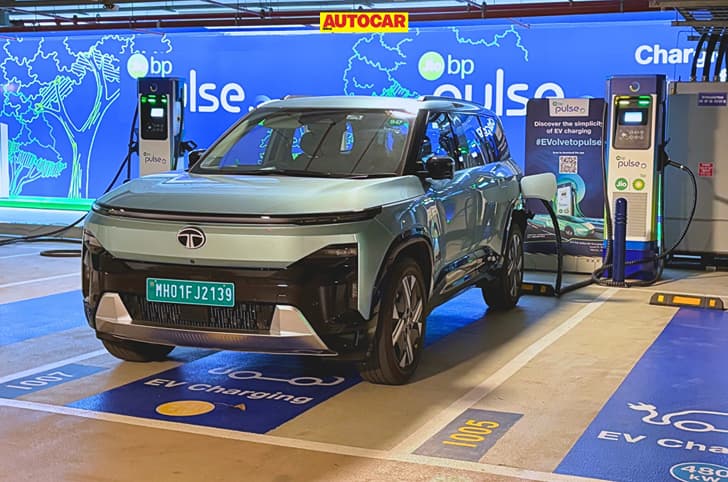

The Tata Sierra EV AWD delivers ~437–438 km real-world range against a 624 km MIDC claim, at ~5.83 km/kWh efficiency, with 20–80% DC fast charging in 35 minutes.
Tata Sierra EV Real-World Range Test in India 2026: How Much Distance Does It Actually Deliver?
The Tata Sierra EV AWD delivers approximately 437–438 km of real-world range from its 75kWh battery — about 70% of its 624 km MIDC-certified figure — based on Autocar India's structured range test conducted in October 2026. That gap between certification and reality reflects standard EV behavior across Indian conditions. What matters is how the Sierra EV's real-world number stacks up against rivals, and whether the charging infrastructure makes that range usable on a daily basis.
The Sierra EV was launched on June 30, 2026 at Rs 18.79 lakh (ex-showroom), built on Tata's Acti.ev+ architecture — the same platform that underpins the Harrier EV. It is available with 63kWh and 75kWh battery packs, in RWD and AWD configurations across eight variants.
Before diving into the test data, here is how the Sierra EV's real-world range compares with key mid-size electric SUV rivals in India:
| Model | Battery | MIDC/ARAI Range | Real-World Range (est.) | Starting Price (ex-showroom) | DC Fast Charging (20–80%) |
|---|---|---|---|---|---|
| Tata Sierra EV AWD | 75kWh LFP | 624 km | ~437–438 km | Rs 26.41 lakh (helped A 75) | 35 min (240kW charger) |
| Tata Sierra EV RWD | 75kWh LFP | 665 km | ~465–480 km (est.) | Rs 23.64 lakh (Adventure 75) | ~26 min (120kW, claimed) |
| Tata Sierra EV RWD | 63kWh LFP | 535 km | ~370–390 km (est.) | Rs 18.79 lakh (Pure 63) | ~30 min (est.) |
| Hyundai Creta Electric | 51.4kWh | 510 km | ~380–420 km (est.) | Rs 19.12 lakh | ~45 min (est.) |
| Mahindra BE 6 Sporteq | Up to 79kWh | 683 km | ~480–520 km (est.) | Rs 21.52 lakh | ~20 min (est.) |
| Maruti Suzuki e Vitara | 49kWh / 61kWh | ~500 km (est.) | ~350–420 km (est.) | Rs 17.49 lakh (est.) | ~30 min (est.) |
Note: Real-world range estimates for rivals are indicative. Only the Sierra EV AWD figure is from a structured Autocar India test. Maruti Suzuki e Vitara figures are based on available pre-launch data and are subject to revision.
What exactly did Autocar India test, and how was it conducted?
Autocar India's range testing methodology is a structured, repeatable procedure conducted on real roads — not a laboratory simulation. The test car's battery was fully charged before the run, tyre pressures were set to manufacturer specifications, and the car was driven on a fixed loop covering Mumbai city roads and an adjoining state highway on a weekday.
For the Sierra EV AWD test, the following conditions applied:
- Driving mode: Eco throughout
- Regen setting: L3 in city, L1 on highway
- Climate control: 22°C, full-auto setting
- Other electricals: Audio system, indicators, and ventilated front seats used as a regular driver would
- Ambient temperature during city run: ~40°C
The 40°C city temperature is a critical variable. At that heat, the HVAC compressor ran continuously without cycling off, placing a sustained load on the battery. This is a realistic scenario for Indian summers in cities like Mumbai, Delhi, or Chennai — and it explains a meaningful portion of the gap between the MIDC figure and the real-world result.
At the end of each cycle, range was calculated based on the percentage of charge consumed — a consistent method that allows comparison across vehicles tested by the same publication.
What real-world range did the Sierra EV AWD actually achieve?
Autocar India's test returned the following figures for the Sierra EV AWD (75kWh):
- City efficiency: 5.83 km/kWh → 438 km range
- Highway efficiency: 5.82 km/kWh → 437 km range
The near-identical city and highway efficiency figures are notable. Typically, EVs perform better in city conditions due to regenerative braking recovering energy during stop-and-go traffic. The Sierra EV's city advantage was almost entirely neutralised by the extreme HVAC load at 40°C. On the highway, the absence of regen recovery was offset by more stable, aerodynamically efficient cruising.
The MIDC-certified range for the AWD variant is 624 km, meaning the real-world result is approximately 70% of the certification figure. This retention ratio is broadly in line with what well-engineered EVs achieve in Indian conditions and reflects honest numbers buyers should plan around.
For the RWD 75kWh variant, Tata claims a higher MIDC range of 665 km. Applying the same ~70% retention ratio would suggest a real-world range of approximately 465–480 km for that variant, though Autocar India has not yet published a separate test for the RWD configuration.
How does the Sierra EV's efficiency compare to what you'd expect from a 2,130kg AWD SUV?
The Sierra EV AWD weighs 2,130 kg — a significant kerb weight for a mid-size SUV. Achieving 5.83 km/kWh in city conditions at 40°C ambient temperature, with continuous HVAC operation, is a creditable result for a vehicle of this mass.
Efficiency is measured as the distance travelled per unit of energy consumed (km/kWh). A higher number means the vehicle extracts more range from each kilowatt-hour of stored energy. The Sierra EV AWD's 5.83 km/kWh sits at a competitive level for a dual-motor, 306hp SUV in this weight class.
The powertrain configuration is worth understanding: the front motor is a 140hp induction motor, while the rear motor is a 209hp PMSM (permanent magnet synchronous motor), delivering a combined torque of 504 Nm. In Eco mode, the car likely prioritises the more efficient PMSM rear motor and calls on the front induction motor only when additional traction or power is demanded — a common strategy in dual-motor EVs that helps preserve efficiency.
The four driving modes — Eco, City, Sport, and Boost — and four regen levels (L0 through L3) give drivers meaningful control over how range and performance are balanced. The test found that L3 regen, while effective at energy recovery, felt abrupt in engagement and will require an adjustment period for drivers transitioning from lighter regen settings.
How fast does the Sierra EV charge, and what should buyers realistically expect?
Charging speed is measured as the rate at which energy is added to the battery, typically expressed in kilowatts (kW). A higher charging rate means less time spent at a charger for a given amount of energy added.
Tata claims the Sierra EV can charge from 20 to 80% in 26 minutes on a 120kW DC fast charger, and can add 263 km of range in 15 minutes. The launch event cited a figure of 250 km in 15 minutes — a minor discrepancy likely reflecting different measurement conditions.
Autocar India's charging test used a 240kW DC fast charger and found:
- 20–80%: 35 minutes (vs. Tata's 26-minute claim on a 120kW charger)
- 80–100%: An additional 39 minutes
- Peak observed charging speed: ~90.3kW
The 90.3kW peak is significantly below the 240kW charger's capacity, which tells you that the Sierra EV's battery management system (BMS) caps the maximum charge acceptance rate. This is common with LFP (lithium iron phosphate) chemistry — LFP cells prioritise cycle life, thermal stability, and safety over peak charging speed. The trade-off is that LFP batteries typically charge more slowly than NMC (nickel manganese cobalt) alternatives, particularly in the upper state-of-charge range.
The 35-minute 20–80% time on a 240kW charger being slower than Tata's 26-minute claim on a 120kW charger deserves attention. This suggests the real-world peak acceptance rate is closer to 90–100kW regardless of charger capacity, meaning buyers with access to a 120kW charger should not expect meaningfully faster charging than those using a 240kW station. The bottleneck is the car, not the charger.
For practical planning: a 20–80% charge adds approximately 290–300 km of real-world range (based on the 437–438 km full-charge result) in 35 minutes. That is a usable fast-charging stop on a long highway run.
The 80–100% segment taking 39 minutes reflects standard LFP tapering behaviour — charging slows significantly above 80% to protect cell longevity. Most EV charging guides recommend stopping at 80% for daily use and only charging to 100% before a long trip.
How does the Sierra EV's range hold up across its variant lineup?
The Sierra EV is available in eight variants, with MIDC-certified ranges as follows:
- 63kWh variants (Pure 63, Pure S 63, Adventure 63, helped 63): 535 km MIDC
- 75kWh RWD variants (Adventure 75, helped 75, helped A 75): 665 km MIDC
- 75kWh AWD variant (helped A 75 AWD): 624 km MIDC
The AWD variant's lower MIDC range (624 km vs. 665 km for the RWD 75kWh) reflects the additional weight and drivetrain friction of the dual-motor setup. In real-world terms, applying the ~70% retention ratio from the AWD test gives approximately:
- 63kWh variants: ~370–390 km real-world
- 75kWh RWD: ~465–480 km real-world
- 75kWh AWD: ~437–438 km real-world (confirmed by test)
For buyers who primarily drive in cities and do not need AWD capability, the 75kWh RWD variants offer meaningfully better real-world range at a lower price point. The Adventure 75 at Rs 23.64 lakh (on-road, Delhi) is likely the sweet spot for most buyers — it delivers the larger battery without the AWD premium.
How does the Sierra EV compare to the Maruti Suzuki e Vitara and other mid-size electric SUVs?
The mid-size electric SUV segment in India spans vehicles priced between approximately Rs 15–30 lakh with battery capacities ranging from 40–80kWh. The Sierra EV sits at the premium end of this band, competing with the Hyundai Creta Electric, Mahindra BE 6 Sporteq, and the upcoming Maruti Suzuki e Vitara.
The Maruti Suzuki e Vitara is positioned as a value-conscious entry into the electric mid-size SUV space, expected to appeal to buyers who prioritise the Maruti service network and brand familiarity over outright performance or range. With an estimated 49kWh or 61kWh battery and projected real-world range in the 350–420 km band, the e Vitara targets buyers who do not need the Sierra EV's 437+ km real-world capability or its 504 Nm dual-motor performance.
The Sierra EV, by contrast, offers more power (306hp combined), more torque (504 Nm), faster real-world charging (263 km in 15 minutes claimed), and a larger feature set including a triple-screen dashboard, 12-speaker JBL audio with Dolby Atmos, Level 2 ADAS, V2L/V2V charging, and a 622-litre boot expanding to 1,257 litres. The e Vitara's likely advantage will be a lower entry price and Maruti's unmatched service network density across India.
For buyers considering the e Vitara who want to understand what additional money buys in the Sierra EV: the real-world range advantage is real but not dramatic (perhaps 50–80 km more), while the performance, charging speed, and feature gap is more pronounced. The decision ultimately comes down to whether AWD capability, Boost Mode (0–100 kph in 5.8 seconds), and the Sierra's premium feature set justify the price premium.
If safety ratings are a priority in your decision, our guide to 5-star Bharat NCAP-rated electric SUVs under Rs 25 lakh covers the current crash-test space for this segment.
What are the real-world conditions that most affect Sierra EV range?
Several variables are primary range determinants for any EV in Indian conditions:
Ambient temperature and HVAC load. The test was conducted at ~40°C, with the HVAC compressor running continuously. In cooler conditions (25–30°C), efficiency would likely improve by 8–12%, pushing real-world range to 475–490 km in the city. Conversely, in extreme heat above 45°C, range could drop further.
Driving mode. The test was conducted entirely in Eco mode. City and Sport modes will consume more energy, reducing range. Boost mode, which enables the 5.8-second 0–100 kph sprint, will have the most significant impact on efficiency if used frequently.
Regen setting. L3 regen recovers the most energy in stop-and-go city traffic but felt abrupt according to the test. L1 was used on the highway, where regen opportunities are fewer. Buyers who master L3 regen in city conditions may see marginal improvements over the test figures.
Speed. Highway range is particularly sensitive to speed. The test was conducted at fixed average speeds on a state highway. At sustained 120 kph+ speeds on expressways, aerodynamic drag increases significantly and real-world range would be lower than the 437 km highway figure recorded in the test.
Load and terrain. The Sierra EV's 205mm ground clearance and six terrain modes (on AWD variants) enable off-road use, but rough terrain and inclines will reduce range considerably. For buyers planning weekend off-road trips, the real-world range on trails will be well below the highway figure.
Is the Sierra EV's LFP battery a long-term advantage or a compromise?
LFP (lithium iron phosphate) chemistry uses iron and phosphate in the cathode, offering superior thermal stability, longer cycle life, and reduced degradation over time compared to NMC chemistry — but at the cost of lower energy density and slower peak charging speeds.
For Indian buyers, LFP has specific advantages:
- Thermal stability: LFP cells are significantly more resistant to thermal runaway, which matters in India's high-temperature climate.
- Cycle life: LFP batteries typically retain capacity better over 1,000+ charge cycles, meaning less range degradation over years of ownership.
- 100% SOC charging: LFP batteries can be regularly charged to 100% without the degradation penalty that affects NMC cells, making full charges before long trips a practical option.
- Lifetime warranty: Tata offers a lifetime high-voltage battery warranty for eligible private owners — a significant ownership assurance.
The trade-off — slower peak charging (observed at ~90.3kW vs. the 240kW charger's capacity) — is real but manageable given that the 20–80% charge adds ~290 km of real-world range in 35 minutes.
What does the Sierra EV's charging infrastructure look like in practice?
The Sierra EV supports DC fast charging, AC charging, V2L (Vehicle-to-Load), and V2V (Vehicle-to-Vehicle) charging. V2L allows the vehicle's battery to power external electrical devices — useful for camping, worksites, or emergency power supply. V2V allows the Sierra EV to charge another compatible EV directly.
For daily home charging, the Sierra EV's AC charging capability means overnight charging from a home wallbox is the most practical routine. The home charger and installation cost extra and are not included in the vehicle price — a point confirmed at launch.
Tata's Tata.ev charging network and third-party networks (Ather Grid, Statiq, BPCL Pulse) are expanding rapidly, but the 90.3kW real-world peak charging speed means buyers do not need to specifically seek out 150kW+ chargers — a 60–120kW charger will deliver comparable real-world charging times.
For buyers planning long-distance travel, our guide to the best electric cars for long trips in India in 2026 covers charging corridor availability and route planning in detail.
Should you buy the 63kWh or 75kWh Sierra EV — and does AWD make sense?
The answer depends on your primary use case:
63kWh RWD (Rs 18.79–24.28 lakh ex-showroom): Real-world range of approximately 370–390 km suits buyers with daily commutes under 100 km and access to home charging. The lower price makes the Sierra EV accessible at a competitive entry point, and the 535 km MIDC figure provides a comfortable buffer for most city-to-city trips within a state.
75kWh RWD (Rs 23.64–26.41 lakh ex-showroom): This is the sweet spot. Approximately 465–480 km real-world range, 665 km MIDC, and the same fast-charging capability as the AWD — without the weight penalty. For buyers who do not need AWD traction, this configuration offers the best range-per-rupee in the Sierra EV lineup.
75kWh AWD (Rs 27.69 lakh on-road, Delhi): Confirmed 437–438 km real-world range, 504 Nm combined torque, 5.8-second 0–100 kph, six terrain modes, and off-road capability. The Rs 1.2 lakh AWD premium over the helped A 75 RWD is justified for buyers who want performance, all-weather traction, or occasional off-road use. The range trade-off vs. the RWD 75kWh is approximately 30–40 km in real-world conditions.
For context on the most affordable ways to own an electric SUV in India, including financing and BaaS options, see our guide to affordable electric SUV ownership in 2026.
What is the monthly running cost of the Sierra EV?
Using Autocar India's charging cost calculator data: for the helped A 75 AWD with a 624 km MIDC range, a daily drive of 60 km, and an electricity tariff of Rs 6/kWh, the estimated monthly electricity cost is Rs 1,298. This is a significant cost advantage over a comparable petrol SUV, which would consume approximately Rs 5,000–7,000 per month in fuel at similar mileage.
The Sierra EV's LFP chemistry and lifetime battery warranty further reduce long-term ownership anxiety — two factors that have historically been among the top concerns for Indian EV buyers.
The bottom line: Is 437 km of real-world range enough?
For the vast majority of Indian buyers, yes. A real-world range of 437–438 km covers most inter-city trips within a state on a single charge, and daily commutes of up to 150 km with comfortable buffer. The 35-minute 20–80% fast charge adds approximately 290 km of range — enough to make the Sierra EV practical on highway runs with a single charging stop.
The gap between the 624 km MIDC figure and the 437 km real-world result is not a surprise; it reflects the expected outcome of testing in 40°C heat with continuous HVAC operation. Buyers should plan around the real-world number, not the certification figure.
Where the Sierra EV earns its premium positioning is in the combination of real-world range, charging speed, performance (504 Nm, 5.8-second 0–100 kph), LFP durability, and a feature set that includes triple screens, Level 2 ADAS, V2L/V2V, and a lifetime battery warranty. Against the Maruti Suzuki e Vitara's expected value, the Sierra EV asks buyers to pay more for meaningfully more — and the real-world test data suggests it largely delivers on that promise.
For buyers evaluating the broader electric SUV market, our roundup of the best electric cars to buy in India in 2026 provides a full starting point.
Sources
- Tata Sierra EV real world range tested, explained | Autocar India
- Tata Sierra EV Range (2026) - ARAI & Autocar Tested Range | Autocar India
- Tata Sierra EV (2026) - Price, Range & Expert Reviews | Autocar India
- Tata Sierra EV launch live highlights: Launched at Rs 18.79 lakh, offers 665km claimed range - India Today