
Tata Motors debuts the production-spec Sierra EV on June 30, 2026, reviving an iconic nameplate as a premium family-focused electric SUV to rival the Maruti Suzuki e Vitara and others.
Tata Sierra EV Debut on June 30, 2026: What India's Newest Premium EV SUV Means for Buyers
Tata Motors will debut the production-specification Sierra EV on June 30, 2026, making it one of the most anticipated electric vehicle reveals in India this year. The Sierra nameplate — last seen on Indian roads in the 1990s — is being reborn as a premium electric SUV, reshaping the competitive space for buyers evaluating options above the ₹20 lakh mark.
Before diving into what the Sierra EV means for the market, here is a snapshot of how it is expected to stack up against key rivals in the premium EV SUV segment at the time of writing. Note that Sierra EV pricing and full specifications are not yet confirmed; figures marked with an asterisk are based on pre-launch teasers and industry estimates.
| Model | Expected/Confirmed Price (ex-showroom) | Segment Position | Key Differentiator |
|---|---|---|---|
| Tata Sierra EV* | ₹25–35 lakh (est.) | Premium EV SUV | Iconic revival, larger family-SUV proportions, EV-native platform |
| Maruti Suzuki e Vitara | ~₹17–23 lakh (est.) | Compact premium EV SUV | Suzuki-Toyota alliance tech, wide service network |
| Tata Nexon EV | ~₹14–20 lakh | Mass-market EV SUV | Proven reliability, strong resale, Tata service network |
| Tata Harrier EV | ~₹22–26 lakh | Premium EV SUV | 3-row option, Omega Arc platform, ADAS suite |
| MG ZS EV | ~₹18–23 lakh | Premium EV SUV | Large battery, feature-rich cabin |
Sierra EV pricing and specifications are pre-launch estimates and subject to change at the June 30 reveal.
What exactly is the Tata Sierra EV, and why does the nameplate matter?
The Tata Sierra EV is a production-specification electric SUV that revives the Sierra nameplate — originally a lifestyle off-roader sold by Tata Motors between 1991 and 2000 — reimagined for the electric age. The original Sierra was India's first indigenous SUV with a monocoque body, and its distinctive three-door, wrap-around rear glass silhouette made it a cult vehicle. That iconography is central to the new model's identity.
Tata Motors first showcased the Sierra in concept form at Auto Expo 2020, then returned with a more production-ready concept at Auto Expo 2023. In late 2025, the company teased the production-spec version alongside the ICE (internal combustion engine) Sierra, confirming that both powertrains would be offered — a strategy that mirrors what Tata has done successfully with the Nexon and Harrier.
The EV variant is expected to be built on Tata's Generation 2 electric architecture, which underpins the Nexon EV and Harrier EV. This platform is a purpose-engineered EV structure that integrates the battery pack into the floor for a lower centre of gravity and maximised cabin space — a key advantage for a family-focused SUV.
The ICE Sierra, already on sale from ₹11.49 lakh (introductory ex-showroom), gives buyers a preview of the design language and feature set. The ICE model's highlights — including a TheaterPRO dual-screen infotainment system, Arcade Suite gaming, JBL-Harman audio with Dolby, a 6-way powered driver seat with memory function, India's first homegrown AR HUD (HypAR), and L2+ ADAS with 22 features — strongly suggest the EV will carry over and expand this technology stack.
When will the Sierra EV launch, and what happens after June 30?
The June 30, 2026 event is a debut, not a sales launch. In Tata Motors' product cadence, a "debut" typically means the production-spec vehicle is revealed with confirmed specifications, variant line-up, and often pricing. Deliveries generally follow within four to twelve weeks of the debut event, depending on production readiness and booking volumes.
The Sierra EV has been in development since at least the 2020 Auto Expo concept, giving Tata Motors over six years of refinement time. The late-2025 production tease alongside the ICE Sierra suggests both variants are on a coordinated launch timeline, with the ICE already in showrooms and the EV following closely.
For buyers, this timeline matters for several practical reasons:
- Booking windows typically open at or shortly after the debut event. Early bookings often come with priority delivery slots and sometimes introductory pricing.
- Test drives are usually available within two to four weeks of the debut at Tata's EV-enabled dealerships.
- Government subsidies under FAME III (if extended or replaced by a successor scheme) may apply, though the Sierra EV's likely price point above ₹25 lakh could place it outside the subsidy band depending on final policy parameters.
The safest approach for interested buyers is to register interest on the Tata Motors website after June 30 and wait for the confirmed specification sheet before committing a booking amount.
What features can buyers expect on the Sierra EV?
While Tata Motors has not released the full Sierra EV specification sheet ahead of the June 30 debut, the ICE Sierra's feature list and the company's EV product strategy provide strong directional signals.
The ICE Sierra is equipped with:
- TheaterPRO: Dual screens, Arcade Suite gaming, and immersive JBL-Harman audio with Dolby — positioning the Sierra firmly in the premium family-entertainment SUV category.
- HypAR HUD: India's first homegrown AR HUD with 19 smart visuals, offering navigation overlays and safety alerts on the windscreen.
- L2+ ADAS: 22 intelligent features including adaptive cruise control, lane-keep assist, and automatic emergency braking.
- 6-Way Powered Driver Seat with Memory and Welcome Function: The seat adjusts automatically when the driver approaches, a feature typically found in luxury sedans.
- Thigh Support Extender: Extended under-thigh support for long-journey comfort — a thoughtful addition for a family SUV.
- Super Glide Suspension: Tata's tuning for ride comfort over broken surfaces.
- Clamshell Tailgate with Gesture Control: Opens wide with a foot gesture, useful when hands are full.
- Magnum R19 Alloy Wheels: Large-diameter wheels that reinforce the SUV's premium stance.
- Wrap-Around Rear Glass: The iconic B-pillar and wrap-around glass design from the original Sierra, retained as a design signature.
The EV variant will almost certainly carry all of these features and add EV-specific elements: a digital instrument cluster with battery and range readouts, regenerative braking modes (likely including one-pedal driving), and Tata's connected-car suite (iRA) with remote pre-conditioning, charge scheduling, and over-the-air updates.
Battery size and range remain unconfirmed. Given the Sierra's larger footprint compared to the Nexon EV, a pack in the 60–70 kWh range with a claimed range of 450–500 km (MIDC) would align with Tata's positioning strategy. The Harrier EV, a comparable-sized model, offers a 65 kWh battery with approximately 500 km of claimed range — a useful reference point. These figures remain estimates until the June 30 reveal.
For a broader look at feature-rich electric SUVs, our guide to best electric cars with ADAS in India in 2026 covers the current state of driver-assistance technology across the segment.
How does the Sierra EV fit into Tata's broader EV portfolio?
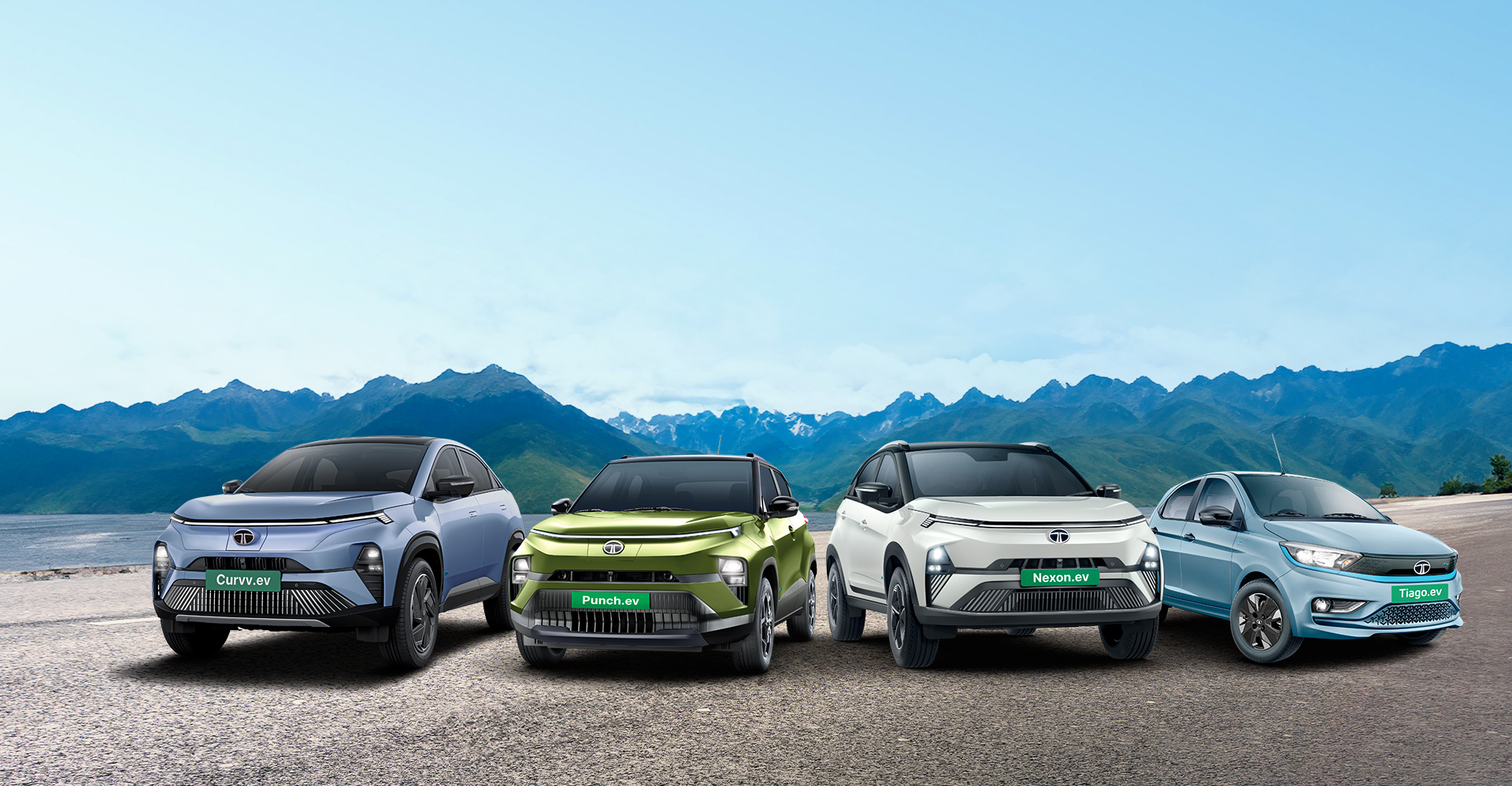
Tata Motors is India's largest electric vehicle manufacturer by volume, with a portfolio spanning the Tiago EV (entry-level), Punch EV (compact SUV), Nexon EV (mid-size SUV), Curvv EV (coupe SUV), and Harrier EV (premium SUV). The Sierra EV slots in as the brand's lifestyle-premium offering — distinct from the Harrier EV's more conventional three-row SUV positioning.
The Sierra EV's role in the portfolio is to attract buyers who want:
- A recognisable, emotionally resonant nameplate with heritage value.
- A larger, more spacious cabin than the Nexon EV or Curvv EV.
- Premium technology (AR HUD, TheaterPRO, L2+ ADAS) without paying the premium of a luxury import.
- An EV that doubles as a family road-trip vehicle — a use case that demands both range and comfort.
This positioning overlaps meaningfully with the Tata Harrier EV, but the Sierra differentiates through its design identity and the lifestyle-SUV narrative. Where the Harrier EV is a mainstream family hauler, the Sierra EV is pitched as something you choose because of what it says about you — a distinction that matters in the premium segment.
For buyers comparing the two within the Tata family, the decision will likely come down to whether you prioritise the Harrier's three-row practicality or the Sierra's iconic design and more driver-focused character.
How does the Sierra EV compare to the Maruti Suzuki e Vitara?
The Maruti Suzuki e Vitara is the most direct segment rival that buyers will benchmark the Sierra EV against. Maruti Suzuki's first mass-market electric SUV for India, co-developed with Toyota on the Suzuki-Toyota global EV platform, the e Vitara is positioned in the compact-to-mid premium segment.
Here is where the two models diverge in buyer relevance:
Size and space: The Sierra EV is expected to be a larger vehicle than the e Vitara, with a longer wheelbase and more rear-seat space. For families with three or more occupants making regular long trips, this matters. The e Vitara is a compact SUV; the Sierra EV is shaping up as a mid-size-to-large SUV.
Brand narrative: Maruti Suzuki's pitch with the e Vitara is trust, reliability, and the widest service network in India — over 4,000 touchpoints. Tata's Sierra pitch is heritage, technology, and the emotional pull of an iconic nameplate reborn. Both are legitimate value propositions; they appeal to different buyer personalities.
Technology stack: Based on the ICE Sierra's feature list, the Sierra EV is likely to offer a more aggressive technology package — AR HUD, dual-screen TheaterPRO, L2+ ADAS — than the e Vitara's expected feature set. However, the e Vitara benefits from Toyota's hybrid and EV engineering heritage, which may translate to better battery management and long-term reliability data.
Price: The e Vitara is expected to be priced more accessibly than the Sierra EV. If the Sierra EV lands above ₹25 lakh, it occupies a different price band from the e Vitara's likely ₹17–23 lakh range. Buyers with a budget ceiling around ₹20 lakh will find the e Vitara a more natural fit; those willing to stretch for a larger, more feature-laden vehicle will look at the Sierra EV.
After-sales: Maruti's service network advantage is real and significant, particularly for buyers in Tier 2 and Tier 3 cities. Tata Motors has been aggressively expanding its EV-enabled service infrastructure, but Maruti's reach remains unmatched. If after-sales accessibility is a priority, our guide on which electric SUV has the best after-sales service network in India is worth reading before you decide.
The honest summary: the e Vitara and Sierra EV are not direct substitutes — they serve overlapping but distinct buyer profiles. The e Vitara is for the buyer who wants a trusted, compact, value-oriented electric SUV from India's most popular car brand. The Sierra EV is for the buyer who wants a statement vehicle with more space, more technology, and a story to tell.
What is the Sierra EV's heritage, and why does it matter for buyers today?
The original Tata Sierra, produced from 1991 to 2000, holds a unique place in Indian automotive history. It was India's first indigenous SUV with a monocoque (unibody) construction — a structural approach that was ahead of its time in the domestic market. Its three-door body, panoramic wrap-around rear glass, and boxy-yet-purposeful silhouette made it instantly recognisable on Indian roads.
The Sierra was discontinued as the market shifted toward more conventional multi-door SUVs, but it retained a devoted following. When Tata Motors revealed the Sierra concept at Auto Expo 2020, the response was overwhelmingly positive — proof that heritage nameplate revivals carry genuine commercial value when executed with authenticity.
The production Sierra ICE, now on sale from ₹11.49 lakh, retains the wrap-around rear glass and the bold proportions of the original while modernising everything else. The EV variant is expected to take this further, with a cleaner front fascia (no grille required), flush door handles, and aerodynamic detailing that EV-native design allows.
For buyers, the heritage angle is not just nostalgia. It signals Tata's confidence in the Sierra as a long-term nameplate — one that will receive sustained investment in updates, variants, and technology refreshes. A brand does not revive a cult nameplate only to abandon it after one generation.
Is the Sierra EV suitable for long road trips in India?
This is the question that matters most for family buyers, and the honest answer is: it depends on the final battery specification, which will only be confirmed on June 30.
The directional signals are positive. The Sierra EV's likely 60–70 kWh battery (based on the Harrier EV benchmark) would support a real-world range of 350–420 km under mixed driving conditions — sufficient for most intercity routes in India without a mid-journey charge stop. The ICE Sierra's Super Glide Suspension and comfort-focused cabin (thigh support extenders, powered seats, TheaterPRO entertainment) are clearly designed with long journeys in mind.
The infrastructure picture has also improved significantly. Tata Motors' Tata.ev charging network, combined with third-party networks like Statiq, Ather Grid, and ChargeZone, now covers most national highways and major city pairs. Our guide to best electric cars for long trips in India in 2026 provides a useful framework for evaluating how current EVs perform on extended journeys.
One area of uncertainty is DC fast-charging speed. The Harrier EV supports up to 150 kW DC charging, enabling a 10–80% charge in approximately 30 minutes. If the Sierra EV matches this, a highway charging stop becomes a 30-minute break — manageable for a family road trip. Slower charging speeds would change the calculus.
Buyers who prioritise long-trip capability should wait for the June 30 specification reveal, specifically looking for: confirmed battery capacity, ARAI/MIDC certified range, DC fast-charging speed, and AC charging rate.
How does the Sierra EV's safety story shape up?
Safety is non-negotiable for family buyers, and Tata Motors has built a strong reputation here. The Nexon EV was the first Indian car to receive a 5-star Global NCAP rating, and the Punch EV and Harrier EV have continued that trend. The Sierra, built on the same Generation 2 platform, is expected to carry forward this safety architecture.
The ICE Sierra already features Electronic Stability Program (ESP) with 21 smart functions and L2+ ADAS with 22 features — a suite that includes automatic emergency braking, lane departure warning, blind-spot monitoring, and rear cross-traffic alert. The EV variant will almost certainly match or exceed this.
For buyers who weight safety heavily, our guide to 5-star Bharat NCAP electric cars in India worth buying in 2026 provides context on how current EVs perform under India's domestic crash-test protocol.
The Sierra EV has not yet been tested under Bharat NCAP or Global NCAP — it has not launched yet. Expect test results within 12–18 months of the commercial launch, which is the typical timeline for new models.
What should buyers do right now, before June 30?
The Sierra EV debut is 18 days away at the time of writing. Here is a practical checklist for buyers actively considering the vehicle:
Research the ICE Sierra first. The Tata Sierra ICE is already in showrooms and shares the design, cabin, and most features with the EV. A test drive will tell you whether the Sierra's proportions, seating position, and cabin quality meet your expectations — before you commit to the EV.
Set a budget range, not a fixed number. The Sierra EV is expected to land between ₹25–35 lakh, but until June 30, this is an estimate. Build a budget range that accommodates a ₹5 lakh variance and identify which variants (base, mid, top) fall within your comfort zone.
Compare against confirmed rivals. The Maruti Suzuki e Vitara, Tata Harrier EV, and MG ZS EV are all available now with confirmed pricing and specifications. Test driving these before the Sierra EV launch gives you a calibrated benchmark. Our best electric SUVs in India in 2026 guide covers the full competitive set.
Check your home charging setup. The Sierra EV, with a larger battery, will benefit from a 7.2 kW or 11 kW AC home charger. If your housing society or apartment does not yet have EV charging infrastructure, factor in the installation timeline and cost.
Watch the June 30 reveal for these specifics: battery capacity, ARAI-certified range, DC fast-charging speed, variant-wise pricing, and the booking/delivery timeline. These five data points will tell you everything you need to make a decision.
What does the Sierra EV's arrival mean for the premium EV SUV segment overall?
The Sierra EV's debut on June 30 is significant beyond Tata Motors' own portfolio. It signals that India's premium EV SUV segment — loosely defined as electric SUVs priced between ₹20–40 lakh — is becoming genuinely competitive.
Until recently, buyers in this segment had limited choices: the Tata Harrier EV, the MG ZS EV, and a handful of imported options priced significantly higher. The Maruti Suzuki e Vitara's arrival expanded the options at the lower end of this band. The Sierra EV, if priced and specified as expected, fills the upper-mid tier with a vehicle that has both emotional appeal and substantive technology.
For buyers, more competition in this segment means better value, faster feature adoption, and stronger after-sales support as brands compete for loyalty. The Sierra EV's L2+ ADAS, AR HUD, and TheaterPRO system will pressure rivals to accelerate their own technology roadmaps — a dynamic that benefits every buyer in the segment, regardless of which vehicle they ultimately choose.
India's EV penetration in the passenger vehicle segment crossed 2.5% in 2025 and is on a trajectory toward 5–7% by 2028, according to industry estimates. Premium EVs like the Sierra EV play a disproportionate role in this growth by normalising electric mobility for aspirational buyers who then influence their social networks. A successful Sierra EV launch is good for the Indian EV space as a whole.
If you are still in the early stages of evaluating whether an EV is right for you, our full guide to best electric cars to buy in India in 2026 covers the full market from entry-level to premium.
The bottom line: should you wait for the Sierra EV?
If you are in the market for a premium electric SUV and your budget is ₹25 lakh or above, waiting until June 30 costs you nothing except time. The Sierra EV's debut will deliver confirmed specifications and pricing, giving you a complete picture of the market before you commit.
If your budget is closer to ₹15–20 lakh, the Sierra EV is likely to be out of range, and the Maruti Suzuki e Vitara, Tata Nexon EV, or MG ZS EV are more relevant options to evaluate now.
If you need a vehicle urgently and cannot wait, the Tata Harrier EV is the closest available alternative in terms of size, technology, and brand philosophy — and it is a strong product in its own right.
The Sierra EV is not just another new model launch. It is the return of a nameplate that shaped India's SUV culture, reimagined for an electric future. Whether the production vehicle lives up to that promise will be answered on June 30, 2026.
Sources
- Tata Sierra EV to debut on June 30
- Tata Sierra – Official Page (ICE)
- Best Electric SUVs in India in 2026 – EV Index India
- Best Electric Cars with ADAS in India in 2026 – EV Index India
- Best Electric Cars for Long Trips in India in 2026 – EV Index India
- Which Electric SUV Has the Best After-Sales Service Network in India? – EV Index India
- Which 5-Star Bharat NCAP Electric Cars in India Are Worth Buying in 2026? – EV Index India
- Best Electric Cars to Buy in India in 2026 – EV Index India