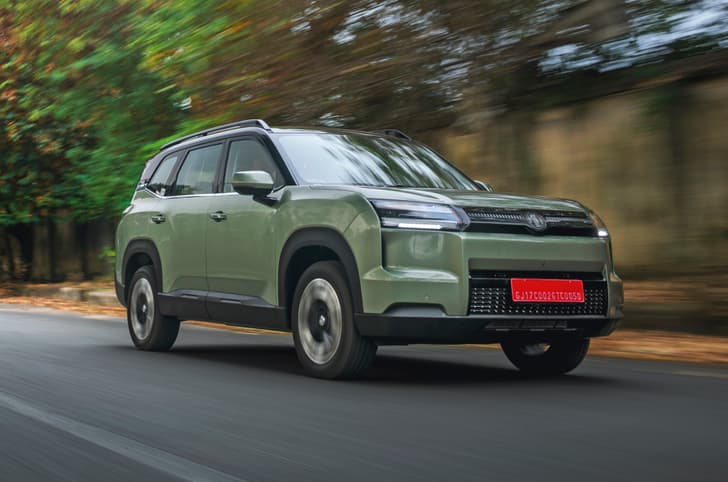

The MG Hector Tomahawk EV (₹19.49–22.99 lakh) beats the Mahindra XEV 9S on price and cabin space, but loses on range, charging speed, and powertrain performance.
MG Hector Tomahawk EV vs Mahindra XEV 9S in India 2026: 3 Reasons to Buy and 3 Reasons Not To
The MG Hector Tomahawk EV is priced from ₹19.49 lakh to ₹22.99 lakh (ex-showroom) and is the first MG model built on the brand's new ADAPT platform — making it the most technologically advanced MG sold in India to date. Its direct rival in the three-row electric SUV space is the Mahindra XEV 9S, which starts at ₹20.65 lakh and stretches to ₹29.95 lakh across its wider battery and trim lineup. The question for most buyers is simple: does the Hector Tomahawk EV's lower entry price and larger cabin justify its compromises in range and charging speed?
Before diving into the reasons to buy and avoid each car, here is a head-to-head snapshot of the key numbers that matter at the decision stage.
| Spec | MG Hector Tomahawk EV | Mahindra XEV 9S | Maruti Suzuki e Vitara |
|---|---|---|---|
| Price range (ex-showroom) | ₹19.49–22.99 lakh | ₹20.65–29.95 lakh | ~₹17–22 lakh (est.) |
| Seating | 7 (or 5 in top trim) | 7 | 5 |
| Battery capacity | 69.2 kWh | 59 / 70 / 79 kWh | ~49 kWh (est.) |
| MIDC range | 517 km | 521 / 600 / 679 km | ~500 km (est.) |
| Power | 204 hp | 231 / 245 / 286 hp | ~145 hp (est.) |
| Drive layout | FWD | RWD | FWD / AWD |
| DC fast-charge time | 35 min (90 kW) | 20 min (140–180 kW) | TBC |
| Boot (all rows up) | 192 litres | Not disclosed | ~270 litres (est.) |
| Platform | ADAPT (new) | INGLO | Suzuki/Toyota BEV |
| BaaS scheme available | Yes (from ₹13.99 lakh) | No | No |
Sources: Autocar India 7-seater comparison; Autocar India 5-seater comparison. Maruti e Vitara figures are estimates based on pre-launch data and may change at launch.
The Maruti Suzuki e Vitara deserves early mention: it is a compact five-seat electric SUV positioned below this segment on both price and footprint. For buyers who find the Hector Tomahawk's 4,745 mm length and seven-seat architecture more than they need, the e Vitara offers a simpler, more city-friendly alternative — without the ADAPT platform's tech complexity or the XEV 9S's premium pricing ceiling.
Why should you buy the MG Hector Tomahawk EV?
Reason 1: It is the most spacious three-row EV under ₹23 lakh
Spaciousness combines interior volume, row-to-row legroom, and practical boot space — and on all three counts, the Hector Tomahawk EV punches above its price point.
At 4,745 mm long and 1,770 mm tall, the Hector Tomahawk EV is the longest and tallest vehicle in the three-row electric segment, edging out the XEV 9S (4,737 mm) and the Kia Carens Clavis EV (4,550 mm) on both dimensions, according to Autocar India's 7-seater comparison. Its 2,810 mm wheelbase is the second-longest in the segment, trailing only the Vinfast VF MPV 7 by 30 mm but beating the XEV 9S's 2,762 mm.
That wheelbase translates into tangible benefits for second-row passengers. Autocar India's first drive notes that occupants get more than enough legroom, reclining seats, a centre armrest with cupholders, sunblinds, AC vents, USB ports, and adjustable headrests. The second row also slides and tumbles with a one-touch function, making third-row access straightforward — something that is often an afterthought in this segment.
With all three rows in use, the boot holds 192 litres — the largest declared figure among seven-seaters in this comparison, though Mahindra has not disclosed the XEV 9S's equivalent figure. Fold the third row flat and that expands to 528 litres, which is genuinely usable family-trip territory.
The front seats are ventilated and the driver's seat gets a memory function. Two-tone beige-and-black soft-touch materials and good fit-and-finish give the cabin a premium feel that is unusual at this price point. For large families who need three genuine rows of seats without crossing the ₹23 lakh mark, no rival currently matches what the Hector Tomahawk EV offers.
Reason 2: Feature density and ADAPT platform technology
The Hector Tomahawk EV launches MG's ADAPT (Adaptive Dynamic Automotive Platform Technology) architecture in India — and the feature list reflects that positioning. A 15.6-inch infotainment touchscreen sits at the centre, offering crisp graphics, snappy performance, swipe-based gesture controls, wireless Apple CarPlay and Android Auto, AI-powered karaoke, and multi-lingual voice commands. Six mood-based ambient settings and a 256-colour ambient lighting system round out the atmosphere.
A 10-speaker Infinity system handles audio, which Autocar India describes as sounding great. The 360-degree camera system is crisp-looking. Level-2 ADAS covers the standard bases, and the regenerative braking system uses sensor data to automatically adjust regen levels in real time based on traffic conditions — a feature that makes urban driving noticeably less fatiguing. A 'Custom' drive mode lets drivers tweak power output and regen braking in 10-percent increments, a level of granularity that most rivals do not offer at this price.
For buyers seeking the best electric cars with ADAS in India in 2026, the Hector Tomahawk EV's Level-2 suite is competitive, though the XEV 9S also carries a full ADAS package.
The BaaS (Battery-as-a-Service) scheme is another differentiator. MG offers the Hector Tomahawk EV with a segment-first BaaS option that knocks approximately ₹6 lakh off the sticker price, reducing the entry point to ₹13.99 lakh for the 7-seater, in exchange for a monthly battery rental fee of ₹4.9/km. For buyers who drive moderate distances and want to minimise upfront capital outlay, this is a meaningful option. Our detailed guide on BaaS schemes in India explains the maths behind when this makes sense.
Reason 3: Competitive pricing against a well-specified rival
The Hector Tomahawk EV delivers equivalent or superior specifications at a lower transaction cost than the XEV 9S at the entry level.
The XEV 9S starts at ₹20.65 lakh for its base 59 kWh variant, which produces 231 hp and claims 521 km of MIDC range. The Hector Tomahawk EV starts at ₹19.49 lakh with a 69.2 kWh battery, 204 hp, and 517 km of MIDC range — a larger battery and comparable range at a lower price, per Autocar India's 7-seater pricing data. The Hector also undercuts the XEV 9S's top-spec 79 kWh variant (₹29.95 lakh) by a significant margin.
In the 5-seater configuration, the Hector Tomahawk EV's top-spec Essence variant is priced at ₹23 lakh — substantially below the equivalent top-spec XEV 9e (₹29.35 lakh) and the Tata Harrier EV (₹29.19 lakh), as noted in Autocar India's 5-seater comparison.
For buyers comparing this segment against the best electric cars under ₹20 lakhs in India in 2026, the Hector Tomahawk EV's base variant sits right at that threshold and offers seven seats — a combination that no other car in India currently replicates.
Why should you NOT buy the MG Hector Tomahawk EV?
Reason 1: The XEV 9S has significantly better range and far faster charging
Range anxiety remains a real concern for Indian EV buyers, and this is where the Hector Tomahawk EV's numbers become uncomfortable. Its MIDC-claimed range of 517 km from a 69.2 kWh battery is the lowest figure in the 7-seater segment relative to battery size. The base 59 kWh XEV 9S claims 521 km — more range from a smaller battery. The 70 kWh XEV 9S claims 600 km, and the 79 kWh version claims 679 km. Even the Kia Carens Clavis EV's 51.4 kWh variant claims 490 km, according to Autocar India's 7-seater range comparison.
Charging speed presents a more serious problem. The Hector Tomahawk EV supports DC fast charging at up to 90 kW, with a claimed charge time of 35 minutes. The XEV 9S supports 140 kW to 180 kW DC charging depending on variant, with a 20-minute claimed charge time across all battery options. That 15-minute difference at a fast charger becomes meaningful on long road trips. The Hector Tomahawk EV also does not support 11 kW AC charging, meaning home and destination charging is slower than the XEV 9S at 7.2 kW AC (12.5 hours vs the XEV 9S's 8.7–11.7 hours depending on battery).
For buyers who regularly do long-distance drives, our guide to the best electric cars for long trips in India in 2026 makes clear that charging speed is as important as claimed range — and the Hector Tomahawk EV lags on both metrics relative to the XEV 9S.
Reason 2: Non-linear power delivery and FWD limitations
The Hector Tomahawk EV's powertrain calibration is a genuine weak point. Autocar India's first drive explicitly flags that the 'Standard' drive mode dulls throttle response, while firmer throttle inputs in any mode produce torque steer — a sudden surge of power through the front wheels that pulls the car sideways. In 'Sport' mode, the front tyres are easily overwhelmed. Power delivery lacks the linearity that makes driving predictable.
This matters for two reasons. New or inexperienced EV drivers may find the car unpredictable in spirited driving. The front-wheel-drive layout is a structural limitation: the XEV 9S uses rear-wheel drive, which inherently handles torque delivery better and provides a more balanced driving dynamic. The XEV 9S's RWD setup also means it is the only three-row electric SUV in India with a rear-biased layout — a genuine differentiator for driving enthusiasts.
The Hector Tomahawk EV's suspension adds another layer to this picture. While the cabin is well-insulated from powertrain, tyre, and wind noise, the suspension itself becomes audible over broken road surfaces — an unusual inversion that undermines the premium feel of the interior. The brakes are good, and the steering is light and manageable in the city, but the overall dynamic package is less polished than the XEV 9S at equivalent price points.
Reason 3: The touchscreen-first interface creates real-world distraction
The 15.6-inch infotainment screen is simultaneously the Hector Tomahawk EV's biggest selling point and its most significant ergonomic problem. Almost every major function — climate control, audio, drive modes, ADAS settings — is buried within the touchscreen's menu structure. Autocar India notes that the labyrinth of menus and sub-menus requires taking eyes off the road repeatedly, and the screen's large surface area catches reflections that cause further distraction while driving.
The 8.8-inch digital driver's display compounds the problem: while it is sharp, the fonts used for readouts are small, making information difficult to read at a glance. This is a calibration and UI design failure rather than a hardware one, and it may be addressable via a software update — but as of the September 2026 launch, it is a real-world issue.
For buyers who prioritise safety and intuitive controls, this is a meaningful concern. The XEV 9S also uses a large touchscreen as its primary interface, but Mahindra's INGLO platform has had more time to mature its software layer. Buyers seeking the best electric cars with ADAS in India in 2026 should factor in that ADAS effectiveness depends partly on how easily the driver can interact with the system without distraction.
How does the Mahindra XEV 9S compare directly?
The Mahindra XEV 9S is a three-row electric SUV built on Mahindra's INGLO platform, offering three battery options (59, 70, and 79 kWh) and a rear-wheel-drive layout across all variants. This makes it the only RWD three-row electric SUV in India — a distinction that matters for driving dynamics and high-speed stability.
HT Auto's spec comparison confirms that the XEV 9S delivers greater range and power at comparable price points, with the 79 kWh variant's 286 hp and 679 km MIDC range representing the segment's performance ceiling. The XEV 9S also gets a 150-litre frunk — useful for charging cables and valuables — while the Hector Tomahawk EV has no frunk at all.
Where the XEV 9S falls short is at the top of its price range: the 79 kWh variant at ₹29.95 lakh is nearly ₹7 lakh more expensive than the Hector Tomahawk EV's top-spec variant. Mahindra also does not offer a BaaS scheme, meaning the full sticker price must be financed conventionally. For buyers on a tighter budget who still want three rows and a large battery, the Hector Tomahawk EV's value is hard to dismiss.
Where does the Maruti Suzuki e Vitara fit in this picture?
The Maruti Suzuki e Vitara is worth considering as a compact alternative for buyers drawn to the Hector Tomahawk EV's lower price but who do not actually need seven seats or a 4,745 mm footprint. The e Vitara is a compact five-seat electric SUV built on a Suzuki-Toyota BEV platform, expected to be priced from approximately ₹17 lakh — undercutting even the Hector Tomahawk EV's base price.
For urban buyers who want a simpler feature set, easier parking, and a lower entry cost, the e Vitara offers a credible alternative without the ADAPT platform's tech complexity or the XEV 9S's premium pricing. It will not seat seven, will not match the Hector's boot space, and is unlikely to offer the same ADAS depth — but for a family of four or five that does not need the third row, it represents a more right-sized choice.
The e Vitara also brings Maruti Suzuki's unmatched service network, which is a practical consideration for buyers in Tier-2 and Tier-3 cities where MG's and Mahindra's EV service infrastructure is thinner. Our guide on the best electric SUV after-sales service networks in India covers this in detail.
Who should buy the MG Hector Tomahawk EV?
The Hector Tomahawk EV makes the most sense for families of six or seven who need genuine three-row space under ₹23 lakh and are willing to accept slower charging in exchange for a lower purchase price. Buyers who primarily drive in cities and on intercity highways within 400–450 km will find the 517 km MIDC range sufficient with a buffer.
Buyers interested in the BaaS scheme can reduce upfront cost significantly — the ₹13.99 lakh entry price with BaaS is the lowest for any seven-seat EV in India by a wide margin. Our BaaS guide explains the per-kilometre economics in detail.
Tech enthusiasts who want the latest ADAPT platform features — gesture controls, AI karaoke, real-time regen adjustment — in a large SUV format will appreciate what the Hector Tomahawk EV delivers.
Who should buy the Mahindra XEV 9S instead?
The XEV 9S is the better choice for buyers who regularly drive 500+ km in a single day and need the fastest possible charging turnaround. The 20-minute DC charge time (vs 35 minutes for the Hector) is a genuine advantage on long trips.
Driving enthusiasts who value the rear-wheel-drive layout and the more linear power delivery that comes with it will prefer the XEV 9S. Buyers who want the highest possible range — the 79 kWh variant's 679 km MIDC claim is the segment's best and provides meaningful real-world comfort on highway runs — should lean toward Mahindra.
Buyers comfortable spending ₹20–25 lakh who want a more mature software and ADAS experience from the INGLO platform will find the XEV 9S a solid investment.
Final verdict: which one should you buy?
The MG Hector Tomahawk EV and Mahindra XEV 9S are the two most directly competitive three-row electric SUVs in India under ₹30 lakh in 2026, and the right choice depends almost entirely on how you weight price against long-distance capability.
If budget is the primary constraint and you need seven seats, the Hector Tomahawk EV is the clear answer — no other car in India offers three rows of seats, a 69.2 kWh battery, and a full feature set for under ₹20 lakh. The BaaS option makes it even more accessible. Accept the slower charging, the FWD torque steer, and the touchscreen-heavy interface as the trade-offs you are making for that value.
If you drive long distances regularly, value driving dynamics, or want the peace of mind that comes with faster charging and a larger range buffer, the XEV 9S's 70 kWh or 79 kWh variants justify their premium. The ₹1.16–7 lakh price gap over equivalent Hector Tomahawk EV variants narrows quickly when you factor in the XEV 9S's superior efficiency and charging infrastructure compatibility.
And if neither car's size or complexity fits your life — if you are a family of four or five who wants a simpler, more city-friendly EV at a lower price — keep an eye on the Maruti Suzuki e Vitara, which is expected to arrive at a price point that undercuts both of these SUVs while bringing Maruti's nationwide service network along with it. For a full picture of the best electric cars to buy in India in 2026, the choice between these three vehicles will define the mass-market EV segment for the next two years.
Sources
- 3 reasons to buy the MG Hector Tomahawk EV and 3 reasons not to | Autocar India
- MG Hector Tomahawk EV 7-seater vs rivals: Price, specs compared | Autocar India
- MG Hector Tomahawk EV 5-seater vs rivals: Price, specs compared | Autocar India
- MG Hector Tomahawk EV vs Mahindra XEV 9S spec comparison: price, battery pack, range, features | HT Auto
- MG Hector Tomahawk EV – Official Model Page | Autocar India
- Which Electric Cars Offer Battery as a Service (BaaS) in India and Are They Worth Buying? | EV Index India
- Best Electric Cars for Long Trips in India in 2026 | EV Index India
- Best Electric Cars with ADAS in India in 2026 | EV Index India
- Which Electric SUV Has the Best After-Sales Service Network in India? | EV Index India
- Best Electric Cars to Buy in India in 2026 | EV Index India
- Best Electric Cars Under ₹20 Lakhs in India in 2026 | EV Index India