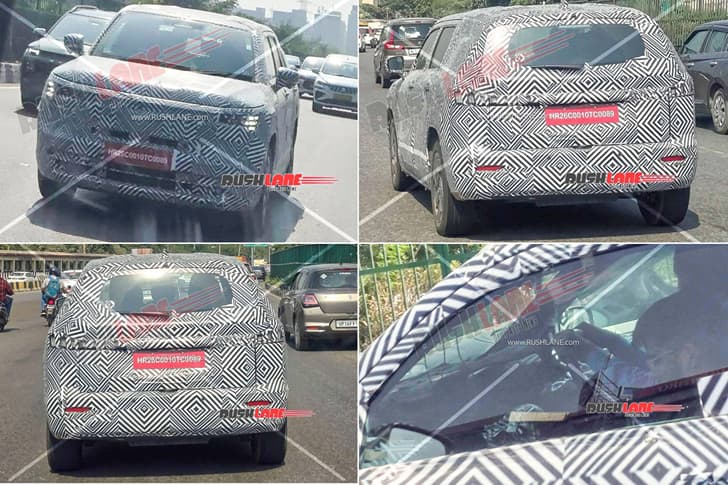

Maruti's YMC electric MPV shares the e Vitara's platform and batteries (49kWh/61kWh), targets a sub-Rs 18 lakh price, and is set to debut by end-2026 with a 2027 launch.
Maruti's Electric MPV (YMC) Spied in India 2026: What the e-Vitara Platform Means for Family EV Buyers
Maruti Suzuki's upcoming electric MPV — internally codenamed YMC — is a three-row, family-oriented battery electric vehicle built on the same skateboard platform as the Maruti Suzuki e Vitara, with an expected starting price of around Rs 14 lakh and a targeted launch in 2027. Fresh spy shots published in October 2026 by Autocar India reveal new exterior design details and a connected-screen interior setup, giving family EV buyers their clearest look yet at what Maruti is preparing to take on the nascent three-row electric segment.
Here is how the YMC stacks up against the vehicles it will share DNA with — and compete against — at a glance:
| Model | Expected Price (Rs) | Battery Options | Claimed Range | Rows | Platform |
|---|---|---|---|---|---|
| Maruti Suzuki YMC (upcoming) | ~14–18 lakh | 49kWh / 61kWh | Lower than e Vitara (TBC) | 3 | Suzuki-Toyota shared (e Vitara platform) |
| Maruti Suzuki e Vitara | 16.19–20.21 lakh | 49kWh / 61kWh | 440km / 543km (ARAI) | 2 | Suzuki-Toyota shared |
| Kia Carens Clavis EV | ~18 lakh (starting) | Single pack | ~450km (est.) | 3 | Kia dedicated EV |
| BYD eMAX 7 | 26.9–29.9 lakh | Single pack | ~530km (NEDC) | 3 | BYD e-Platform 3.0 |
| Mahindra XEV 9S | Premium segment | Dual pack options | ~600km (est.) | 3 | INGLO platform |
Sources: Autocar India, Financial Express, HT Auto
What did the latest YMC spy shots actually reveal?
The October 2026 test mule, photographed and reported by Autocar India, provides the most detailed exterior look at the YMC to date. Up front, the electric MPV sports wraparound LED headlamps resembling those on the Maruti Victoris, with slatted daytime running lamps (DRLs) that extend downward. A connecting element bridges the two headlamp clusters — whether this becomes an LED light bar or chrome trim in the production version remains unclear.
As a pure electric vehicle, the YMC's front fascia is largely blanked off, with only a slim air intake above the bumper and a wide air dam in the bumper itself. This reflects the aerodynamic priority of EVs and mirrors the approach taken on the e Vitara, which also uses active aero flaps on its front air intakes.
The profile is distinctly boxy and upright. Squared-off wheel arches and glasshouse area signal maximum interior volume — a deliberate choice for a vehicle targeting large families. The large rear quarter area, first noted in earlier spy shots from May 2026, confirms three-row packaging.
At the rear, a full-width light bar with a clear lens is visible, along with a chunky bumper housing slim reflectors. The test mule lacks a roof spoiler; production versions may add one for aerodynamic benefit or visual flair.
Inside, one spy image captures a connected-screen setup that Autocar India describes as similar to the e Vitara's dual-screen infotainment and instrument cluster arrangement. This marks the first interior confirmation that the YMC will carry over the e Vitara's cockpit architecture, a meaningful detail for buyers who value software continuity across Maruti's EV lineup.
How does the YMC share its platform with the e Vitara, and why does that matter?
The Maruti Suzuki YMC is a platform derivative — a vehicle using the same skateboard architecture, battery system, and core powertrain as an existing model, adapted to a different body style and size. The donor is the e Vitara, co-developed by Suzuki and Toyota Motor Corporation for both domestic and export markets.
Autocar India's May 2026 report confirmed that the YMC will use the same 49kWh and 61kWh battery pack options as the e Vitara. Both packs pair with a front-mounted motor producing 189Nm of torque — 144hp in the 49kWh configuration and 174hp in the 61kWh version. The electric motor and other powertrain components are shared between both models.
For family EV buyers, this platform sharing carries several practical implications:
Cost efficiency: Shared tooling and components allow Maruti to price the YMC more aggressively than a ground-up MPV EV would permit. Financial Express reports that Maruti could position the YMC below the Kia Carens Clavis EV, which starts at around Rs 18 lakh — a significant pricing ambition for a three-row electric vehicle.
Service network readiness: Because the YMC shares its battery chemistry, motor, and power electronics with the e Vitara, Maruti's service technicians trained on the e Vitara will be able to work on the YMC with minimal additional training. This matters in a country where EV after-sales infrastructure is still maturing. If you're evaluating service network depth, our guide on which electric SUV has the best after-sales service network in India provides useful context.
Manufacturing location: The YMC will be manufactured at Maruti's Gujarat facility, the same plant that produces the e Vitara, according to Financial Express. This consolidates EV production at a single hub, improving logistics and quality control.
Toyota derivative: Just as the e Vitara spawned the Toyota Urban Cruiser Ebella, the YMC will also spawn a Toyota-badged derivative at a later date. This dual-brand strategy expands the addressable market and further amortises development costs across a larger production volume.
What will the YMC's range actually be, and how does it compare to the e Vitara?
Buyers need to manage expectations carefully here. The e Vitara's ARAI-claimed range figures — 440km for the 49kWh battery and 543km for the 61kWh unit — are achieved in a two-row SUV body. The YMC is larger, heavier, and carries a third row of seating. Physics and engineering both point to meaningfully lower range figures for the MPV, even with identical battery packs.
Autocar India explicitly notes that "the YMC MPV's larger size will likely make for lower range figures." No official range estimate has been published yet, and buyers should treat any third-party speculation with caution until Maruti releases homologated data.
The 61kWh variant will offer meaningfully more range than the 49kWh variant, and the real-world range gap between the two packs — which on the e Vitara is roughly 100km in ARAI terms — is likely to persist on the YMC. For families planning long-distance travel, the 61kWh pack will be the more practical choice. Our article on best electric cars for long trips in India in 2026 explains the real-world range calculus in detail.
The boxy, upright body of the YMC — while excellent for interior headroom and third-row access — will create more aerodynamic drag than the e Vitara's more sculpted SUV silhouette. Maruti will likely tune the battery management system and regenerative braking calibration specifically for the YMC's weight and drag profile, but the range deficit versus the e Vitara is structurally unavoidable.
Who is the YMC actually competing against in the three-row EV segment?
The three-row electric vehicle segment in India comprises battery electric vehicles offering seating for six or more passengers across three rows, typically positioned as family movers or premium people carriers. Until recently, this segment was thin: BYD's eMAX 7 (formerly the E6) held the field largely alone at the premium end.
That landscape is changing. Financial Express notes that Mahindra's XEV 9S has been recording monthly sales of more than 3,000 units, while VinFast has entered with the VF-MPV and is preparing the Limo Green for fleet operations. Tata Motors is reportedly evaluating an electric version of the Safari. At the premium end, the Tesla Model Y L, Kia EV9, and MG M9 are broadening consumer interest, though volumes remain niche.
For the YMC's specific price positioning — sub-Rs 18 lakh — the primary rival is the Kia Carens Clavis EV, currently the only electric MPV under Rs 20 lakh. The Carens Clavis EV gives Kia a head start in this exact price band, and Maruti will need to match or undercut it on both price and range to make a compelling case.
The YMC's structural advantages over the Carens Clavis EV, if Maruti executes well, are Maruti's unmatched dealer and service network depth across India, the brand trust that comes with being the country's largest carmaker, and the potential for a lower entry price given the platform cost efficiencies described above. The Carens Clavis EV's advantages are its head start in the market, established owner community, and Kia's premium brand positioning.
Buyers considering the YMC should also look at our roundup of best electric cars under Rs 20 lakh in India in 2026 to understand the full competitive space at this price point.
What does the YMC's design language signal about Maruti's EV direction?
The YMC's design, as visible in spy shots, deliberately departs from the e Vitara's well-contoured, dynamic SUV surfaces. Where the e Vitara has sculpted body panels and a relatively low roofline for an SUV, the YMC is upright, boxy, and maximalist in its use of interior volume. This is a conscious trade-off: aerodynamic efficiency is sacrificed for cabin space, the correct priority for a family MPV.
The front-end treatment — with wraparound LEDs, a connecting light element, and a blanked-off EV fascia — follows the visual grammar that Maruti has established with the e Vitara and the Victoris. The full-width rear light bar is a contemporary design cue that signals the vehicle's EV identity and premium intent.
The absence of flush door handles (the YMC uses conventional pull-type handles, as does the e Vitara) is worth noting. Flush handles are an aerodynamic and aesthetic feature associated with premium EVs; their absence suggests Maruti is prioritising cost and ease of use over aerodynamic marginal gains — sensible for a mass-market family vehicle.
The interior spy shot showing a connected-screen setup is significant. The e Vitara's dual-screen layout — combining a digital instrument cluster with a touchscreen infotainment system — is a feature that Maruti's Nexa customers have come to expect. Carrying this over to the YMC, which is also expected to be sold through the Nexa retail network, maintains brand consistency and reduces software development costs.
Will the YMC be sold through Nexa, and what does that mean for buyers?
Autocar India reports that the YMC may be sold via Maruti's Nexa retail network, consistent with the e Vitara's distribution channel. Nexa is Maruti Suzuki's premium retail format, housing models like the Baleno, XL6, Invicto, Grand Vitara, and e Vitara — vehicles positioned above the mainstream Arena channel.
For buyers, Nexa distribution carries several implications. The showroom experience is designed to be more premium than a standard Maruti Arena outlet, with dedicated sales consultants and a more curated environment. Nexa service centres are equipped to handle the more complex electronics and features of premium models — relevant for an EV with a sophisticated battery management system. Nexa's geographic footprint, while extensive, is not as wide as Arena's; buyers in smaller cities may need to travel to a Nexa outlet for service.
The Nexa channel positioning also signals Maruti's intent to price the YMC as a premium product within its lineup — not a budget EV, but a considered family purchase. The expected Rs 14–18 lakh price range sits comfortably within Nexa's typical bracket.
What are Maruti's volume ambitions for the YMC, and are they realistic?
Autocar India's May 2026 report states that Maruti Suzuki is reportedly looking at an annual volume potential of over 50,000 to 1 lakh units for the YMC, including exports. Financial Express adds that a substantial share of initial production could be earmarked for exports, with Maruti targeting over 100 global markets over time.
These are ambitious numbers. For context, the e Vitara — which Autocar India notes "hasn't quite taken off as Maruti would have liked" in the domestic market — has been gaining traction slowly since its launch. The YMC faces the same structural headwinds: charging infrastructure gaps in smaller cities, range anxiety among first-time EV buyers, and the premium price premium that EVs carry over equivalent ICE vehicles.
However, the YMC has a structural advantage the e Vitara lacks: it addresses a genuine product gap. India's MPV segment is enormous — the Ertiga alone consistently sells tens of thousands of units per month — and there is no affordable electric MPV from a mass-market Indian brand. If Maruti can price the YMC aggressively and deliver a compelling range figure, the demand case is stronger than it was for the e Vitara.
The export dimension is also meaningful. Suzuki's global distribution network, particularly in Southeast Asia, Africa, and parts of Europe, gives the YMC access to markets where three-row family EVs are in demand and where Maruti's brand equity is strong.
Industry executives quoted by Financial Express acknowledge that volumes in the segment could remain modest initially but are expected to build gradually as charging infrastructure improves and battery costs decline — a realistic assessment that buyers should internalise before reading too much into headline volume targets.
When will the YMC launch, and what should buyers do now?
The current consensus across multiple sources is consistent: Autocar India reports a potential debut by end-2026, with a market launch in 2027. HT Auto lists an expected launch in April 2027, and Carlelo corroborates the 2027 timeline.
For buyers actively shopping for a family EV today, the practical question is whether to wait for the YMC or buy something available now. A few scenarios:
If your primary need is a three-row EV under Rs 20 lakh and you can wait 12–18 months, the YMC is worth watching. Its platform maturity (borrowed from the e Vitara), expected Nexa service support, and aggressive pricing target make it a compelling proposition on paper.
If you need a vehicle now and the three-row requirement is firm, the Kia Carens Clavis EV is the only realistic option in this price band. At the premium end, the BYD eMAX 7 and Mahindra XEV 9S are available but at significantly higher price points.
If you are open to a two-row EV and value Maruti's service network, the Maruti Suzuki e Vitara — available now at Rs 16.19–20.21 lakh — offers the same platform, batteries, and powertrain that the YMC will use, with the benefit of being a proven, purchasable product today. For buyers who want to understand the e Vitara's ownership proposition before the YMC arrives, our guide to affordable ways to own an electric SUV in India is a useful starting point.
Pricing for the YMC remains officially under wraps. The Rs 14 lakh expected starting price cited by HT Auto and Autocar India is an industry estimate, not a Maruti announcement. Treat it as a directional signal, not a confirmed figure.
What are the key unknowns buyers should track before the YMC launches?
Several material uncertainties remain as of October 2026:
Range figures: No ARAI-tested range data exists for the YMC. The e Vitara's 440km and 543km figures are the best proxy, but the YMC's heavier, less aerodynamic body will reduce these. The actual numbers will be decisive for buyers considering the 49kWh entry variant.
Charging capability: The e Vitara supports DC fast charging, but the maximum charging rate for the YMC has not been confirmed. Fast-charging speed is a critical spec for a family vehicle used on long trips. Our article on best electric cars for long trips in India explains why charging speed matters as much as range.
Safety ratings: The e Vitara has not yet been rated under Bharat NCAP as of this writing. The YMC's safety credentials will be important for family buyers. Our guide to 5-star Bharat NCAP electric cars in India explains what to look for.
Final pricing: The sub-Rs 18 lakh target is ambitious. Battery costs, import duties on cells, and GST structure will all influence the final on-road price. Watch for any policy changes affecting EV taxation in the 2027 Union Budget.
Toyota derivative timeline: The Toyota-badged version of the YMC will follow the Maruti launch, but no timeline has been confirmed. Buyers who prefer Toyota's service network may want to wait for this variant.
The YMC represents Maruti Suzuki's most direct attempt to bring its MPV dominance into the electric era. Success will depend on execution — pricing, range, and service network deployment — more than on the platform itself, which is already proven through the e Vitara. The spy shots suggest the design intent is clear and the engineering groundwork is laid. The next 12 months will determine whether the YMC becomes India's defining affordable electric family vehicle or another cautious step in a segment that is still finding its footing.
Sources
- Maruti electric MPV spied testing with new design details | Autocar India
- New Maruti three-row EV spied testing | Autocar India
- Maruti targets three-row EV space with YMC MPV | Financial Express
- Maruti Suzuki YMC Expected Price, Launch Date, Booking Details | HT Auto
- New Maruti Suzuki Cars Expected in 2027 | Carlelo
- Maruti Suzuki e Vitara | Autocar India