
The Mahindra Vision T has been spotted testing for the first time, revealing a production-ready electric SUV on the NU_IQ platform targeting the ₹18–20 lakh segment against rivals like the Maruti e Vitara.
The Mahindra Vision T prototype has been spotted testing on Indian roads for the first time, confirming that Mahindra's next mid-size electric lifestyle SUV is deep into development. Built on the all-new NU_IQ monocoque architecture and carrying a strong design lineage from the 2023 Thar.e concept, the Vision T is expected to be priced around ₹18–20 lakh — placing it squarely in one of India's most contested EV battlegrounds in 2026.
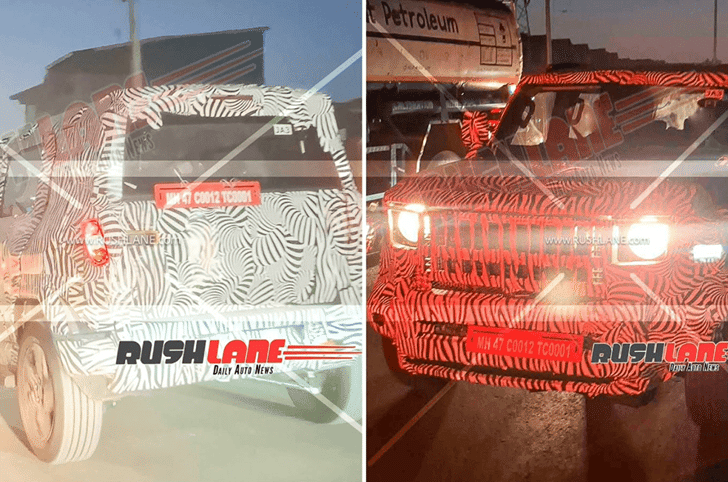
RushLane captured spy shots reported by Autocar India on 5 October 2026, showing a heavily camouflaged pre-production mule that nevertheless reveals enough to make a compelling case: this is a production-intent vehicle, not a show car. The flat bonnet, upright windscreen, pronounced wheel arches, split grille with horizontal slats, and five-door layout all echo the Vision T concept unveiled in August 2025. What's changed from concept to prototype tells its own story about how Mahindra is calibrating this SUV for real-world buyers.
How does the Vision T compare to its key rivals at a glance?
The ₹15–20 lakh electric SUV segment is shaping up to be the defining battleground of India's EV market in 2026–27. Here is how the Vision T stacks up against the cars most buyers will cross-shop it against:
| Model | Expected/Current Price | Platform | Body Length | Key Powertrain | Off-Road Angles (Approach/Departure) | 5-Star Safety Target |
|---|---|---|---|---|---|---|
| Mahindra Vision T | ₹18–20 lakh (expected) | NU_IQ (monocoque) | 3,990–4,320mm range | Electric (AWD/FWD); hybrid on cards | 28° / 34.9° | Yes (Global NCAP + Euro NCAP) |
| Maruti Suzuki e Vitara | ₹17.49–19.99 lakh (approx.) | Suzuki HEARTECT-e | ~4,275mm | Electric (FWD/AWD) | Road-biased crossover | Bharat NCAP 5-star |
| Tata Harrier EV | ₹21.49–25.49 lakh | OMEGA Arc | 4,598mm | Electric (FWD) | Road-biased | Bharat NCAP 5-star |
| MG Hector Tomahawk EV | ₹19.49 lakh | Steel monocoque | 4,720mm | Electric (FWD) | Road-biased | — |
| Mahindra Vision S (sibling) | ₹10.50–15 lakh (expected) | NU_IQ (monocoque) | Sub-4m | Electric/Petrol/Diesel/Hybrid | 28° / 34.9° | Expected |
The Vision T stands out as the only upcoming model in this price band combining genuine off-road geometry with an electric powertrain. The Maruti Suzuki e Vitara — a road-biased urban electric crossover on Suzuki's HEARTECT-e platform — is the closest price-segment rival, but it does not attempt the same off-road positioning. That distinction will matter enormously to buyers who want Thar DNA in a five-door, family-friendly package.
What does the Vision T prototype's exterior design actually reveal?
The Vision T represents a production-intent evolution of the Mahindra Thar.e concept, first shown in August 2023, then refined into the Vision T concept at Mahindra's Freedom NU event in August 2025. The prototype seen in October 2026 carries over several design cues from the Vision T concept, though with the pragmatic adjustments that always accompany the journey from show floor to production line.
Up front, the split grille with horizontal slats is present and accounted for — one of the clearest concept carry-overs. The flat, clamshell-style bonnet and upright windscreen give the SUV a boxy, purposeful stance that is unmistakably Thar-family. The front bumper is an off-road-spec unit, reinforcing that Mahindra intends to keep the rugged character intact even in the electric version.
The rectangular outer rearview mirrors are notably similar to those on the Mahindra Thar Roxx, suggesting deliberate design continuity across the Thar family. The wheels have moved away from the polygonal, concept-car design of the Vision T toward more conventional alloy units — a practical concession that will likely help with tyre availability and cost. The vehicle sits visibly high off the ground, and side steps are present, both consistent with the off-road SUV brief.
One detail that stands out in the rear: the tailgate-mounted spare wheel is absent on the prototype. Auto India Daily notes that this is likely a testing-phase omission, and the production version is expected to carry a tailgate-mounted spare, as the Thar Roxx does. The rear quarter glass is fully hidden under camouflage, and the tail-lights appear to be temporary halogen units — LED units are expected in the production car.
The vertically positioned rear door handles, a distinctive design choice from the Vision T concept, have been retained on the prototype. This is a small but telling detail: Mahindra is not abandoning the concept's character in the name of cost-cutting.
What does the interior spy shot tell us?
The interior is almost entirely camouflaged, but two elements are clearly visible: A-pillar-mounted grab handles and an illuminated digital driver's display. The grab handles are a direct nod to the Thar's off-road DNA — they signal that Mahindra is positioning this as a vehicle you might actually take off-road, not just one that looks like it could.
The digital instrument cluster is consistent with what Mahindra has been rolling out across its newer SUV lineup. The production-spec Vision T could be equipped with wireless charging, steering-mounted audio controls, wireless Android Auto and Apple CarPlay, and automatic climate control — a feature set that would be competitive in the ₹18–20 lakh bracket.
Whether the panoramic sunroof, portrait-style touchscreen, and three-spoke steering wheel from the Vision T concept will make it to production remains uncertain. The sibling Vision S, which has been spied in closer-to-production form, shows a binnacle-mounted digital display and a 10.25-inch infotainment unit borrowed from the Thar Roxx — suggesting Mahindra may use shared components across the NU_IQ family to manage costs. If the Vision T follows a similar approach, buyers should expect a polished but pragmatic interior rather than a concept-car cabin.
The Vision S interior spy shots also revealed a two-spoke steering wheel similar to the XUV 7XO's, along with a drive selector on the centre console indicating an automatic transmission. The Vision T may share some of these elements, though its larger, more premium positioning could justify a more distinctive interior treatment.
What is the NU_IQ platform, and why does it matter?
The NU_IQ architecture is Mahindra's all-new modular monocoque platform, engineered specifically for SUVs measuring between 3,990mm and 4,320mm in length. It is the technical foundation for both the Vision T and the smaller Vision S, and it represents a significant departure from the body-on-frame construction of the original Thar.
Modularity is its most important characteristic. NU_IQ supports front-wheel-drive and all-wheel-drive layouts, and accommodates petrol, diesel, hybrid, and fully electric powertrains. This means Mahindra can launch the Vision T as an EV first and add ICE or hybrid variants later — or vice versa — without a fundamental re-engineering exercise.
The off-road geometry built into NU_IQ is genuinely impressive for a monocoque platform. An approach angle of up to 28 degrees, a departure angle of up to 34.9 degrees, and a breakover angle of up to 28.2 degrees put the Vision T in a different league from road-biased crossovers in this price range. For context, the Maruti Suzuki e Vitara — while a capable urban SUV — is not designed around these kinds of off-road parameters. Buyers who want genuine trail capability in an electric SUV currently have very limited options in India; the Vision T is shaping up to be the answer.
Mahindra has committed to targeting a 5-star rating from both Global NCAP and Euro NCAP for Vision T-based models. This is a meaningful commitment at a time when safety ratings are increasingly influencing purchase decisions. Our guide to 5-star Bharat NCAP electric cars in India shows how safety credentials are becoming a key differentiator in the EV segment.
What powertrain will the production Vision T use?
This is the biggest open question. The 2023 Thar.e concept was showcased as a pure electric SUV, and the Vision T concept followed the same direction. An electric-first launch is the most likely scenario, with ICE or hybrid variants following later — mirroring Mahindra's strategy with the XUV 400 and the broader BE/XEV series.
The NU_IQ platform's AWD capability is particularly relevant here. An electric AWD setup — with motors on both axles — would give the Vision T genuine off-road performance to match its off-road geometry, something no other EV in the ₹18–20 lakh bracket currently offers. Whether Mahindra prices AWD within reach of the target segment, or reserves it for a higher variant, will be a critical commercial decision.
A hybrid powertrain is also on the cards. A strong hybrid could extend range and reduce charging anxiety for buyers in areas with limited public charging infrastructure — a real concern for anyone planning to take this SUV on the kind of adventures its design suggests. If you're evaluating EVs for longer journeys, our best electric cars for long trips in India guide is worth reading alongside this.
Battery capacity, range, and charging speed have not been officially confirmed. Given the platform's length range (up to 4,320mm), there is physical space for a reasonably large battery pack. Mahindra's existing BE 6e and XEV 9e use a 79kWh pack; the Vision T, being a smaller vehicle, would likely use a smaller battery — possibly in the 50–60kWh range — but this is speculation at this stage.
How does the Vision T fit into Mahindra's broader NU_IQ family?
The Vision T is part of a deliberate family strategy built around the NU_IQ platform, with the Vision S occupying the sub-4-metre segment below it. The Vision S, expected to be priced at ₹10.50–15 lakh, has been spied in close-to-production form with circular Thar Roxx-like headlights, a tailgate-mounted spare wheel, and a boxy, upright silhouette. It targets the compact SUV segment where the XUV 3XO currently competes.
The Vision T sits above the Vision S, targeting buyers who want more space, more capability, and are willing to pay for it. Together, the two models give Mahindra a coherent NU_IQ-based lineup that spans from ₹10.50 lakh to ₹20 lakh — a significant portion of the Indian SUV market.
Mahindra's Vision 2027 roadmap, announced in 2025, stated that NU_IQ-based SUVs would enter production from 2027. This timeline is consistent with the current stage of prototype testing for both the Vision T and Vision S. A 2027 launch for the Vision T would mean it arrives after the Maruti Suzuki e Vitara has had time to establish itself in the market — giving Mahindra the opportunity to learn from the e Vitara's reception and position the Vision T accordingly.
How does the Vision T compare to the Maruti Suzuki e Vitara as a buying decision?
The Maruti Suzuki e Vitara is a road-biased premium electric crossover built on Suzuki's HEARTECT-e platform, offered in both FWD and AWD configurations, and positioned as a technology-forward urban SUV with the reassurance of Maruti's service network. It is the benchmark that the Vision T will be measured against in the ₹17–20 lakh segment.
The e Vitara's strengths are well-documented: Maruti's unmatched after-sales network (relevant if you're evaluating EV after-sales service networks in India), competitive pricing, and a refined, urban-optimised driving experience. Its AWD variant offers decent all-weather capability, though it is not engineered for the kind of off-road use the Vision T's geometry suggests.
The Vision T's differentiator is clear: it offers Thar-family off-road credentials in a five-door, family-practical electric package. If Mahindra can deliver on the NU_IQ platform's promised approach and departure angles, and price the electric variant competitively, the Vision T will offer something the e Vitara simply does not — the ability to go meaningfully off-road without compromising on urban usability.
The trade-off, as always with Mahindra's newer platforms, will be service network depth and long-term reliability data. Mahindra has been expanding its EV service infrastructure, but Maruti's network remains a significant advantage for buyers in smaller cities and towns.
For buyers considering both, the decision will likely come down to use case: urban-first buyers who want a premium electric crossover with strong resale value and service peace of mind will lean toward the e Vitara. Buyers who want an electric SUV that can handle a weekend trail or a monsoon-flooded road — and who are willing to wait for the Vision T's launch — have a genuinely compelling alternative on the horizon.
Safety-conscious buyers should note that Mahindra has committed to a 5-star target from Global NCAP and Euro NCAP for Vision T-based models. The e Vitara has already achieved a 5-star Bharat NCAP rating. Both will meet the safety bar that most buyers in this segment now expect. Our guide to best electric SUVs with 6 airbags under ₹20 lakh covers the current state of safety equipment in this price band.
What is still unknown — and what should buyers watch for?
Considerable uncertainty remains. Mahindra has not confirmed:
- The production name (Vision T may be a concept name, not the market name)
- The battery capacity, range, or charging speed
- The exact launch timeline (2027 is the working assumption based on the Vision 2027 roadmap)
- The final powertrain lineup — electric-only, or electric plus hybrid/ICE
- The price (₹18–20 lakh is the expected range, not a confirmed figure)
- Whether the panoramic sunroof, portrait touchscreen, and concept-car interior elements survive to production
What the prototype does confirm is that the Vision T is a real vehicle in active road testing, that its design is substantially close to the concept, and that Mahindra is serious about delivering a five-door electric lifestyle SUV on the NU_IQ platform. The prototype's independent rear suspension — hinted at in the underbody shots — would be a significant technical step for the Thar family if confirmed, improving both ride quality and off-road articulation compared to the solid rear axle of the existing Thar.
Buyers in the market now and unable to wait for the Vision T's 2027 launch should look at the best electric cars under ₹20 lakh in India in 2026 — the Maruti e Vitara, MG Hector Tomahawk EV, and Tata Nexon EV are the current benchmarks. Buyers who can wait, and who want the specific combination of off-road geometry, electric powertrain, and Thar-family character, should put the Vision T on their watchlist and track Mahindra's announcements through early 2027.
What does this spy shot mean for the Indian EV market in 2026–27?
The Vision T prototype's appearance on public roads in October 2026 signals that India's mid-size electric SUV segment is about to get significantly more competitive. The ₹15–20 lakh band — currently anchored by the Maruti e Vitara, Tata Nexon EV, and MG Windsor EV — is where the volume battle for India's EV market will be fought over the next two to three years.
Mahindra's entry into this segment with a genuine off-road-capable electric SUV changes the competitive calculus. It also validates the segment's growth: Mahindra would not be investing in the NU_IQ platform and testing the Vision T at this stage if it did not see a large, addressable market in the ₹18–20 lakh electric SUV space.
The broader context matters too. Maruti's hatchback sales rose 41 percent in H1 FY27, and SUV sales grew even faster at 56 percent — with Maruti attributing part of the growth to GST revisions. The Indian car market is shifting toward SUVs at an accelerating pace, and the electrification of that shift is the defining trend of the next five years. The Vision T, if it launches on schedule and at the expected price, will be one of the most important electric SUVs India has seen — not because of any single specification, but because of what it represents: the Thar's spirit, electrified and made accessible to a family audience.
For buyers evaluating their options in the best electric cars to buy in India in 2026, the Vision T is one to watch — even if it is not yet one to buy.
Sources
- Mahindra Vision T prototype spied testing for the first time | Autocar India
- Mahindra Vision T prototype spied testing for the first time (AMP) | Autocar India
- Mahindra Vision S interior spied in close detail | Autocar India
- Mahindra Vision S spied testing: Compact Scorpio-like styling revealed | Times of India
- Mahindra Thar Electric Spotted Testing For The First Time, Vision T-Inspired Design Revealed | Auto India Daily
- Mahindra Vision T – Official Model Page | Autocar India
- Mahindra Vision S – Official Model Page | Autocar India
- MG Hector Tomahawk EV launched at Rs 19.49 lakh | Autocar India