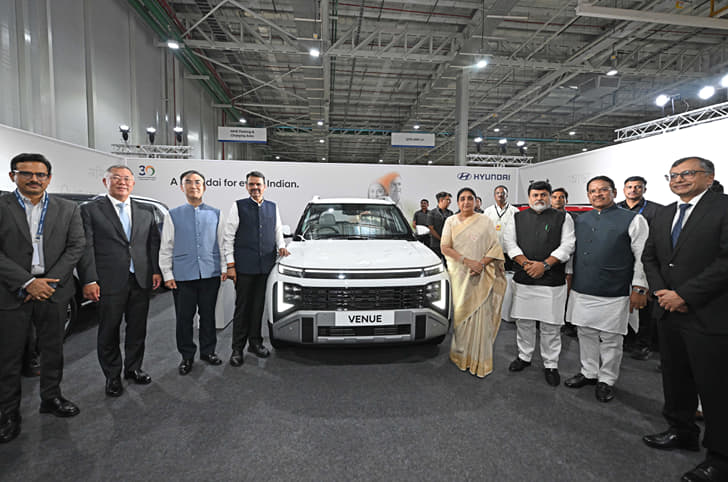

Hyundai's new ₹11,000 crore Pune plant opens with 1.7 lakh units/year capacity, scaling to 3.2 lakh by 2030, and is built to produce both ICE and EVs — reshaping India's mid-size EV competition.
Hyundai Motor India's Talegaon, Pune plant — inaugurated on October 14, 2026, with a committed investment of ₹11,000 crore — marks the company's first major manufacturing facility outside Tamil Nadu and the most technologically advanced automotive plant to open in India this decade.
The plant launches with an installed annual capacity of 1.7 lakh units and will scale to 3.2 lakh units by 2030. Combined with the existing Chennai plant, Hyundai's total India production capacity will reach approximately 11.4 lakh units per year by decade's end. For Indian car buyers, this matters: more domestic capacity typically translates to shorter waiting periods, more competitive pricing, and a broader model range built locally.
Here is a snapshot of how the Pune plant stacks up against the broader Indian EV manufacturing space and what it means for key models in the segment:
| Manufacturer | Plant Location | EV-Ready Lines | Announced Capacity (by 2030) | Key Model(s) | Export Markets |
|---|---|---|---|---|---|
| Hyundai Motor India | Talegaon, Pune (+ Chennai) | Yes — ICE/EV dual-line | 3.2 lakh units (Pune alone); 11.4 lakh combined | Venue (ICE/export), future EVs | 35+ countries |
| Tata Motors | Pune (Chikhali) + Sanand | Yes — dedicated EV lines | ~5 lakh units (combined, est.) | Nexon EV, Harrier EV, Curvv EV | Select markets |
| Maruti Suzuki (Suzuki) | Manesar + Kharkhoda (upcoming) | Yes — e Vitara platform | Kharkhoda targeting ~2.5 lakh units/year | e Vitara (mid-size EV SUV) | Japan, Europe |
| Mahindra & Mahindra | Chakan, Pune | Yes — BE/XEV series | ~2.5 lakh units (EV-dedicated, est.) | XEV 9e, BE 6 | Select markets |
The dual-line architecture — capable of producing internal combustion engine (ICE) vehicles and electric vehicles on the same production floor — is the detail that matters most for buyers watching the EV space. It gives Hyundai the operational agility to shift output toward EVs as demand accelerates, without the capital cost of building a separate dedicated EV facility.
What exactly did Hyundai open in Pune, and why does it matter?
The Talegaon facility is a brownfield conversion: Hyundai acquired the site from General Motors in August 2023 and completed its transformation into a fully operational, globally benchmarked plant within 19 months — a timeline that is unusually fast for a facility of this scale and technological complexity.
Maharashtra Chief Minister Devendra Fadnavis inaugurated the plant, with Hyundai Motor Group Executive Chair Euisun Chung and Hyundai Motor Company President and CEO José Muñoz present. HMIL Managing Director and CEO Tarun Garg announced the ₹11,000 crore phased investment commitment, which includes an additional ₹4,000 crore beyond what had previously been disclosed, as reported by The Hindu.
Chung remarked at the inauguration: "India remains one of Hyundai's most important and strategic markets globally. The inauguration of the Pune plant reflects our long-term commitment to India's growth and our confidence in its bright future."
A dedicated engine shop with an annual production capacity of 1.5 lakh units signals Hyundai's intent to deepen localisation. The company has announced plans to increase its localisation rate from 83% to 92%, a move that will reduce import dependency and could structurally lower vehicle costs over time.
What technology does the Pune plant use, and why should EV buyers care?
The Talegaon facility runs on Hyundai's proprietary E-FOREST digital factory platform, an integrated Industry 4.0 manufacturing space combining AI-based quality inspection, predictive maintenance powered by machine learning, IoT-enabled shopfloor connectivity, digital simulations, and augmented reality-based worker training.
In practical terms:
- AI quality checks run in real time during production, catching defects before vehicles leave the line. The plant recorded zero field complaints in its first 100 days of operations and maintained an exceptionally low warranty claim rate.
- Predictive maintenance systems monitor equipment continuously, reducing unplanned downtime — which directly supports production consistency and delivery timelines.
- Advanced robotics are deployed across welding, painting, and assembly operations, improving precision and reducing rework.
- The plant logged over 16 million accident-free man-hours during its ramp-up phase.
For EV buyers, the dual-line capability is the most consequential feature. The same production lines that currently build ICE models can be reconfigured to produce electric vehicles. Autocar India confirmed that the plant's lines "can support multiple internal combustion engine and hybrid models," with EV production readiness built into the facility's foundational design.
Hyundai is also pursuing nearly 40 ongoing research projects with seven Indian academic institutions, covering battery technology, electrification, and future mobility. This academic pipeline suggests Hyundai is building localised battery and electrification knowledge that could eventually support India-specific EV products at competitive price points.
Which Hyundai models will be built at Pune, and what comes next for EVs?
The Hyundai Venue compact SUV is the anchor model for the Pune plant at launch. It will be manufactured exclusively at Talegaon and exported to more than 35 countries, according to Autocar India. The Venue's export mandate makes Pune a global production hub for one of Hyundai's highest-volume models — a status that typically attracts further investment and model additions over time.
The plant's EV-readiness, however, is the forward-looking story. Hyundai's current India EV lineup — the Creta Electric and Ioniq 5 — is produced at Chennai. As the Pune plant scales toward its 3.2 lakh unit target by 2030, it becomes the natural candidate to absorb EV production overflow or host new EV model introductions, particularly in the mid-size SUV segment where demand is growing fastest.
Hyundai has not publicly confirmed specific EV models for Pune production yet, but the plant's dual-line architecture and the company's stated commitment to electrification research in India make it a logical next step. Buyers considering Hyundai EVs in 2027–2028 should watch for Pune-origin production announcements, which could signal improved availability and lower ex-factory costs.
If you are currently evaluating Hyundai's EV range, our guide to the best electric cars to buy in India in 2026 covers the Creta Electric and its competitors in detail.
How does this affect the competitive space for mid-size EVs in India?
Hyundai's Pune expansion lands at a moment when the mid-size EV SUV segment is becoming the most contested space in Indian automotive, with Tata, Mahindra, and Maruti Suzuki all scaling capacity simultaneously.
The Maruti Suzuki e Vitara is the most directly relevant competitor to watch. Maruti's EV production roadmap is anchored to its upcoming Kharkhoda plant in Haryana, which is designed to handle the e Vitara's volume ambitions alongside export commitments to Japan and Europe. Hyundai's Pune expansion creates genuine competitive pressure on that roadmap — not because it directly threatens Kharkhoda's construction timeline, but because it raises the bar on manufacturing technology, localisation depth, and export-linked production efficiency that the entire segment will be benchmarked against.
For buyers, this competition is directionally positive. When two major manufacturers are simultaneously scaling EV-capable capacity in India, the downstream effects tend to include faster model introductions, more competitive pricing as localisation improves, and better after-sales infrastructure as dealer networks expand to support higher volumes. Our analysis of which electric SUV has the best after-sales service network in India is worth reading alongside this news, because manufacturing scale and service network depth are closely correlated.
Mahindra's Chakan plant in Pune is already producing the XEV 9e and BE 6 on a dedicated EV platform. Hyundai's arrival in the same city with a dual-line EV-ready facility creates a genuine Pune EV manufacturing cluster — which has implications for component suppliers, skilled labour availability, and the broader EV space in western India.
What does the supply chain investment mean for Indian buyers long-term?
The supplier space around the Pune plant is substantial and growing. Autocar Professional reported that 55 Tier-1 suppliers are already operating in Pune, with nearly half of Hyundai's supplier network located within 50 kilometres of the plant. Collectively, these Tier-1 suppliers have invested approximately ₹4,600 crore in Maharashtra. The combined Tier-1 and Tier-2 supplier network has generated more than 18,000 employment opportunities in the state.
This supplier density matters for buyers for a specific reason: proximity of component manufacturing to the assembly plant reduces logistics costs and lead times, which in turn supports faster production ramp-ups and more stable parts availability for after-sales service. When a supplier is 30 kilometres from the plant rather than 1,500 kilometres away in another state, the entire supply chain becomes more resilient — and that resilience eventually shows up in vehicle delivery timelines and service part availability.
The localisation increase from 83% to 92% is the most buyer-relevant number here. Higher localisation typically means lower exposure to currency fluctuation on imported components, which has historically been one of the factors that pushes EV prices upward when the rupee weakens. A more localised supply chain is a structural hedge against price volatility — relevant for anyone planning an EV purchase in the 2027–2028 window.
How significant is the export milestone Hyundai announced alongside the plant inauguration?
The Pune inauguration coincided with Hyundai Motor India crossing 40 lakh cumulative passenger vehicle exports since 1999 — and domestic sales of nearly 1 crore passenger vehicles over its 30 years in India. These numbers establish India's role in Hyundai's global manufacturing strategy and explain why the company is willing to commit ₹11,000 crore to a single facility.
Export-linked production means manufacturing output where a significant portion of vehicles built at a facility are destined for international markets rather than domestic sale. For the Pune plant, the Venue's mandate to serve 35+ export markets makes it a classic export-linked production hub. This model has a well-established precedent in Indian automotive: Hyundai's Chennai plant has been one of India's largest vehicle exporters for over two decades.
The relevance for domestic buyers is indirect but real. Export volumes help manufacturers achieve the production scale needed to spread fixed costs across more units, which supports competitive domestic pricing. A plant that only serves the Indian market has a narrower base over which to amortise capital investment; one that serves 35 countries can justify deeper tooling investment and faster technology upgrades.
What should buyers actually do with this information right now?
If you are in the market for a Hyundai EV today — the Creta Electric being the most accessible option — the Pune plant news does not change your immediate buying decision. The Creta Electric is currently produced at Chennai, and that will not shift in the near term.
What the Pune plant does change is the medium-term outlook. Buyers who are considering waiting for the next generation of Hyundai EVs, or who are watching for price corrections as localisation improves, now have a clearer timeline: the plant scales to full 3.2 lakh unit capacity by 2030, localisation hits 92% in phases, and EV-ready production lines are already in place. That is a credible roadmap for more affordable, more available Hyundai EVs in the 2027–2029 window.
For buyers currently evaluating the mid-size EV SUV segment more broadly — where the Maruti Suzuki e Vitara, Hyundai Creta Electric, Tata Harrier EV, and Mahindra BE 6 are the primary options — the competitive dynamic is shifting in buyers' favour. More manufacturing capacity from multiple players means more supply, which historically moderates waiting periods and creates pricing pressure across the segment. Our guide to 5-star Bharat NCAP electric SUVs under ₹25 lakh is a useful companion read for anyone shortlisting in this price band.
If you are buying a Hyundai vehicle in Maharashtra or western India, the Pune plant's proximity to Mumbai ports and its dense local supplier network should translate to better parts availability and faster service turnaround at authorised service centres in the region. This is not guaranteed, but it is a reasonable expectation as the plant matures.
For longer-range EV planning, our roundup of the best electric cars for long trips in India in 2026 covers real-world range and charging infrastructure considerations that remain relevant regardless of which plant your vehicle comes from.
What are the broader implications for India's EV manufacturing ambitions?
The Talegaon plant is significant beyond Hyundai's own balance sheet. It represents the second major EV-capable manufacturing hub to open in Pune in the current investment cycle, after Mahindra's Chakan facility. Together, they are creating a western India automotive cluster with genuine EV manufacturing depth — a counterweight to the Tamil Nadu cluster that has historically dominated Indian passenger vehicle production.
For India's EV policy ambitions, this geographic diversification is meaningful. The government's PLI scheme for advanced chemistry cell batteries and the broader FAME framework have been designed to attract exactly this kind of large-scale, technology-intensive manufacturing investment. Hyundai's ₹11,000 crore commitment, Mahindra's Chakan investment, and the supplier space that has coalesced around both plants suggest that western India is emerging as a credible second pillar of India's EV industrial base.
The 40 ongoing research projects with seven Indian academic institutions that Hyundai cited — covering battery technology, electrification, and future mobility — are also worth tracking. India-specific battery research, if it yields commercially viable results, could eventually support locally developed battery chemistries optimised for Indian climate conditions and usage patterns. That foundation is being laid now.
For buyers who prioritise safety alongside the broader EV space, our guide to 5-star Bharat NCAP electric cars worth buying in 2026 provides a useful safety-first filter for the current market.
The bottom line: Hyundai's Pune plant is not just a capacity announcement. It is a structural shift in how India's EV manufacturing space is organised — with implications for model availability, pricing trajectories, supply chain resilience, and the competitive intensity of the mid-size EV segment that will play out over the next three to four years.
Sources
- Hyundai inaugurates Pune plant, to invest Rs 11,000 crore | Autocar India
- Pune plant: Manufacturing redefined — Hyundai Motor India Annual Report 2025-26
- Hyundai to invest additional ₹4,000 crore in Pune plant, to raise output to 3,20,000 units | The Hindu
- Hyundai Motor India Opens Pune Plant, Marking Expansion Beyond Chennai Base | Autocar Professional
- Hyundai Motor India — Official India Site