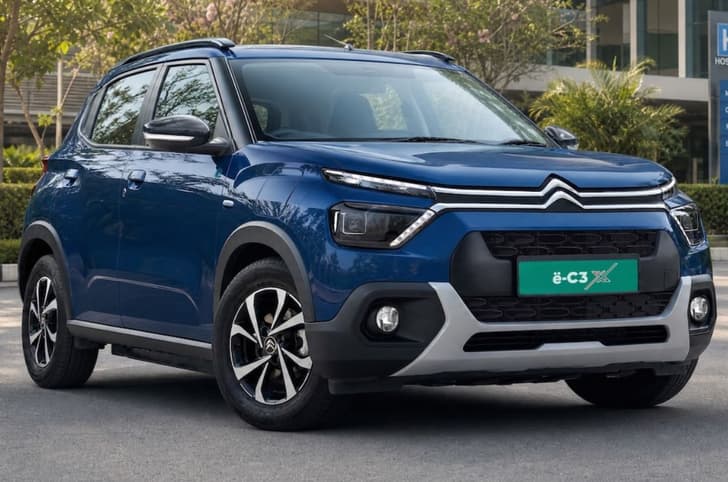

The 2026 Citroen eC3X starts at ₹11.99 lakh, or just ₹6.29 lakh upfront under its BaaS scheme, with a 29.2 kWh battery and 325 km claimed MIDC range.
The 2026 Citroen eC3X launched on 18 June 2026 at ₹11.99 lakh (ex-showroom), making it one of the most aggressively priced electric hatchbacks in India — and its Battery-as-a-Service (BaaS) option slashes that entry point further to ₹6.29 lakh upfront, a figure that puts EV ownership within reach of buyers who previously considered only entry-level petrol cars.
The eC3X is a refreshed, renamed evolution of the Citroen eC3, carrying forward the same 29.2 kWh battery pack but now claiming a MIDC range of 325 km — up 79 km from the outgoing model — thanks to software and calibration improvements. Three variants are on offer: Live, Live (O), and Shine, available both with and without the BaaS plan.
What are the eC3X variant prices, and how does BaaS change the maths?
The full pricing picture, with and without the BaaS scheme, is as follows — per Autocar India's launch report:
| Variant | Non-BaaS Price (ex-showroom) | BaaS Upfront Price | Upfront Saving | Battery Rental |
|---|---|---|---|---|
| Live | ₹11.99 lakh | ₹6.89 lakh | ₹5.10 lakh | ₹2.26/km |
| Live (O) | ₹12.35 lakh | ₹7.09 lakh | ₹5.26 lakh | ₹2.26/km |
| Shine | ₹13.26 lakh | ₹8.30 lakh | ₹4.96 lakh | ₹2.26/km |
Citroen is also offering an introductory consumer discount of up to ₹1.50 lakh for non-BaaS buyers, bringing the effective starting price down to ₹10.49 lakh (ex-showroom) — a reduction of ₹1.74 lakh versus the outgoing eC3's entry price.
Battery-as-a-Service is a financing model where the buyer purchases the vehicle without the battery pack, significantly lowering the upfront cost, and instead pays a per-kilometre rental fee to the manufacturer or a third-party battery provider. In the eC3X's case, the rental is ₹2.26 per km, with a mandatory minimum payment covering 2,000 km every month — that works out to a floor charge of ₹4,520 per month regardless of actual usage. If you drive more than 2,000 km in a month, you pay for the actual kilometres driven at the same rate.
This structure rewards high-mileage users less than it might initially appear. A buyer covering exactly 2,000 km/month pays ₹4,520 in battery rental on top of their vehicle EMI. At 3,000 km/month, the rental bill rises to ₹6,780. Buyers who drive fewer than 2,000 km still pay the ₹4,520 floor, which effectively raises the per-km cost for low-mileage users. For a detailed breakdown of how BaaS models compare across Indian EVs, see our guide on which electric cars offer Battery as a Service in India and whether they're worth buying.
What's new in the 2026 eC3X compared to the old eC3?
Citroen has made meaningful changes across the exterior, interior, and powertrain calibration — enough to justify the new X suffix, even if the fundamental architecture is unchanged.
Exterior updates include new projector LED headlights borrowed from the ICE-powered C3, redesigned 15-inch dual-tone alloy wheels, and electrically adjustable and foldable outside rearview mirrors (ORVMs). The V-shaped LED DRLs, LED tail-lights, black body cladding, halogen front fog lamps, and faux silver skid plates on both bumpers carry over from the previous model. The overall silhouette remains familiar — the eC3X is not a ground-up redesign but a considered mid-cycle refresh.
Interior changes run deeper. The cabin gets a new dual-tone blue-and-beige theme, and the seats are now finished in leatherette rather than fabric — a genuine upgrade for a car at this price point. A new 7-inch colour TFT digital driver's display replaces the older analogue-style cluster. Citroen has also added an auto-dimming inside rearview mirror, a dashcam, a wireless phone charger, and a 6-speaker JBL audio system (up from 4 speakers). The dashcam and JBL speakers are fitted as accessories rather than integrated components, which is worth noting if you're comparing spec sheets.
The 10.25-inch touchscreen infotainment system with wireless Android Auto and Apple CarPlay carries over, as does the manual AC, rear wiper, and rear parking camera with sensors.
Safety has seen the most significant jump: the top Shine variant now gets 6 airbags, while the Live and Live (O) get 4 — compared to just dual airbags across the board on the outgoing eC3. This is a meaningful improvement for a segment where safety equipment has historically been sparse. If airbag count and crash safety are priorities for you, our roundup of 5-star Bharat NCAP electric cars in India is worth reading alongside this article.
What is the eC3X's real-world range likely to be, and how does charging work?
Citroen claims a MIDC range of 325 km from the 29.2 kWh battery — 79 km more than the previous eC3's claimed figure. The battery and motor hardware are unchanged; the improvement comes from recalibrated software and energy management. Real-world range in Indian urban conditions typically comes in at 70–80% of MIDC figures, which would put the eC3X's practical range somewhere between 230 and 260 km — adequate for city commuting and occasional intercity runs, but not a long-haul touring car.
The electric motor produces 57 hp and 143 Nm of torque, mounted on the front axle. The 0–60 km/h sprint takes 6.8 seconds, and top speed is capped at 107 km/h. These numbers are modest but appropriate for a city-focused hatchback.
An AC charger takes the eC3X from 10% to 100% in 10 hours and 30 minutes — essentially an overnight charge on a home wallbox. A DC fast charger handles a 10–80% top-up in 57 minutes, which is competitive for a car at this price. The eC3X does not support ultra-rapid charging, so long-distance travel will require planning around DC charging availability. For buyers who do want to use their EV for longer journeys, our guide to the best electric cars for long trips in India in 2026 covers options with faster charging and larger batteries.
How does the eC3X compare with the Tata Punch EV, its primary rival?
The Tata Punch EV is the eC3X's most direct competitor — Autocar India explicitly notes the rivalry. The Punch EV offers a broader variant range, a larger battery option, and the backing of Tata's extensive service network. The eC3X counters with the BaaS scheme, which no Tata model currently offers, and a lower entry price under BaaS. Here's a side-by-side of key parameters:
| Parameter | Citroen eC3X | Tata Punch EV |
|---|---|---|
| Starting price (ex-showroom) | ₹11.99 lakh | ~₹10.00 lakh (approx.) |
| BaaS entry price | ₹6.89 lakh | Not available |
| Battery capacity | 29.2 kWh | 25 kWh / 35 kWh |
| Claimed range (MIDC) | 325 km | 315 km / 421 km |
| Motor output | 57 hp / 143 Nm | 82 hp / 114 Nm (long range) |
| DC fast charge (10–80%) | 57 min | ~56 min (long range) |
| Airbags (top variant) | 6 | 6 |
The Punch EV's long-range variant offers a meaningfully larger battery and higher motor output, but at a higher price. The eC3X's BaaS option is genuinely unique in this segment and changes the calculus for buyers who are capital-constrained but have predictable monthly driving patterns.
Where does the Maruti Suzuki e Vitara fit in this segment?
The Maruti Suzuki e Vitara is a premium compact electric SUV positioned above the sub-₹12 lakh hatchback segment, with prices expected to start above ₹17 lakh. It targets buyers who want a larger, more feature-rich EV with the reassurance of Maruti's pan-India service network — a different value from the eC3X's affordability-first pitch.
For cost-conscious buyers evaluating the eC3X, the e Vitara represents the next rung up: more space, more range, and more brand confidence, but at a significantly higher upfront cost and without a BaaS option. The eC3X's BaaS scheme at ₹6.89 lakh upfront (Live variant) is aimed squarely at buyers who might otherwise be looking at entry-level petrol hatchbacks, not at those cross-shopping with the e Vitara. That said, buyers with a ₹12–14 lakh budget who are undecided between a premium hatchback EV and a compact EV SUV will find the e Vitara worth considering — particularly if after-sales service network depth is a priority. Our guide to the best electric SUVs in India in 2026 covers the e Vitara and its segment peers in detail.
Is the BaaS scheme actually worth it for the eC3X?
This is the question most buyers will wrestle with, and the honest answer is: it depends on your monthly mileage and how long you plan to keep the car.
The BaaS scheme is worth it if your primary barrier to EV ownership is the upfront cost, and you drive close to or above 2,000 km per month. At 2,000 km/month, the rental cost is ₹4,520 — roughly ₹54,240 per year. Over five years, that's ₹2.71 lakh in battery rental on top of the vehicle cost. Compare that to the ₹5.10 lakh upfront saving on the Live variant under BaaS, and the scheme looks attractive for the first few years. Beyond five years, the economics begin to favour the non-BaaS buyer.
The BaaS scheme is less attractive if you drive fewer than 2,000 km per month, since you still pay the floor charge of ₹4,520 regardless. A buyer doing 1,000 km/month effectively pays ₹4.52 per km in battery rental — nearly double the stated rate. Low-mileage users are better served by the non-BaaS option, especially with the ₹1.50 lakh introductory discount bringing the Live variant down to ₹10.49 lakh.
There's also the question of battery ownership and residual value. Under BaaS, you never own the battery, which means the car's resale value may be lower since any buyer would need to continue the rental arrangement or negotiate a battery purchase separately. This is an evolving area of the used EV market in India, and data on BaaS resale values remains thin.
One more consideration: the mandatory 2,000 km/month minimum means BaaS works best for buyers with consistent, high-volume commuting patterns — think daily office commuters covering 60–80 km per day. For weekend-heavy or irregular drivers, the floor charge makes BaaS a poor fit.
What features does each variant get, and which one offers the best value?
The eC3X comes in three variants. Here's what each one adds:
Live (₹11.99 lakh / ₹6.89 lakh BaaS): Projector LED headlights, V-shaped LED DRLs, LED tail-lights, 15-inch dual-tone alloy wheels, electrically adjustable ORVMs, 10.25-inch touchscreen with wireless Android Auto and Apple CarPlay, 7-inch colour TFT driver's display, manual AC, rear wiper, rear parking camera with sensors, 4 airbags, wireless phone charger, auto-dimming IRVM.
Live (O) (₹12.35 lakh / ₹7.09 lakh BaaS): Adds accessories and minor convenience features over the base Live. The ₹36,000 premium over Live is modest, and the variant is likely to be the volume seller.
Shine (₹13.26 lakh / ₹8.30 lakh BaaS): Adds 6 airbags, leatherette seat upholstery (standard across all variants in the new model, but Shine may get additional trim), dashcam, and JBL 6-speaker audio system. The ₹1.27 lakh premium over Live (O) buys you the safety upgrade to 6 airbags and the JBL audio — worthwhile if you're keeping the car long-term.
For most buyers, the Live (O) at ₹12.35 lakh (or ₹7.09 lakh under BaaS) represents the sweet spot. The Shine's 6-airbag upgrade is meaningful, but the ₹91,000 gap between Live (O) and Shine is steep for what is primarily a safety and audio upgrade.
How does the eC3X's range improvement actually work without a new battery?
A 79 km range improvement from the same 29.2 kWh battery sounds implausible at first glance. The previous eC3 was rated at 246 km MIDC; the eC3X claims 325 km from identical hardware.
Citroen has not published a detailed technical explanation, but range improvements of this nature typically come from revised battery management system (BMS) software that allows deeper discharge cycles, updated regenerative braking calibration that recovers more energy during deceleration, aerodynamic tweaks to the body, or changes to rolling resistance from the new alloy wheel design. It's also possible that the previous MIDC figure was conservative, and the new certification reflects a more optimised test cycle result.
A 32% range improvement from software and minor changes alone is unusual. Real-world testing by independent reviewers will be the true measure. Until those results are published, treat the 325 km figure as an upper bound rather than a guaranteed daily range.
Should you buy the eC3X now, or wait?
The eC3X makes a strong case for itself at ₹10.49 lakh effective (with the introductory discount) for buyers who want a feature-rich, city-focused EV under ₹12 lakh. The BaaS option at ₹6.89 lakh upfront is genuinely compelling for high-mileage urban commuters who are deterred by the standard EV price tag.
Citroen's service network in India remains limited compared to Tata or Maruti, and the brand has had a mixed track record on after-sales support. If service network depth is a priority, our guide to the best electric cars to buy in India in 2026 covers a broader set of options with stronger service infrastructure.
The introductory ₹1.50 lakh discount is time-limited, and the eC3X's combination of 325 km claimed range, 6 airbags on the Shine, JBL audio, and a 10.25-inch touchscreen at sub-₹12 lakh is hard to match in this segment. The BaaS scheme, for the right buyer profile, genuinely changes the affordability equation in a way no other car in this price band currently does.
For buyers considering the eC3X alongside options with ADAS features, the eC3X does not offer any driver assistance systems — a gap relative to some competitors. Our roundup of the best electric cars with ADAS in India in 2026 is a useful reference if that's a priority.
The 2026 Citroen eC3X is a well-timed refresh that addresses the outgoing model's most obvious shortcomings — safety equipment, interior quality, and claimed range — while introducing a financing innovation that could meaningfully expand the addressable market for affordable EVs in India. Whether the BaaS maths work for you depends entirely on how you drive. Run the numbers honestly before signing up.
Sources
- 2026 Citroen eC3X launched at Rs 11.99 lakh — Autocar India
- Citroen eC3 [Old Generation] Key Specs — HT Auto
- Citroen eC3X — Autocar India Model Page
- Which Electric Cars Offer Battery as a Service (BaaS) in India and Are They Worth Buying? — EV Index India
- Best Electric Cars to Buy in India in 2026 — EV Index India
- Best Electric Cars Under ₹20 Lakhs in India in 2026 — EV Index India
- Which 5-Star Bharat NCAP Electric Cars in India Are Worth Buying in 2026? — EV Index India
- Best Electric SUVs in India in 2026 — EV Index India
- Best Electric Cars for Long Trips in India in 2026 — EV Index India
- Best Electric Cars with ADAS in India in 2026 — EV Index India