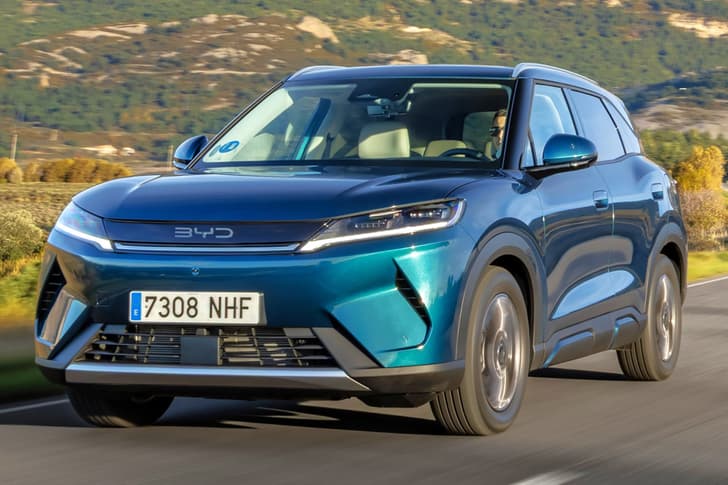

BYD is bringing its DM-i PHEV technology to India in 2026, with the Atto 2 or Sealion 6 as the most likely launch models, offering up to 1,092km combined range.
BYD's first plug-in hybrid SUV for India is confirmed for launch in 2026, with the brand's official teaser naming its DM-i Super Plug-in Hybrid EV powertrain as the technology underpinning the new model. The two most credible candidates are the Atto 2 DM-i and the Sealion 6 — both spotted testing in India and both carrying specifications that would make them genuinely competitive in a segment that, until now, has been dominated by pure EVs and mild hybrids.
This is a meaningful shift. BYD India has sold only full-electric vehicles since entering the market, but globally the brand's PHEV lineup outsells its BEV range. Bringing DM-i to India targets a buyer pool that wants electrified running costs without the charging infrastructure dependency that still limits pure-EV adoption outside major metros.
To frame the choice buyers will face, here is a side-by-side look at the two likely BYD PHEV contenders and how they compare against the Maruti Suzuki e Vitara, which represents the pure-EV alternative in the same mid-premium space:
| Model | Powertrain Type | Battery Options | EV-Only Range | Combined Range | Peak System Power |
|---|---|---|---|---|---|
| BYD Atto 2 DM-i (7.8kWh) | PHEV (1.5L NA + electric) | 7.8 kWh | ~39 km (WLTP) | 928 km (WLTP) | 166 hp |
| BYD Atto 2 DM-i (18kWh) | PHEV (1.5L NA + electric) | 18 kWh | ~39 km (WLTP) | 998 km (WLTP) | 212 hp |
| BYD Sealion 6 (1.5T AWD PHEV) | PHEV (1.5L turbo + electric) | 18.3 kWh / 26.6 kWh | Up to 128 km (NEDC) | 1,092 km | 344 hp |
| Maruti Suzuki e Vitara | Pure BEV | 49 kWh / 61 kWh | 500+ km (claimed) | N/A (no ICE) | ~144 hp |
The table makes the core trade-off visible: PHEVs offer dramatically longer combined range and eliminate range anxiety entirely, while the Maruti Suzuki e Vitara delivers a cleaner, zero-tailpipe-emission drive for buyers who have reliable home or workplace charging. Neither is objectively superior — the right choice depends entirely on how and where you drive.
What exactly is BYD's DM-i technology, and why does it matter for India?
DM-i is defined as BYD's "Dual Mode – intelligent" plug-in hybrid architecture, a system in which a high-efficiency petrol engine and a dedicated electric motor work in parallel, with the electric motor handling most low-speed and urban driving while the petrol engine takes over or supplements at highway speeds. The result is a powertrain that prioritises electric driving first, using the combustion engine primarily as a range extender and generator rather than the primary drive source.
This architecture suits Indian driving patterns for two reasons. The majority of Indian car owners drive fewer than 50 km per day — a distance well within the electric-only range of even the smaller 7.8 kWh Atto 2 battery, meaning most daily commutes would run entirely on electricity. India's public fast-charging network, while growing rapidly, remains sparse outside Tier-1 cities. A PHEV sidesteps this constraint: if you cannot find a charger on a long highway run, you simply continue on petrol.
BYD's DM-i is not a new or unproven technology. It has been deployed across millions of vehicles in China and is now available in markets including Europe, Australia, and Southeast Asia. The India launch represents the technology's entry into one of the world's largest and most price-sensitive automotive markets — and BYD's confidence that Indian buyers are ready for it.
Which model is BYD actually bringing — the Atto 2 or the Sealion 6?
BYD has not officially named the model as of late May 2026, but the evidence points strongly toward both being under active consideration, with the Atto 2 DM-i appearing to be the more immediate candidate.
The Atto 2 has been on BYD India's radar for some time. Test mules were spotted in India as far back as August 2025, and an India launch had been under evaluation even before that. In overseas markets, the Atto 2 DM-i is positioned as a compact-to-mid-size SUV — a segment that maps directly onto the Hyundai Creta EV, Tata Curvv EV, and Maruti Suzuki e Vitara bracket. The 7.8 kWh variant's 166 hp and 928 km combined WLTP range would be a strong value at the right price point. The 18 kWh variant steps up to 212 hp and nudges the combined range to 998 km.
The Sealion 6 is a more premium proposition. BYD showcased it at Auto Expo 2025 to gauge buyer interest, and test mules were spotted in India in May 2026 — suggesting the evaluation is well advanced. The Sealion 6 is visually related to the Sealion 7 EV, which has performed well in India since its early 2025 launch. That brand equity matters: buyers already familiar with the Sealion 7's design language and quality will find the Sealion 6 an easy step sideways into PHEV territory.
The Sealion 6's specifications are genuinely impressive. The 1.5-litre turbocharged AWD variant produces 344 hp and offers up to 128 km of NEDC-rated electric-only range — enough for most Indian buyers to run the car almost entirely on electricity during the working week. The 1,092 km combined range figure, even accounting for the optimism typical of NEDC testing cycles, suggests real-world highway range well above 800 km. The 1.5-litre naturally aspirated FWD variant is more modest at 218 hp but would likely be priced more accessibly.
NEDC-rated ranges are typically 20–30% higher than real-world figures, so the Sealion 6's 128 km electric-only claim should be read as approximately 90–100 km in mixed Indian driving conditions. That remains a very usable number.
How does a PHEV compare to a pure EV for Indian buyers in 2026?
This is the central question for anyone in the mid-premium SUV segment right now, and it does not have a single correct answer. The right choice depends on your charging access, daily driving distance, and how often you do long intercity runs.
The case for PHEV: A plug-in hybrid can run on electricity alone for a meaningful distance but carries a petrol engine for longer journeys or when charging is unavailable. For buyers in cities where apartment charging is not yet available — a very common situation in Indian high-rises — a PHEV offers most of the efficiency benefit of an EV during short daily drives, while the petrol engine handles everything else. You are never stranded. You never need to plan a route around charger locations. The running cost advantage over a conventional petrol car is real, even if you never plug in, because the regenerative braking and electric assist improve fuel economy significantly.
The case for pure EV: The Maruti Suzuki e Vitara is a pure battery-electric vehicle — meaning it produces zero tailpipe emissions, has a mechanically simpler drivetrain with fewer components to service, and offers a smoother, quieter drive than any hybrid. For buyers with home charging or reliable workplace charging, the per-kilometre running cost of a pure EV is lower than a PHEV, because you are never burning petrol. The e Vitara's 49 kWh and 61 kWh battery options offer claimed ranges above 500 km, which is sufficient for most intercity travel in India if you plan charging stops. In cities like Bengaluru, Delhi, or Mumbai where the fast-charging network is reasonably dense, a pure EV is a genuinely practical daily driver.
The honest middle ground: For buyers who do more than 100 km of highway driving per week and do not have guaranteed home charging, a PHEV like the BYD Atto 2 DM-i or Sealion 6 is likely the more practical choice in 2026. For buyers with home charging who primarily drive within city limits, the e Vitara or a comparable pure EV will deliver lower running costs and a simpler ownership experience. The best electric cars for long trips in India guide on this site explores the pure-EV side of this equation in detail.
Why is 2026 the year PHEVs are finally arriving in India?
Several forces have converged to make 2026 the inflection point for PHEVs in India, and it is not coincidental that multiple brands are moving simultaneously.
India's public EV charging network has grown substantially since 2022, but coverage outside major urban corridors remains patchy. PHEVs function without any charging infrastructure at all — they simply become more efficient when you do plug in. This makes them a lower-risk purchase for buyers in Tier-2 and Tier-3 cities, or for those who travel frequently between cities where charging availability is uncertain.
India's GST structure currently treats PHEVs differently from pure EVs, but there is active policy discussion around revised GST structures for cleaner hybrid technologies. Industry observers note that manufacturers like Maruti Suzuki, Toyota, and Mahindra are expected to expand their hybrid and PHEV offerings precisely because the regulatory direction favours electrified powertrains without mandating full battery-electric transitions.
Rising fuel prices add another layer. CNG prices in Delhi reached Rs 83.09 per kg by late May 2026 after a series of hikes — context that makes the fuel-efficiency argument for PHEVs and EVs more compelling than it was two years ago. A PHEV running primarily on electricity for city commutes and switching to petrol on highways offers a hedge against both fuel price volatility and charging anxiety.
Finally, there is the competitive dynamic. BYD's PHEV entry is partly a response to the success of pure-EV rivals in the mid-premium segment. The Sealion 7 EV has done well in India, but BYD is aware that a significant portion of the market remains unconvinced by pure EVs. A PHEV offering allows BYD to address that buyer segment without abandoning its electrification credentials.
What does BYD's PHEV entry mean for the competitive space?
The arrival of BYD's DM-i PHEV reshapes the mid-premium SUV segment in ways that extend beyond just adding another model to the list. It forces a recalibration of how buyers think about electrification.
Until now, the choice in this segment has been binary: buy a conventional petrol or diesel SUV, or commit to a pure EV. The Maruti Suzuki e Vitara, Hyundai Creta EV, Tata Curvv EV, and BYD Sealion 7 represent the pure-EV camp. The Toyota Hyryder and Maruti Grand Vitara represent the strong hybrid camp — efficient but not plug-in capable. BYD's PHEV entry creates a third lane: vehicles that can be driven as EVs for daily use but carry a petrol engine for everything else.
This matters for the e Vitara specifically. The Maruti Suzuki e Vitara is positioned as a premium, technology-forward pure EV — a vehicle for buyers who have made the decision to go fully electric. Its pure-EV positioning is a strength for that buyer, but it also means it is not competing for the buyer who wants electrification without full commitment. BYD's PHEV, by contrast, is explicitly targeting that undecided middle — buyers who are attracted to electric running costs and reduced emissions but are not yet ready to give up the petrol safety net.
The competitive pressure is real but not direct. The e Vitara and a BYD PHEV are answering different questions. The e Vitara answers: "What is the best pure EV in this price bracket?" A BYD PHEV answers: "How do I get most of the EV benefit without the range anxiety?" Buyers who have access to home charging and drive primarily in cities will still find the e Vitara compelling. Buyers who do not have that infrastructure or who travel long distances regularly will find the PHEV more practical.
For a broader view of how pure EVs stack up in this segment, the best electric SUVs in India in 2026 guide covers the full competitive field.
What are the likely price points for BYD's India PHEV?
BYD has not announced pricing, and any figure at this stage is speculative. The brand's existing India pricing provides a useful anchor. The Sealion 7 EV launched in early 2025 at a price point that positioned it firmly in the premium segment. The Atto 2, if launched as a PHEV, would logically be priced below the Sealion 7 to address a broader audience.
In markets where the Atto 2 DM-i is already on sale, it is priced competitively against mid-size petrol SUVs — not at a significant premium. If BYD can replicate that positioning in India, the 7.8 kWh Atto 2 DM-i may land in the Rs 18–24 lakh bracket, which would put it squarely against the Hyundai Creta EV, Tata Curvv EV, and the Maruti Suzuki e Vitara's entry variants.
The Sealion 6, with its larger battery and higher power output, would command a premium — likely in the Rs 25–35 lakh range, depending on which variant BYD chooses to launch. The 1.5-litre turbo AWD variant with 344 hp would be the headline specification but may be priced above the volume sweet spot. The FWD naturally aspirated variant at 218 hp is the more likely volume seller.
India's import duty structure for CBU (completely built unit) vehicles remains a significant cost factor. BYD currently imports its India-market vehicles as CBUs, which means the duty burden is substantial. Until BYD establishes local assembly — which the brand has been evaluating but has not yet confirmed — its PHEVs will carry a price premium over locally assembled rivals. This is the single biggest variable in the pricing equation.
What should buyers watch for before making a decision?
Several things remain unclear as of late May 2026, and buyers considering a BYD PHEV should wait for official confirmation on the following:
Model identity: BYD has confirmed the DM-i powertrain is coming but has not named the model. The Atto 2 and Sealion 6 are the two credible candidates, but they are meaningfully different vehicles in terms of size, power, and likely price. The choice between them matters.
Battery variant availability: Both the Atto 2 and Sealion 6 come in multiple battery configurations globally. BYD may choose to launch only one variant in India initially — as it has done with previous models — which could limit buyer choice. The 7.8 kWh Atto 2 variant's 39 km electric-only range is modest by 2026 standards; the 18 kWh variant's range is more useful for urban driving.
GST classification: India's tax treatment of PHEVs is not as favourable as for pure EVs. PHEVs currently attract a higher GST rate than BEVs, which affects the total cost of ownership calculation. Any policy change before the BYD PHEV launch could significantly alter the value.
After-sales network: BYD's service network in India has expanded but remains concentrated in larger cities. For a PHEV — which has both an electric drivetrain and a petrol engine to maintain — service access matters more than for a pure EV. Buyers outside major metros should verify local service availability before committing. The best electric SUV after-sales service network guide on this site is a useful reference for understanding how brands compare on this dimension.
Real-world range validation: The combined range figures quoted for BYD's PHEVs — 928 km for the Atto 2, 1,092 km for the Sealion 6 — are based on WLTP and NEDC test cycles respectively. Real-world figures in Indian conditions, particularly in high-traffic urban environments and on summer highway runs, will differ. Independent testing once the vehicles are in India will be essential before these numbers can be taken at face value.
How does this fit into the broader 2026 PHEV wave in India?
BYD is not alone in reading the Indian market this way. The 2026 SUV space is seeing multiple brands move toward plug-in hybrid offerings simultaneously. MG is expected to bring the Starlight 560 PHEV as an XUV700 rival, while Jetour is positioning the T2 Hybrid for adventure-oriented buyers. The Kia Syros EV, confirmed for a July 2026 launch at an expected Rs 14–20 lakh price point, represents the pure-EV end of the compact SUV segment.
This simultaneous arrival of multiple PHEV and EV options marks a "hybrid-EV transition phase" — a period in which buyers are not being asked to choose between old and new technology, but between different degrees of electrification. PHEVs act as the bridge: they require no infrastructure commitment, carry no range anxiety, and still deliver meaningful reductions in fuel consumption and emissions for buyers who plug in regularly.
India's charging infrastructure, while improving, is still evolving. PHEVs solve the range anxiety problem that remains the single biggest barrier to pure-EV adoption among buyers outside the top eight to ten cities. As noted by market analysts, rising fuel prices and government pressure toward electrification are accelerating demand for hybrid and PHEV options — not as a permanent destination, but as a practical step for buyers who are not yet ready to go fully electric.
For buyers who are ready to go fully electric, the best electric cars to buy in India in 2026 guide covers the full spectrum of available options, including safety-rated models tracked in the 5-star Bharat NCAP electric cars guide.
The bottom line for mid-premium SUV buyers in 2026: the arrival of BYD's DM-i PHEV means the segment is no longer a binary choice between petrol and pure EV. A third, genuinely capable option is arriving — one that makes the most sense for buyers who want to electrify their daily commute without surrendering flexibility on longer runs. Whether that trade-off is worth the likely price premium over a comparable pure EV depends on your specific driving life. The data, when BYD finally confirms the model and price, will make that calculation straightforward.
Sources
- BYD teases its first plug-in hybrid SUV for India - Autocar India
- BYD Atto 2 mid-size SUV spied on test in India - Autocar India
- BYD Sealion 6 plug-in hybrid SUV spied in India - Autocar India
- BYD Sealion 6 PHEV debuts at Auto Expo 2025 - Autocar India
- BYD India evaluating Creta EV rival for 2025 launch - Autocar India
- 6 Upcoming Hybrid & Electric SUVs in India 2026 - Auto Punditz
- Maruti Suzuki e Vitara - Official Page