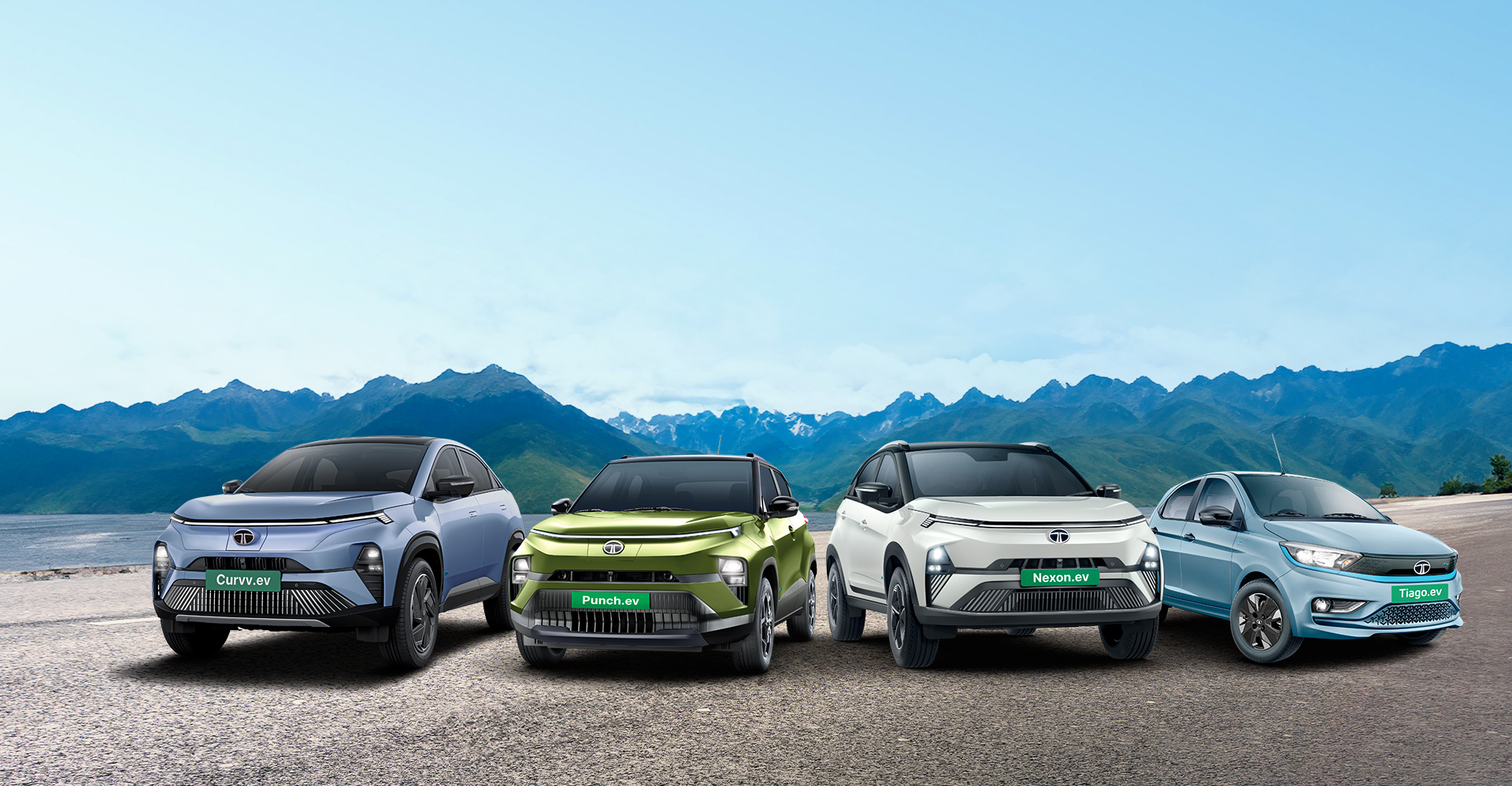

Tata's updated Tiago EV launches May 28, 2026, with bolder styling and prices from ₹7.99 lakh, keeping it India's cheapest electric hatchback.
The updated Tata Tiago EV launches May 28, 2026, with a thoroughly revised exterior and interior, maintaining its position as India's most affordable electric car — priced from ₹7.99 lakh (ex-showroom) with an ARAI-certified range of up to 293 km on the long-range variant.
Tata revealed both the updated Tiago ICE and Tiago EV simultaneously ahead of the launch date, treating the hatchback as a dual-powertrain platform rather than a standalone EV product. The design overhaul — new headlights, revised tail-lights, and fresh alloy wheel designs — gives the car a bolder road presence that the current model, launched in September 2022, has lacked against newer competitors.
Here's how the updated Tiago EV compares to the two most relevant alternatives in the affordable EV space:
| Specification | Tata Tiago EV (2026, LR) | Citroen eC3 | Maruti Suzuki e Vitara (base) |
|---|---|---|---|
| Ex-showroom price (approx.) | ₹7.99 – ₹11.14 lakh | ₹12.00 lakh+ | ₹17.49 lakh+ |
| ARAI-certified range | 293 km (24 kWh) | 320 km | 497 km (60.97 kWh) |
| Battery capacity | 19.2 kWh / 24 kWh | 29.2 kWh | 49 kWh / 60.97 kWh |
| Peak power | 75 hp (LR) | 57 hp | 144 hp / 174 hp |
| Body type | Hatchback | Hatchback | SUV |
| Boot space | 240 litres | 315 litres | ~328 litres |
| 0–60 kph | 5.7 seconds | ~8 seconds | ~7 seconds (est.) |
The Tiago EV wins decisively on price and acceleration, while the Maruti Suzuki e Vitara — a premium electric SUV targeting a different buyer — offers nearly double the real-world range and significantly more cabin space. These are not cross-shop comparisons; they reflect different decisions about budget and use-case.
What exactly has Tata changed in the 2026 Tiago EV update?
The 2026 refresh is a mid-cycle facelift rather than a ground-up redesign. Tata has focused on three areas: exterior styling, interior quality, and feature additions, while leaving the powertrain architecture largely untouched.
The updated Tiago EV gets redesigned headlamp clusters with sharper, more angular graphics. Tail-lights have been revised to create a connected light bar effect at the rear — a design language increasingly common across Tata's EV lineup, from the Nexon EV to the Curvv EV. New alloy wheel designs replace the aero-cover-heavy look of the current car, delivering a more conventional but premium appearance. The closed-off front grille — a signature EV design cue — is retained, along with blue EV badging on the exterior and interior.
Inside, the Tiago EV's infotainment system is expected to reach 10.25 inches on higher trims (already available on current top-spec), with wireless Apple CarPlay and Android Auto, cruise control, and tyre pressure monitoring. The digital instrument cluster continues, and connected car technology with smartwatch compatibility — introduced in the 2025 model year — carries over.
Battery and motor configuration remain unchanged. The 19.2 kWh medium-range pack produces 61 hp and 110 Nm, while the 24 kWh long-range pack produces 75 hp and 114 Nm. Tata claims 0–60 kph in 6.2 seconds for the MR and 5.7 seconds for the LR — figures that remain competitive for a sub-₹12 lakh electric car.
Is the Tiago EV's range still good enough in 2026?
Range anxiety remains the single biggest objection to owning a small, affordable electric hatchback like the Tiago EV. The ARAI-certified 293 km for the LR variant sounds reasonable on paper, but real-world combined range sits at approximately 187 km — translating to about 7.77 km/kWh.
For buyers who drive primarily within a city or on fixed daily commutes under 60–70 km, 187 km of real-world range is entirely adequate. Overnight charging on a 3.3 kW AC home charger (Tata claims 8.7 hours for a full charge on the LR pack) means starting each day with a full battery. The car never needs a public fast charger for daily use.
Weekend highway runs or intercity travel present a different story. At 187 km of real-world range, a Delhi-to-Agra trip (roughly 230 km) requires a charging stop — and the Tiago EV's 3.3 kW onboard charger means DC fast charging is not an option on most variants. The current model lacks DC fast charging across all trims, a meaningful limitation compared to the Citroen eC3 (which also lacks DC fast charging on base trims) and a significant gap versus the Maruti Suzuki e Vitara, which pairs its 60.97 kWh battery with a much larger range buffer and supports faster AC charging.
If Tata has added DC fast charging support to the 2026 Tiago EV — something not yet confirmed in the pre-launch reveal — it would be a meaningful upgrade. Full specifications arrive May 28.
For broader context on range across India's electric car segment, our guide to the best electric cars for long trips in India in 2026 provides a full breakdown.
How does the Tiago EV's pricing strategy work against the Maruti e Vitara?
The Maruti Suzuki e Vitara sits in the ₹17–23 lakh bracket as India's first mass-market electric SUV from the country's largest carmaker. The Tiago EV, at ₹7.99–₹11.14 lakh, is not a direct competitor — yet both cars compete for the same household budget allocation.
A family considering their first EV purchase in India in 2026 faces a genuine fork in the road. They can buy a Tiago EV LR for around ₹11 lakh on-road and get a practical, proven city-friendly electric hatchback with three-plus years of Tata's EV service network. Or they can stretch to ₹18–20 lakh on-road for the e Vitara's base variant and gain substantially more range, a larger cabin, SUV ground clearance, and Maruti's 4,000+ dealer network.
The Tiago EV's value is strongest for buyers seeking a second car, a city commuter, or a first-time EV at the lowest possible ownership cost. The e Vitara makes more sense as a primary family car where range, space, and highway capability matter.
The May 28 launch resets the price anchor for India's budget EV segment. If Tata holds or marginally reduces pricing — plausible given the MY24 discounts of up to ₹1.30 lakh running through March 2026 — it signals that sub-₹10 lakh electric mobility is here to stay. This keeps pressure on Maruti to justify the e Vitara's premium with tangible feature and range differentiation, which the e Vitara does deliver.
What does the updated design actually look like, and does it matter?
Design carries weight in the hatchback segment. The Tiago ICE has always sold on value, but the EV variant attracts a slightly different buyer — typically more urban, more tech-aware, and more conscious of how the car looks parked outside an apartment complex.
The current Tiago EV's design, while clean, has aged noticeably since 2022. The aero wheel covers that came standard on most trims divided opinion: functional for range efficiency, but visually polarising. The 2026 update's shift to proper alloy wheels (at least on higher trims) addresses this directly.
The connected tail-light graphic at the rear is a meaningful visual upgrade. It brings the Tiago EV's rear-end design closer to what Tata has done with the Nexon EV and Punch EV facelifts, creating a more coherent family identity across the EV range. The new headlamp clusters sharpen the front-end, which previously looked somewhat soft compared to the Citroen eC3's more distinctive face.
Whether the design changes convince buyers previously put off by the Tiago EV's looks is subjective. Commercially, the refresh gives Tata's dealer network a fresh talking point and removes the "it looks dated" objection from sales conversations.
How does the Tiago EV compare to the Citroen eC3 after the update?
The Citroen eC3 is the Tiago EV's most direct rival in the electric hatchback space. Both are sub-₹15 lakh electric cars, both are hatchbacks, and both target urban buyers who want EV ownership without SUV prices.
The eC3 has a larger 29.2 kWh battery and 320 km ARAI range, which appears to be a clear win over the Tiago EV LR's 293 km. In real-world use, the gap narrows — Citroen's real-world range estimates are similarly discounted from ARAI figures. The eC3's 57 hp motor is noticeably less powerful than the Tiago EV LR's 75 hp, making the Tata feel quicker off the line in city traffic.
Pricing is where the Tiago EV wins convincingly. At ₹7.99 lakh entry-level versus the eC3's higher starting point, the Tata is accessible to a meaningfully larger pool of buyers. The 2026 update reinforces rather than changes this dynamic.
Boot space favours the eC3: 315 litres versus the Tiago EV's 240 litres. For families who regularly carry luggage or prams, this matters. For solo commuters or couples, it rarely becomes a deciding factor.
Tata's service network advantage is also significant. Its EV service infrastructure, built over three-plus years of Nexon EV and Tiago EV sales, is considerably more developed than Citroen's in India. For buyers in Tier-2 cities, this can be the deciding factor.
What safety credentials does the Tiago EV carry into 2026?
Safety is an area where the Tiago EV has historically been at a disadvantage. The standard Tiago ICE received a 4-star Global NCAP rating in 2023, but the EV variant has not been separately crash-tested under the newer Bharat NCAP protocol launched in 2023.
This matters because Bharat NCAP is India's domestic vehicle safety assessment programme, aligned with Global NCAP methodology, and its ratings increasingly filter informed buyer decisions. The Tiago EV's absence from Bharat NCAP testing is a gap Tata has not yet addressed publicly.
For buyers who prioritise safety ratings alongside EV credentials, our guide to 5-star Bharat NCAP electric cars in India is worth reading before deciding. The Maruti Suzuki e Vitara, by contrast, is expected to pursue strong safety ratings given Maruti's renewed focus on crash performance following the Grand Vitara's NCAP results.
Standard safety features on the Tiago EV include dual airbags, ABS with EBD, rear parking sensors, and a rear camera on higher trims. The 2026 update has not been confirmed to add additional airbags or advanced driver assistance systems (ADAS), which remain absent from this price segment — a reasonable trade-off at under ₹12 lakh but worth noting for buyers comparing against the e Vitara's more feature-rich safety package.
What are the charging options and real ownership costs?
Charging infrastructure and running costs are where the Tiago EV makes its strongest case as a daily driver. At approximately ₹7–8 per kWh on home electricity tariffs, a full charge of the 24 kWh LR pack costs roughly ₹168–192. That delivers around 187 km of real-world range, translating to a per-kilometre fuel cost of under ₹1.05 — compared to roughly ₹6–7 per km for a petrol Tiago at current fuel prices.
Over 50,000 km of annual city driving, that difference compounds to savings of approximately ₹2.5–3 lakh per year in fuel costs alone, before accounting for lower servicing costs (no oil changes, fewer brake wear items due to regenerative braking).
Tata's claimed charging time of 8.7 hours for the 24 kWh pack on a 3.3 kW AC charger is consistent with overnight home charging. Most buyers will plug in at 10 pm and wake up to a full battery. The absence of DC fast charging on most variants is only problematic if you regularly need to charge on the go — which, for a city commuter, is rare.
Tata's home charger installation support and the Tez app for connected car features (remote charge monitoring, pre-conditioning, trip planning) add genuine convenience value beyond raw specifications.
For a full cost picture of EV ownership in India, including battery replacement scenarios and service costs, our best electric cars under ₹20 lakhs guide covers the segment comprehensively.
Who should buy the updated Tiago EV, and who should look elsewhere?
The updated Tiago EV suits a specific buyer profile: urban, commute-focused, budget-conscious, and comfortable with the limitations of a small hatchback. If your daily driving is under 60 km, you have access to home charging, and you want the lowest possible entry point into EV ownership, the Tiago EV remains the most compelling option in India in 2026.
It is not the right choice if you regularly drive on highways, need to carry four adults comfortably on long trips, or want a car that serves as your household's only vehicle for all use cases. In those scenarios, the Tata Nexon EV, the Citroen eC3 (for slightly more range), or — with a significantly larger budget — the Maruti Suzuki e Vitara makes more sense.
The e Vitara's positioning as a premium electric SUV answers a different question: can an electric car replace a petrol SUV as a family's primary vehicle? The Tiago EV's question is simpler: can an electric car replace a petrol hatchback for city use at the lowest possible cost? Both answers are yes in 2026 — but they are not interchangeable.
Buyers exploring the full range of options in the affordable EV segment before the May 28 launch should consult our best electric cars to buy in India in 2026 guide for a broader comparison.
What should buyers watch for at the May 28 launch?
Three things will determine whether the 2026 Tiago EV is a meaningful upgrade or a cosmetic refresh:
Pricing. If Tata holds the ₹7.99 lakh entry price or reduces it, the car strengthens its position as India's most accessible EV. If prices rise by more than ₹30,000–40,000 across variants, the value weakens against the backdrop of MY24 discounts running through early 2026.
DC fast charging availability. Adding DC fast charging support — even at 7.2 kW or 15 kW — to the LR variant would remove the biggest practical objection to the car. Tata has the technology in its portfolio (the Nexon EV and Punch EV both support DC fast charging), and bringing it to the Tiago EV would constitute a genuine upgrade rather than a styling exercise.
Battery warranty terms. Tata currently offers an 8-year/1.6 lakh km battery warranty on the Tiago EV, among the best in the segment. Any change to these terms will matter to buyers calculating long-term ownership costs.
The May 28 launch event will also confirm on-road pricing across cities, variant-level feature lists, and delivery timelines. Given that the MY24 model has been available with discounts of up to ₹1.30 lakh in recent months, dealers will be eager to clear existing stock before the new model arrives — making the next week a potentially good time to negotiate on the outgoing variant if you are not particular about the new design.
India's budget EV segment is at an inflection point in 2026. The Tiago EV's refresh, the Maruti Suzuki e Vitara's arrival, and the gradual expansion of public charging infrastructure are collectively shifting the conversation from "should I buy an EV?" to "which EV fits my life?" The Tiago EV's answer — affordable, proven, city-ready — remains as relevant today as it was when the car first launched in 2022. The May 28 update is Tata's bet that it will stay relevant for the next three years.
Sources
- Tata reveals updated Tiago, Tiago EV ahead of May 28 launch
- Tata Tiago EV – Price, Range & Expert Reviews | Autocar India
- Maruti Suzuki e Vitara – Official Page
- Best Electric Cars to Buy in India in 2026 | EV Index India
- Best Electric Cars Under ₹20 Lakhs in India in 2026 | EV Index India
- Best Electric Cars for Long Trips in India in 2026 | EV Index India
- Which 5-Star Bharat NCAP Electric Cars in India Are Worth Buying in 2026? | EV Index India