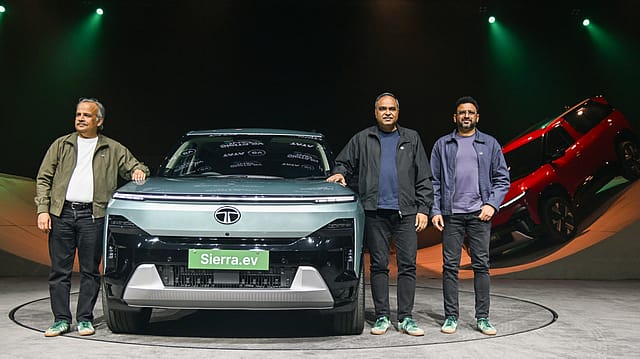

Tata Motors crossed the 20% EV penetration mark in October 2026, with electric vehicles accounting for roughly 1 in 5 passenger cars sold, driven by a 75% year-on-year surge and the Punch.ev's record 5,000-unit month.
Tata Motors Hits 20% EV Sales in October 2026: What India's EV Penetration Milestone Means for Buyers
In October 2026, electric vehicles accounted for approximately 20–21.5% of Tata Motors' total passenger vehicle sales — the first time the company has crossed the 1-in-5 threshold in a single month, marking a structural shift in how India's largest electric passenger vehicle maker generates its volumes.
Two measurement approaches yield slightly different figures. VAHAN retail registration data, reported by E-Vehicle Info, shows 14,552 EV registrations out of 73,002 total passenger vehicle registrations — an EV share of 19.9%. Wholesale dispatch data covering domestic and international markets, reported by Mint and Times of India Auto, puts total EV sales at 16,244 units out of 75,426 — a share of 21.5%. Timing lags between factory dispatches and retail registrations, plus a small export volume in the wholesale figure, explain the gap. Both data sets confirm the same reality: EVs now constitute a structurally significant slice of Tata's business, not a rounding error.
To put October's performance in context, here are the key competitors and new entrants shaping the segment:
| Model / Brand | Segment | Price Range (ex-showroom) | ARAI Range | Oct 2026 Relevance |
|---|---|---|---|---|
| Tata Punch.ev | Compact electric SUV | ₹9.79 – ₹12.99 lakh | 365 km (30 kWh) / 468 km (40 kWh) | First standalone EV to cross 5,000 monthly dispatches |
| Mahindra XUV 9S | Mid-size electric SUV | ~₹21–26 lakh (est.) | ~450–500 km (est.) | Tata's closest rival in monthly EV dispatch rankings |
| Maruti Suzuki e Vitara | Mid-size electric SUV | ~₹17–22 lakh (est.) | ~500 km (est.) | Entering market as Tata's 20% EV share raises competitive stakes |
| Tata Nexon.ev | Compact electric SUV | ~₹14–20 lakh | ~465 km (est.) | Core volume driver alongside Punch.ev |
| Tata Curvv.ev | Coupe-SUV electric | ~₹17–22 lakh | ~502 km (est.) | Expanding Tata's mid-size EV presence |
Price and range estimates for Mahindra XUV 9S and Maruti e Vitara are indicative; verify with brand showrooms before purchase.
What does "20% EV penetration" actually mean for a carmaker?
EV penetration rate is the proportion of electric vehicles in a manufacturer's total passenger vehicle sales within a given period. When Tata Motors crosses 20% EV penetration, it means that for every 100 passenger cars the company sells, at least 20 are battery-electric — with no combustion engine, no hybrid, no CNG.
This differs markedly from India's overall EV penetration rate, which remained in the low single digits for the passenger vehicle segment as a whole. Tata's internal rate of 20%+ is significant because it shows that a mainstream Indian automaker — one that sells everything from the Tiago hatchback to the Safari SUV — has reached a point where electric models are no longer a niche within its own portfolio.
For buyers, this matters practically: a manufacturer that derives one-fifth of its revenue from EVs has strong financial and reputational incentives to invest in after-sales infrastructure, software updates, and battery warranty support for those models. The risk of a manufacturer quietly deprioritising its EV line diminishes as that line's share of total business grows.
How did Tata reach this milestone in October 2026?
Tata Motors' electric passenger vehicle sales rose 74.9% year-on-year in October 2026, from 9,286 units in October 2025 to 16,244 units, according to Mint. That growth rate is nearly three times faster than the company's overall passenger vehicle growth of 23% in the same period.
Open Magazine's analysis sharpens the picture: total passenger vehicle sales increased by 14,131 units year-on-year, and EVs contributed 6,958 of those additional units — approximately 49.2% of the entire incremental growth. Nearly half of Tata's year-on-year volume increase came from electric models.
Three factors drove this acceleration:
The Punch.ev's volume breakthrough. The Punch.ev crossed 5,000 monthly wholesale dispatches for the first time in October, according to Mint, making it the first standalone electric passenger car model in India to achieve that milestone. The model had been tracking between 4,400 and 4,700 units in preceding months, so October represented a meaningful step up.
A tough base that still got beaten. October 2025 was not a soft comparison month. Times of India Auto notes it was the first full month after a GST cut in September 2025, and Diwali fell on 21 October 2025. This year, Dhanteras and Diwali fall on 6–8 November 2026, meaning October 2026's strong performance came before the main festive buying window.
Portfolio depth. Tata's EV lineup now spans the Punch.ev, Nexon.ev, Curvv.ev, and Avinya concept pipeline. The company is not dependent on a single model to generate EV volume, which reduces the risk of a single supply disruption derailing monthly numbers.
What is the Punch.ev's 5,000-unit milestone, and why does it matter?
The 5,000-unit monthly dispatch milestone marks the point at which a single electric passenger car model ships 5,000 or more units from manufacturer to dealerships within a calendar month. No standalone electric passenger car in India had previously crossed this threshold, according to Mint.
The Punch.ev has been in a close race with the Mahindra XUV 9S for the top spot in monthly EV dispatch rankings. Mahindra briefly led in August 2026 with 4,508 units against Punch.ev's 4,430. Tata reclaimed the lead in September with 4,702 units against Mahindra's 4,636 — a margin of just 66 units. October's 5,000+ units for the Punch.ev opened that gap considerably.
For buyers considering the Punch.ev, the volume milestone carries practical weight: higher production throughput typically means shorter waiting periods and better parts availability at service centres. The model is priced between ₹9.79 lakh and ₹12.99 lakh (ex-showroom) following a September 2026 price revision, and offers 30 kWh and 40 kWh battery options with ARAI-certified ranges of 365 km and 468 km respectively. It also carries a 5-star Bharat NCAP safety rating — if safety ratings are a priority in your shortlist, our guide to 5-star Bharat NCAP electric cars in India covers the full picture.
Tata also offers a Battery as a Service (BaaS) option on the Punch.ev, which separates the battery cost from the vehicle price and can reduce the upfront purchase amount significantly. Our explainer on BaaS models in India covers how this works and whether it makes financial sense for different buyer profiles.
One important clarification: the 5,000-unit figure is a wholesale dispatch number reported by the company, not the same as the 14,552 VAHAN retail registrations for all Tata EVs combined. Wholesale dispatches and retail registrations differ because of pipeline inventory, timing cut-offs, and the fact that dispatched vehicles may sit at dealerships before being registered to end customers.
How does Mahindra compare, and where does the Maruti e Vitara fit in?
Mahindra reached an EV share of 13.2% of its passenger vehicle registrations in October 2026, according to E-Vehicle Info. That is meaningful for a company that only recently entered the electric passenger vehicle segment at scale, but it trails Tata's 20% share by roughly 7 percentage points.
The more strategically interesting entrant is the Maruti Suzuki e Vitara. Maruti Suzuki is India's largest passenger vehicle manufacturer by volume, and its entry into the electric SUV segment with the e Vitara represents the first time the company has fielded a battery-electric passenger car in the Indian market. The e Vitara is positioned in the mid-size electric SUV segment — broadly the same territory as the Tata Nexon.ev and Curvv.ev, and adjacent to the Mahindra XUV 9S.
Tata's 20% EV penetration milestone is directly relevant to the Maruti e Vitara's competitive positioning. It signals that Indian buyers are now comfortable purchasing electric vehicles from mainstream manufacturers at scale — not just as early adopters, but as a significant portion of the buying population. For Maruti, which has a vastly larger dealer and service network than Tata, this is both a challenge and an opportunity: the market is proven, but Tata has a multi-year head start in EV-specific infrastructure, battery management software, and customer familiarity.
For a buyer comparing the two, the e Vitara brings Maruti's legendary service reach and resale value reputation to the EV segment. Tata brings deeper EV-specific experience, an established charging space, and a broader model range across price points. The most affordable way to own an electric SUV in India guide on this site compares total cost of ownership across these options in more detail.
Does the broader passenger vehicle market contraction matter for EV buyers?
Yes. India's overall passenger vehicle market faced pressure in October 2026. The Hindu BusinessLine reported that total industry passenger vehicle wholesales were near 5 lakh units for the month, with the festive season's main buying days (Dhanteras, Diwali) falling in November rather than October this year.
Within this environment, Tata's 23% year-on-year passenger vehicle growth stands out. But the more important signal for EV buyers is that Tata's EV growth of 75% happened despite, not because of, a buoyant overall market. EV demand is not simply riding a broad auto sector wave — it is outpacing the overall market by a factor of roughly three.
This has two implications for buyers. First, EV supply constraints are more likely than demand constraints in the near term. If you are considering a Punch.ev or Nexon.ev, check actual delivery timelines at your local dealership rather than assuming immediate availability. Second, the fact that EVs are growing faster than the overall market means manufacturers are allocating more production capacity to electric models — which should, over time, improve availability and moderate prices.
What are the risks and limitations in reading October's numbers?
Several caveats deserve attention before drawing firm conclusions from a single month's data.
Festive season timing distortion. Diwali fell on 21 October 2025 but on 8 November 2026, according to Times of India Auto. This means October 2025 captured peak festive demand, while October 2026 did not. The 75% year-on-year EV growth is therefore measured against a relatively strong base month, which makes it more impressive — but it also means November 2026 may show an even larger absolute number as the actual festive buying window opens.
Wholesale vs. retail distinction. The 16,244 EV figure is a wholesale dispatch number. The 14,552 figure from VAHAN is a retail registration number. Neither is wrong; they measure different things. For buyers, the retail registration figure is more relevant — it represents cars that have actually been delivered and registered to customers. The gap between the two (approximately 1,700 units) represents vehicles in the dealer pipeline.
Single-month volatility. One month's data does not establish a trend. The Punch.ev's 5,000-unit October may be followed by a softer November if festive demand pulls forward into the first week of the month and then normalises. Mint notes that sustaining 5,000+ monthly dispatches over the next several months will be the real test of whether October signals a structural demand shift.
Competition is intensifying. Mahindra is expanding its electric SUV lineup, and the Maruti Suzuki e Vitara's entry into the mid-size EV segment will add a well-resourced competitor with India's largest dealer network. Tata's current dominance in EV market share is not guaranteed to persist at the same level as the competitive field deepens.
What should buyers take away from Tata's October EV numbers?
For a buyer actively evaluating an electric vehicle purchase in late 2026, Tata's October performance carries several concrete implications.
The Punch.ev is now a volume product, not a niche one. Crossing 5,000 monthly dispatches means the model is being produced and sold at a scale that supports a solid parts supply chain and trained service technicians at a meaningful number of dealerships. If you have been hesitant about EV after-sales support, the volume numbers reduce — though do not eliminate — that concern. Our guide to the best after-sales service network for electric SUVs in India provides a more granular breakdown.
The mid-size EV segment is where the real competition is heating up. The Punch.ev's sub-₹13 lakh price point is relatively uncrowded. But the ₹17–25 lakh segment — where the Tata Nexon.ev, Curvv.ev, Mahindra XUV 9S, and Maruti Suzuki e Vitara all compete — is becoming genuinely contested. Buyers in this range have more options than at any previous point, and the competitive pressure is likely to keep prices in check and push manufacturers to improve features and warranty terms.
EV penetration at 20% within Tata's portfolio signals mainstream acceptance. When a mainstream manufacturer crosses 20% internally, it is no longer accurate to describe EVs as an emerging or experimental category within that brand. For buyers who have been waiting for EVs to become "mainstream enough," Tata's October numbers are a reasonable signal that the threshold has been crossed — at least for this manufacturer.
Range anxiety is less relevant at current price points than it was two years ago. The Punch.ev's 40 kWh variant offers 468 km of ARAI-certified range at under ₹13 lakh. Real-world range will be lower — typically 70–80% of ARAI figures in mixed driving — but even at 330–370 km of real-world range, the model covers the needs of most urban and semi-urban buyers. If long-distance travel is a priority, our guide to the best electric cars for long trips in India in 2026 covers models with higher real-world range.
Battery as a Service remains a relevant cost lever. Tata's BaaS option on the Punch.ev can meaningfully reduce the upfront cost of entry into EV ownership. With the base Punch.ev starting at ₹9.79 lakh ex-showroom, and BaaS reducing that further, the total cost of ownership case for the model is stronger than the sticker price alone suggests. See our BaaS explainer for the full cost breakdown.
What happens next — and what should buyers watch?
The November 2026 sales data will be the first real test of whether October's numbers represent a new baseline or a festive-adjacent spike. Dhanteras and Diwali falling in early November means the main festive buying window is now open, and EV registrations in November could be higher still — or could normalise if October pulled forward some demand.
Beyond the monthly data, three structural developments will shape the EV market over the next six to twelve months:
The Maruti Suzuki e Vitara's ramp-up will test whether Maruti's distribution and service advantages can translate into EV market share quickly enough to challenge Tata's lead. Maruti's scale is formidable — the company sells more passenger vehicles in a month than Tata does across its entire portfolio — and even a modest EV penetration rate within Maruti's volumes would represent a large absolute number of units.
Charging infrastructure expansion remains the single most important enabler of EV adoption beyond the urban core. Buyers in Tier 2 and Tier 3 cities are watching this closely, and manufacturers that invest in or partner with charging networks will have a meaningful advantage in those markets.
Battery cost trajectories will determine how quickly the price gap between EVs and equivalent ICE vehicles narrows. At ₹9.79 lakh for the base Punch.ev, Tata has already brought an electric SUV to a price point that competes with mid-range petrol hatchbacks on total cost of ownership. Further battery cost reductions could push that crossover point even lower.
For buyers considering an EV purchase today, the October 2026 data from Tata Motors offers a useful data point: the market is real, the volumes are meaningful, and the competitive space is about to become significantly more interesting. Whether you are looking at the Punch.ev at the accessible end, the Nexon.ev or Curvv.ev in the mid-range, or waiting to evaluate the Maruti Suzuki e Vitara, the next six months will offer more options and, likely, more competitive pricing than any previous period in India's EV history.
Our best electric cars to buy in India in 2026 guide and the best electric cars under ₹20 lakh shortlist are updated regularly as new data comes in — worth bookmarking if you are in the research phase of your purchase.
Sources
- Tata Motors: 1 In 5 Cars Registered In October Was Electric - E-Vehicle Info
- Tata Punch.ev crosses 5,000 monthly dispatches for first time, sets new benchmark for India's EV market | Mint
- Auto Sales October 2026: Tata Motors Sells 75,426 Cars And 47,652 Commercial Vehicles | Times of India Auto
- QUICK TAKE | Seven Things to Know About Tata Motors' October Sales and 75% EV Surge | Open Magazine
- Festive surge: Cars near 5 lakh despite EV dip; two-wheelers top 23 lakh as electric models hit 2026 peak | The Hindu BusinessLine
- Tata Motors Passenger Vehicles — Official Site
- Maruti Suzuki e Vitara — Official Page