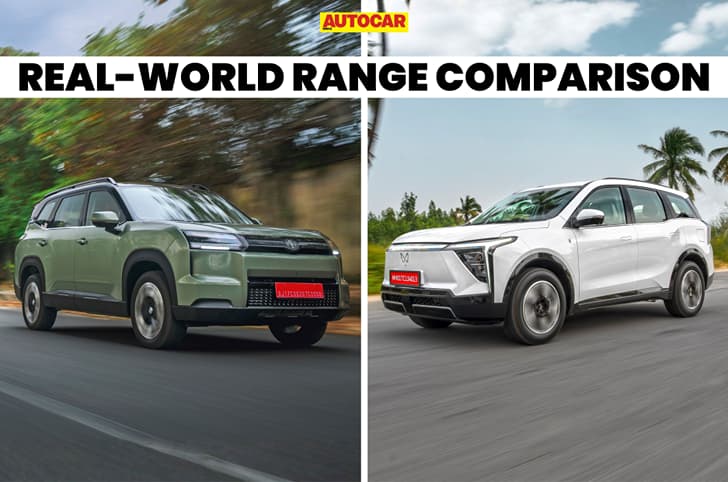

The Mahindra XEV 9S beats the MG Hector Tomahawk EV in real-world average range (477.5 km vs 446 km), though the MG leads in city efficiency. The XEV 9S costs more but offers a larger battery and faster charging.
MG Hector Tomahawk EV vs Mahindra XEV 9S: Real-World Range Test in India 2026
The Mahindra XEV 9S delivers a real-world average range of 477.5 km against the MG Hector Tomahawk EV's 446 km — a gap of 31.5 km — according to Autocar India's standardised range test conducted in October 2026. That headline number masks a more detailed story: the MG actually covers more ground in city conditions, while the Mahindra's advantage is entirely built on the highway. For most Indian family buyers choosing between these two 3-row electric SUVs, the split matters enormously.
Before diving into the driving data, here is a full specification and price snapshot of both cars alongside the Maruti Suzuki e Vitara — which competes in the compact SUV segment below but is included here to anchor the broader EV market context that 3-row buyers are navigating in 2026.
| Specification | MG Hector Tomahawk EV | Mahindra XEV 9S (79 kWh) | Maruti Suzuki e Vitara |
|---|---|---|---|
| Battery capacity | 69.2 kWh | 79 kWh | ~60 kWh (est.) |
| Motor setup | Single, front (FWD) | Single, rear (RWD) | Single, front (FWD) |
| Power | 204 hp | 286 hp | ~175 hp (est.) |
| Torque | 310 Nm | 380 Nm | ~300 Nm (est.) |
| Claimed ARAI/MIDC range | 517 km | 679 km | ~500 km (est.) |
| Real-world city range | 495 km | 478 km | — |
| Real-world highway range | 397 km | 477 km | — |
| Real-world average range | 446 km | 477.5 km | — |
| Max DC fast charging | 90 kW | 180 kW | ~50 kW (est.) |
| Kerb weight | 1,908 kg | 2,201+ kg | ~1,700 kg (est.) |
| Rows / seating | 3-row / 7-seat | 3-row / 7-seat | 2-row / 5-seat |
| Price (ex-showroom) | ₹19.50–23.50 lakh | ₹22.65–30.15 lakh | ₹17–22 lakh (est.) |
Note: e Vitara figures are estimates based on publicly available pre-launch data; real-world test data not yet available. XEV 9S kerb weight is inferred from the XEV 9e (2,201 kg); the 3-row 9S will be heavier.
What are the real-world range figures, and how were they measured?
Real-world range is the distance an electric vehicle can travel on a single full charge under conditions that replicate everyday Indian driving — as opposed to the controlled laboratory cycles used for ARAI or MIDC certification figures. Autocar India's methodology begins with each car charged to 100 percent, tyres inflated to manufacturer-recommended pressures, and a fixed loop covering both urban and expressway stretches at set average speeds. The air conditioning is set to 22°C in auto mode, and features such as the music system, lights, and ventilated seats are used as a regular owner would. Range is then calculated from the percentage of charge consumed across the loop, not by running the battery to zero.
Autocar India's test produced these results:
- MG Hector Tomahawk EV city range: 495 km
- MG Hector Tomahawk EV highway range: 397 km
- MG Hector Tomahawk EV average range: 446 km
- Mahindra XEV 9S city range: 478 km
- Mahindra XEV 9S highway range: 477 km
- Mahindra XEV 9S average range: 477.5 km
The MG's city figure of 495 km is 17 km ahead of the XEV 9S's 478 km — a meaningful lead given that a large share of Indian EV usage is urban. On the highway, the Mahindra's 477 km versus the MG's 397 km represents an 80 km gap that is hard to ignore for anyone planning intercity travel.
Both cars fall well short of their ARAI/MIDC claims. The Tomahawk EV achieves 86 percent of its 517 km claim in city conditions but only 77 percent on the highway. The XEV 9S achieves 70 percent of its 679 km claim in the city and 70 percent on the highway — a remarkably consistent real-world-to-claimed ratio across both environments, even if the absolute gap from the claimed figure is larger.
Why does the MG Hector Tomahawk EV do better in the city?
The city efficiency advantage of the Tomahawk EV comes down to two factors: weight and regenerative braking character.
The MG Hector Tomahawk EV weighs 1,908 kg. The Mahindra XEV 9S, being a 3-row extension of the XEV 9e platform (which itself weighs 2,201 kg), tips the scales at over 2,200 kg — a difference of more than 250 kg. In stop-start urban traffic, carrying less mass directly translates to lower energy consumption per kilometre.
Autocar India's performance test reveals an important nuance in regenerative braking. The XEV 9S recovers energy far more aggressively than the Tomahawk EV at every regeneration level. In the 80–20 kph regen distance test, the XEV 9S at L1 covers 341 m before slowing to 20 kph, while the Tomahawk EV covers 575.94 m — nearly 235 m more. At L3, the XEV 9S covers 162.46 m versus 210.09 m for the MG. Despite this, the MG still edges ahead in city range, which suggests its lighter kerb weight more than compensates for its milder regen.
The Tomahawk EV's regenerative braking, even in its strongest setting, is relatively mild, which limits its city efficiency ceiling. A stronger regen system may push its city range even further — but MG has clearly tuned for a smoother, less abrupt driving feel.
Why does the Mahindra XEV 9S dominate on the highway?
Highway range is the distance achievable on a single charge when driving at sustained expressway speeds — typically 80–120 kph in Indian real-world conditions — where aerodynamic drag and sustained motor load replace the stop-start losses of city driving.
At highway speeds, the weight penalty of the XEV 9S matters less, because the energy cost of acceleration events is reduced. What matters more is aerodynamic efficiency and motor efficiency at sustained load. The Tomahawk EV's bulky, upright body — measuring 4,745 mm long and 1,770 mm tall with a flat-fronted design — creates meaningful aerodynamic drag at expressway speeds, which Autocar India explicitly identified as a limiting factor. The XEV 9S, despite being heavier, appears to have a more aerodynamically efficient profile at speed.
The XEV 9S also benefits from a larger 79 kWh battery versus the MG's 69.2 kWh unit. At highway speeds where regen recovery is minimal, raw battery capacity becomes the dominant variable. The Mahindra has approximately 14 percent more usable energy to draw from, and on the highway — where the MG cannot recover losses through regen — this advantage compounds.
The result: 477 km for the XEV 9S versus 397 km for the Tomahawk EV on the highway. That 80 km gap is significant for buyers who plan to use their 3-row SUV for family road trips from Delhi to Jaipur, Mumbai to Pune, or Bengaluru to Mysuru.
How do they compare on acceleration and braking?
Range is only part of the performance picture. Autocar India's instrumented performance tests reveal a clear hierarchy in straight-line speed.
0–100 kph: XEV 9S in 7.54 seconds; Tomahawk EV in 8.23 seconds. 0–120 kph: XEV 9S in 9.98 seconds; Tomahawk EV in 11.28 seconds.
The gap is modest at lower speeds — just 0.08 seconds to 60 kph — but widens meaningfully above that. By 120 kph, the Mahindra is 1.30 seconds ahead, reflecting its 82 hp and 70 Nm advantages. The XEV 9S's rear-wheel-drive layout also contributes to its stronger high-speed pull, as the driven wheels are not fighting steering inputs.
In rolling acceleration, the XEV 9S completes the 20–80 kph kickdown run in 4.11 seconds versus 4.56 seconds for the MG, and the 40–100 kph run in 4.74 seconds versus 5.45 seconds. The Mahindra's advantage grows at higher speeds — exactly the scenario that matters for highway overtaking.
Braking tells a different story. The Tomahawk EV stops from 80 kph in 27.52 m (2.39 seconds), while the XEV 9S requires 29.67 m (2.55 seconds) — 2.15 m more. The MG's lighter weight gives it a stopping advantage in conventional braking, which is a genuine safety benefit.
Under regenerative braking, the XEV 9S is far more effective at all three levels, which has implications for both efficiency and driver feel. Buyers who prefer one-pedal-style driving will find the XEV 9S more satisfying; those who prefer a conventional driving experience may prefer the MG's gentler regen.
How do charging speeds compare, and does it matter for road trips?
Charging capability is the maximum rate at which a vehicle's battery can accept electrical energy from an external source, measured in kilowatts (kW) for DC fast charging and typically expressed as the time to charge between two state-of-charge percentages.
The XEV 9S supports DC fast charging at up to 180 kW, with Mahindra claiming a 20–80 percent charge in 20 minutes. The Tomahawk EV is rated at 90 kW DC, with MG quoting approximately 35 minutes for a 30–80 percent charge. These figures use different charging windows, so direct comparison requires caution — but the XEV 9S's peak charging rate is double that of the MG, which is a meaningful advantage at India's growing network of 150 kW+ fast chargers.
For AC charging at home, the XEV 9S supports an optional 11.2 kW onboard charger (in addition to the standard 7.2 kW unit), completing a full charge in approximately 8 hours. The Tomahawk EV supports 7.4 kW AC charging, taking around 12.5 hours from 10 to 100 percent.
For road-trip buyers — the primary audience for a 3-row electric SUV — the XEV 9S's faster DC charging and longer highway range make it the more capable long-distance vehicle. A buyer driving Delhi to Agra and back (approximately 420 km round trip) could complete the journey in the XEV 9S without charging, while the Tomahawk EV's 397 km highway range would require a top-up on the return leg.
For buyers focused on long-distance capability, our guide to best electric cars for long trips in India in 2026 provides additional context across the full market.
What does the MG Hector Tomahawk EV offer that the XEV 9S doesn't?
The Tomahawk EV is not simply a lesser version of the XEV 9S. It brings several genuine advantages that matter to specific buyers.
Price: The Tomahawk EV starts at ₹19.50 lakh (ex-showroom), which is ₹3.15 lakh less than the XEV 9S's entry price of ₹22.65 lakh. At the top of the range, the gap widens to ₹6.65 lakh. For buyers with a firm budget ceiling around ₹20–23 lakh, the Tomahawk EV is the only 3-row electric SUV in this comparison that fits. It also qualifies for the Battery-as-a-Service (BaaS) scheme at an introductory price of ₹13.99 lakh plus ₹4.90/km battery rental — a structure that lowers the upfront cost significantly for buyers who are uncertain about long-term battery ownership. Our guide to BaaS electric cars in India explains how this model works in practice.
Vehicle-to-Home (V2H): The Hector Tomahawk EV is the first vehicle in India to offer V2H capability, according to JSW MG Motor India's official launch announcement. This allows the car's 69.2 kWh battery to power household appliances during outages — a feature with real utility in Indian cities where power cuts remain common.
Platform: The Tomahawk EV is the first product built on MG's ADAPT (Advanced Drive Architecture Platform Technology) — described by the company as India's first Multi-New Energy Vehicle (NEV) platform. This means the same architecture underpins both the EV and the PHEV variant (which offers over 1,100 km combined range), giving buyers flexibility if they want to switch powertrains at a future purchase.
Lifetime battery warranty: Both the EV and PHEV variants of the Hector Tomahawk come with a lifetime battery warranty for the first owner — a strong ownership assurance that reduces long-term anxiety about battery degradation.
City range: As the real-world test confirms, the Tomahawk EV covers 17 km more than the XEV 9S in city conditions. For buyers in dense metros like Mumbai, Delhi, or Bengaluru whose daily driving is almost entirely urban, this is the number that matters most.
Braking: The Tomahawk EV stops 2.15 m shorter from 80 kph than the XEV 9S — a meaningful safety margin that reflects its weight advantage.
What does the Mahindra XEV 9S offer that the MG doesn't?
The XEV 9S's advantages are concentrated in performance, highway capability, and charging infrastructure readiness.
Highway range: 477 km versus 397 km — an 80 km advantage that is decisive for intercity travel.
Acceleration: Quicker from 0–100 kph (7.54 s vs 8.23 s) and significantly faster at highway speeds, with a 1.30-second gap to 120 kph. For buyers who want a 3-row family SUV that also feels genuinely quick, the XEV 9S is the stronger performer.
DC fast charging: 180 kW peak versus 90 kW. At India's expanding network of high-power chargers, the XEV 9S can replenish its larger battery in roughly the same time it takes the MG to charge its smaller one.
Regenerative braking effectiveness: At every regen level, the XEV 9S recovers energy more aggressively. At L3, it covers 162.46 m to slow from 80 to 20 kph; the MG covers 210.09 m. This makes the XEV 9S more efficient in mixed driving where partial deceleration events are frequent.
ARAI claimed range: 679 km versus 517 km. Even accounting for real-world discounting, the XEV 9S's larger certified range gives it a psychological and practical buffer.
Which buyer profile suits each car?
Choosing between these two 3-row electric SUVs is less about which is objectively better and more about which trade-offs align with your usage pattern.
Choose the MG Hector Tomahawk EV if:
- Your daily driving is predominantly urban (city range of 495 km is best-in-class for this segment)
- Your budget is between ₹19.50 lakh and ₹23.50 lakh
- You want V2H capability for home backup power
- You value a lifetime battery warranty and the BaaS pricing option
- You prefer gentler, more conventional regenerative braking
- Short stopping distances matter to you (27.52 m from 80 kph)
Choose the Mahindra XEV 9S if:
- You regularly drive on highways or plan intercity road trips (477 km highway range)
- You want faster DC charging for long-distance convenience (180 kW vs 90 kW)
- Performance matters — the XEV 9S is quicker to 100 kph and significantly faster at highway speeds
- You prefer stronger one-pedal-style regenerative braking
- Your budget extends to ₹22.65–30.15 lakh
For buyers whose budget or space requirements don't extend to a 3-row SUV, the Maruti Suzuki e Vitara is worth tracking. Positioned in the compact 5-seat electric SUV segment below these two vehicles, the e Vitara is expected to bring Maruti's extensive service network and competitive pricing to the EV space. As the 3-row electric segment matures — with the Tomahawk EV and XEV 9S establishing what real-world range looks like at the ₹20–30 lakh price point — it also sets benchmarks that a future larger Maruti platform sibling would need to meet. For now, the e Vitara serves a different buyer, but the efficiency lessons from this segment are directly relevant to where Maruti's EV ambitions are heading.
If safety ratings are a priority in your decision, our guide to 5-star Bharat NCAP electric SUVs under ₹25 lakh is worth reading alongside this comparison.
How do ARAI claimed figures compare to real-world results?
The ARAI (Automotive Research Association of India) claimed range is the maximum distance a vehicle can travel on a single charge under standardised laboratory test conditions, including controlled temperature, fixed speed profiles, and no accessory loads beyond the minimum required. It is not intended to represent real-world driving.
In this comparison, the gap between claimed and real-world figures is instructive:
| Metric | MG Hector Tomahawk EV | Mahindra XEV 9S |
|---|---|---|
| ARAI/MIDC claimed range | 517 km | 679 km |
| Real-world city range | 495 km (95.7% of claim) | 478 km (70.4% of claim) |
| Real-world highway range | 397 km (76.8% of claim) | 477 km (70.2% of claim) |
| Real-world average range | 446 km (86.3% of claim) | 477.5 km (70.3% of claim) |
The MG Hector Tomahawk EV achieves a higher percentage of its claimed range in real-world conditions — particularly in the city, where it reaches 95.7 percent of its ARAI figure. This suggests MG's 517 km claim is relatively conservative, or that the test cycle used aligns closely with Indian urban driving patterns.
The XEV 9S consistently achieves around 70 percent of its 679 km claim across both environments. This is not unusual for a vehicle with a large battery and high power output — more capable vehicles often have more optimistic certification figures. The real-world average of 477.5 km is still strong in absolute terms, and the highway figure of 477 km is genuinely impressive for a vehicle weighing over 2,200 kg.
Buyers should treat ARAI figures as a ceiling, not an expectation. For practical planning, the real-world averages from standardised tests like Autocar India's are the more useful reference points.
Is the price difference justified?
The MG Hector Tomahawk EV's base variant is ₹3.15 lakh cheaper than the XEV 9S's entry price, and the top-spec Tomahawk EV is ₹6.46 lakh cheaper than the XEV 9S Pack Three Above (₹29.95 lakh). That is a substantial gap.
What the extra money buys in the XEV 9S: 80 km more highway range, 82 hp more power, 70 Nm more torque, 90 kW faster DC charging, and stronger regenerative braking. What the MG offers for less: V2H capability, a lighter and more city-efficient package, shorter braking distances, and a lifetime battery warranty.
For buyers who will primarily use their 3-row SUV for school runs, weekend family outings, and occasional city driving, the Tomahawk EV's value is compelling. For buyers who treat their SUV as a road-trip vehicle — or who simply want the most capable electric SUV in this price band — the XEV 9S justifies its premium.
The BaaS option for the Tomahawk EV further complicates the comparison. At ₹13.99 lakh upfront plus ₹4.90/km battery rental, the total cost of ownership depends heavily on annual mileage. Buyers who drive fewer than 15,000 km per year may find the BaaS model cheaper over five years; high-mileage users will likely prefer the outright purchase price. Our detailed explainer on Battery as a Service in India breaks down the maths.
What should you know before buying either car?
Both vehicles are 3-row electric SUVs in a segment that is still establishing itself in India. A few practical considerations apply to both:
Charging infrastructure: Both cars support CCS2 DC fast charging, which is the dominant standard at Indian public charging stations. The XEV 9S's 180 kW capability future-proofs it for the next generation of ultra-fast chargers being deployed on national highways; the Tomahawk EV's 90 kW is adequate for current infrastructure but may feel limiting in three to four years.
Service network: MG has an established dealer network across India, and the Hector nameplate has been in the market since 2019 — giving it a service familiarity advantage. Mahindra's EV service network is expanding rapidly following the success of the XEV 9e. Our guide to after-sales service networks for electric SUVs in India provides a current comparison.
ADAS: Both vehicles offer Level 2 ADAS. The Tomahawk EV includes MG's i-SMART 3.0 with 80+ connected features and India's first GenAI-powered voice assistant capable of understanding 30+ Hinglish commands — a feature that may appeal to buyers who use voice control frequently. For a broader look at EVs with advanced driver assistance, see our guide to best electric cars with ADAS in India in 2026.
Dimensions: The Tomahawk EV measures 4,745 mm in length with a 2,810 mm wheelbase — segment-leading proportions that translate to genuine third-row usability. The XEV 9S is similarly sized. Both are large vehicles that will require consideration for tight urban parking.
The bottom line
The MG Hector Tomahawk EV and Mahindra XEV 9S are genuinely different vehicles that happen to share a segment. The Tomahawk EV is the more city-efficient, more affordable, and more feature-innovative option — with V2H, a lifetime battery warranty, and BaaS pricing that no competitor currently matches. The XEV 9S is the more capable highway machine, the quicker performer, and the faster charger.
If your driving is split evenly between city and highway, the XEV 9S's 477.5 km average range edges the MG's 446 km — but the ₹3–6 lakh price gap means the Tomahawk EV delivers better value per kilometre of real-world range for most buyers. If you live in a metro and rarely venture beyond 300 km from home, the Tomahawk EV's 495 km city range and lower price make it the smarter buy. If you're a road-trip family that covers 500+ km in a single day, the XEV 9S is the one to choose.
For buyers considering the broader EV market, our best electric cars to buy in India in 2026 guide covers the full spectrum from compact to premium — including where the Maruti Suzuki e Vitara fits for buyers who don't need three rows but want a trusted brand's take on electric mobility.
Sources
- MG Hector Tomahawk EV vs Mahindra XEV 9S real-world range compared | Autocar India
- Mahindra XEV 9S vs MG Tomahawk EV performance comparison | Autocar India
- JSW MG Motor India Launches the MG Hector Tomahawk in EV and PHEV | MG Motor Official Newsroom
- MG Hector Tomahawk EV and PHEV Press Release (PDF) | MG Motor India
- MG Hector Tomahawk EV | MG Motor India Official Page
- Mahindra XEV 9S | Autocar India Car Page
- Which Electric Cars Offer Battery as a Service (BaaS) in India and Are They Worth Buying? | EV Index India
- Best Electric Cars for Long Trips in India in 2026 | EV Index India
- 5-Star Bharat NCAP-Rated Electric SUVs Under Rs 25 Lakh in India (2026) | EV Index India
- Which Electric SUV Has the Best After-Sales Service Network in India? | EV Index India
- Best Electric Cars with ADAS in India in 2026 | EV Index India
- Best Electric Cars to Buy in India in 2026 | EV Index India