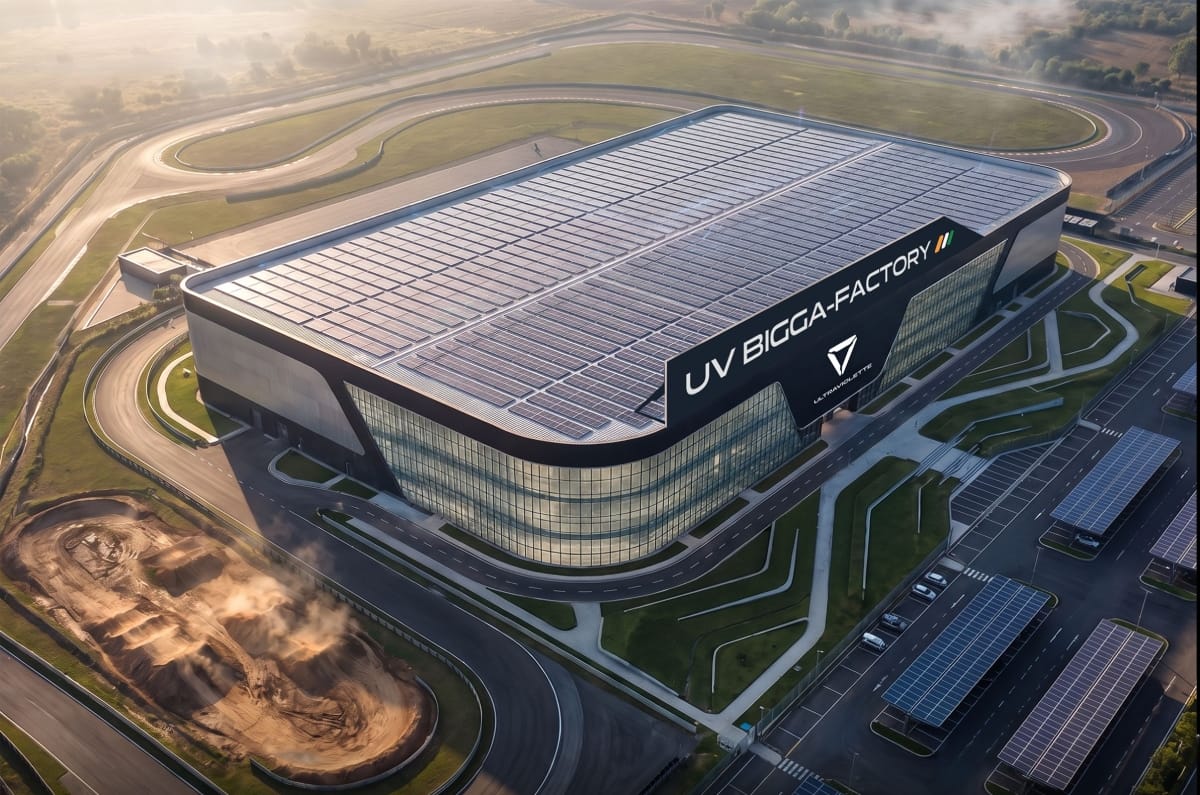

Ultraviolette's new BIGGA Factory in Hosur starts at 2.5 lakh units/year capacity, scalable to 5 lakh, and will first produce the Tesseract electric scooter from 2026–27.
Ultraviolette's BIGGA Factory — short for Big Global Ambition — is a greenfield electric-vehicle manufacturing facility at SIPCOT Industrial Park, Shoolagiri, Hosur, Tamil Nadu, with initial annual production capacity of 2.5 lakh (250,000) units, scalable to 5 lakh (500,000) units. Announced on 10 September 2026, it represents the most significant capacity expansion by any Indian performance-EV brand to date, signaling Ultraviolette's shift from niche motorcycle maker to mainstream electric two-wheeler player.
The factory will initially produce the upcoming Tesseract electric scooter before expanding across Sports, Crossover, Cruiser, Street and Scooter segments. A product roadmap image released with the announcement hints at two additional models for 2027.
What exactly is the BIGGA Factory and what will it make?
The BIGGA Factory is Ultraviolette's second manufacturing site, complementing its existing Bengaluru facility. The acronym signals Big Global Ambition — designed for international markets as well as domestic volumes.
The Tesseract electric scooter will be the first product off the Hosur line, with pre-booking available and expected Q1 2027 availability. The product roadmap shows two additional vehicles for 2027: one closely resembling a new X-47 electric motorcycle variant, and another with a rounded, family-scooter profile that would position Ultraviolette in the mainstream commuter segment.
This table contextualizes the BIGGA Factory announcement alongside other major EV manufacturing capacity additions in India's two- and four-wheeler space in 2026:
| Company / Model | Facility / Announcement | Capacity / Scale | Segment |
|---|---|---|---|
| Ultraviolette BIGGA Factory | SIPCOT Industrial Park, Hosur, TN | 2.5 lakh/yr initial → 5 lakh/yr | Electric two-wheelers (scooter + motorcycle) |
| Ather Energy | Hosur Plant 2 (existing + expansion) | ~1 lakh/yr (approx., ongoing expansion) | Electric scooters (Rizta, Konarc, 450X) |
| TVS Motor (iQube) | Hosur manufacturing complex | Multi-lakh capacity (shared ICE + EV lines) | Electric scooters |
| Bajaj Auto (Chetak) | Akurdi + Waluj, Maharashtra | Scaling toward 1 lakh+ EV units/yr | Electric scooters |
| Maruti Suzuki e Vitara | Suzuki Motor Gujarat, Hansalpur | ~1.5 lakh/yr (shared platform with Toyota) | Electric SUV (four-wheeler) |
The Maruti Suzuki e Vitara, a four-wheeler in a different segment, illustrates a broader pattern: India's largest automakers are simultaneously committing to dedicated EV manufacturing infrastructure in 2026. A buyer choosing between an electric scooter and an entry-level electric car will find both segments undergoing rapid capacity-driven price competition.
Why did Ultraviolette choose Hosur?
Hosur is an automotive manufacturing cluster in Krishnagiri district, Tamil Nadu, roughly 45 km from Bengaluru, hosting plants for TVS Motor, Ather Energy, Volvo Eicher Commercial Vehicles and multiple Tier-1 component suppliers. Three factors drove Ultraviolette's location decision.
Proximity to its Bengaluru R&D centre enables engineering teams to iterate quickly between design, prototyping and production validation. Hosur's supplier ecosystem — built over decades of ICE manufacturing and increasingly oriented toward EV components — reduces supply-chain risk and logistics costs. The Government of Tamil Nadu facilitated land allotment at SIPCOT Industrial Park, likely with incentives under the state's EV policy framework.
Tamil Nadu has aggressively pursued EV investment, and Hosur has become something of a two-wheeler EV hub — Ather Energy's primary facility is located there. Ultraviolette's presence in the same cluster creates competitive pressure but taps into the same talent pool and supplier density.
What manufacturing technology will the BIGGA Factory use?
The BIGGA Factory is built around Industry 4.0 principles. ETAuto's reporting details the following systems:
A Manufacturing Execution System (MES) provides real-time production tracking across the assembly line. Digital lean manufacturing and digital quality systems reduce waste and flag defects before vehicles leave the line.
Collaborative robots — cobots — handle sorting, welding and assembly tasks. Automated assembly fool-proofing systems reduce human error at critical joining points, while vision-based inspection systems perform quality checks that would otherwise require manual examination.
Every vehicle produced at the facility will be evaluated on a dedicated on-site test track before dispatch. At 2.5 lakh units per year, running every vehicle through a physical test loop is operationally intensive but aligns with Ultraviolette's brand positioning around performance and reliability.
This combination of cobots, MES and vision inspection mirrors what Ather Energy has described for its Hosur operations and what TVS Motor uses at its integrated complex. For a company of Ultraviolette's current scale — the X-47 is a relatively low-volume performance motorcycle — this represents a significant step up in manufacturing maturity.
How many jobs will the factory create?
The Hindu reported that the project is expected to create approximately 2,000 job opportunities in its initial phase, with employment scaling further over the next five years as capacity ramps up. This covers direct manufacturing jobs; indirect employment in the supplier space and logistics would add to that number, though Ultraviolette has not quantified indirect job creation.
For Hosur's local economy, 2,000 direct jobs from a single facility is significant. The town already has a large manufacturing workforce, but EV-specific roles — battery assembly technicians, cobot operators, MES system administrators — represent a different skill profile from traditional ICE manufacturing and likely command a wage premium.
Narayan Subramaniam, Co-founder and CEO of Ultraviolette, framed the announcement in terms of growth trajectory: "We are at an inflection point in Ultraviolette's journey. Over the last few years, we have built our foundation around technology, performance and product innovation; the next phase is about building the scale to take that foundation much further."
What does the 2027 product roadmap reveal?
The product roadmap image released alongside the factory announcement shows silhouettes of two new products, both planned for 2027. Ultraviolette has not provided names, specifications or pricing, so what follows is based on visual interpretation of the silhouette image as reported by Autocar India.
The first silhouette closely resembles the existing X-47 electric motorcycle, suggesting a new variant — possibly a different battery configuration, colour option, or performance tune — rather than an entirely new model. The X-47 currently retails between ₹2.49 lakh and ₹4.59 lakh ex-showroom, and a new variant could push either upmarket (higher range or power) or downmarket (more accessible entry price) depending on strategy.
The second silhouette carries more significance for the market. It shows a scooter with a rounded, upright profile markedly different from the Tesseract's sportier stance. This profile matches what the industry calls a family scooter — a commuter-oriented electric scooter with a step-through frame, generous underseat storage, and ergonomics suited to daily urban use by multiple rider types.
Entry into the family scooter segment would put Ultraviolette in a crowded field. Ather has just launched the Konarc targeting this space. Simple Energy has introduced the Wave family scooter range. TVS's iQube, Bajaj's Chetak and Vida's VX2 already dominate mainstream EV scooter sales volumes. Entering this segment with the BIGGA Factory's capacity behind it would be logical — the mainstream scooter segment is where the volume lies, and 2.5 lakh units per year only makes sense if Ultraviolette targets mass-market buyers, not just performance enthusiasts.
How does this compare to what competitors are doing?
The electric two-wheeler market in India recorded cumulative eight-month sales of 13.6 lakh units through August 2026, already surpassing full-year 2025 volumes. Ultraviolette's 2.5 lakh unit initial capacity, if fully utilised, would represent a meaningful market share.
TVS Motor, Bajaj and Ather collectively account for the bulk of current EV two-wheeler sales. TVS's iQube and Bajaj's Chetak benefit from established dealer networks and brand recognition that Ultraviolette lacks at scale. Ultraviolette's existing Bengaluru facility produces the X-47 motorcycle, a performance product with a different buyer profile from the mainstream scooter customer.
The BIGGA Factory gives Ultraviolette the physical capacity to compete at volume — but capacity alone does not create demand. The Tesseract's pricing, range, charging compatibility and after-sales network will determine whether the factory runs at meaningful utilisation rates. None of those details have been confirmed yet.
For buyers currently evaluating electric scooters, the BIGGA Factory announcement signals that Ultraviolette is serious about the segment, but the Tesseract remains a pre-booking product with a Q1 2027 timeline. Those needing a scooter now are better served by currently available options. Those willing to wait have reason to monitor Ultraviolette's next product reveal closely.
What is the significance of Hosur as India's EV manufacturing hub?
Hosur's emergence as a two-wheeler EV cluster is not accidental. The town's automotive heritage — hosting TVS Motor's operations for decades — created a foundation of manufacturing talent, tooling suppliers and logistics infrastructure that EV startups have leveraged. Ather Energy chose Hosur for its primary plant. Now Ultraviolette is following.
This clustering effect is defined in industrial economics as agglomeration: the tendency of firms in related industries to co-locate because shared benefits (labour pools, supplier proximity, knowledge spillovers) outweigh the costs of local competition. For India's EV transition, Hosur plays a role similar to what Pune plays for ICE two-wheelers or what Sriperumbudur plays for electronics manufacturing.
The Tamil Nadu government's role in facilitating land at SIPCOT for the BIGGA Factory fits a pattern of state-level competition for EV investment that has intensified since 2023. Karnataka, Maharashtra, Rajasthan and Tamil Nadu have all offered incentive packages to attract EV manufacturers, and Tamil Nadu's automotive base gives it a structural advantage for two-wheeler and commercial vehicle EV production.
What should buyers and investors watch for next?
Several questions remain unanswered after the BIGGA Factory announcement, and they will determine whether this capacity addition translates into market share.
The Tesseract's price has not been confirmed. Pre-bookings are open on Ultraviolette's website, but without a price, buyers cannot make a genuine purchase decision. Given that the Ather Rizta starts around ₹1.10 lakh and the TVS iQube ranges from approximately ₹1.00 lakh to ₹1.50 lakh, Ultraviolette will need to price the Tesseract competitively to access the volume that justifies 2.5 lakh units of annual capacity.
The factory's construction timeline has not been disclosed. The Tesseract is listed for Q1 2027 delivery, implying the Hosur facility needs to be operational by late 2026 or early 2027. Whether that timeline is achievable given the scale of infrastructure — including the on-site test track and Industry 4.0 systems — remains an open question.
International market ambitions have been mentioned but not detailed. Subramaniam's statement references serving "a much larger customer base in India and international markets," and the BIGGA acronym itself encodes global ambition. Which markets, at what price points, and through what distribution channels remain unclear.
The 2027 product roadmap silhouettes have generated speculation but no confirmed specifications. If Ultraviolette launches a family scooter in 2027, it will need a dealer and service network significantly larger than what currently supports the X-47 — a performance motorcycle with a relatively small but loyal owner base.
For buyers in the electric SUV or car segment tracking the broader EV space, the Hosur factory announcement is part of a larger pattern of infrastructure investment across segments. The Maruti Suzuki e Vitara, for instance, is backed by Suzuki Motor Gujarat's established manufacturing scale — a reminder that volume credibility in EVs increasingly requires demonstrated factory capacity, not just product announcements.
What is Ultraviolette's current product lineup and how does the BIGGA Factory fit in?
Ultraviolette currently sells the X-47 electric motorcycle in multiple variants (priced between ₹2.49 lakh and ₹4.59 lakh ex-showroom) and has the Shockwave and Tesseract in its upcoming pipeline. The Shockwave is listed with an expected price of ₹1.50–₹2.00 lakh and Q1 2026 pre-book status on Autocar India's listings. The Tesseract is the scooter that will anchor the BIGGA Factory's initial production.
The existing Bengaluru facility will continue producing the X-47 and supporting R&D operations. The BIGGA Factory is explicitly positioned as the scale-up vehicle for the scooter and future multi-segment portfolio — not a replacement for Bengaluru but an addition to it.
This dual-facility model is common among maturing EV manufacturers: keep the original site for lower-volume, higher-complexity products and R&D, while the new greenfield site handles high-volume assembly with greater automation. Ather Energy operates a similar model with its Hosur plant handling volume production while its Bengaluru office anchors engineering.
The BIGGA Factory represents Ultraviolette's clearest signal yet that it intends to be a full-spectrum electric two-wheeler company — not just a performance motorcycle brand. Whether execution matches ambition will become clearer once the Tesseract launches and the factory begins ramping production in 2027.
For buyers researching the Indian EV market more broadly — whether for two-wheelers or the growing range of electric SUVs now available in India — the Hosur factory announcement is a useful data point: India's EV manufacturing infrastructure is scaling rapidly, and the competitive dynamics of 2027 will look substantially different from today's market.
Sources
- Ultraviolette announces new factory in Hosur | Autocar India
- Ultraviolette to establish BIGGA factory in Hosur | The Hindu
- Ultraviolette to set up Hosur plant with annual capacity of 2.5 lakh units | ETAuto
- Ultraviolette Press & News | Ultraviolette Official
- Best Electric SUVs in India in 2026 | EV Index India