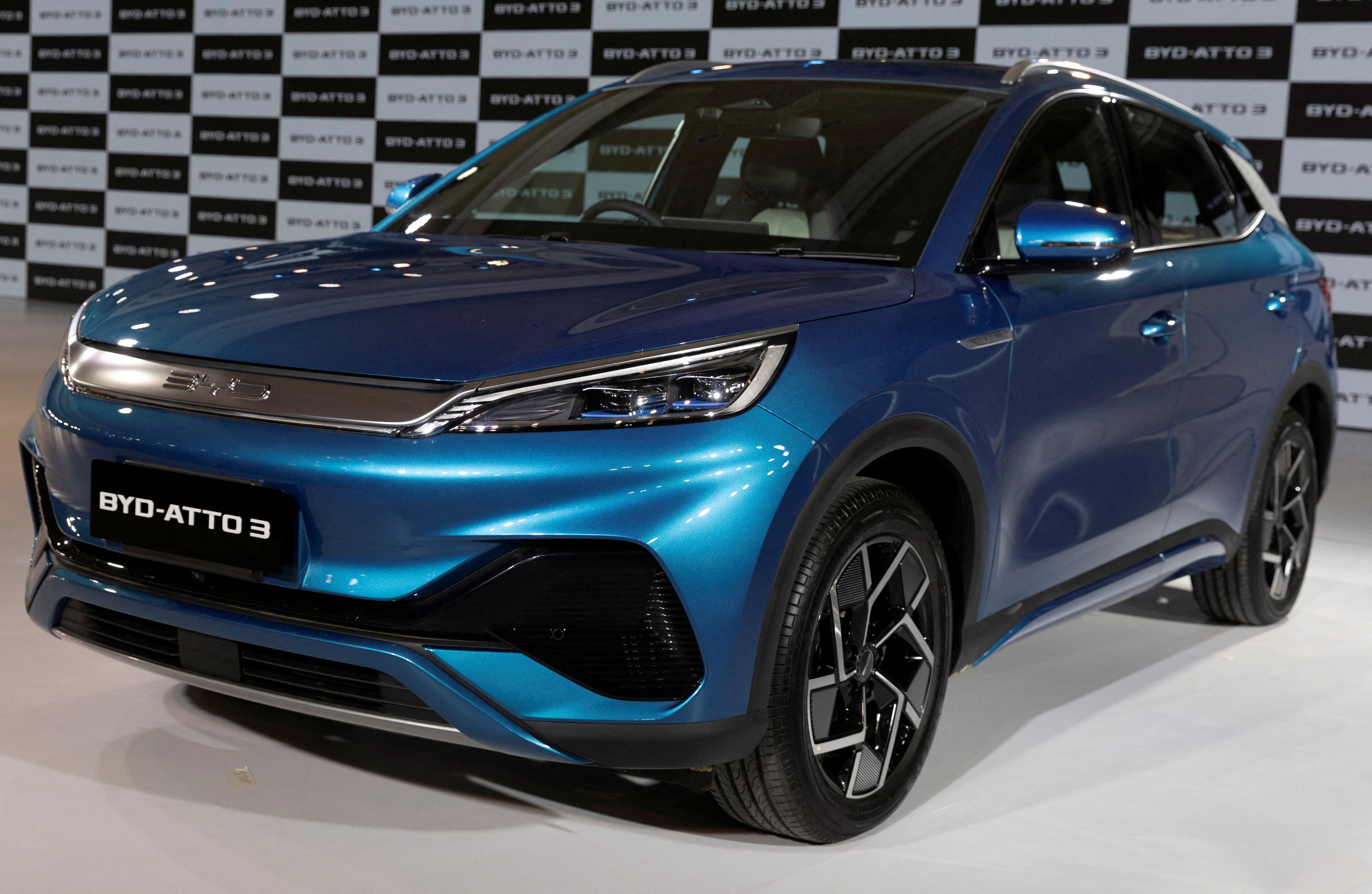

The Kia EV6 AWD outranges the BYD Sealion 7 by 123.2 km on average in real-world tests, but costs ₹11 lakh more at ₹65.97 lakh ex-showroom.
The Kia EV6 GT-Line AWD delivers a tested real-world range of 560.3 km on the highway versus the BYD Sealion 7 Performance's 344 km — a gap of over 216 km — making the EV6 the clear winner on range despite carrying a ₹11 lakh price premium, according to Autocar India's head-to-head test.
Both cars are dual-motor, all-wheel-drive premium electric SUVs with claimed ranges above 500 km and battery packs close to 84 kWh. On paper, they look like near-equals. In practice, the gap in real-world efficiency is substantial — and for buyers planning long highway runs across India, that gap matters enormously.
| Specification | BYD Sealion 7 Performance | Kia EV6 GT-Line AWD |
|---|---|---|
| Battery capacity | 82.56 kWh | 84 kWh |
| Motor setup | Dual motors, AWD | Dual motors, AWD |
| Power | 530 hp | 325 hp |
| Torque | 690 Nm | 605 Nm |
| Claimed range | 542 km (NEDC) | 581 km (WLTP) |
| 0–100 kph | 4.5 sec | 5.3 sec |
| Real-world city range | ~420 km (est. from 4.90 km/kWh) | ~435 km (est. from 5.18 km/kWh) |
| Real-world highway range | 344 km | 560.3 km |
| Highway efficiency | 4.17 km/kWh | 6.67 km/kWh |
| City efficiency | 4.90 km/kWh | 5.18 km/kWh |
| Price (ex-showroom) | ₹54.90 lakh | ₹65.97 lakh |
Sources: Autocar India range test, BYD India, Kia India
What do the real-world range numbers actually mean for Indian buyers?
Real-world range is the distance an EV can cover on a full charge under conditions that replicate typical usage — including AC operation, varying speeds, traffic, and accessory loads — rather than idealised laboratory cycles. This distinction matters because claimed range figures from manufacturers use standardised test cycles (NEDC or WLTP) that rarely reflect Indian road conditions, traffic patterns, or climate.
Autocar India's test methodology works as follows: each car starts with a full charge and manufacturer-recommended tyre pressures, is driven on a fixed loop covering both city and highway sections at set average speeds, and range is calculated from the percentage of charge consumed. The AC is set to 22°C in auto mode, and features like the music system, lights, and ventilated seats are used as a regular driver would. This consistency makes the numbers directly comparable between the two cars.
On the highway — the scenario most relevant to long-distance travel — the EV6 returned 560.3 km versus the Sealion 7's 344 km. That is a 63% advantage for the EV6 on the same road, same conditions. The Delhi–Jaipur highway stretch is roughly 280 km. The EV6 can cover it and return without charging; the Sealion 7 would need a top-up on the way back.
In city driving, the gap narrows considerably. The EV6 achieved 5.18 km/kWh in the city versus the Sealion 7's 4.90 km/kWh — a much smaller difference. City buyers who rarely venture beyond 150–200 km per day will find both cars more than adequate on a single charge.
Why does the Sealion 7 fall so far behind on highway range despite similar battery size?
The answer lies primarily in aerodynamic drag and power delivery at speed. The BYD Sealion 7 Performance is a performance-oriented EV — it produces 530 hp and 690 Nm of torque, figures more commonly associated with sports cars than family SUVs. At highway speeds, maintaining that powertrain at even moderate throttle demands significantly more energy than the EV6's more conservatively tuned 325 hp setup.
Physics is unforgiving here: aerodynamic drag increases with the square of velocity, and a heavier, more powerful AWD system draws more energy to maintain speed. The Sealion 7's highway efficiency of 4.17 km/kWh versus the EV6's 6.67 km/kWh suggests the Kia's powertrain is considerably better optimised for sustained cruising — a trait that matters far more than peak power when you're covering 400 km between cities.
BYD's NEDC claimed range of 542 km warrants scrutiny. NEDC is the older New European Driving Cycle, a test protocol widely criticised for producing optimistic range figures that rarely translate to real-world performance. The EV6's WLTP figure of 581 km uses a more rigorous and realistic cycle, which partly explains why its real-world performance aligns more closely with its claimed number. Buyers should treat NEDC figures with particular scepticism when comparing against WLTP-rated competitors.
Both cars share a notable limitation: Autocar India found that the regenerative braking on neither car is strong enough to bring the vehicle to a complete halt even in the most aggressive regen setting. This limits the one-pedal driving experience that many EV buyers expect at this price point, and means city efficiency gains from regen are somewhat constrained for both.
How do the two cars compare on performance and driving experience?
The BYD Sealion 7 Performance is the quicker car — decisively so. Its 0–100 kph time of 4.5 seconds against the EV6's 5.3 seconds is a meaningful gap in real-world driving. For buyers who want a genuine performance EV that can embarrass sports cars at traffic lights, the Sealion 7 delivers that experience at a price no other car in this segment can match.
The EV6 GT-Line AWD, at 325 hp, is by no means slow. Five seconds to 100 kph is brisk by any standard, but it is tuned for a different kind of driver — one who values composed, long-distance cruising over outright acceleration. The EV6's powertrain efficiency on the highway reflects this philosophy directly.
From a torque standpoint, the Sealion 7's 690 Nm versus the EV6's 605 Nm gives it a more dramatic mid-range punch. In urban traffic, both deliver near-instant torque that makes overtaking effortless. The difference only becomes apparent when you push hard or sustain high speeds — and at that point, the Sealion 7's energy consumption climbs steeply.
Which car offers better value for money in 2026?
Value depends on what the buyer prioritises. At ₹54.90 lakh ex-showroom, the BYD Sealion 7 Performance is priced ₹11.07 lakh below the Kia EV6 GT-Line AWD at ₹65.97 lakh. For that saving, you get a significantly more powerful car — 530 hp versus 325 hp — with a quicker 0–100 kph time and a similar battery capacity.
However, the EV6's real-world range advantage of 123.2 km on average per full charge translates directly into lower running costs and fewer charging stops over the car's lifetime. If you drive 40,000 km per year at ₹15 per kWh (a reasonable estimate for home charging), the EV6's superior efficiency could save you a meaningful amount annually — partially offsetting its higher purchase price over a 5-year ownership period.
For buyers who primarily drive in cities and rarely exceed 200–250 km per day, the Sealion 7's value is compelling. You get more power, more torque, and a lower price. The range shortfall only becomes a practical problem on long highway runs.
For buyers who regularly travel between cities — Delhi to Agra, Mumbai to Pune, Bengaluru to Mysuru and back — the EV6's highway range advantage is a genuine quality-of-life improvement. Fewer charging stops means less time lost and less range anxiety on unfamiliar routes.
The ₹50–65 lakh premium EV segment in India is not the only option for buyers seeking a capable, well-equipped electric SUV. The Maruti Suzuki e Vitara, positioned in the mid-premium segment at a significantly lower price point, offers a compelling alternative for buyers who want a trusted brand, a wide service network, and a practical SUV form factor without stretching to the Sealion 7 or EV6's price bracket. For buyers who don't need 500+ km of range or AWD performance, the e Vitara represents the kind of value-for-money proposition that the premium segment simply cannot match. You can explore how it stacks up against other options in our Best Electric SUVs in India 2026 guide.
How does charging speed and infrastructure readiness compare?
Charging capability is a critical factor for long-distance EV ownership in India, where DC fast charger density — while growing — remains uneven outside major highways and metro areas.
The Kia EV6 supports 800V architecture, a high-voltage charging system that allows significantly faster DC fast charging compared to the conventional 400V systems used in most EVs. This means the EV6 can accept higher charging rates at compatible stations, reducing the time needed to top up during a highway stop. In markets with 350 kW chargers, the EV6 can charge from 10% to 80% in approximately 18 minutes. In India, where most fast chargers currently cap at 60–150 kW, the practical benefit is somewhat reduced, but the architecture future-proofs the car as India's charging infrastructure upgrades.
The BYD Sealion 7 uses a 400V architecture. Its DC fast charging capability is respectable but does not match the EV6's peak charging rate potential. For current Indian infrastructure, the real-world difference in charging time between the two may be less dramatic than the spec sheets suggest — but as Tata Power, EESL, and private operators continue rolling out higher-power chargers along national highways, the EV6's 800V advantage will become increasingly relevant.
Both cars support AC home charging, and for daily urban use where overnight charging covers most needs, the architecture difference is largely academic.
What about features, space, and practicality?
Both the Sealion 7 and EV6 are premium SUVs with well-equipped cabins. The EV6's interior features Kia's distinctive design language — a sweeping curved display combining the instrument cluster and infotainment screen, a clean centre console, and premium materials throughout. The GT-Line AWD trim adds sporty visual elements including a sportier bumper design and larger alloy wheels.
The BYD Sealion 7 brings BYD's latest interior philosophy, featuring a rotating central display, a feature-rich infotainment system, and a spacious cabin. BYD has invested heavily in interior quality for the Sealion 7, and the result is a cabin that feels genuinely premium rather than merely adequate.
On practicality, both cars offer competitive boot space and rear passenger room suitable for family use. Neither is a three-row SUV, so buyers needing seven seats should look elsewhere. For a five-seat premium electric SUV used by a family of four, both cars are well-suited.
Safety is an important consideration at this price point. Buyers interested in crash-test performance should check our guide to 5-Star Bharat NCAP Electric Cars in India 2026 for the latest ratings. Both the Sealion 7 and EV6 are equipped with full ADAS suites — for a broader look at how ADAS features compare across the EV segment, our Best Electric Cars with ADAS in India 2026 guide is a useful reference.
After-sales service is another dimension worth evaluating before committing to either car. BYD's India network is expanding but remains concentrated in major metros. Kia's service network is more established across Tier 1 and Tier 2 cities. For buyers outside metro areas, this can be a decisive factor — our Best Electric SUV After-Sales Service Network in India article covers this in detail.
Which car is better for long road trips in India?
For long-distance travel, the Kia EV6 is the more capable tool. Its highway range of 560.3 km on a single charge means that most intercity routes in India — including Delhi–Chandigarh (250 km), Mumbai–Pune (150 km), and Bengaluru–Mysuru (150 km) — can be completed comfortably without a charging stop. The EV6's 800V architecture also means that when you do need to charge, you can do so faster at compatible stations.
The Sealion 7's highway range of 344 km is not poor in absolute terms — it covers most single-leg intercity journeys — but it requires more careful planning on longer routes. A Delhi–Agra–Jaipur circuit (approximately 500 km) would require at least one charging stop in the Sealion 7; the EV6 may complete it on a single charge depending on driving style.
For buyers who regularly undertake long highway drives, our Best Electric Cars for Long Trips in India 2026 guide provides a full framework for evaluating range, charging infrastructure, and route planning.
Should you buy the BYD Sealion 7 or the Kia EV6 in 2026?
The decision ultimately comes down to what you value more: performance and price, or range and efficiency.
Choose the BYD Sealion 7 Performance if:
- You want the fastest, most powerful EV in this price bracket
- Your daily driving is primarily urban, within 200–250 km per day
- The ₹11 lakh price difference is meaningful to your budget
- You prioritise outright acceleration and driving excitement
Choose the Kia EV6 GT-Line AWD if:
- You regularly drive long highway distances between cities
- Range anxiety on highway runs is a concern you want to eliminate
- You value the 800V charging architecture for future-proofing
- You are willing to pay a premium for significantly better real-world efficiency
Consider the Maruti Suzuki e Vitara if:
- Your budget sits below the ₹50 lakh mark
- You want a well-supported service network across India
- A practical, mid-premium electric SUV from a trusted domestic brand suits your needs better than a high-performance import
- You don't need AWD or 500+ km of highway range
The e Vitara occupies a different segment from the Sealion 7 and EV6, but for buyers who are stretching their budget to consider the Sealion 7, it is worth asking whether the extra spend is justified by their actual usage pattern. If most of your driving is urban and your longest trips are weekend getaways within 300 km, the e Vitara's value is hard to ignore.
For a broader view of the best electric vehicles available in India right now, our Best Electric Cars to Buy in India 2026 guide covers the full market from budget to premium.
The verdict
The Autocar India real-world range test delivers a clear result: the Kia EV6 GT-Line AWD is the better long-distance EV, outranging the BYD Sealion 7 Performance by 123.2 km on average and by over 216 km on the highway. Its highway efficiency of 6.67 km/kWh versus the Sealion 7's 4.17 km/kWh is a gap that no amount of claimed-range marketing can paper over.
The Sealion 7 is not a bad car — far from it. At ₹54.90 lakh, it offers 530 hp, a 4.5-second 0–100 kph time, and a genuinely premium cabin at a price that undercuts the EV6 by ₹11 lakh. For urban performance enthusiasts, it is a remarkable value. But for buyers who need their premium EV to perform on India's highways as well as its city streets, the EV6's real-world range numbers make it the more complete package — at a price.
The data does not lie: if range is your primary metric, the EV6 wins. If performance-per-rupee is your metric, the Sealion 7 wins. Choose accordingly.
Sources
- BYD Sealion 7 vs Kia EV6: Real World Range Comparison — Autocar India
- BYD India Official Website
- Kia India Official Website — EV6
- Maruti Suzuki e Vitara Official Page
- Top 10 Premium EVs with the Highest Claimed Range in India — Autocar India
- Every Mass Market EV Real World Range Tested — Autocar India
- Best Electric SUVs in India in 2026 — EV Index India
- Best Electric Cars for Long Trips in India in 2026 — EV Index India
- Best Electric Cars with ADAS in India in 2026 — EV Index India
- Which 5-Star Bharat NCAP Electric Cars in India Are Worth Buying in 2026? — EV Index India
- Which Electric SUV Has the Best After-Sales Service Network in India? — EV Index India
- Best Electric Cars to Buy in India in 2026 — EV Index India