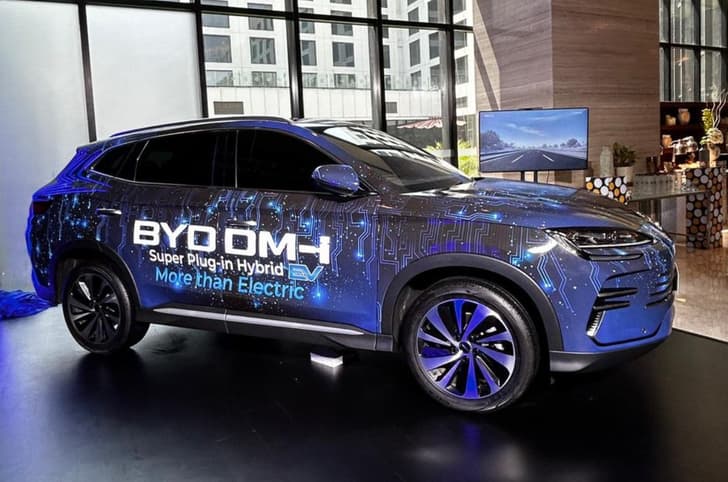

BYD Seal U arrives in India by end-2026 at ~₹45–50 lakh with DM-i PHEV tech offering 200 km EV range and 1,200+ km combined range.
BYD Seal U PHEV Launch in India by End-2026: What DM-i Super Hybrid Tech Means for Buyers
The BYD Seal U is scheduled to arrive in India by the end of 2026, making it the first BYD model in the country to carry the brand's proprietary DM-i Super Plug-in Hybrid EV powertrain — a system that claims over 1,200 km of combined driving range and up to 200 km on electricity alone. Expected pricing sits at approximately ₹45–50 lakh (ex-showroom), positioning the Seal U squarely in the premium SUV segment where it will compete against both incoming PHEVs and established pure-electric options.
Before diving into the technology, here is how the Seal U stacks up against the two most relevant alternatives a buyer in this price band is likely to consider:
| Specification | BYD Seal U (PHEV) | Maruti Suzuki e Vitara (BEV) | JSW Jetour T2 (PHEV) |
|---|---|---|---|
| Powertrain type | Plug-in Hybrid (PHEV) | Pure Electric (BEV) | Plug-in Hybrid (PHEV) |
| Battery capacity | 18.3 kWh (Blade) | ~49 kWh / ~61 kWh | TBC |
| EV-only range | Up to 200 km | ~400–500 km (est.) | TBC |
| Combined range | 1,200+ km | ~400–500 km | TBC |
| Engine | 1.5L turbo-petrol | None | TBC |
| Peak power | Up to 323 hp (AWD, intl.) | TBC (India spec) | TBC |
| Claimed fuel consumption | 4.8 L/100 km | Zero | TBC |
| Thermal efficiency | 43.04% | N/A | TBC |
| Expected India price | ~₹45–50 lakh | ~₹17–22 lakh (est.) | ~₹40–50 lakh (est.) |
| Expected launch | End-2026 | 2026 | End-2026 |
Sources: Autocar India. Maruti e Vitara and Jetour T2 India specs are preliminary estimates; final figures may differ.
The table makes one trade-off immediately visible: the Seal U's PHEV architecture delivers a dramatically longer combined range than a pure-EV like the Maruti Suzuki e Vitara, but its electric-only capability is far smaller than what a dedicated BEV can offer. Which side of that trade-off matters more depends entirely on how and where you drive.
What exactly is BYD's DM-i Super Plug-in Hybrid EV system?
DM-i Super Plug-in Hybrid EV is BYD's proprietary electric-first hybrid architecture that combines a high-efficiency internal combustion engine, a large traction battery, and two electric motors — prioritising electric drive in the vast majority of real-world conditions while retaining a petrol engine for extended range and high-load scenarios.
The system in the Seal U consists of three core components:
The engine: A 1.5-litre direct-injection turbocharged petrol unit. BYD claims a thermal efficiency of 43.04 percent for this engine — described as the world's best for a production hybrid powertrain. Most conventional petrol engines achieve thermal efficiencies in the 35–40 percent range, meaning more of the fuel's energy converts into motion rather than heat. The claimed fuel consumption figure is 4.8 litres per 100 km when running on petrol.
The battery: An 18.3 kWh Blade battery using BYD's lithium iron phosphate (LFP) cell-to-pack technology. This design integrates individual cells directly into the pack structure without intermediate modules, improving energy density and structural rigidity while reducing fire risk.
The motors: Two electric motors — a traction motor and a starter-generator — with claimed combined efficiency of 97.5 percent. The starter-generator serves dual purposes: starting the engine and acting as a generator to replenish the battery when the engine is running.
What distinguishes the DM-i architecture from a conventional hybrid is its operating logic. Under normal urban driving, the wheels are driven almost entirely by the traction motor, with the petrol engine spinning up only to charge the battery via the starter-generator — functioning much like a range-extender or series hybrid. Only under sustained high-speed cruising or heavy acceleration does the engine connect mechanically to the drivetrain in a parallel hybrid configuration. The system manages all mode transitions automatically; the driver never selects between EV, series, or parallel modes.
This electric-first philosophy is why BYD claims the Seal U can cover over 1,200 km on a full tank and a fully charged battery, and up to 200 km on electricity alone. For Indian buyers who live in cities but occasionally drive long intercity routes, that combination addresses both daily commuting (on electricity, at near-zero running cost) and highway journeys (on petrol, without range anxiety).
The system also supports Vehicle-to-Load (V2L) functionality, allowing the Seal U to power external electrical appliances — increasingly relevant for buyers who want their vehicle to double as a power source during outages or outdoor activities.
What is the BYD Seal U as a car?
The Seal U is a five-seat mid-size SUV built on BYD's Ocean series design language, measuring 4,775 mm in length, 1,890 mm in width, and 1,670 mm in height, with a 2,765 mm wheelbase. Those dimensions place it in the same territory as the Mahindra XEV 9e — a large five-seater rather than a compact crossover.
Internationally, the Seal U is sold under two names: Seal U in some markets and Sealion 6 in others. It made its India debut at Auto Expo 2025 as the Sealion 6 PHEV, so the vehicle is not entirely new to Indian audiences — the brand has simply been building awareness ahead of a formal commercial launch.
Globally, the Seal U is available in both front-wheel drive and all-wheel drive configurations. In AWD form, the combined output reaches up to 323 hp and 550 Nm of torque, enabling a 0–100 kph sprint in 5.9 seconds. BYD has confirmed that India-bound specifications may differ from international versions, so exact power output and range figures for the Indian market remain to be finalised.
Visually, the Seal U closely resembles the BYD Sealion 7 already on sale in India — the primary differentiator being a functional front grille on the Seal U, which houses the engine cooling system the PHEV requires. The interior carries BYD's signature ocean-inspired aesthetic, anchored by a 15.6-inch rotating infotainment touchscreen. Equipment highlights confirmed for the model include 19-inch alloy wheels, vegan leather upholstery, an Infinity premium audio system, a 360-degree camera system, and a full ADAS suite. The rotating infotainment display — which can switch between portrait and landscape orientation — has become a recognisable BYD brand signature across its lineup.
How does the DM-i system compare to a conventional PHEV or full hybrid?
A conventional PHEV typically combines a plug-in battery large enough for meaningful electric-only range with a full parallel hybrid drivetrain where both the engine and motor can drive the wheels simultaneously. Most European and Japanese PHEVs — think Toyota RAV4 PHEV or Volvo XC60 Recharge — operate this way, with electric-only ranges of 50–80 km and combustion engines that take over smoothly beyond that.
BYD's DM-i goes further in two respects. First, the 18.3 kWh battery is substantially larger than most competing PHEVs in this class, enabling up to 200 km of pure-EV range — closer to what a budget BEV delivers than what a typical PHEV offers. Second, the system's default operating mode is series hybrid (engine charges battery, motor drives wheels) rather than parallel hybrid, which means the engine is decoupled from the drivetrain in most driving conditions. This produces smoother, more EV-like driving characteristics and allows the engine to operate consistently near its peak efficiency point rather than being forced to match wheel speed.
The trade-off is that the DM-i system is more complex than a simple parallel hybrid and requires a larger battery — which adds weight and cost. It is also more dependent on regular charging to deliver its headline efficiency figures; a buyer who never plugs in will see fuel consumption closer to 6–8 L/100 km rather than the claimed 4.8 L/100 km.
How does the Seal U PHEV compare to the Maruti Suzuki e Vitara and other pure-EV options?
The Maruti Suzuki e Vitara represents the opposite end of the electrification spectrum from the Seal U: a purpose-built battery electric vehicle with no combustion engine, no fuel costs, and no range anxiety within its battery's capability — but also no fallback when charging infrastructure is unavailable or inconvenient.
For buyers evaluating whether to go PHEV or full-EV, the decision typically comes down to three factors: daily driving distance, access to home charging, and frequency of long intercity trips.
If your daily commute is under 60–70 km and you have reliable home charging, a pure-EV like the e Vitara covers virtually all your driving on electricity, with public fast-charging handling the occasional longer trip. The e Vitara's lower expected price point (estimated ₹17–22 lakh) also makes it accessible to a wider buyer base than the Seal U's ₹45–50 lakh positioning.
The Seal U's DM-i system makes the most sense for buyers whose daily driving exceeds 100–150 km, who travel intercity highways frequently, or who live in areas where public charging infrastructure remains patchy. The 1,200+ km combined range means a Seal U owner can drive from Delhi to Mumbai on a single tank plus charge without stopping at a charging station — a scenario where any current BEV, including the e Vitara, would require at least one or two charging stops.
That said, the e Vitara and the Seal U are not really competing for the same buyer at the same price point. They represent different philosophies for different use cases. The more direct comparison for the Seal U is the incoming JSW Jetour T2 PHEV, also expected to arrive by end-2026 in a similar price bracket. Specifications for the Jetour T2 have not been confirmed for India at the time of writing, so a detailed comparison is premature.
For buyers researching the broader best electric SUVs in India in 2026, the Seal U's arrival adds a meaningful new option at the premium end — one that blurs the line between electrified and fully electric.
What does 43.04 percent thermal efficiency actually mean for running costs?
Thermal efficiency is the percentage of the fuel's chemical energy that is successfully converted into mechanical work, with the remainder lost as heat. A conventional petrol engine typically achieves 35–38 percent thermal efficiency under optimal conditions; diesel engines can reach 40–42 percent. BYD's claim of 43.04 percent for the Seal U's 1.5-litre turbo-petrol unit, if validated in real-world conditions, would represent a genuine engineering achievement.
In practical terms, higher thermal efficiency translates directly into lower fuel consumption for the same power output. The claimed 4.8 L/100 km figure — roughly 20.8 km per litre — is exceptional for a petrol-powered SUV of this size and performance level. A conventional petrol SUV of similar dimensions typically returns 10–14 km per litre under mixed driving conditions.
Buyers should apply some scepticism to manufacturer-claimed efficiency figures. Real-world fuel consumption depends heavily on driving style, road conditions, ambient temperature, and — critically for a PHEV — how frequently the battery is charged. A Seal U owner who charges regularly and drives primarily in EV mode will see running costs close to a pure-EV. One who rarely charges and relies primarily on the petrol engine will see fuel economy closer to a conventional hybrid, not the headline 4.8 L/100 km figure.
The electric motor efficiency claim of 97.5 percent is more straightforward: electric motors are inherently more efficient than combustion engines, and 97–98 percent efficiency is standard for high-quality permanent magnet motors used in automotive applications.
What equipment does the Seal U offer, and how does it compare to rivals?
The Seal U's confirmed equipment list for India includes features that are competitive with — and in some cases ahead of — what rivals offer at similar price points:
The 15.6-inch rotating infotainment display is a BYD signature that has drawn consistent attention since its introduction on the Atto 3. The ability to switch between portrait and landscape orientations is genuinely useful for navigation versus media use, though some buyers find the large screen visually dominant in the cabin.
The Infinity premium audio system is a step up from the standard speakers found in many competitors at this price. Infinity (a Harman brand) has been used across several BYD models globally and is generally well-regarded for sound quality.
The ADAS suite — while not yet detailed for the India-spec model — is expected to include features such as adaptive cruise control, lane-keeping assist, automatic emergency braking, and blind-spot monitoring. BYD's ADAS implementations across its global lineup have been competitive with European and Korean rivals. For buyers who prioritise driver assistance technology, our guide to best electric cars with ADAS in India in 2026 covers the current space in detail.
The 360-degree camera system and 19-inch alloy wheels round out a specification that feels appropriate for the ₹45–50 lakh price bracket. Vegan leather upholstery has become a standard expectation in this segment, particularly among buyers who are environmentally conscious — a demographic that overlaps significantly with PHEV and EV buyers.
What is the expected India launch timeline and pricing?
BYD has confirmed an end-2026 launch window for the Seal U in India, as reported by Autocar India. The brand showcased the DM-i technology in India for the first time in June 2026, suggesting that homologation and localisation work is well advanced.
The expected price range of ₹45–50 lakh (ex-showroom) is an estimate based on the vehicle's positioning and BYD's pricing strategy for its existing India lineup. The Sealion 7 EV, which is already on sale, provides a reference point for how BYD prices its premium models in India. Final pricing will depend on import duties, localisation levels, and competitive dynamics at the time of launch.
India currently imposes a 100 percent import duty on fully built-up (CBU) vehicles priced above $40,000, which significantly inflates the cost of imported premium cars. BYD has been exploring local assembly options in India, and the extent to which the Seal U is locally assembled versus imported will have a material impact on its final price. If BYD manages to assemble the Seal U locally — even at a semi-knocked-down (SKD) level — it may price the vehicle more aggressively than the ₹45–50 lakh estimate suggests.
The JSW Jetour T2 PHEV, also expected by end-2026, will be the most direct competitor. JSW Motors has been building its India presence through the Jetour brand partnership, and the T2's pricing and specifications will significantly shape how the Seal U is received.
Should you wait for the Seal U PHEV or buy a BEV now?
This is the practical question most buyers reading this article are actually asking. The honest answer depends on your specific situation, but here is a framework for thinking through it.
Buy a BEV now if: Your daily driving is under 100 km, you have home charging, and you live in a city with a reasonable public charging network. The Maruti Suzuki e Vitara, for instance, is designed precisely for this use case — urban and semi-urban buyers who want to eliminate fuel costs and emissions for their daily driving. If you are considering long-trip capability, our guide to best electric cars for long trips in India in 2026 can help you assess which BEVs handle highway driving most effectively.
Wait for the Seal U if: You regularly drive 150+ km per day, frequently travel intercity routes where charging stops are inconvenient, or want the flexibility of a vehicle that can function as a pure EV for daily use but never leaves you stranded on a highway. The 1,200+ km combined range is a genuine differentiator that no current BEV in India can match.
Consider the price gap seriously: At ₹45–50 lakh, the Seal U is roughly double the expected price of the Maruti Suzuki e Vitara. That price difference buys you range flexibility and a larger, more premium vehicle — but it also means a longer payback period on any fuel savings. Buyers for whom ₹45–50 lakh is the right budget should also look at the best electric SUVs in India in 2026 to understand the full competitive space before committing.
Factor in the PHEV running cost reality: A PHEV's economics are most favourable when the owner charges regularly. If you cannot charge at home or at work, the Seal U's running costs will be higher than a comparable BEV and similar to a conventional petrol SUV. The DM-i system's efficiency advantage is real, but it is maximised only when the battery is kept charged.
What does the Seal U's arrival mean for India's EV market?
BYD's decision to bring PHEV technology to India — rather than expanding its pure-EV lineup — reflects a pragmatic read of the Indian market. Charging infrastructure, while improving rapidly, remains uneven outside major metros. Range anxiety is a real barrier to BEV adoption for a significant portion of potential buyers. A PHEV with 200 km of electric range and 1,200+ km of combined range addresses both concerns simultaneously.
The DM-i system's arrival also signals that the India market is maturing. A year ago, the conversation was primarily about whether buyers would accept EVs at all. Today, BYD is introducing a technology sophisticated enough to compete with the best hybrid systems from Toyota, Honda, and European manufacturers — and doing so at a price point that, while premium, is not stratospheric.
For the broader market, the Seal U's launch alongside the Jetour T2 PHEV suggests that 2026 will be the year PHEVs establish a genuine foothold in India's premium SUV segment. This matters for buyers of pure-EV models too: increased competition from PHEVs will likely push BEV manufacturers to improve range, reduce prices, and expand charging networks faster than they otherwise would.
The Maruti Suzuki e Vitara's pure-EV approach and the Seal U's PHEV architecture are not competing philosophies so much as complementary solutions for different buyer profiles. India's electrification story has room for both — and the arrival of credible PHEV options makes the overall market more accessible to buyers who are not yet ready to commit fully to battery-electric motoring.
For buyers who want to understand how safety standards factor into this decision, our guide to 5-star Bharat NCAP electric cars in India is worth reading alongside this article, as crash-test ratings for the Seal U's India specification have not yet been published.
Key takeaways for buyers
The BYD Seal U represents a genuinely new option in India's premium SUV market — not just another EV, but a PHEV system sophisticated enough to challenge the best hybrid technology available globally. The DM-i Super Plug-in Hybrid EV system's 43.04 percent thermal efficiency, 200 km electric-only range, and 1,200+ km combined range are headline figures that, if they hold up in Indian real-world conditions, make a compelling case for buyers who need more flexibility than a pure-EV currently offers.
The ₹45–50 lakh price point is premium but not unreasonable for what is on offer: a large five-seat SUV with a sophisticated powertrain, a well-equipped interior, and the BYD brand's growing service network in India. The end-2026 launch timeline means buyers have several months to track final specifications, pricing, and early owner reports before committing.
The competition — particularly the Jetour T2 PHEV — will shape how aggressively BYD prices the Seal U at launch. Watch that space closely as the year progresses.
Sources
- BYD Seal U India launch by end-2026 with PHEV powertrain — Autocar India
- BYD Sealion 6 PHEV debuts at Auto Expo 2025 — Autocar India
- BYD Seal U — Autocar India Model Page
- BYD Sealion 7 — Autocar India Model Page
- BYD Official India Website
- Best Electric SUVs in India in 2026 — EV Index India
- Best Electric Cars for Long Trips in India in 2026 — EV Index India
- Best Electric Cars with ADAS in India in 2026 — EV Index India
- 5-Star Bharat NCAP Electric Cars in India 2026 — EV Index India