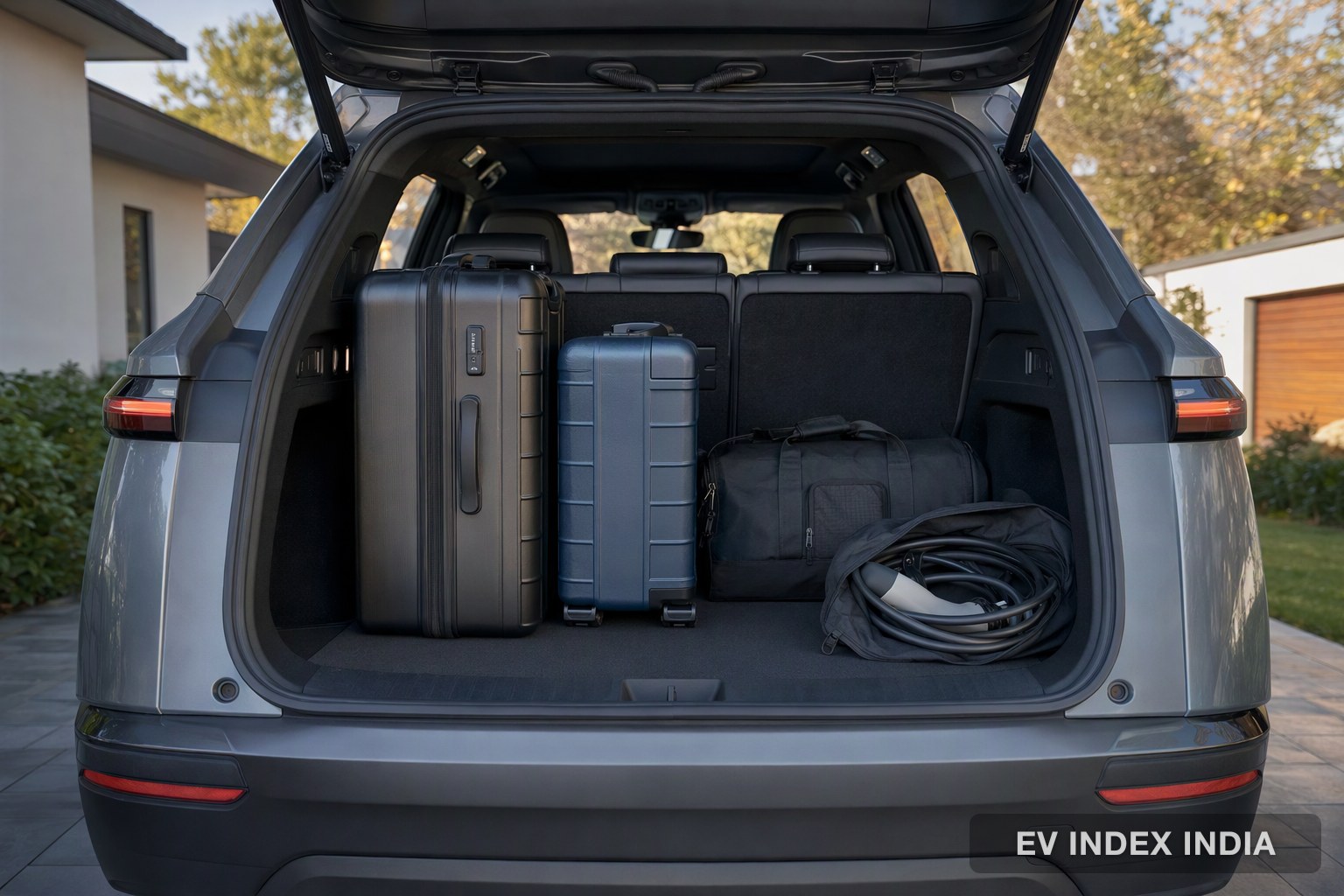
Electric SUVs with the biggest boot in India
We ranked 18 electric SUVs under ₹30 lakh by boot volume, keeping frunk space separate. The XEV 9e (663 L) and Sierra.ev (622 L) are the only two with VDA-rated figures above 600 litres, and the Windsor EV is the cheapest route to a 600-litre boot. The XEV 9S's 527 litres is measured with its third row folded, and the Maruti e Vitara has the smallest boot at 238 to 306 litres by Autocar India's measure.
The Mahindra XEV 9e has the biggest boot of any electric SUV under ₹30 lakh in India: 663 litres (VDA method), plus a 150-litre frunk, from ₹21.90 lakh. Next come the Tata Sierra.ev at 622 litres (VDA) from ₹18.79 lakh and the MG Windsor EV at 604 litres from ₹14.85 lakh, the cheapest way into a 600-litre boot. The VinFast VF7 (537 litres) and the Mahindra XEV 9S (527 litres with its third row folded) follow. At the small end, the Maruti Suzuki e Vitara is the tightest. Maruti publishes no figure for it, and Autocar India measures it at 238 to 306 litres depending on where the sliding rear seat sits.
Prices below are the starting ex-showroom price of the cheapest variant, Delhi where the maker quotes a city, checked 16 Nov 2026. Boot figures are the maker's own unless the table says otherwise.
Boot space ranking: electric SUVs under ₹30 lakh
| Rank | Model | Boot, seats up (litres) | Basis | Frunk (litres) | Price from (ex-showroom, checked 16 Nov 2026) | Battery (kWh) | Claimed range (km) |
|---|---|---|---|---|---|---|---|
| 1 | Mahindra XEV 9e | 663 | VDA (ISO V211) | 150 | ₹21.90 lakh | 59, 79 | 522 to 656 |
| 2 | Tata Sierra.ev | 622 (1,257 seats folded) | VDA | 55 RWD, 35 QWD | ₹18.79 lakh | 63, 75 | 566 to 665 |
| 3 | MG Windsor EV | 604 (579 on higher variants) | Not stated | None listed | ₹14.85 lakh | 38, 52.9 | 332 to 449 |
| 4 | VinFast VF7 | 537 | Not stated | None listed | ₹22.99 lakh (Autocar India) | 59.6, 70 (usable) | 438 to 532 |
| 5 | Mahindra XEV 9S | 527 (third row folded) | VDA (ISO V211) | 150 | ₹20.65 lakh | 59, 70, 79 | 521 to 679 |
| 6 | Tata Harrier.ev | 502 | Not stated | 67 RWD, 35 QWD | ₹21.79 lakh | 65, 75 | 538 to 627 |
| 7 | Tata Curvv.ev | 500 | Not stated | 11.6 (Empowered X) | ₹17.19 lakh | 55 | 502 |
| 8 | Mahindra BE 6 | 455 | VDA (ISO V211) | 45 | ₹19.45 lakh | 59, 70, 79 | 573 to 708 |
| 9 | MG ZS EV | 448 | Autocar India; MG publishes none | None listed | ₹17.99 lakh | 50.3 | 461 |
| 10 | BYD Atto 3 | 440 (1,340 seats folded) | Autocar India | None listed | ₹24.99 lakh (Autocar India) | 49.92, 60.48 | 468 to 521 |
| 11 | Hyundai Creta Electric | 433 | Autocar India; Hyundai publishes none | 22 (selected trims) | ₹18.03 lakh | 42, 51.4 | up to 510 |
| 12 | VinFast VF6 | 423 (1,576 seats folded) | Autocar India | None listed | ₹18.19 lakh (Autocar India) | 59.6 (usable) | 463 to 468 |
| 13 | Kia Syros EV | 390 (465 with rear seat slid forward, HTX trims and X-Line) | As quoted | 16 | ₹13.50 lakh | 42, 51.4 | 443 to 526 |
| 14 | Tata Punch.ev | 366 | VDA | None listed | ₹9.79 lakh | 30, 40 | up to 468 |
| 15 | Mahindra XUV 3XO EV | 364 | VDA (ISO V211) | None listed | ₹13.89 lakh | 39.4 | 351 |
| 16 | Tata Nexon.ev | 350 | Not stated | Yes, Empowered +A 45 only (size not stated) | ₹12.49 lakh | 30, 45 | 275 to 489 |
| 17 | Citroen e-C3X | 315 | As quoted | None listed | ₹12.09 lakh | 29.2 | 330 |
| 18 | Maruti Suzuki e Vitara | 238 to 306 | Autocar India; Maruti publishes none | None listed | ₹16.19 lakh | 49, 61 | 440 to 543 |
Claimed ranges are the makers' certified figures on the MIDC cycle (Part 1 + Part 2) where the maker names it. The top of each range belongs to the largest battery. "None listed" means the maker's brochure or spec sheet we checked does not list a frunk; it does not prove the car has none.
Two prices need a word. Tata's own Harrier.ev page title still says "from ₹21.69 lakh", but the cheapest variant card on the same page (Adventure 65) reads ₹21,79,000, so we use that. The Punch.ev page has the same split: ₹9.69 lakh in its FAQ text, ₹9,79,000 on the Smart 30 card. The card price is the one we quote.
Why boot figures do not compare cleanly
Boot litres in India are quoted in at least three ways, and the makers rarely say which.
The VDA method fills the boot with standard 1-litre blocks, usually up to the parcel shelf or the top of the rear seatback. Mahindra prints "VDA ISO V211" next to every figure in its brochures. Tata does so for the Sierra.ev and Punch.ev, but not for the Harrier.ev, Curvv.ev or Nexon.ev. MG, VinFast, Kia and Citroen quote a number with no method attached.
The second problem is seating. The XEV 9S's 527 litres is measured with the third row folded, which Mahindra's brochure states plainly. So it is a five-seat boot figure on a car you may be buying for seven seats. Mahindra does not publish a figure with all three rows up. The Syros EV's 465 litres only applies with the sliding second row pushed fully forward on the HTX trims and the X-Line; the everyday figure is 390.
The third is that some makers publish nothing. Maruti's e Vitara brochure and Hyundai's Creta Electric brochure both skip boot volume, as does MG for the ZS EV. For those three we use Autocar India's figures and say so.
Treat a 30-litre gap between two cars as a tie unless both use the same method. A 100-litre gap is real.
Frunk space is separate
A frunk is the storage well under the bonnet, and we never add it to the boot figure. The XEV 9e and XEV 9S have the largest at 150 litres each, big enough for a cabin bag. The Harrier.ev's frunk is 67 litres on the rear-wheel-drive versions but 35 litres on the dual-motor QWD, because the front motor takes the space. The Sierra.ev follows the same pattern, 55 litres on RWD and 35 on QWD.
The smaller frunks are mostly cable bins. The Curvv.ev's 11.6 litres (Empowered X only), the Syros EV's 16 litres and the Creta Electric's 22 litres (not on the Executive trims) hold a charging cable and not much else. The BE 6's 45 litres sits between the two groups.
Biggest boots under ₹20 lakh
These cars start under ₹20 lakh. Several of them go well past ₹20 lakh in higher trims or with the bigger battery, so check the variant you want.
| Model | Boot (litres) | Price from (ex-showroom, checked 16 Nov 2026) | Cheapest variant |
|---|---|---|---|
| Tata Sierra.ev | 622 | ₹18.79 lakh | Pure 63 |
| MG Windsor EV | 604 | ₹14.85 lakh | Excite (38 kWh) |
| Tata Curvv.ev | 500 | ₹17.19 lakh | Accomplished X 55 |
| Mahindra BE 6 | 455 | ₹19.45 lakh | One 59 kWh |
| MG ZS EV | 448 | ₹17.99 lakh | Executive |
| Hyundai Creta Electric | 433 | ₹18.03 lakh | Executive (42 kWh) |
| VinFast VF6 | 423 | ₹18.19 lakh | Earth |
| Kia Syros EV | 390 | ₹13.50 lakh | HTK (42 kWh) |
| Tata Punch.ev | 366 | ₹9.79 lakh | Smart 30 |
| Mahindra XUV 3XO EV | 364 | ₹13.89 lakh | AX5 |
| Tata Nexon.ev | 350 | ₹12.49 lakh | Creative + MR |
| Citroen e-C3X | 315 | ₹12.09 lakh | Live |
| Maruti Suzuki e Vitara | 238 to 306 | ₹16.19 lakh | Delta (49 kWh) |
Tata Sierra.ev: 622 litres
The Sierra.ev has the biggest boot in this bracket and one of only two VDA-rated figures above 600 litres in this list. Tata's brochure gives 622 litres with the rear seats up and 1,257 litres with the 60:40 rear seat folded. Add a 55-litre frunk on the rear-drive versions. The base Pure 63 costs ₹18.79 lakh with a 63 kWh pack rated at 566 km; the 75 kWh RWD claims 665 km.
The weakness: the 75 kWh and dual-motor versions push the price well into the ₹20 lakh-plus bracket, and the QWD's frunk drops to 35 litres. Our Sierra.ev model page has the full variant list.
MG Windsor EV: 604 litres
The Windsor is the cheapest car here with a boot above 600 litres. MG's brochure gives 604 litres on the Excite and Exclusive variants and 579 litres on the Essence, Exclusive Pro and Essence Pro. MG does not say how it measures either figure. The base Excite costs ₹14,84,800 ex-showroom (MG quotes an all-India price) with a 38 kWh battery and 332 km of claimed range.
The weakness is the battery that comes with the big boot. A 38 kWh pack and a range of 332 km are modest for a car this size, and the 52.9 kWh pack (449 km) comes only on the Pro variants, which are also the ones with the smaller 579-litre boot. MG's brochure also notes that the home charger is not standard on the Excite. If you are weighing space against range under ₹20 lakh, our list of electric SUVs under ₹20 lakh for family space and range goes further.
Tata Curvv.ev: 500 litres
The Curvv.ev's 500 litres is a big number for a car with a sloping, coupe-style tail, though Tata does not state the method. It has a single 55 kWh pack rated at 502 km, from ₹17.19 lakh for the Accomplished X 55. The 11.6-litre frunk and the powered tailgate are on the Empowered X only. The sloping rear glass limits how tall a load you can stack, whatever the litre figure says.
Mahindra BE 6: 455 litres
The BE 6 gives 455 litres (VDA) and a 45-litre frunk, from ₹19.45 lakh for the One 59 kWh. Its claimed range runs from 573 km (59 kWh) to 708 km (79 kWh), the longest of any car in this list. It is the range pick rather than the space pick: its boot is 208 litres smaller than its XEV 9e sibling's.
MG ZS EV: 448 litres
MG does not publish the ZS EV's boot volume in its brochure or on its model page. Autocar India lists 448 litres. It starts at ₹17.99 lakh with a 50.3 kWh pack and a claimed 461 km, though MG does not name the test cycle. Of the cars under ₹20 lakh it is the one where you have the least official data to go on.
Hyundai Creta Electric: 433 litres
Hyundai's Creta Electric brochure lists a 22-litre frunk on the Premium and most higher trims but gives no boot volume. Autocar India's figure is 433 litres. Prices start at ₹18,02,800 (New Delhi) for the Executive 42 kWh, and the 51.4 kWh Long Range claims up to 510 km. The Executive, Executive Tech and Long Range Executive (O) do not get the frunk.
VinFast VF6: 423 litres
Autocar India lists the VF6's boot at 423 litres, rising to 1,576 litres with the rear seats folded. It starts at ₹18.19 lakh (Autocar India, Delhi) with a 59.6 kWh usable pack and up to 468 km claimed. We could not open VinFast's own India site for this check, so the price and boot figure are Autocar's.
Kia Syros EV: 390 litres
The Syros EV's sliding second row helps here: 390 litres normally, 465 litres with the seat slid fully forward on the HTX trims and the X-Line. It also has a 16-litre covered frunk. The HTK 42 kWh starts at ₹13.50 lakh (Kia's Delhi price), and the 51.4 kWh Extended Range claims 526 km. The weakness is that the 465-litre figure costs you rear legroom, and the base HTK does not get the slide.
Tata Punch.ev, Mahindra XUV 3XO EV and Tata Nexon.ev: 350 to 366 litres
These three sit within 16 litres of each other, which is too close to call given that the Nexon.ev's method is not stated. The Punch.ev (366 litres, VDA) is the cheapest at ₹9.79 lakh, though Tata lists the 30 kWh version's range as "under certification" and only the 40 kWh has a certified 468 km. The XUV 3XO EV (364 litres, VDA) has one 39.4 kWh battery and a claimed 351 km. The Nexon.ev (350 litres) is the only one of the three with a frunk, and only on the Empowered +A 45. Its 45 kWh pack claims 489 km.
Citroen e-C3X: 315 litres
The e-C3X has 315 litres from ₹12.09 lakh, with a 29.2 kWh battery and an ARAI-certified 330 km. Its battery is the smallest of any SUV here.
Maruti Suzuki e Vitara: 238 to 306 litres
The e Vitara has the smallest boot in this list. Maruti's brochure gives no figure, and Autocar India puts it at 238 to 306 litres depending on where the sliding rear seat is set. Maruti fits a luggage board for a flat floor and a separate box for the charger and tools on all three trims, which helps, but it cannot make up a gap of nearly 300 litres to the Windsor. Its strength is range for the money: up to 543 km from the 61 kWh pack.
Biggest boots from ₹20 lakh to ₹30 lakh
| Model | Boot (litres) | Frunk (litres) | Price from (ex-showroom, checked 16 Nov 2026) | Cheapest variant |
|---|---|---|---|---|
| Mahindra XEV 9e | 663 | 150 | ₹21.90 lakh | Pack One 59 kWh |
| VinFast VF7 | 537 | None listed | ₹22.99 lakh (Autocar India) | Earth |
| Mahindra XEV 9S | 527 (third row folded) | 150 | ₹20.65 lakh | Pack One Above 59 kWh |
| Tata Harrier.ev | 502 | 67 RWD, 35 QWD | ₹21.79 lakh | Adventure 65 |
| BYD Atto 3 | 440 | None listed | ₹24.99 lakh (Autocar India) | Dynamic |
Mahindra XEV 9e: 663 litres
The XEV 9e has the biggest boot of any electric SUV under ₹30 lakh: 663 litres by the VDA method, plus a 150-litre frunk. Mahindra's brochure gives a range of 522 km for the 59 kWh pack and 656 km for the 79 kWh. The Pack One 59 kWh starts at ₹21.90 lakh without a home charger.
The coupe roofline cuts the height of the tailgate opening. Mahindra also publishes no seats-folded figure, so you cannot compare its full load bay against the Sierra.ev's 1,257 litres. See the XEV 9e model page for every pack and price.
VinFast VF7: 537 litres
The VF7's brochure quotes 537 litres, method not stated. The base Earth has a 59.6 kWh usable battery and 438 km of claimed range. The Wind trims move to 70 kWh and 532 km, and the dual-motor Sky to 510 km. Autocar India lists the Earth at ₹22.99 lakh in Delhi. The trade-off is the dealer network, which is much thinner than Tata's or Mahindra's.
Mahindra XEV 9S: 527 litres with the third row folded
The XEV 9S is the only three-row electric SUV in this list, and its 527 litres plus a 150-litre frunk is measured with the third row folded. With all seven seats in use, Mahindra does not publish a figure, and you should expect far less. It starts at ₹20.65 lakh for the Pack One Above 59 kWh 7-seater, with 521 km claimed; the 79 kWh claims 679 km.
Tata Harrier.ev: 502 litres
The Harrier.ev has a quoted boot volume of 502 litres (method not stated) and has the biggest frunk of any Tata, 67 litres on the rear-drive versions. The QWD dual-motor version drops to a 35-litre frunk. The Adventure 65 starts at ₹21.79 lakh with 538 km claimed; the 75 kWh RWD claims 627 km. It costs about ₹3 lakh more than the Sierra.ev and has 120 fewer litres of boot, so buy it for its size and road presence rather than its luggage space.
BYD Atto 3: 440 litres
The Atto 3 has 440 litres, or 1,340 litres with the rear seats folded. The Dynamic, with a 49.92 kWh pack and 468 km claimed, starts at ₹24.99 lakh (Autocar India, Delhi). The 60.48 kWh claims 521 km. It is the most expensive car in this bracket and has the smallest boot in it. The Curvv.ev gives you 60 litres more for ₹7.8 lakh less.
Above ₹30 lakh
Two premium electric SUVs quote big boots. The Hyundai Ioniq 5 has 527 litres plus a 57-litre front compartment, at ₹55.71 lakh (Autocar India, Delhi). The BYD Sealion 7 quotes 500 litres from ₹41.90 lakh (Autocar India, Delhi). Neither beats the XEV 9e or Sierra.ev on boot volume, and both cost roughly twice as much or more.
Which to buy for luggage
If boot space is the main reason you are buying, the XEV 9e and Sierra.ev are the two to test. They are also the only two with VDA-rated figures above 600 litres. The Sierra.ev costs ₹3.11 lakh less to start and publishes a seats-folded figure. The XEV 9e has the bigger frunk.
On a budget under ₹15 lakh, the Windsor's 604 litres is well above the 350 to 390 litres of the Nexon.ev, Syros EV and XUV 3XO EV. The cost is range: 332 km from the base 38 kWh pack.
If you need seven seats, the XEV 9S is the only electric SUV under ₹30 lakh that offers them. Plan around a much smaller boot when all three rows are up.
For a wider view of how these cars compare beyond luggage, see our best electric SUVs under ₹25 lakh and the guide for families switching from a petrol SUV.
Frequently asked questions
Which electric SUV has the biggest boot in India?
Under ₹30 lakh, the Mahindra XEV 9e has the biggest boot at 663 litres (VDA method), plus a 150-litre frunk. It starts at ₹21.90 lakh ex-showroom.
Which electric SUV under ₹20 lakh has the most boot space?
The Tata Sierra.ev, with 622 litres (VDA) from ₹18.79 lakh. The MG Windsor EV is close at 604 litres and costs less, from ₹14.85 lakh.
Does the frunk count towards boot space?
No. Makers quote the frunk separately, and so do we. The XEV 9e and XEV 9S have the largest frunks at 150 litres each. Most others are 11 to 67 litres.
How much boot space does the Maruti e Vitara have?
Maruti does not publish a figure. Autocar India measures 238 to 306 litres depending on the sliding rear seat position, the smallest of the electric SUVs in this list.
What is the boot space of the Mahindra XEV 9S?
527 litres by the VDA method, measured with the third row folded, plus a 150-litre frunk. Mahindra does not publish a figure with all three rows up.
Why do some electric SUVs have no official boot figure?
Some makers leave it out of the brochure. Hyundai does not list one for the Creta Electric, Maruti for the e Vitara or MG for the ZS EV. For those we used Autocar India's figures.
How this was checked
Boot, frunk, battery and range figures come from each maker's current brochure or spec page, opened on 16 Nov 2026. Where a maker published no boot figure (Hyundai Creta Electric, MG ZS EV, Maruti e Vitara) or where we could not open the maker's site (VinFast VF6), we used Autocar India's figure and said so. Prices are the cheapest variant's ex-showroom price from the maker's own price page or price list (Delhi where the maker quotes a city; MG quotes an all-India price and Mahindra's listing names no city), and from Autocar India's Delhi prices for BYD and VinFast.
Last verified: 2026-11-16
Sources
- Mahindra XEV 9e brochure R1 (Apr 2026), specifications
- Mahindra XEV 9S brochure (Oct 2026), specifications
- Mahindra BE 6 brochure (Oct 2026), specifications
- Mahindra XUV 3XO EV brochure R3, specifications
- Mahindra eSUV listing, XEV 9e prices
- Mahindra eSUV listing, XEV 9S prices
- Mahindra eSUV listing, BE 6 prices
- Tata Sierra.ev brochure (Jul 2026)
- Tata Harrier.ev brochure (Oct 2026)
- Tata Curvv.ev Series X brochure (Oct 2026)
- Tata Nexon.ev brochure (Oct 2026)
- Tata Punch.ev brochure (Jun 2026)
- Tata.ev price pages (Sierra.ev, Harrier.ev, Curvv.ev, Nexon.ev, Punch.ev), Delhi
- MG Windsor EV brochure (specifications and prices)
- MG ZS EV brochure (specifications and prices)
- Kia Syros EV specifications page
- Kia Syros EV brochure (2026)
- Hyundai Creta Electric brochure
- Hyundai India price API, Creta Electric, New Delhi
- Citroen e-C3X brochure (Aug 2026)
- NEXA e VITARA price in New Delhi
- NEXA e VITARA web brochure (Sep 2026)
- VinFast VF7 India brochure (hosted by Autocar India)
- Autocar India: VinFast VF7 price in Delhi
- Autocar India: VinFast VF6 price in Delhi
- Autocar India: VinFast VF6 specifications
- Autocar India: BYD Atto 3 price in Delhi
- Autocar India: BYD Atto 3 specifications
- Autocar India: Hyundai Creta Electric specifications
- Autocar India: MG ZS EV specifications
- Autocar India: Maruti Suzuki e Vitara specifications
- Autocar India: Hyundai Ioniq 5 specifications
- Autocar India: BYD Sealion 7 specifications