Which Electric SUVs Use a CCS2 Charging Port in India?
CCS2 is the common DC fast-charging port on electric SUVs in India, with Type 2 for AC through the same inlet. The Ministry of Power's 2024 charging guidelines list the BIS IS 17017 connector standards for cars. Since the port is shared, compare the peak DC rate, the charger each quoted time assumes and the AC charging rate. The e Vitara has a CCS2 DC inlet and Type-2 AC inlet, takes 45 minutes for 10 to 80% on a charger of at least 70 kW, and Maruti does not publish its peak DC rate.
Practically every electric SUV on sale in India uses a CCS2 charging port. The Maruti Suzuki e Vitara, Tata Nexon EV and Curvv EV, Mahindra XEV 9e and XEV 9S, Hyundai Creta Electric, Kia Syros EV, MG Windsor EV and BYD Sealion 7 all print "CCS2" as the charging standard in their India brochures or specification tables, and Porsche India specifies CCS fast charging for the Macan Electric and Cayenne Electric. We read the makers' own documents for 16 electric SUVs and did not find one that names any other DC connector.
So the port will not help you choose between them. What differs is how much power each car can take through it: 45 kW on the smaller-battery MG Windsor EV, 150 kW on a BYD Sealion 7, 200 kW on a Mercedes-Benz EQS SUV and up to 390 kW on a Porsche Cayenne Electric. The AC side differs too, from 7.4 kW home charging on the e Vitara to 22 kW on the EQS SUV.
Key takeaways
- CCS2 handles DC fast charging. The upper part of the same inlet is a Type 2 socket for AC charging at home or at slower public points. One flap, two jobs.
- The Ministry of Power's 2024 charging guidelines list the BIS standards that cover these connectors for cars, which is why public DC chargers for four-wheelers in India carry CCS2 guns.
- Several makers, including Maruti, Tata, Hyundai and Kia, do not publish a peak DC charging rate. They publish a time and the charger it was measured on. Read those two together.
- The e Vitara has a CCS2 DC inlet and a Type 2 AC inlet on every variant, per its brochure. Its DC time of 45 minutes for 10 to 80% is slower than most rivals above Rs 20 lakh.
What CCS2 is, and why India uses it
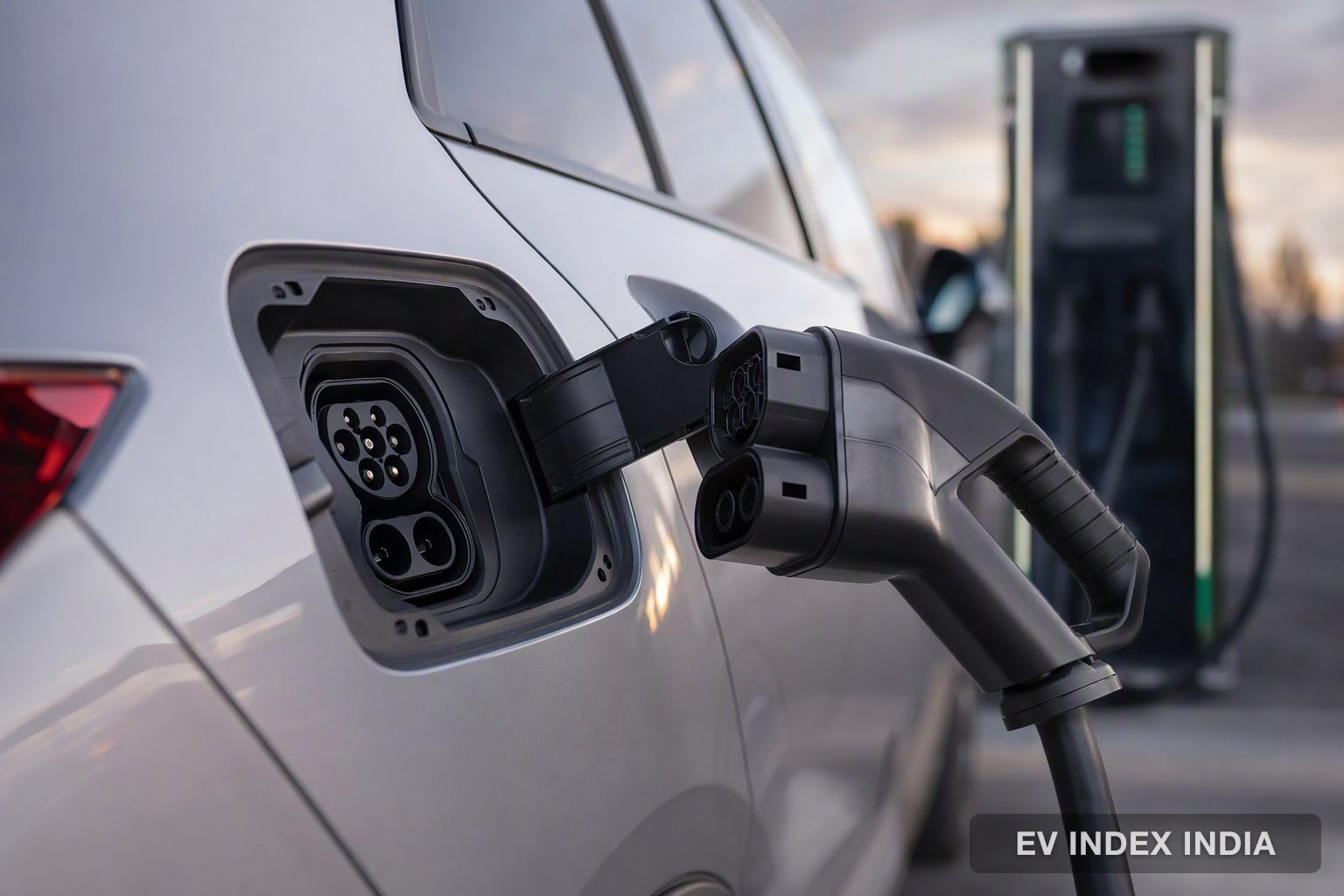
CCS stands for Combined Charging System. The "2" refers to the version built around the European Type 2 AC connector. Look inside the flap and you see a round seven-pin Type 2 socket on top, with two large DC pins below it. A home wallbox or slow public charger plugs into the top part only. A DC fast charger's larger gun covers both.
India's rules point to this design for cars. The Ministry of Power's Guidelines for Installation and Operation of Electric Vehicle Charging Infrastructure-2024, issued on 17 September 2024, carry an annexure of "Indian Standards for EV Chargers notified by BIS". For four-wheelers it lists IS 17017-2-2 as the plug, socket and vehicle inlet standard for AC charge points of 11 kW and 22 kW, and IS 17017-2-3 for DC charging from 50 kW to 250 kW. Those are the parts of the IS 17017 series on conductive charging that correspond to the international connector standards behind Type 2 and CCS. The annexure works in standard numbers, not connector nicknames, and the guidelines do not ban other connectors. In practice, every carmaker we checked has settled on CCS2.
Two-wheelers and three-wheelers are a separate story. The same annexure lists different standards (IS 17017-2-6 and IS 17017-2-7) for light electric vehicles, so a scooter's fast charger and a car's are not interchangeable.
What each electric SUV publishes about its charging port
| Model | Charging standard as printed by maker | Peak DC rate published | DC time and window (charger used) | AC charging published |
|---|---|---|---|---|
| Maruti Suzuki e Vitara | CCS2 DC inlet, Type-2 AC inlet | Not published | 45 min, 10 to 80% (minimum 70 kW) | 7.4 kW single-phase: about 6.5 h (49 kWh), 9 h (61 kWh), 10 to 100% |
| Tata Nexon EV | CCS2 | Not published | 45 kWh: 40 min, 10 to 80% (60 kW). 30 kWh: 56 min (50 kW) | 7.2 kW: 6 h 36 min (45 kWh), 10 to 100% |
| Tata Curvv EV | CCS2 | Not published | 55 kWh: about 40 min, 10 to 80% (70 kW or higher) | 7.2 kW: about 7.9 h, 10 to 100% |
| Mahindra XEV 9e, XEV 9S (BE 6 brochure gives the same charging figures) | CCS2 | Not published as a peak | 20 min, 20 to 80% (140 kW input for 59 kWh, 160 kW for 70 kWh, 180 kW for 79 kWh) | 7.2 kW or 11.2 kW wall charger: 79 kWh in 11.7 h or 8 h, 0 to 100% |
| Hyundai Creta Electric | CCS2 | Not published | 39 min, 10 to 80% (above 100 kW) | 7.4 kW: 6 h (42 kWh), 7 h 15 min (51.4 kWh), 10 to 100% |
| Kia Syros EV | CCS2 | Not published | 39 min, 10 to 80% (100 kW) | 10.8 kW onboard charger; 11 kW wallbox: 4 h (42 kWh), 4 h 50 min (51.4 kWh), 10 to 100% |
| MG Windsor EV | CCS2 | 45 kW (38 kWh), 60 kW (52.9 kWh) | About 45 min and 50 min, 20 to 80% | 7.4 kW: about 7 h (38 kWh), 9.5 h (52.9 kWh), 10 to 100% |
| MG ZS EV | "Type-2 Plus CCS" | Not published | 60 min, 0 to 80% (50 kW) | 7.4 kW charger optional on some variants |
| BYD Sealion 7 | DC port CCS 2, AC port Type 2 | 150 kW (110 kW on Dynamic) | No timed figure in the India table | 11 kW port (7 kW on Dynamic) |
| Kia EV9 | Connector not named; 400 V and 800 V charging | Not published | 24 min, 10 to 80% (350 kW) | Not checked |
| Mercedes-Benz EQS SUV | Type 2 cable listed; DC rate given | 200 kW | 31 min, 10 to 80% | Up to 22 kW; 12.25 h, 0 to 100% |
| BMW iX xDrive50 | Not stated in the release | 195 kW | 35 min, 10 to 80% (195 kW) | 11 kW standard, 22 kW optional |
| Porsche Macan Electric | CCS | 270 kW | 21 min, 10 to 80% (above 270 kW) | Not checked |
| Porsche Cayenne Electric | CCS | 390 kW | 16 min, 10 to 80% (above 390 kW) | 11 kW, 22 kW optional |
Read from makers' India brochures and web pages on 13 October 2026. The charging windows differ between brands (10 to 80%, 20 to 80%, 0 to 80%), so the times in the fourth column are not a ranking. Our wider guide to the fastest-charging electric cars in India covers cars beyond SUVs.
What actually differs between CCS2 cars
Peak DC power
The connector is rated for far more power than most cars draw. The car's battery and electronics set the limit. MG is unusually direct about this: the Windsor EV brochure has a line reading "maximum fast charging capability" of 45 kW with the 38 kWh pack and 60 kW with the 52.9 kWh pack. BYD India's table marks the Sealion 7's DC port as CCS 2 at 150 kW on the Premium and Performance and 110 kW on the Dynamic. At the top end, Porsche says the Cayenne Electric accepts up to 390 kW and the Macan Electric up to 270 kW, both on 800-volt hardware.
Plug a 390 kW-capable Porsche into a 60 kW charger and it charges at 60 kW. Plug a Windsor EV into a 240 kW charger and it still takes 45 or 60 kW. The lower of the two numbers always wins.
Maruti, Tata, Hyundai and Kia (on the Syros EV) do not print a peak figure. They state a time and the charger rating it assumes. Mahindra gives a "charger input" of 140 kW, 160 kW or 180 kW depending on the pack, which tells you what the charger must supply, not what the car sustains.
AC charging rate
This is the number that shapes daily life, because most charging happens parked at home. The onboard AC charger converts wall current to DC for the battery, and its rating caps how fast any wallbox can fill the car.
The Kia Syros EV's brochure states a 10.8 kW onboard charger, which with an 11 kW wallbox refills the 51.4 kWh pack from 10 to 100% in 4 hours 50 minutes. The Hyundai Creta Electric has the same pack size but its brochure quotes only a 7.4 kW charger, at 7 hours 15 minutes. The EQS SUV accepts 22 kW AC, and BMW and Porsche offer 22 kW as an option over a standard 11 kW.
Anything above 7.4 kW needs a three-phase connection, which many Indian homes and apartment parking bays do not have. Check your sanctioned load before paying extra for a faster wallbox.
Where the port is
It sounds trivial until you park nose-in at a charger with a short cable. Makers rarely put the port position in a specification table. Porsche is the exception here: its India page says the Cayenne Electric has an AC port on both sides and the DC port on the left. For the others, look at the car or the brochure photographs and compare with how chargers are laid out where you park.
What comes in the box
The e Vitara brochure lists a 3 kW portable charging cable. Mahindra lists a 13 A portable charger and offers 7.2 kW and 11.2 kW wall chargers as options. Tata's Curvv EV brochure lists a 7.2 kW AC wallbox as the included charger. MG notes that the 7.4 kW charger is not standard on the Windsor EV's Excite variant. These details move between model years, so confirm them on the quotation.
The Maruti Suzuki e Vitara's charging hardware
The e Vitara brochure lists, under "charger details": a Type-2 AC charging inlet, a CCS2 DC charging inlet, a 3 kW portable charging cable, battery thermal management preconditioning through in-vehicle controls, an immediate charging switch, and a lamp inside the charging port lid with a charge indicator.
The specification table gives the same DC time, 45 minutes for 10 to 80%, for the 49 kWh Delta and the 61 kWh Zeta and Alpha. The footnote is more specific: the 45 minutes is "based on charging an e VITARA with a 61kWh battery from 10% to 80% and requires a minimum 70kW rapid DC charger". On AC, Maruti quotes a 7.4 kW single-phase charger: about 6.5 hours for the 49 kWh pack and about 9 hours for the 61 kWh pack, 10 to 100%.
Two things Maruti does not publish: the car's peak DC rate and its onboard AC charger rating. You may see 100 kW or similar quoted for the e Vitara elsewhere, including in older articles on this site; that number is not in the brochure. What the brochure supports is that a 70 kW charger is enough to hit the stated time. On a 50 kW or 60 kW unit, expect longer than 45 minutes.
Against rivals, the e Vitara's DC time is middling to slow. The Creta Electric and Syros EV quote 39 minutes for the same 10 to 80% window with smaller packs, and Mahindra quotes 20 minutes for a narrower 20 to 80% window. The e Vitara's defence is its certified range of 543 km on the 61 kWh pack, which means fewer stops in the first place.
How this was checked, and what was not
Each row in the table comes from the maker's India brochure PDF or India web page, opened on 13 October 2026. "Not published" means the document we read does not state the figure. It does not mean the car lacks the capability.
Not verified: the Tata Harrier EV, because Tata's EV website was returning server errors that day; VinFast, Audi, the Volvo EX90 and the Hyundai Ioniq 5, whose India pages did not load or did not state the standard; and Tesla, which does not describe its India charge port on the Model Y page we read. The Kia EV9, Mercedes-Benz EQS SUV and BMW iX documents give DC charging rates and times but do not name the connector. We have no reason to think any of them uses a different connector for India, but we did not confirm it. BMW's figures are from its March 2024 India launch release for the iX xDrive50.
For how the public network stacks up against these cars, see our guide to charging infrastructure for electric SUVs in India.
Frequently asked questions
Which electric SUVs in India use a CCS2 charging port?
All the mainstream ones we checked: the Maruti Suzuki e Vitara, Tata Nexon EV and Curvv EV, Mahindra XEV 9e and XEV 9S, Hyundai Creta Electric, Kia Syros EV, MG Windsor EV and ZS EV, and BYD Sealion 7. Porsche India specifies CCS fast charging for the Macan Electric and Cayenne Electric.
Does the Maruti Suzuki e Vitara have a CCS2 port?
Yes. The brochure lists a CCS2 DC charging inlet and a Type-2 AC charging inlet. DC charging from 10 to 80% takes 45 minutes on a charger of at least 70 kW.
Is CCS2 the same as Type 2?
Not quite. Type 2 is the AC connector. CCS2 adds two DC pins beneath a Type 2 socket, so a CCS2 car accepts both a Type 2 AC plug and a CCS2 DC gun through the same flap.
Is CCS2 mandatory in India?
The Ministry of Power's 2024 guidelines list the BIS standards that public chargers should follow for each vehicle class, and for cars those are the standards covering Type 2 AC and combined DC connectors. The guidelines do not use the word "mandatory" for a single connector, but every carmaker checked here fits CCS2.
Do all CCS2 cars charge at the same speed?
No. The MG Windsor EV with the 38 kWh pack takes up to 45 kW, the BYD Sealion 7 Premium up to 150 kW and the Porsche Cayenne Electric up to 390 kW, all through the same type of port.
Can I use any public DC charger with a CCS2 car?
Any DC charger with a CCS2 gun will physically fit. You may still need that network's app or RFID card, and the car will charge at the lower of its own limit and the charger's output.
Last verified: 2026-10-13
Sources
- Maruti Suzuki e Vitara brochure: NEXA
- Ministry of Power: Guidelines for Installation and Operation of Electric Vehicle Charging Infrastructure-2024
- Bureau of Indian Standards: IS 17017 (Part 1) Electric Vehicle Conductive Charging System
- Mahindra XEV 9e brochure
- Mahindra XEV 9S brochure
- Hyundai India: Creta Electric brochure
- Kia India: Syros EV brochure
- MG Motor India: Windsor EV brochure
- MG Motor India: ZS EV brochure
- BYD India: Sealion 7 specifications
- Porsche India: Cayenne Electric
- Porsche India: Macan Electric