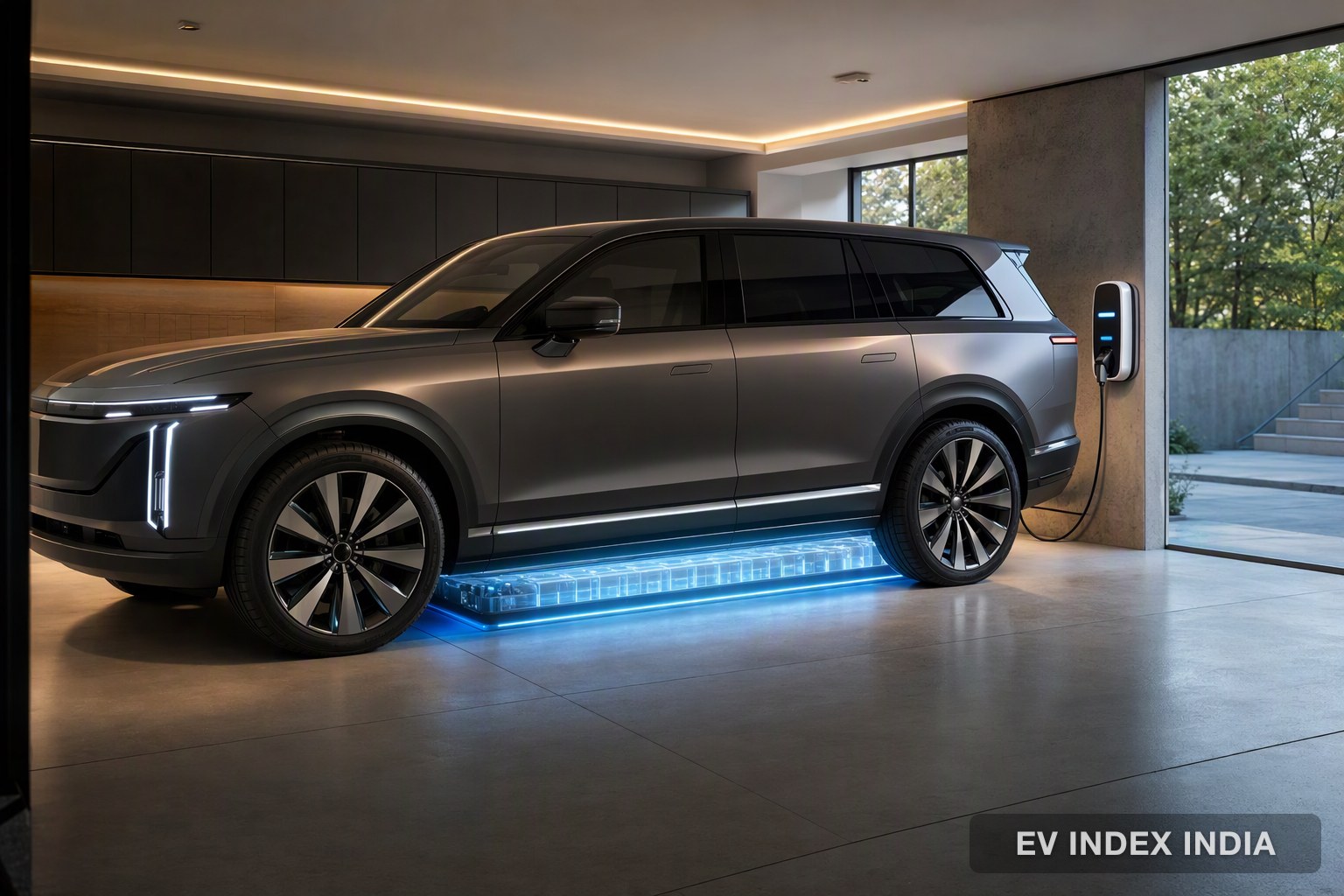
Which Electric SUV Has the Largest Battery Pack in India?
Ranked on figures each maker publishes for India, the EQS SUV (118 kWh usable) leads, followed by the Cayenne Electric, iX xDrive50, Macan Electric and EV9. Porsche quotes gross capacity and Mercedes quotes usable, so the order near the top depends on the basis. Volume brands stop at 82.56 kWh (BYD Sealion 7) and 79 kWh (Mahindra). The e Vitara offers 49 kWh and 61 kWh packs with 440 km and 543 km certified range: a mid-sized battery in a light car, not a large one. Several SUVs, including the Volvo EX90 and Tata Harrier EV, could not be verified and are flagged.
The Mercedes-Benz EQS SUV has the largest battery pack of any electric SUV whose maker publishes the figure for India: 118 kWh of usable energy, according to Mercedes-Benz India's technical data for the EQS 450 4MATIC. The Porsche Cayenne Electric is next at 113 kWh gross, then the BMW iX xDrive50 at 111.5 kWh, the Porsche Macan Electric at 100 kWh gross and the Kia EV9 at 99.8 kWh. Among volume brands, the largest packs we could verify are 82.56 kWh in the BYD Sealion 7 and 79 kWh in Mahindra's XEV 9e, BE 6 and XEV 9S. The Maruti Suzuki e Vitara's bigger pack is 61 kWh, which puts it well down the national order, behind at least eleven other models.
That is the honest market-wide picture. If your budget stops at Rs 25 lakh, the ranking looks very different, and we cover it separately in electric cars with the biggest battery under Rs 25 lakh.
Key takeaways
- The EQS SUV leads on 118 kWh usable. You will see 122 kWh quoted for it elsewhere; the number in Mercedes-Benz India's own data table is 118 kWh, so that is the one used here.
- Gross and usable capacity are different things. Porsche quotes gross, Mercedes quotes usable, and most Indian brochures print one number without saying which. The order near the top could shift by a place if everyone used the same basis.
- Five SUVs carry roughly 100 kWh or more, and all five are luxury models. Among volume brands, the largest pack we could verify is 82.56 kWh.
- The e Vitara's 61 kWh pack is the largest Maruti sells and gives a certified 543 km. It is not a big battery by national standards. It is a mid-sized one in a car that weighs 1,790 to 1,820 kg.
Electric SUV battery packs in India, largest first
| Rank | Model | Largest pack (maker's figure) | Basis stated by maker | Range claimed with that pack |
|---|---|---|---|---|
| 1 | Mercedes-Benz EQS SUV (EQS 450 4MATIC) | 118 kWh | Usable | Not printed in the data table |
| 2 | Porsche Cayenne Electric | 113 kWh | Gross | Listed as "TBA" on Porsche India |
| 3 | BMW iX xDrive50 | 111.5 kWh | Not stated | Up to 635 km (WLTP) |
| 4 | Porsche Macan Electric | 100 kWh | Gross | Listed as "TBA" on Porsche India |
| 5 | Kia EV9 | 99.8 kWh | Not stated | 561 km (ARAI MIDC) |
| 6 | Kia EV6 | 84 kWh | Not stated | 663 km (ARAI MIDC) |
| 7 | BYD Sealion 7 (Premium, Performance) | 82.56 kWh | Not stated | 567 km and 542 km (NEDC) |
| 8 | Mahindra BE 6 | 79 kWh | Not stated | 708 km (MIDC) |
| 8 | Mahindra XEV 9S | 79 kWh | Not stated | 679 km (MIDC) |
| 8 | Mahindra XEV 9e | 79 kWh | Not stated | 656 km (MIDC) |
| 11 | Tata Harrier EV | 75 kWh (not re-verified, see below) | Not stated | Not re-verified |
| 12 | Maruti Suzuki e Vitara (Zeta, Alpha) | 61 kWh | Not stated | 543 km (certified) |
| 13 | Tata Curvv EV | 55 kWh | Not stated | 502 km (MIDC) |
| 14 | MG Windsor EV | 52.9 kWh | Not stated | 449 km (MIDC) |
| 15 | Hyundai Creta Electric, Kia Syros EV | 51.4 kWh | Not stated | 510 km and 526 km (MIDC) |
| 17 | MG ZS EV | 50.3 kWh | Not stated | 461 km |
| 18 | Tata Nexon EV | 45 kWh | Not stated | 489 km (MIDC) |
Figures come from each maker's India brochure or India web page, read on 13 October 2026. Range numbers use different test cycles (MIDC, NEDC, WLTP) and should not be compared across rows. Kia calls the EV6 a crossover; it is included because buyers cross-shop it with SUVs.
Why "largest" depends on gross versus usable
A battery pack has a total energy content (gross) and a smaller portion the car lets you use (usable or net). The gap is a buffer that protects the cells at the top and bottom of the charge window. On large packs it runs to several kilowatt-hours.
This matters at the top of the table. Mercedes-Benz India publishes 118 kWh as "usable energy content". Porsche publishes 113 kWh for the Cayenne Electric and 100 kWh for the Macan Electric as gross capacity, and its India page footnotes the Macan figure as exactly that. BMW India's launch release for the iX xDrive50 says the two floor-mounted batteries "have a combined capacity of 111.5 kWh" without labelling it. So the EQS SUV's lead is real: its usable figure is already larger than its rivals' gross ones. Between second and third place, though, we cannot say which car lets you use more energy, because neither maker publishes a usable figure for India.
Indian mass-market brochures rarely specify. Maruti, Mahindra, Tata, Hyundai, Kia, MG and BYD all print a single "battery capacity" line.
The five biggest packs, and what they cost
Mercedes-Benz EQS SUV: 118 kWh usable
The EQS 450 4MATIC on Mercedes-Benz India's site lists 118 kWh usable, a maximum DC charging rate of 200 kW, 10 to 80% in 31 minutes, and AC charging at up to 22 kW (0 to 100% in 12.25 hours at a wallbox). It weighs 2,890 kg at the kerb. That last number is the cost of a pack this size: the car is more than a tonne heavier than an e Vitara.
Porsche Cayenne Electric: 113 kWh gross
Porsche India lists the Cayenne Electric from Rs 1,77,27,000 and the Turbo from Rs 2,27,51,000. The 113 kWh gross figure comes from Porsche's newsroom, which describes six modules and 192 cells. It is the fastest-charging big pack here: 10 to 80% in 16 minutes, but only at a station supplying more than 390 kW under Porsche's stated optimal conditions. Check whether any charger on your routes can supply that before counting on it.
BMW iX xDrive50: 111.5 kWh
BMW India's launch release of March 2024 gives 111.5 kWh, up to 635 km on the WLTP cycle and 10 to 80% in 35 minutes on a 195 kW charger. The same release is candid about slower hardware: on a 50 kW DC charger the same top-up takes 97 minutes. We could not load bmw.in on the day of writing, so treat this as the launch specification and confirm the current model year with a dealer.
Porsche Macan Electric: 100 kWh gross
From Rs 1,21,62,000 on Porsche India, whose page shows a single 100 kWh pack for the range. 10 to 80% takes 21 minutes at a station delivering more than 270 kW.
Kia EV9: 99.8 kWh
Kia India's brochure gives 99.8 kWh, 561 km on the ARAI MIDC cycle and 10 to 80% in 24 minutes with a 350 kW charger. Kia lists it from Rs 1,29,91,312 ex-showroom.
The volume-brand ceiling: 79 to 82.56 kWh
The BYD Sealion 7 carries 82.56 kWh in the Premium (Rs 49,90,000) and Performance (Rs 55,90,000), and 71.8 kWh in the entry Dynamic (Rs 41,90,000), per BYD India's specification table. Claimed range is 567 km, 542 km and 520 km respectively on the NEDC cycle, which is more generous than MIDC.
Mahindra's three electric SUVs share a 79 kWh top pack. The brochures give 708 km for the BE 6, 679 km for the seven-seat XEV 9S and 656 km for the XEV 9e, all MIDC Part 1 plus Part 2. All three also come with a 59 kWh pack, and the BE 6 and XEV 9S add a 70 kWh option in between.
These are the largest batteries you can buy from a volume brand in India, and the Mahindras bring that capacity in at a fraction of the luxury cars' price. We have not re-checked Mahindra's variant prices for this piece.
Where the Maruti Suzuki e Vitara sits
The e Vitara is sold with two lithium iron phosphate packs, according to the NEXA brochure:
| Variant | Battery | Certified range | Motor output | Kerb weight |
|---|---|---|---|---|
| Delta | 49 kWh | 440 km | 105.8 kW, 193 Nm | 1,730 kg |
| Zeta | 61 kWh | 543 km | 128 kW, 193 Nm | 1,790 kg |
| Alpha | 61 kWh | 543 km | 128 kW, 193 Nm | 1,820 kg |
At 61 kWh, it is twelfth in the table above. It holds roughly half the energy of an EQS SUV and 18 kWh less than a Mahindra BE 6. Nobody should buy an e Vitara because it has the biggest battery, because it doesn't.
What it does have is efficiency. A certified 543 km from 61 kWh works out to about 8.9 km per kWh on the test cycle. The Kia EV9's 561 km from 99.8 kWh is about 5.6 km per kWh on a comparable Indian cycle. Lab figures flatter every car, but the gap shows why capacity and range do not rank in the same order: a lighter SUV needs less battery to go the same distance.
Its weaknesses are just as plain. DC charging takes 45 minutes for 10 to 80%, and Maruti's footnote says the figure is based on the 61 kWh pack and needs a charger of at least 70 kW. Mahindra quotes 20 minutes for a 20 to 80% window on its 79 kWh pack with a 180 kW charger. The windows differ, so the two times are not directly comparable, but the e Vitara is clearly the slower car at a highway stop. The entry Delta also drops to 49 kWh and 440 km. The battery warranty is 8 years or 1,60,000 km, where Mahindra's brochure offers a lifetime warranty to the first registered owner. As checked for this site's 12 October coverage, the range ran from Rs 16.19 lakh to Rs 20.21 lakh ex-showroom.
Does the biggest battery matter?
Less than the ranking suggests. Three things decide whether a large pack is useful to you.
The first is charging speed. A 118 kWh pack on a 50 kW charger is a very long stop; BMW's own 97-minute figure for the iX makes the point. Our guide to the fastest-charging electric cars in India covers this in more detail.
The second is weight. The EQS SUV's 2,890 kg kerb weight is roughly 1,100 kg more than the e Vitara Zeta's. That mass costs efficiency, tyres and brakes.
The third is how you actually drive. If your longest regular trip is 300 km, a 61 kWh or 79 kWh SUV covers it with margin, and you would be paying for capacity you rarely touch. For how these cars do outside the lab, see electric cars with the best real-world range.
How this list was built, and what was not verified
Every capacity figure was taken from the maker's India brochure or India web page on 13 October 2026, not from aggregators. Where a maker states gross or usable, the table says so.
Several SUVs are missing because their makers do not publish a battery capacity for India, or because we could not read the page:
- Volvo EX90: on sale from Rs 1,26,00,000 per Volvo India, with a 625 km WLTP estimate, but the India page prints no kWh figure. Given its size and claimed range it would probably sit near the top of the table if Volvo India published the number.
- Mercedes-Benz G 580 with EQ Technology: listed on Mercedes-Benz India with 210 kW DC charging and a 3,085 kg kerb weight, but no battery capacity in the India data table.
- Tesla Model Y and Lotus Eletre: neither India page states a kWh figure.
- Audi, VinFast and the Hyundai Ioniq 5: the India pages either did not load or returned errors, so they are left out without judgment on their size.
- Tata Harrier EV: Tata's EV website was returning server errors on the day of writing. The 75 kWh figure is the one Tata launched the car with, and Bharat NCAP's report names the tested variant "EMP 75", but we could not re-read the brochure. Its position in the table is provisional.
BMW's figure is from a 2024 launch release, as noted. Prices are quoted only where the maker's page showed them on the day.
Frequently asked questions
Which electric SUV has the largest battery in India?
The Mercedes-Benz EQS SUV, with 118 kWh usable in the EQS 450 4MATIC per Mercedes-Benz India. The Porsche Cayenne Electric (113 kWh gross) and BMW iX xDrive50 (111.5 kWh) follow.
Which mainstream electric SUV has the biggest battery?
The BYD Sealion 7 Premium and Performance at 82.56 kWh. Among Indian brands, the Mahindra BE 6, XEV 9e and XEV 9S top out at 79 kWh.
What is the battery capacity of the Maruti Suzuki e Vitara?
49 kWh on the Delta and 61 kWh on the Zeta and Alpha, both lithium iron phosphate. Certified range is 440 km and 543 km respectively.
Does the e Vitara have the largest battery in its price range?
No. Mahindra's BE 6 and XEV 9e offer 79 kWh, and the Tata Harrier EV was launched with a 75 kWh option. The e Vitara's 61 kWh is larger than the Tata Curvv EV (55 kWh), MG Windsor EV (52.9 kWh) and Hyundai Creta Electric (51.4 kWh).
Is a bigger battery always better?
No. A bigger pack adds weight and cost and takes longer to fill on the same charger. Range depends on efficiency as much as capacity, which is why a 61 kWh e Vitara is certified for nearly as many kilometres as a 99.8 kWh Kia EV9.
What is the difference between gross and usable battery capacity?
Gross is everything the cells hold. Usable is the part the car lets you draw, after a protective buffer. Porsche quotes gross figures and Mercedes-Benz India quotes usable, so check which one you are reading before comparing two cars.
Last verified: 2026-10-13
Sources
- Maruti Suzuki e Vitara brochure: NEXA
- Porsche India: Cayenne Electric
- Porsche Newsroom: high-voltage system in the Cayenne Electric
- Porsche India: Macan Electric
- BMW Group India press release: BMW iX xDrive50 launched in India
- Kia India: EV9 brochure
- Kia India: EV6 brochure
- BYD India: Sealion 7 specifications
- Mahindra BE 6 brochure
- Mahindra XEV 9e brochure
- Mahindra XEV 9S brochure
- Bharat NCAP: Tata Harrier.ev crash test result