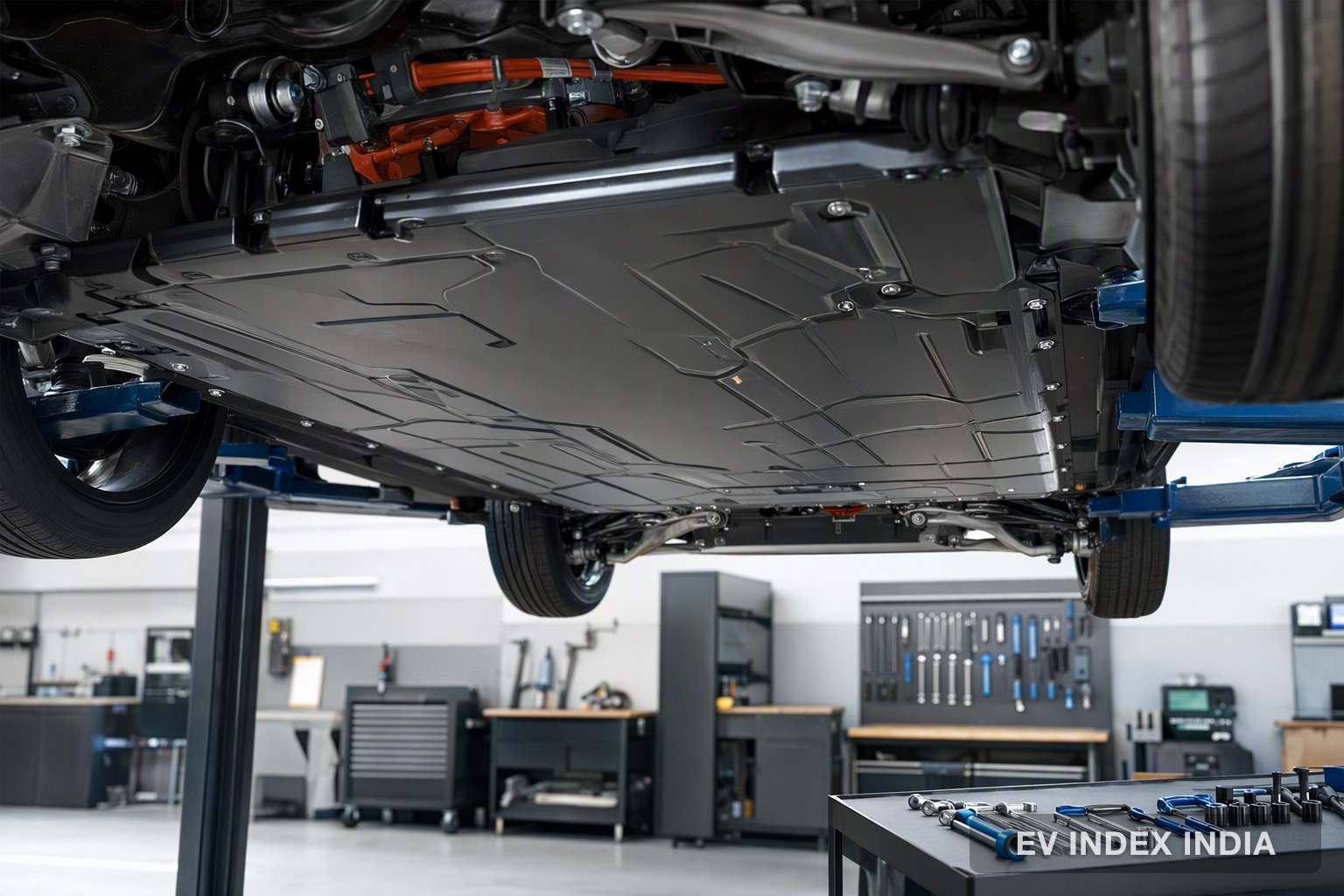
Best Electric SUV With BaaS Ownership and Fast Charging in India
Five makers publish BaaS for electric SUVs: MG, Tata, Mahindra, Hyundai and Maruti. For Tata and Mahindra it is a second loan with a fixed battery EMI, and the per-km rate is an illustration at 60 km a day; MG alone describes usage-based billing with some financiers. Maruti publishes Rs 10.99 lakh plus Rs 3.99 per km for the e Vitara Delta only, labelled introductory. At about 1,800 km a month the battery costs roughly Rs 7,000 to Rs 10,600 before electricity. No maker publishes the battery loan interest rate for these SUVs.
The Mahindra BE 6 is the best electric SUV in India if you want Battery-as-a-Service and fast charging together: Mahindra prices it from Rs 11.45 lakh under BaaS with the battery at an effective Rs 3.75 per km, and its brochure quotes 20 to 80 percent in 20 minutes. The XEV 9e offers the same terms from Rs 13.90 lakh. Below those, three SUVs share a Rs 10.99 lakh BaaS entry price: the Hyundai Creta Electric (Rs 3.9 per km), the Maruti Suzuki e Vitara (Rs 3.99 per km) and the Tata Curvv.ev (Rs 5 per km), all with a 39 to 45 minute fast charge. The lowest BaaS entry price on an SUV is the Tata Nexon.ev's Rs 8.99 lakh. MG, which started BaaS in India, prices the Windsor EV from Rs 9.99 lakh but has the slowest charging.
Five manufacturers now publish a BaaS price for an electric SUV. What they mean by it differs more than the similar-looking numbers suggest, and most of this article is about that difference.
What BaaS is in India today: usually a second loan
The name suggests you rent a battery and pay by the kilometre. For most of these cars that is not what happens.
Tata's September 2026 press release calls BaaS a dual-loan finance product: the vehicle and the battery are financed through separate loan accounts, and the battery EMI depends on battery size, down payment and tenure. Mahindra's release uses the same structure and is blunter, stating that BaaS is a finance product offered by the financier and is not a pay-per-use programme. Maruti's own banner prices the e Vitara at Rs 10.99 lakh plus a battery EMI, and its brochure describes a fixed monthly fee for the battery.
In all three cases the per-km figure is an illustration. Each maker divides a monthly battery instalment by an assumed 60 km of driving a day. Drive 30 km a day and the instalment is the same, so your real cost per kilometre doubles. Drive 100 km a day and it falls.
MG is the exception, in part. Its Windsor BaaS page says some finance partners bill on the kilometres actually driven with no monthly minimum, tracked by a telematics unit, while certain financiers apply a minimum of 1,500 km a month. MG also says the rental is made up of principal and interest, so it is still a financed battery, but with usage-linked billing available.
Hyundai's wording sits between the two. Its Creta Electric page calls the plan a rental starting at Rs 3.9 per km and, in the same panel, a battery EMI. Hyundai does not publish the assumptions behind the rate.
Three more things recur wherever a maker prints its fine print. The price excludes the electricity you put in. The vehicle is hypothecated to the financier. And the plans are for private buyers only. Hyundai's page is silent on all three.
BaaS prices and charging compared
| Model | BaaS entry price | Battery cost quoted | Regular entry price | Upfront gap | Monthly battery cost at 1,800 km (our arithmetic) | Quoted DC fast charge on that variant |
|---|---|---|---|---|---|---|
| Mahindra BE 6 | Rs 11.45 lakh | Rs 3.75/km | Rs 19.45 lakh | Rs 8.00 lakh | Rs 6,975 (Mahindra's stated EMI) | 20 to 80% in 20 min, 140 kW charger |
| Mahindra XEV 9e | Rs 13.90 lakh | Rs 3.75/km | Rs 21.90 lakh | Rs 8.00 lakh | Rs 6,975 (Mahindra's stated EMI) | 20 to 80% in 20 min, 140 kW charger |
| Tata Harrier.ev (65 kWh) | Rs 14.49 lakh | Rs 5.9/km | Rs 21.79 lakh | Rs 7.30 lakh | Rs 10,620 | 20 to 80% in about 25 min, 100 kW charger |
| Hyundai Creta Electric | Rs 10.99 lakh | From Rs 3.9/km | Rs 18.03 lakh | Rs 7.04 lakh | Rs 7,020 | 10 to 80% in 39 min, charger above 100 kW |
| Maruti Suzuki e Vitara (Delta) | Rs 10.99 lakh | Rs 3.99/km | Rs 16.19 lakh | Rs 5.20 lakh | Rs 7,182 | 10 to 80% in 45 min, 70 kW minimum |
| Tata Curvv.ev (55 kWh) | Rs 10.99 lakh | Rs 5/km | Rs 17.19 lakh | Rs 6.20 lakh | Rs 9,000 | 10 to 80% in 40 min, 70 kW or more |
| Tata Nexon.ev (45 kWh) | Rs 8.99 lakh | Rs 4.4/km | Rs 14.34 lakh | Rs 5.35 lakh | Rs 7,920 | 10 to 80% in 40 min, 60 kW |
| MG Windsor EV (38 kWh) | Rs 9.99 lakh | Rs 3.99/km | Rs 14.85 lakh | Rs 4.86 lakh | Rs 7,182 | 20 to 80% in about 45 min, 45 kW maximum |
| MG ZS EV | Rs 13.00 lakh | Rs 4.5/km | Rs 17.99 lakh | Rs 4.99 lakh | Rs 8,100 | 0 to 80% in 60 min, 50 kW |
All prices are ex-showroom as published by each manufacturer and read in October 2026. BaaS prices and per-km rates are the makers' own; the gap and the monthly column are our subtraction and multiplication (60 km a day for 30 days). Mahindra's prices exclude the charger. The regular entry prices for the BE 6, XEV 9e and Creta Electric are the lowest variants on each maker's price feed, and we have assumed the BaaS starting price applies to the same variant.
The SUVs, and what each maker actually publishes
Mahindra BE 6 and XEV 9e
Mahindra extended BaaS to all variants of the BE 6, XEV 9e and XEV 9S on 28 August 2026. The published terms: BE 6 from Rs 11.45 lakh and XEV 9e from Rs 13.90 lakh, with battery financing at an effective Rs 3.75 per km, based on a battery EMI starting at Rs 6,975 and 60 km a day. The EMI changes with battery size, down payment and tenure, so the 70 kWh and 79 kWh packs will cost more a month than the 59 kWh pack the headline rests on. Mahindra names no financier and gives no tenure.
On charging these two are in a class of their own among BaaS cars. Even the entry 59 kWh pack is quoted at 20 minutes for 20 to 80 percent on a 140 kW charger, and it is certified for 573 km in the BE 6 and 522 km in the XEV 9e. By our subtraction, the Rs 8 lakh that comes off the sticker is the largest gap in the table, which also means the largest amount moved onto the battery loan.
Tata Harrier.ev, Curvv.ev and Nexon.ev
Tata's press release of 28 September 2026 extended BaaS from its smaller cars to the Nexon.ev, Curvv.ev, Sierra.ev and Harrier.ev. It gives one price per model, for the entry trim: Nexon.ev 45 kWh at Rs 8.99 lakh and Rs 4.4 per km, Curvv.ev at Rs 10.99 lakh and Rs 5 per km, Harrier.ev 65 kWh at Rs 14.49 lakh and Rs 5.9 per km. All assume 60 km a day and personal use.
Tata's per-km figures are the highest here because its batteries are large relative to the car's price. The Harrier.ev's works out to more than Rs 10,000 a month. Against that, the Harrier.ev 65 charges from 20 to 80 percent in about 25 minutes on a 100 kW charger, and the Curvv.ev and Nexon.ev 45 take 40 minutes from 10 to 80 percent.
What Tata does not publish for these three models: BaaS prices for higher trims, interest rates, tenures, named financiers, or exit terms. Its model pages and brochures do not mention BaaS at all; the press release is the only first-party source.
Hyundai Creta Electric
Hyundai's Creta Electric page advertises BaaS from Rs 10.99 lakh with the battery from Rs 3.9 per km, up to 100 percent on-road funding excluding the battery, and free charger installation. Its own FAQ puts the reduction at around Rs 7 lakh. The regular range starts at Rs 18,02,800.
That is the whole of what Hyundai publishes. The page does not say which variant the price applies to, what daily distance the rate assumes, who the financier is, or whether there is a minimum. Fast charging is 10 to 80 percent in 39 minutes for both the 42 kWh and 51.4 kWh packs, on a charger above 100 kW.
Maruti Suzuki e Vitara
Maruti does offer BaaS on the e Vitara, and it is worth being exact about how much it says. NEXA's finance page carries a banner reading Rs 10.99 lakh plus battery EMI at Rs 3.99 per km, and the e Vitara price page repeats those two figures in its description. The footnote says the plan shown is for the Delta variant, calculated on 60 km of running a day and excluding charging cost, and that BaaS prices are indicative for Delhi and may vary with taxes and financier terms. The brochure adds that the vehicle is hypothecated to the financier, that the offer is through select financiers and for private registration only, and describes the arrangement as a fixed monthly fee for the battery.
Against the Delta's Rs 16,19,000 regular price, that is Rs 5.20 lakh less upfront, the smallest gap among the Rs 10.99 lakh trio but on the lowest regular price. The Delta has the 49 kWh LFP pack with a 440 km certified range, seven airbags and a CCS2 inlet. Maruti's spec table shows 45 minutes for 10 to 80 percent, with a footnote that the figure is based on the 61 kWh battery and needs a charger of at least 70 kW. The Delta has no ADAS.
What Maruti does not publish: a BaaS price or rate for the Zeta or Alpha, the tenure, the financiers' names, or any minimum. The price is labelled introductory, and the same footnote mentions validity on retail sales to 31 March 2026 in a sentence that also covers a charging offer, while the banner was still live in October 2026. Ask the dealer for the current rate in writing. On published terms this is a real BaaS option, less documented than MG's and no more or less of a loan than Tata's or Mahindra's.
MG Windsor EV and ZS EV
MG launched BaaS with the Windsor in September 2024, describing it at the time as a first for the passenger vehicle industry, and it remains the only maker that prints a BaaS price for every variant. The Windsor runs from Rs 9.99 lakh (Excite, 38 kWh) to Rs 13.99 lakh (Essence Pro, 52.9 kWh), at Rs 3.99 per km on the 38 kWh pack and Rs 4.50 on the 52.9 kWh pack. The ZS EV starts at Rs 13.00 lakh with Rs 4.5 per km. MG names its finance partners and answers questions other makers leave open: you cannot bring your own financier, you can sell the car by repaying what is outstanding on both vehicle and battery, and a battery damaged through the customer's fault is the customer's cost.
Its sources are not tidy. The BaaS page still quotes the 2024 launch rate of Rs 3.5 per km, and the ZS EV's BaaS prices for three of four variants differ between brochure and website.
Charging is where MG trails. The Windsor's 38 kWh pack accepts 45 kW at most and takes about 45 minutes for 20 to 80 percent; the 52.9 kWh pack peaks at 60 kW. The ZS EV is quoted at 60 minutes from 0 to 80 percent on a 50 kW charger. The MG Comet EV also has BaaS, from Rs 4.99 lakh, but it is a city hatchback with no DC fast charging, so it is outside this list.
Does BaaS suit you
Start from the monthly figure, not the per-km one. At the makers' own assumption of about 1,800 km a month, the battery costs roughly Rs 7,000 to Rs 10,600 a month across these SUVs before electricity. If you drive much less than that and the plan is a fixed EMI, which is the case for Tata and Mahindra and appears to be for Maruti, you pay the same and the headline rate no longer describes your cost.
Then compare like with like. The upfront gap is not a saving. It is the amount being financed separately, with interest. A single loan on the full price over the same tenure is the honest comparison, and no manufacturer publishes the interest rate on the battery loan for these SUVs, so you need both quotes from the dealer.
Finally, ask how you get out. To sell the car you will generally have to close the battery finance first. Only MG says so on its own site. Our earlier explainer on how BaaS works for electric cars goes through the resale and five-year cost questions in more depth.
How this guide was built and what was not verified
BaaS prices and terms come only from the manufacturers' own channels: Mahindra's and Tata's press releases, Hyundai's Creta Electric page, NEXA's finance and price pages and the e Vitara brochure, and MG's brochures and Windsor BaaS page, all read in October 2026. Charging times and ranges are from the current brochures. The ordering puts charging speed first and battery cost second.
Not verified: interest rates, tenures and foreclosure charges, which no maker publishes for these models; which variant Hyundai's Rs 10.99 lakh applies to; whether Maruti's introductory rate is still honoured at dealers; and BaaS pricing for the Kia, VinFast and BYD ranges, which we did not check. We did not contact any financier. The monthly figures are our arithmetic on the makers' stated assumptions.
Frequently asked questions
Which electric SUV with BaaS charges fastest?
The Mahindra BE 6 and XEV 9e, quoted at 20 to 80 percent in 20 minutes on a 140 kW to 180 kW charger depending on the pack. The Tata Harrier.ev is next at about 25 minutes.
Does Maruti offer BaaS on the e Vitara?
Yes. NEXA publishes an introductory BaaS price of Rs 10.99 lakh plus a battery EMI of Rs 3.99 per km for the Delta variant, assuming 60 km a day and excluding charging cost. It does not publish BaaS prices for the Zeta or Alpha.
Is the per-km battery charge based on how much I drive?
Mostly not. Tata and Mahindra describe BaaS as a second loan with a fixed EMI, and the per-km figure assumes 60 km a day. MG says some of its finance partners bill on actual kilometres and others apply a 1,500 km monthly minimum.
Which is the cheapest electric SUV under BaaS?
The Tata Nexon.ev 45 at Rs 8.99 lakh, then the MG Windsor EV at Rs 9.99 lakh. The Hyundai Creta Electric, Maruti e Vitara and Tata Curvv.ev all start at Rs 10.99 lakh.
Does the BaaS price include charging costs?
No. MG, Tata, Mahindra and Maruti all state that the battery charge excludes the electricity used to charge the car. Hyundai's page does not address it, and you should assume the same.
Can a company or taxi operator buy on BaaS?
Not under the published terms. MG and Maruti limit BaaS to private registration, and Tata and Mahindra to personal use.
Last verified: 2026-10-13
Sources
- Mahindra press release: Battery-as-a-Service across the Electric Origin SUV portfolio
- Tata Motors press release: TATA.ev extends Battery-as-a-Service
- Hyundai India: Creta Electric highlights and Battery-as-a-Service
- NEXA: Smart Finance, e Vitara BaaS offer
- NEXA: e Vitara price and variants
- Maruti Suzuki e Vitara brochure (September 2026): NEXA
- JSW MG Motor India: Windsor BaaS FAQ
- MG Windsor EV brochure: JSW MG Motor India
- MG ZS EV brochure: JSW MG Motor India
- JSW MG Motor India press release: MG Windsor launch with BaaS (September 2024)
- Mahindra XEV 9e brochure
- Tata Harrier.ev brochure: Tata.ev