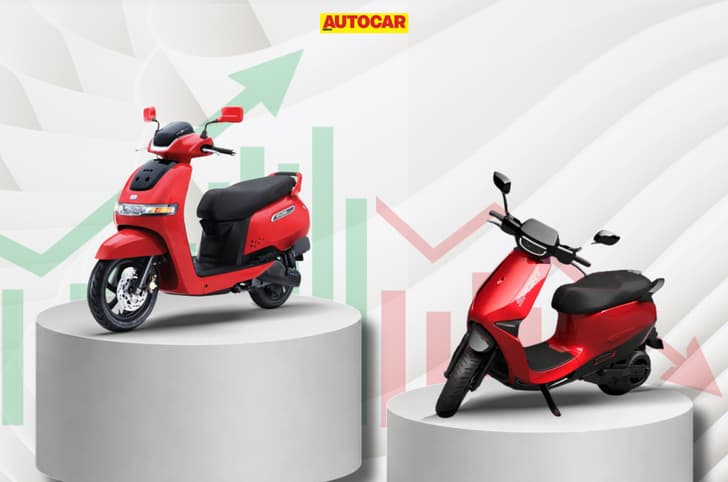

TVS (53,990 units) and Bajaj (48,383 units) overtook Ola Electric (13,449 units) in September 2026 by using superior service networks, distribution depth, and sustained product launches while Ola's share collapsed from 35% in 2024 to ~6.6%.
Why TVS and Bajaj Overtook Ola Electric in India's Two-Wheeler EV Race in 2026
India's electric two-wheeler market is defined as the segment of battery-powered motorcycles and scooters sold domestically, and in 2026 it crossed 2 lakh monthly registrations — yet the company that built the category's early momentum, Ola Electric, now holds barely 6.6% of it. In September 2026, TVS registered 53,990 electric two-wheelers and Bajaj registered 48,383, while Ola managed just 13,449. Ather Energy and Hero MotoCorp added 30,477 and 24,306 respectively. The market was not shrinking. Ola was.
That distinction matters. Ola Electric did not lose because electric scooters fell out of favour. It lost ground while the category it helped create was expanding at record pace. That makes the story considerably more instructive than a simple tale of a startup failing.
Where the key players stood in September 2026
| Manufacturer | Sep 2026 Registrations | H1 2026 Market Share | H1 2026 YoY Change | Key Product |
|---|---|---|---|---|
| TVS Motor | 53,990 | 25.9% | +65.7% | iQube / Orbiter |
| Bajaj Auto | 48,383 | 22.5% | +48.0% | Chetak (incl. C2501) |
| Ather Energy | 30,477 | 17.4% | +91.1% | Rizta / 450X |
| Hero MotoCorp | 24,306 | 10.9% | +200%+ | Vida V2 |
| Ola Electric | 13,449 | 6.8% | -44.1% | S1 series / Roadster X |
Sources: Autocar India, Business Standard, E-Vehicle Info
The broader Indian EV car market shows a similar pattern. Brands with strong after-sales infrastructure are consolidating their positions — a principle visible in which electric SUVs offer the best after-sales service networks. The Maruti Suzuki e Vitara, entering the electric car space with Maruti's 4,000-plus dealer touchpoints behind it, illustrates exactly the same principle at play in the two-wheeler segment: distribution depth and service trust matter as much as the product itself.
How did Ola Electric build such a commanding early lead?
Ola's rise spans 2021 to 2024, when the company transformed electric scooters from a niche, utilitarian product into an aspirational consumer category. The foundation was the 2020 acquisition of Amsterdam-based Etergo, which gave Ola a design and engineering starting point for what became the S1 and S1 Pro.
The scooters were genuinely different. Touchscreens, over-the-air software updates, voice commands, connected features and a futuristic aesthetic gave the S1 the feel of a consumer technology product rather than a conventional two-wheeler. Ola understood that Indian consumers did not simply want a cheaper petrol scooter — they wanted something that felt new. That insight proved correct.
By 2024, Ola sold 4,29,187 electric two-wheelers — a 35% share of the 12.1 lakh-unit market — and became the first Indian electric two-wheeler manufacturer to cross 4 lakh annual sales. The Futurefactory in Tamil Nadu was one of India's most ambitious two-wheeler manufacturing facilities. The brand was a household name. The opportunity in front of the company was enormous.
What went wrong with Ola's product and service strategy?
The first structural problem was that Ola brought a software-company mindset into a hardware business. Software products can be launched, patched and improved iteratively. Vehicles are less forgiving — a software bug can be fixed overnight, but a mechanical or safety failure can strand a customer on the roadside.
A BBC investigation in 2025 raised questions from former employees about the pace of development from the Etergo platform to launch, including concerns around testing. Ola disputed that characterisation. But the broader pattern was undeniable: fire incidents, software failures, suspension controversies, and a growing volume of customer complaints about reliability.
The second and more damaging problem was service. Ola's original go-to-market strategy was a direct-to-consumer, digital-first model that bypassed traditional dealerships. Online ordering, no showroom dependency, a modern customer relationship built through an app. It was a coherent vision — until something went wrong with a vehicle.
When customers needed repairs, spare parts or technical support, the absence of a physical service network became a serious liability. Economic Times reporting attributed Ola Electric's decline in market share to service-related concerns, quality issues, and rising customer dissatisfaction.
Ola responded by expanding aggressively — announcing 4,000 sales and service touchpoints, building what it called Hyperservice, deploying AI-based diagnostics, and training third-party mechanics. By 2026, the company had pivoted further, opening its network to dealer partners and announcing a 500-outlet dealer network. That represents a significant strategic reversal: the company that once wanted to bypass traditional automobile distribution is now building it. The pivot may well be the right call, but it confirms that the original strategy underestimated how traditional the automobile business actually is.
Why were TVS and Bajaj better positioned to win the EV market?
TVS and Bajaj did not need to teach India that electric scooters could be exciting. Ola had already done that work. What the incumbents brought was everything Ola lacked at scale: manufacturing depth, a nationwide dealer and service network, established supplier relationships, brand trust built over decades, and the financial resilience to absorb a multi-year investment cycle.
TVS registered 2,51,438 electric two-wheelers in H1 2026, up 65.7% year-on-year, and held 25.9% market share. The iQube and the newer Orbiter drove that growth. TVS held the No. 1 monthly sales position since April 2025, and in June 2026 set a new industry record of 55,783 monthly registrations — surpassing even Ola's previous record of 53,647 set in May 2024.
By August 2026, TVS had crossed a cumulative milestone that underlines the speed of the turnaround. According to Autocar India, TVS had registered 11,27,873 electric two-wheelers cumulatively, overtaking Ola's 11,17,031 to become India's largest e2W manufacturer by total domestic registrations. At the end of July 2026, Ola had still been ahead by 15,996 units. In the first 24 days of August alone, TVS registered 35,304 units against Ola's 8,466 — erasing the deficit entirely.
Bajaj's trajectory was equally striking. Bajaj Auto registered 2,18,089 electric two-wheelers in H1 2026, up 48% year-on-year. The launch of the affordable Chetak C2501 in January 2026 was a turning point, opening up a price-sensitive customer segment that Ola's premium-leaning lineup had not fully addressed. Bajaj's Q2 registrations were 16.6% higher than Q1, and by June 2026 the gap between Bajaj and TVS had narrowed to under 4,000 units from more than 9,500 units at the start of the year.
Hero MotoCorp recorded the sharpest percentage growth of all. Registrations more than tripled to 1,06,019 units in H1 2026 from 34,378 in H1 2025, taking Hero's market share from 5.4% to 10.9%. Hero had nearly matched its entire 2025 sales volume within the first six months of 2026.
Did Ola's product expansion hurt its core business?
From 2023 onwards, Ola's public narrative kept expanding. Motorcycles. Electric cars. Battery cells. AI. Energy storage. Three-wheelers and four-wheelers through a planned Gen 4 architecture. A futuristic motorcycle concept called Diamondhead. Each announcement was individually defensible. None of them was obviously stupid. But the pattern they created was a company whose horizon kept moving faster than its current business could keep up.
The motorcycle — the Roadster family, unveiled in August 2024 — was a logical category extension. India is a motorcycle country, and any company serious about becoming a major automobile manufacturer eventually has to enter it. Ola launched the Roadster X and X+ and began deliveries. But every new vehicle category means a new engineering challenge, a new supplier base, a new parts inventory, a new service requirement, and a new opportunity to disappoint a customer — all at a time when the existing scooter customer base was already expressing dissatisfaction.
The electric car project went further. Ola had publicly discussed a high-performance electric car before Reuters reported in 2024 that the project was being suspended as the company refocused resources on two-wheelers. Abandoning the car was probably the right call. But the more instructive point is what happened before it: Ola had again moved the conversation several steps ahead of its current operational reality.
This pattern — exciting next product, unresolved current problem — repeated itself often enough to become a defining feature of the company's public identity.
What is Ola's battery cell strategy, and does it still matter?
Battery cell manufacturing is the process of producing the fundamental electrochemical units that store and release energy in an EV — and it determines a huge part of an electric vehicle's cost, range, performance, packaging and long-term competitiveness. Ola understood early that remaining dependent on third-party cell suppliers was a structural vulnerability.
The company built the Battery Innovation Centre for cell R&D and the Gigafactory for development and mass manufacturing of advanced cell technology. It began working on an indigenous 4680 Bharat Cell — a large-format cylindrical cell format — and by late 2025 and into 2026, Ola began mass deliveries of vehicles powered by its own cells, including the S1 Pro+ and Roadster X+.
In April 2026, Ola announced readiness of an indigenous 46100 LFP (lithium iron phosphate) cell, designed for lower cost and broader applicability across mobility and energy storage. In August 2026, the company brought that LFP technology into the mass-market S1 Z range. The logic of vertical integration is now clearer than it was when Ola first announced the programme: controlling the cell means controlling cost, which means being able to compete at lower price points without sacrificing margin.
The cell journey also exposed the same sequencing problem that characterised the rest of Ola's expansion. In 2025, Ola faced scrutiny after missing a milestone linked to advanced-cell production commitments under the government's PLI scheme, and subsequently moderated its near-term capacity ambitions. Cell manufacturing requires chemistry expertise, specialised equipment, yield management, quality control, capital at scale, and reliable customers — none of which can be rushed.
If Ola's cell programme matures as intended, it could become a genuine competitive moat. No other Indian electric two-wheeler manufacturer is attempting vertical integration at this level. The question is whether the company's market position will be strong enough by the time the technology advantage is fully deployable.
What about Ola's rare-earth-free motor — is that significant?
Ola developed a rare-earth-free ferrite motor and received government certification for the technology in 2025. The company said the motor matched the performance of rare-earth permanent-magnet motors in the tested 7kW and 11kW variants while reducing dependence on imported rare-earth materials.
This matters for a specific reason. In FY26, Chinese export restrictions on rare earth metals disrupted India's EV industry, affecting the supply of permanent magnets critical for electric motors. Manufacturers that depend on rare-earth permanent magnets faced import delays and supply risk. A certified ferrite motor that performs comparably is not just an engineering achievement — it is a supply chain hedge with real commercial value.
If Ola can deploy this motor at scale, it reduces a cost and supply-chain vulnerability that affects the entire Indian EV industry. That is meaningful technology. It just does not show up in monthly registration data.
Is Ola's decline permanent, or is there a recovery path?
The data through mid-2026 shows some signs of sequential stabilisation, even if the year-on-year picture remains severe. Ola's registrations increased from 7,808 units in January 2026 to 16,150 in June, and Q2 volume of 43,744 units was nearly double the 22,255 registered in Q1. That is not a recovery of market share — it is a recovery from a very weak base — but it suggests the business has not entered a terminal spiral.
The path back to relevance runs through a few specific things.
First, service credibility. The dealer network expansion and the Hyperservice programme need to produce measurable improvements in customer experience. Ola has claimed that over 80% of vehicles are now serviced the same day. If that claim is consistently true and verifiable, it addresses the single biggest driver of customer dissatisfaction.
Second, product focus. The S1 Z range, powered by the new LFP cell, targets a more price-sensitive customer segment. If Ola can offer a genuinely competitive product at a lower price point — backed by its own cell rather than a third-party supplier — it has a differentiated offer that TVS and Bajaj cannot easily replicate in the short term.
Third, the motorcycle. The Roadster X and X+ are in a category where TVS and Bajaj are also competing, but where Ola's technology-forward positioning could resonate with a younger buyer who wants something that feels different from a conventional motorcycle. Whether Ola can execute on service for a motorcycle customer base, on top of its scooter base, remains to be seen.
The broader EV market context is favourable. India's electric two-wheeler market averaged more than 1.63 lakh registrations a month in 2026 and is on course to approach 20 lakh annual sales for the first time. A rising tide does not automatically lift Ola's boat — the company lost share while the market grew — but a large and expanding market does mean that even a 7-8% share represents meaningful volume.
What does Ola's story tell us about the Indian EV market more broadly?
The Ola Electric story is a case study in the difference between pioneering a category and sustaining leadership within it. These are related but distinct capabilities.
Ola pioneered the category. It made electric scooters aspirational, proved that Indian consumers would pay for a premium EV experience, and forced the entire two-wheeler industry to take electrification seriously. TVS, Bajaj and Hero were watching. They entered the market later, but they entered with decades of manufacturing, distribution and service infrastructure already in place.
TVS, Bajaj, Ather and Hero together accounted for 95.6% of the Indian e2W market's incremental registrations in H1 2026, with their combined share rising from 66.6% to 76.7% year-on-year. The market is consolidating around manufacturers with scale, established brands, and expanding distribution and service networks.
The lesson is not that startups cannot compete with incumbents in the Indian automobile industry. Ather Energy, an EV-first company, grew registrations 91.1% year-on-year in H1 2026 and holds 17.4% market share — a stronger position than Ola despite being a smaller company. Ather's relative success suggests that product quality, service reliability and focused execution matter more than being first.
In a hardware business with high service intensity, the advantages of being first erode quickly once well-resourced incumbents decide to compete seriously. Being first buys time. It does not buy permanent advantage.
Ola had that time. The question the company's leadership will have to answer honestly is whether the time was used to make the core business extremely good, or whether it was used to announce the next big idea while the current business remained unresolved.
Based on the data, it was used for both — and the balance was wrong.
Whether the cell technology, the ferrite motor, the LFP platform and the dealer network expansion can collectively rebuild Ola's position is genuinely uncertain. The technology bets are real. The market is large. But TVS and Bajaj are not standing still, and the gap in cumulative registrations — TVS now leads Ola in lifetime sales — will take years to close even in an optimistic scenario.
For buyers considering an electric two-wheeler today, the practical implication is straightforward: TVS and Bajaj offer products backed by service networks that have been tested at scale, with the financial resilience to support long-term ownership. Ola's products remain technologically interesting, particularly the cell-powered variants, but the service experience is still being rebuilt. The risk profile is different, and buyers should weigh it accordingly.
The same logic applies in the four-wheeler EV segment, where buyers evaluating options like the Maruti Suzuki e Vitara benefit from Maruti's established national service infrastructure — a reminder that across the Indian EV market, the manufacturer's ability to support a vehicle over its ownership life is as important as the vehicle's specifications on launch day. For a deeper look at how after-sales networks compare across electric vehicles, see our guide to which electric SUVs offer the best after-sales service networks in India.
Sources
- Ola Electric Had It All — So How Did TVS And Bajaj Overtake It? - E-Vehicle Info
- TVS overtakes Ola in cumulative electric two-wheeler sales | Autocar India
- TVS, Bajaj, Hero and Ather corner 96% of H1 e2W growth as Ola loses ground | Business Standard
- Legacy players gain ground in EV two-wheelers as Ola Electric slips | Economic Times
- TVS, Bajaj, Hero and Ather Power EV Boom; Ola Electric Loses More Ground | Outlook Business
- TVS iQube Electric Scooter | TVS Motor Company
- Ola Electric Official Website