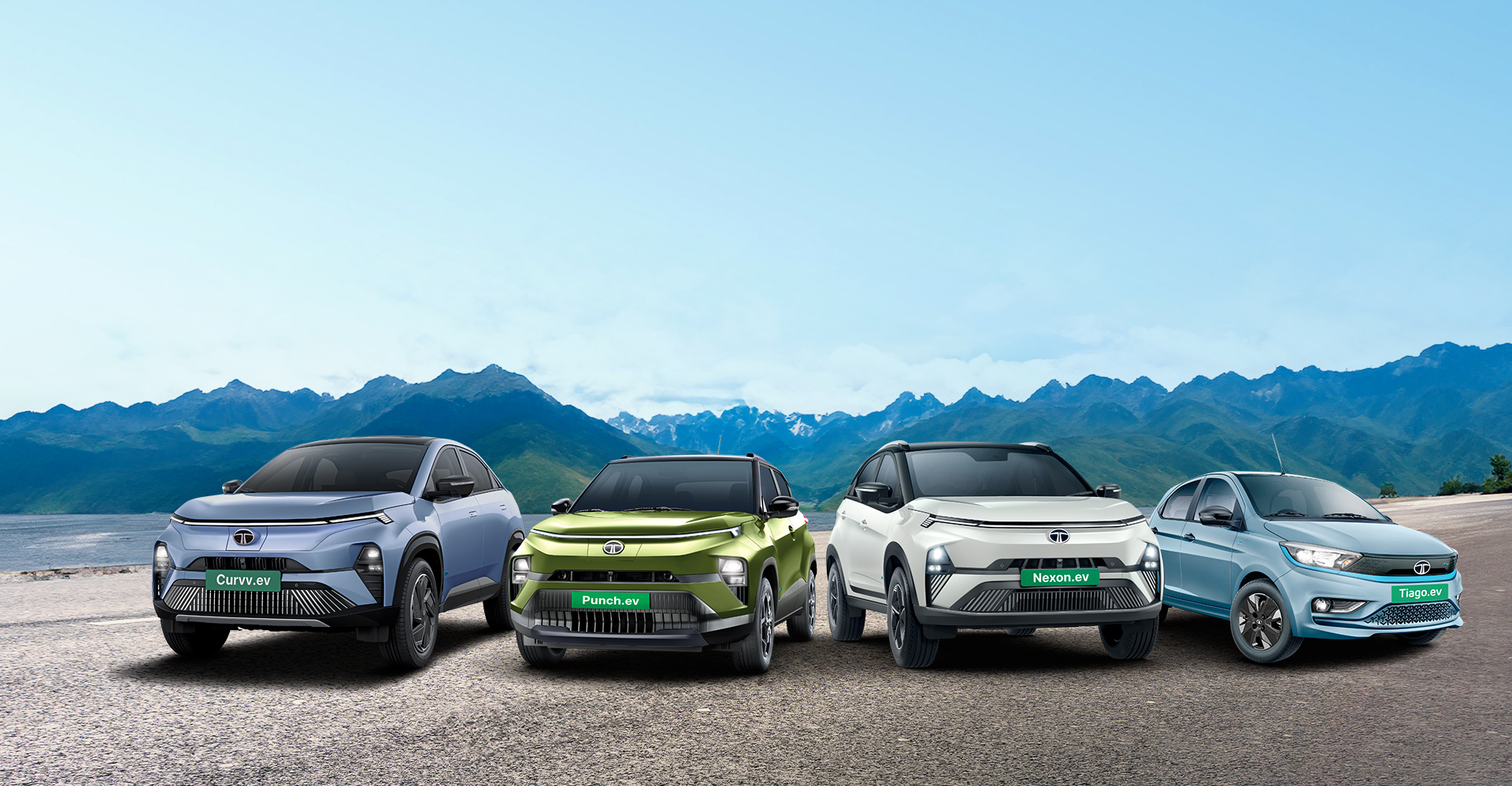

Tata Motors and Mahindra have pushed Hyundai to fourth place in India's 2026 PV rankings, driven by aggressive EV portfolios, SUV dominance, and double-digit volume growth while Hyundai contracted 2.3%.
Why Tata Motors and Mahindra Are Outpacing Hyundai in India's 2026 EV Race
For the first time in nearly three decades, Hyundai Motor India does not hold second place in India's passenger vehicle market — it holds fourth. By the close of FY2025-26, Mahindra sold 6,60,276 units and Tata Motors sold 6,31,387 units domestically, while Hyundai's volumes contracted 2.3% to 5,84,906 units — the only contraction among the top four manufacturers. This gap reflects a structural shift driven by product strategy, EV momentum, and a market that has decisively tilted toward SUVs and electric vehicles.
The table below captures the monthly sales picture for calendar year 2026 (January–April), based on Vahan registration data:
| OEM | Jan 2026 | Feb 2026 | Mar 2026 | Apr 2026 | Trend |
|---|---|---|---|---|---|
| Maruti Suzuki | 2,18,740 | 1,56,428 | 1,75,160 | 1,58,223 | Dominant leader |
| Tata Motors | 64,797 | 57,877 | 67,162 | 57,472 | Consistent #2 |
| Mahindra & Mahindra | 65,308 | 56,016 | 64,080 | 54,897 | Consistent #3 |
| Hyundai India | 67,110 | 46,632 | 49,933 | 47,345 | Slipped to #4 |
| Toyota Kirloskar Motor | 36,495 | 27,939 | 28,991 | 26,779 | Stable #5 |
(Source: Vahan Data via ETAuto)
Hyundai led in January 2026 with 67,110 units, briefly reclaiming the No. 2 spot it had historically held. From February onward, both Tata and Mahindra pulled ahead by margins exceeding 10,000 units per month — a gap that is difficult to close without a step-change in product cadence or pricing strategy.
How did Tata Motors build such a commanding lead?
Tata Motors' rise stems from a multi-front offensive: EVs, CNG, SUVs, and new model launches firing simultaneously. In FY26, the company's EV sales rose 43% year-on-year to 92,120 units, reinforcing its position as India's dominant electric passenger vehicle brand. CNG volumes exceeded 1.7 lakh units, growing 24% — a segment Tata has aggressively expanded as a bridge fuel for buyers not yet ready for full electrification.
The Nexon and Punch remained the highest-selling SUV models nationally in the second half of FY26. The Sierra's return as a production vehicle added aspirational pull to the portfolio, while petrol variants of the Harrier and Safari broadened the addressable market. In April 2026 alone, Tata sold 59,000 vehicles domestically, a YoY growth of 30.5%, with EV sales jumping 72.1% to 9,150 units compared to 5,318 units in April 2025.
The EV story carries particular weight. Tata's approach to electrification rests on a platform-first strategy — the Punch EV, Nexon EV, Curvv EV, and Harrier EV all share Tata's in-house Acti.ev architecture, which allows the company to spread development costs across multiple body styles while maintaining consistent charging and software standards. This depth takes years to replicate and represents a core competitive advantage. Hyundai's Creta Electric, despite being a strong product, has not been enough to shift the overall balance.
For buyers evaluating EVs, Tata's portfolio breadth means there is a Tata electric option at almost every price point from ₹10 lakh to ₹25 lakh. That coverage is hard to match. Our guide to the best electric cars to buy in India in 2026 maps the full competitive space.
What is driving Mahindra's 20% growth?
Mahindra's FY26 performance rests on a concentrated bet on a single body style paying off at scale. The company sells no hatchbacks, sedans, or vans in the domestic market — its entire domestic portfolio is SUVs. In a year when India's PV market tilted decisively toward utility vehicles, that focus became a structural advantage rather than a limitation.
The Scorpio-N, XUV700, Thar, and Thar Roxx carried extended waiting periods for much of FY26, a reliable indicator of demand that outpaces supply. The XEV 9e and BE 6 — Mahindra's first purpose-built electric SUVs on the INGLO platform — added a credible EV narrative to a brand that had previously been absent from the electric conversation. The XEV 9S, flagged as a key volume driver in early 2026, has extended that electric momentum into the new financial year.
Mahindra's 6,60,276 units in FY26 represent a 20% increase from 5,51,487 units in FY25. The gap between Mahindra and Hyundai now stands at over 75,000 units — a margin that would have seemed implausible two years ago when Hyundai was comfortably second and Mahindra was a distant fourth. In April 2026, Mahindra dispatched 56,331 SUVs domestically, a YoY growth of 8%, with total vehicle sales including commercial vehicles reaching 94,627 units.
The INGLO platform deserves close examination. It is Mahindra's proprietary EV architecture developed in partnership with Volkswagen Group's technology arm, offering 800V charging compatibility, over-the-air software updates, and a modular battery system. Mahindra has committed to launching multiple electric SUVs on this platform through 2027, which means the EV pipeline is as deep as the ICE pipeline — a combination that makes the brand's competitive position increasingly durable.
Why is Hyundai struggling despite strong products?
Hyundai's challenge is structural rather than product-specific. The Creta Electric is genuinely well-engineered, the Alcazar has found a loyal audience, and the Venue remains competitive in the compact SUV segment. Yet Hyundai's domestic volumes fell 2.3% to 5,84,906 units in FY26 — the only contraction among the top four manufacturers.
Several factors compound each other. Hyundai's portfolio breadth — spanning hatchbacks, sedans, and SUVs — has not translated into growth in a market where SUVs now dominate wholesale volumes. The Grand i10 Nios and Aura, while steady sellers, do not generate the kind of aspirational demand that drives social word-of-mouth and showroom footfall. Hyundai has a single electric model in volume production for the Indian market, the Creta Electric, compared to Tata's four-plus EV lineup. The company's export strength — it led India's PV export rankings in FY25 with 1,63,386 units — has not offset the domestic erosion.
Hyundai's CEO Tarun Garg has acknowledged the pressure: "While we stay mindful of the prevailing geopolitical uncertainties, Hyundai is well-prepared for a strong year, delivering aspirational, connected and innovative products, along with unmatched customer experience and pride of ownership." The company has announced 26 new launches by 2030, including both new nameplates and model upgrades — but the pipeline benefit will take time to materialise in monthly registrations.
April 2026 offered a partial bright spot: Hyundai sold 51,902 vehicles domestically, its highest-ever tally for the month of April since inception, representing 17% YoY growth. Tata's 30.5% growth in the same month means the gap widened rather than narrowed. Hyundai is growing; its rivals are simply growing faster.
Where does the Maruti Suzuki e Vitara fit into this competitive picture?
The Maruti Suzuki e Vitara enters a market reshaped by the competition described above. Maruti Suzuki remains the undisputed market leader — 218,740 units in January 2026 alone — but its EV presence has been conspicuously absent while Tata and Mahindra built their electric ecosystems. The e Vitara is Maruti's answer to that gap.
Maruti Suzuki's first mass-market electric SUV for India, the e Vitara was developed on a platform co-engineered with Toyota (which explains why Toyota's Kirloskar Motor arm is also launching a near-identical product). It arrives with the brand equity of Maruti's 40-year relationship with Indian buyers, the country's largest service network, and the trust that comes from selling more cars than the next three manufacturers combined.
The e Vitara faces a specific challenge that Maruti has not encountered before: it is entering a segment where Tata and Mahindra have years of EV-specific experience, established charging partnerships, and software ecosystems already in their second or third generation. A buyer considering the e Vitara will inevitably compare it against the Nexon EV's proven reliability record, the Mahindra BE 6's INGLO platform credentials, and the Creta Electric's feature set. That is a formidable comparison set.
The e Vitara's competitive advantage lies in Maruti's service reach and the Toyota alliance's engineering depth. Its disadvantage is timing — arriving after the market has already formed strong opinions about what an Indian EV should look like and how it should be supported. Whether Maruti can use its distribution muscle to overcome that timing gap is one of the more interesting strategic questions of 2026. For a deeper look at how the e Vitara stacks up on real-world range, see our guide to electric cars with the best real-world range in India in 2026.
Is the SUV boom the whole story, or is EV strategy the real differentiator?
Both factors matter, but EV strategy is increasingly the differentiator at the margin. The SUV boom explains Mahindra's rise — its concentrated ICE SUV portfolio was perfectly positioned for the market's structural shift. Tata's growth story is more nuanced: its SUV volumes are strong, but its EV sales growing 43% in FY26 and 72% in April 2026 alone signal that the electric transition is accelerating faster than the broader market expected.
The data point that deserves attention is Tata's April 2026 EV number: 9,150 units in a single month. Annualised, that is over 1,10,000 EVs per year from one manufacturer. India's total EV passenger vehicle market was roughly 1,00,000 units in all of FY24. Tata alone is now selling at a pace that exceeds the entire market's volume from two years ago. That is a remarkable compression of the adoption curve.
Mahindra's INGLO-based EVs — the BE 6 and XEV 9e — are still in their early ramp-up phase, but the order books have been strong and the platform's 800V architecture gives Mahindra a credible answer to the "charging anxiety" objection that has historically slowed EV adoption in India. As fast-charging infrastructure expands along national highways, the 800V advantage becomes more tangible for real-world buyers. Our guide to the best electric cars for long trips in India in 2026 explores how charging infrastructure shapes long-distance EV usability.
Hyundai's EV strategy has been more cautious in India. The Creta Electric is a strong product, but a single model cannot match the portfolio depth of Tata's four-plus EV lineup or Mahindra's expanding INGLO range. Hyundai's global EV lineup — the Ioniq 5, Ioniq 6, and Ioniq 9 — has not been brought to India at volume, partly due to localisation requirements and partly due to pricing constraints. Until Hyundai can offer Indian buyers an EV at every price point the way Tata does, the structural disadvantage in the electric segment will persist.
What does Q4 FY26 tell us about the trajectory heading into FY27?
The January-to-March quarter of 2026 sharpened the competitive divergence. Tata Motors was the largest of the three companies in Q4 FY26 by domestic volumes, selling 1,98,743 units — a 36% increase from 1,46,127 units in Q4 FY25. That quarterly number alone exceeded Hyundai's entire Q4 FY26 domestic tally by a substantial margin.
The gap between Tata and Hyundai — over 46,000 units for the full year — and the gap between Mahindra and Hyundai — over 75,000 units — are not easily closed in a single quarter. Closing a gap of that size requires either a significant new product launch that captures disproportionate demand, or a competitor stumbling. Hyundai has the product pipeline (26 launches by 2030) but the timeline is long. Tata and Mahindra, meanwhile, are not standing still: Tata has the Sierra ICE, additional Curvv variants, and potential new CNG models in its pipeline, while Mahindra is expanding INGLO-based EVs and has the XUV 700's successor in development.
The contest for second position between Tata and Mahindra is genuinely live — the FY26 gap of roughly 29,000 units is narrow enough to flip in a single strong quarter. But the contest between either of them and Hyundai for third position looks increasingly one-sided unless Hyundai can accelerate its India-specific EV and SUV strategy materially.
What should a buyer take away from this competitive shift?
For an Indian car buyer in 2026, the competitive reshuffling at the OEM level has direct implications for ownership experience, not just brand pride.
Tata's EV leadership means its charging network partnerships, software update cadence, and battery warranty terms have been stress-tested by the largest installed base of electric passenger vehicles in India. If you are buying an EV and after-sales support matters — and it should — Tata's scale is a genuine advantage. Our analysis of the best after-sales service network for electric SUVs in India covers this in detail.
Mahindra's INGLO platform brings a level of engineering ambition — 800V charging, modular battery, software-defined vehicle architecture — that was previously associated only with global premium EV brands. The BE 6 and XEV 9e are priced at a premium relative to Tata's lineup, but the technology gap justifies the delta for buyers who prioritise future-proofing. Safety-conscious buyers should also note that several 2026 EVs from both Tata and Mahindra have been assessed under Bharat NCAP — our guide to 5-star Bharat NCAP electric cars in India is worth consulting before finalising a purchase.
Hyundai's Creta Electric remains a compelling product on its own merits — well-built, feature-rich, and backed by a service network that, while smaller than Maruti's, is extensive by any reasonable standard. The brand's 2.3% volume decline is a corporate-level story; it does not mean the Creta Electric is a bad car. Buyers who prioritise Korean build quality and feature density over EV space depth will still find Hyundai's offering competitive.
The Maruti Suzuki e Vitara, entering this market in 2026, could reshape the competitive order again — or struggle to gain traction against entrenched EV incumbents. Maruti's distribution network of over 4,000 touchpoints is unmatched, and the Toyota co-development pedigree adds engineering credibility. But the e Vitara will need to demonstrate real-world range, charging reliability, and software quality that matches or exceeds what Tata and Mahindra have already delivered — not just on paper, but in the hands of buyers across India's diverse driving conditions. Buyers considering the e Vitara alongside other options would do well to check our roundup of best electric SUVs under ₹25 lakhs by range in 2026 for a full comparison.
The broader lesson from the 2026 sales data is that India's EV market rewards commitment. Tata committed early, built a platform, expanded the lineup, and is now reaping the volume benefits. Mahindra committed to a premium EV platform and is beginning to see returns. Hyundai hedged — strong global EV portfolio, cautious India rollout — and is now playing catch-up in a market that has moved faster than most analysts predicted. The e Vitara's success will depend on whether Maruti can avoid making the same mistake.
Sources
- Auto Sales In 2026: Hyundai Faces Stiff Competition from Tata Motors and Mahindra in 2026 Vehicle Sales, ETAuto
- Hyundai Slips to No. 4 as Mahindra and Tata Motors Both Overtake it in FY26 Domestic PV Sales, Autocar Pro
- Tata Beats Mahindra and Hyundai Again in April 2026 Sales, CarLelo
- Tata Motors Official Website
- Mahindra Electric Vehicles Official Page
- Maruti Suzuki e Vitara Official Page