
India's Auto PLI scheme locks out EV startups via a ₹10,000 crore revenue threshold, handing legacy OEMs a 13–16% cost advantage that directly affects EV pricing and competition in 2026.
India's Auto PLI scheme, approved by the Union Cabinet on September 15, 2021, with a ₹25,938 crore outlay over five years, is defined as a production-linked incentive programme that rewards incremental sales of advanced automotive technologies—but only for manufacturers whose global group revenue from automotive manufacturing exceeds ₹10,000 crore and whose fixed assets exceed ₹3,000 crore. That single eligibility gate has kept every Indian EV-first startup outside the scheme, and the government confirmed in late April 2026 that there is no proposal to change this.
The consequence is a structural cost gap. Ather Energy CEO Tarun Mehta put the number plainly: exclusion places emerging EV manufacturers at a 13% to 16% cost disadvantage at a stage when they are still investing heavily in capability building. For buyers in 2026, that gap shows up in sticker prices, feature trade-offs, and ultimately in which companies survive long enough to honour warranties and expand service networks.
Who qualifies and who doesn't — the numbers at a glance
| Company | PLI Eligible? | Basis | Cost Advantage |
|---|---|---|---|
| Maruti Suzuki (e Vitara) | Yes | Global group revenue well above ₹10,000 cr | 13–16% vs excluded peers |
| Tata Motors | Yes | Revenue threshold met | 13–16% vs excluded peers |
| Bajaj Auto | Yes | Revenue threshold met | 13–16% vs excluded peers |
| TVS Motor Company | Yes | Revenue threshold met | 13–16% vs excluded peers |
| Ola Electric | Yes | Net worth ≥ ₹1,000 cr (non-auto investor path) | 13–16% vs excluded peers |
| Ather Energy | No | Revenue & asset thresholds not met at scheme launch | None |
| Euler Motors | No | Revenue & asset thresholds not met at scheme launch | None |
| River | No | Revenue & asset thresholds not met at scheme launch | None |
Sources: ETAuto (Apr 2026), ETAuto (Apr 2026), Autocar Pro (Feb 2026)
The application window for the PLI-Auto scheme closed on March 31, 2021—a date when most electric-first startups were still in early-scale mode. That one-time structure made entry permanent: companies that missed the window cannot apply retroactively, and the government has ruled out tweaking the scheme because it was approved by the Union Cabinet and cannot be unilaterally amended.
What exactly is the Auto PLI scheme, and how does it work?
The Auto PLI scheme operates as a two-part incentive architecture: a Champion OEM incentive for battery electric vehicles and hydrogen fuel cell vehicles across all vehicle segments, and a Component Champion incentive for high-technology, high-value automotive components. Of 115 applicants, 82 companies were approved, spanning vehicle manufacturers and auto-component firms.
To receive payouts, an approved OEM must sell at least ₹125 crore worth of eligible vehicles in the first year and grow those sales by at least 10% annually. The incentive is therefore linked to incremental sales volume—which structurally favours companies that already have distribution scale, dealer networks, and brand recognition. A startup building its first national sales footprint faces incumbents who can deploy PLI-funded cost reductions from day one.
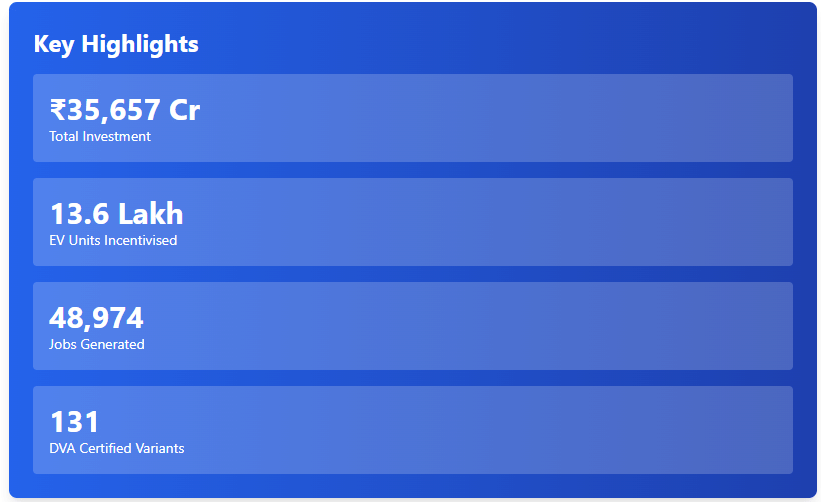
The scheme attracted over ₹35,000 crore in committed investments. It has also faced criticism for lagging job creation, slower-than-projected sales, and delayed incentive payouts. Despite these shortfalls, the government has defended the scheme's design, with a senior official stating: "PLI schemes are not meant for startups but for global champions. Startups lack capital, marketing knowhow… They need hand-holding."
That framing—startups as entities requiring hand-holding rather than competitive policy frameworks—is precisely what Ather, Euler, and policy researchers have pushed back against.
Why do EV startups say this is unfair?
Ather Energy's Tarun Mehta used a train analogy that cuts to the core of the argument: "If legacy businesses are the bogeys, startups and new-age companies are the engines. You cannot take the engine out of the equation and hope for the bogeys to move forward themselves."
The argument extends beyond funding. It concerns what the scheme signals to the market. Euler Motors founder Saurav Kumar said the scheme "risks prioritising past scale over future capability"—a design flaw that leaves companies investing deeply in innovation, localisation, and new product categories outside the policy ambit despite contributing meaningfully to the space.
The Centre for Digital Economy Policy Research (C-DEP) sharpened this critique in a February 2026 report, noting that "OEMs that meet scale thresholds receive cost advantages irrespective of innovation output." The signal this sends is that scale—measured by legacy revenue—is the primary determinant of policy support, not R&D investment, IP creation, or domestic value addition.
The C-DEP report documented a concrete market distortion: between FY23 and FY25, sales growth among non-PLI players fell sharply, declining from 407% in FY22 to -33% in FY24 and -11% in FY25. This decline coincided with a reordering of market leadership at the expense of the industry's innovation engine, the report concluded, attributing the shift directly to PLI-induced cost differentials.
A Department Related Standing Committee of Parliament has also criticised the exclusion, calling for "calibrated flexibility or differentiated eligibility criteria" for high-potential domestic players and startups, particularly in the electric two-wheeler segment.
Does the data back up the innovation argument?
Yes, and the export data is the most striking evidence. Despite PLI beneficiaries receiving a 13–16% cost advantage, 77% of India's electric two-wheeler export volumes were driven by non-PLI models. The C-DEP report concluded that PLI incentives were "primarily used to capture domestic market share rather than to develop export-ready technology platforms."
Patent filings and product development data told a similar story: a significant share of innovation activity originated from OEMs outside the PLI framework. The scheme concentrated resources among incumbents that had largely avoided difficult-to-electrify segments—most notably electric motorcycles, which account for a large share of India's two-wheeler market but saw limited mass-market electric offerings from PLI beneficiaries.
Non-PLI companies in the analysis included Ather, Ampere, BGauss, Revolt, Wardwizard, Purev, Kinetic Green, and Okaya. PLI beneficiaries included Hero MotoCorp, Ola Electric, TVS Motor Company, and Bajaj Auto.
The C-DEP report also warned that as global demand shifts toward electric mobility, India risks losing its traditional automobile export market to Chinese manufacturers such as Yadea, Sunra, Aima, Niu, Tailg, and CFMoto—precisely because the companies building export-competitive technology are the ones being denied policy support.
How is Ather Energy responding to being locked out?
Ather's response is strategically interesting and worth understanding as a buyer. Rather than waiting for policy inclusion, CEO Tarun Mehta has reframed the exclusion as a long-term structural advantage. "Us not having PLI is actually one of the strongest and one of the biggest reasons to be optimistic about us in the mid-term, because we are already operating on the cleanest pricing principle," he told investors after Q3 results.
The logic is straightforward: PLI is not a permanent policy. Companies that build their pricing architecture around PLI payouts face a cliff when the scheme ends or changes. Ather, by contrast, has been forced to make pricing decisions based on market reality—including a ₹3,000 price hike across select models at the start of the January–March quarter to offset rising commodity costs—rather than deferring them in anticipation of subsidies.
"PLI is not a 10-year policy. We don't have the risk of PLI changing our pricing architecture completely a few years later," Mehta said. He acknowledged the near-term pain—"Not having PLI hurts, but I think that is a good pain to take right now to have a very, very, very resilient P&L in the next two, three years"—but framed it as a deliberate trade-off.
Whether this optimism holds depends on whether Ather can close the 13–16% cost gap through operational efficiency, localisation, and scale before PLI-backed competitors entrench their market positions. That remains an open question, and the data on non-PLI market share decline between FY23 and FY25 suggests the window is not unlimited.
What does this mean for the competitive space that legacy OEMs like Maruti enter?
The PLI debate connects directly to the car market that buyers navigate in 2026. The Maruti Suzuki e Vitara—Maruti's first mass-market electric SUV, developed in partnership with Toyota—enters a market where the policy architecture has been explicitly designed to favour companies of Maruti's scale. Maruti Suzuki India Limited's global group revenue from automotive manufacturing comfortably clears the ₹10,000 crore PLI threshold, making it eligible for Champion OEM incentives on battery electric vehicles.
That eligibility is not incidental. As Maruti scales e Vitara production and incremental sales grow, the company can access PLI payouts that are structurally unavailable to smaller, newer EV entrants in the four-wheeler space. The result is a competitive space where legacy scale—accumulated over decades of ICE manufacturing—translates directly into EV cost advantages through policy design, not through EV-specific innovation or investment.
For buyers evaluating the e Vitara against newer EV-native competitors, this matters concretely: Maruti's ability to price the e Vitara competitively is partly underwritten by policy support that its competitors cannot access. If you're comparing the e Vitara to an EV from a smaller, newer manufacturer, you're not comparing apples to apples on cost structure. The playing field is tilted before a single vehicle rolls off the line.
This dynamic is not unique to four-wheelers. In the two-wheeler space, the C-DEP report documented how PLI-induced cost differentials coincided with a reordering of market leadership at the expense of innovation-led players. The four-wheeler EV market, still nascent, could follow a similar trajectory if the policy framework remains unchanged.
Buyers who care about long-term service network depth, resale value, and warranty support may still rationally prefer legacy OEM EVs—Maruti's dealer network alone is a genuine advantage that no startup can replicate quickly. But that advantage should be understood as what it is: a combination of legitimate scale and policy-amplified cost structure, not purely a reflection of EV product quality or innovation.
For a broader view of how legacy OEM scale affects after-sales support in the EV segment, see our guide on which electric SUV has the best after-sales service network in India.
Is there any path for startups to get policy support?
As of May 2026, the answer is effectively no—at least through the existing Auto PLI framework. The government has been explicit: the scheme cannot be tweaked because it was approved by the Union Cabinet, and there are no discussions underway on a new PLI scheme for electric-first manufacturers.
Some representations from startup OEMs have been received by the government, but the official position remains that startups "need hand-holding" through different mechanisms—not production-linked incentives designed for global champions.
The Parliamentary Standing Committee's call for "calibrated flexibility or differentiated eligibility criteria" has not translated into policy action. The C-DEP report's recommendations for recognising innovation-led OEMs through alternative metrics—R&D investment, IP creation, domestic value addition, export performance—have similarly not been adopted.
What remains are indirect support mechanisms: FAME subsidies (where applicable), state-level EV policies, and access to PLI benefits for auto components (which some startup suppliers may qualify for). But the core OEM-level production incentive remains out of reach.
For startups, the practical options are: scale fast enough to qualify for any future scheme, find strategic investors or partners who bring balance-sheet strength, or—as Ather is attempting—build a business model solid enough to compete without policy support. None of these are easy paths, and the market data from FY23–FY25 suggests that the cost disadvantage is real and compounding.
What should EV buyers take away from this policy debate?
Three things are worth internalising as a buyer making decisions in 2026.
First, the price you see on a legacy OEM EV is not purely a function of that company's EV efficiency or innovation. Part of it reflects a 13–16% cost advantage from PLI payouts that EV-first startups cannot access. When a startup's EV is priced similarly to a legacy OEM's offering, the startup is likely operating on thinner margins or absorbing higher costs—which has implications for long-term sustainability.
Second, the companies building the most export-competitive and innovation-intensive EV technology in India are disproportionately outside the PLI framework. The C-DEP finding that 77% of India's e2W exports came from non-PLI models is a striking indicator of where genuine product competitiveness sits. If you value innovation, domestic R&D, and IP creation in your EV purchase, the non-PLI companies may be building products that reflect those values more directly.
Third, policy risk cuts both ways. Buyers who choose PLI-backed OEM EVs benefit from the current cost structure, but that structure is time-limited. When PLI payouts taper, pricing from those OEMs may need to adjust. Buyers who choose non-PLI EVs from companies like Ather are, in Mehta's framing, already buying at market-reality prices—which may prove more stable over time.
For buyers focused on value within a specific budget, our guide on the best electric SUVs under ₹25 lakhs by range in 2026 contextualises how these cost dynamics play out at the product level. And if total cost of ownership is your primary metric, the analysis in which electric SUVs in India have the lowest maintenance cost is worth reading alongside this policy context.
The Auto PLI debate is ultimately about what kind of EV industry India wants to build: one that uses existing industrial scale to accelerate electrification quickly, or one that also nurtures the innovation-led companies that may define the next generation of electric mobility. The government has, for now, chosen the former. Whether that choice produces the outcomes it intends—global-scale Indian EV manufacturers, export competitiveness, technology leadership—will become clearer as the scheme's five-year window closes and the market it shaped comes into full view.
Sources
- Ather, Euler flag absence of level playing field as startups kept out of auto PLI — ETAuto
- Startups unlikely to gain from auto PLI as govt says scheme meant for champion global OEMs — ETAuto
- Auto PLI scheme distorted e2w market, excluded innovators: C-DEP report — Business Standard
- Ather Energy Says Staying Outside PLI Makes Business More Resilient — Autocar Pro
- Maruti Suzuki e Vitara — Official Page