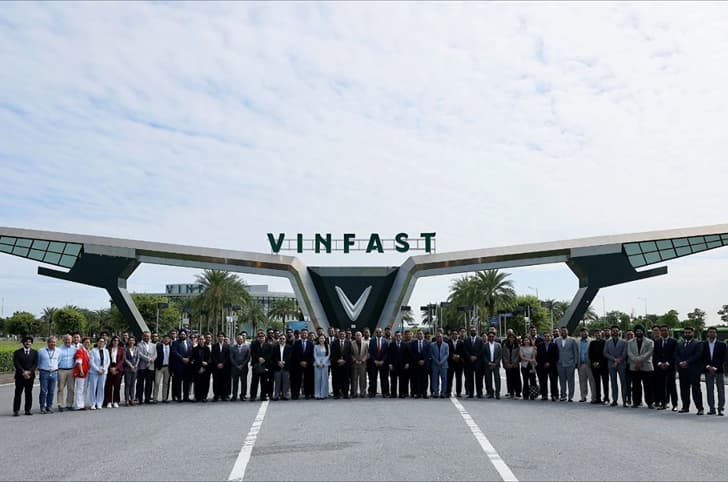

VinFast has signed LOIs with 50+ dealers across 15 states, targeting 34 cities, with the patented Viper and Rasad e-scooters as its likely India launch line-up.
VinFast's India Two-Wheeler Entry in 2026: What the Design Patent Signals for EV Scooter Competition
VinFast's signing of letters of intent with more than 50 electric two-wheeler dealers across 15 Indian states — with plans for showrooms in 34 cities — is the clearest signal yet that the Vietnamese EV giant is ready to move from patent filings to retail presence in one of the world's largest two-wheeler markets.
The move follows a deliberate, multi-step entry playbook: cars first (2025), design patents next (mid-2026), and now dealer network construction. The initial product line-up is expected to feature the Viper and Rasad electric scooters, both of which have had their designs formally protected in India. No launch timeline has been confirmed, but the dealer LOIs make a 2026–27 commercial debut plausible.
To understand what VinFast is walking into — and how it stacks up against the competition it will face — here is a snapshot of the key players and the market context:
| Brand / Model | Segment | Battery / Motor | Est. India Price | Key Differentiator |
|---|---|---|---|---|
| VinFast Viper (expected) | Urban e-scooter | 4.8 kWh / 3 kW hub motor | TBA | Angular styling, hub motor, patented design |
| VinFast Rasad (expected) | Maxi e-scooter | TBA | TBA | Larger format, patented in India Aug 2026 |
| Ather Konarc | Performance e-scooter | TBA | From ₹1 lakh | Launched Aug 2026; established service network |
| TVS iQube | Mass-market e-scooter | Up to 5.1 kWh | ₹1.15–1.71 lakh | Broad dealer reach, proven reliability |
| Bajaj Chetak | Premium e-scooter | 3.2 kWh | ~₹1.15–1.50 lakh | Legacy brand trust, wide service network |
| Maruti Suzuki e Vitara | Compact electric SUV | 49–61 kWh | From ₹15.99 lakh | Four-wheeler segment; Suzuki global platform |
The Maruti Suzuki e Vitara operates in an entirely different segment — compact electric SUVs — but its presence in this table is instructive: as global brands like VinFast enter India across two-wheeler and four-wheeler categories simultaneously, the competitive pressure on every EV segment intensifies. The e Vitara's four-wheeler positioning is defined by its Suzuki-Maruti manufacturing partnership and a buyer base that is unlikely to cross-shop with a ₹35,000–₹50,000 e-scooter, but both stories are part of the same macro narrative of global EV brands accelerating India entries.
What exactly has VinFast done so far — and what is still missing?
VinFast's India two-wheeler strategy unfolds in phases: intellectual property protection first, retail infrastructure second, product launch third. The company entered India in 2025 with electric cars — covering distribution, manufacturing, and assembly — before pivoting attention to two-wheelers.
The sequence of two-wheeler moves is worth tracing precisely:
- Auto Expo 2026: VinFast displayed e-scooters, signalling intent without committing to products or prices.
- June 2026: A design patent for a Viper-like scooter was filed in India, though with minor visual differences from the Vietnam-market model — twin-pod headlight instead of a single-piece unit, slightly more rounded panels.
- July 2026: A closer match to the production Viper was patented, along with what appears to be an electric motorcycle based on the Sulad concept. The Sulad-derived motorcycle, per Vietnamese media reports, could produce up to 50 kW and reach around 130 kph — though VinFast has released no official specifications.
- August 2026: The Rasad maxi-scooter design was patented in India.
- October 2026: LOIs signed with 50+ dealers across 15 states; 34-city showroom plan announced.
What remains unconfirmed: launch dates, India-specific pricing, localisation details, after-sales service commitments, and whether the electric motorcycle will debut alongside the scooters or arrive later. VinFast has disclosed none of these details, and this article will be updated as information becomes available.
What are the Viper and Rasad, and why do these models matter for India?
The VinFast Viper is a sporty urban electric scooter sold in Vietnam and Indonesia, equipped with a 4.8 kWh battery and a 3 kW hub-mounted motor. Its angular styling, five-spoke alloy wheels, and overall silhouette position it as a style-forward alternative to the more conservative designs of some Indian incumbents.
The India-patented version displays angular body panels and an LED headlamp. The HT Auto report on the patent filing notes that the scooter is offered in Vietnam with single or dual 1.5 kWh battery options, delivering ranges of 82 km and 145 km respectively, with varied charging times. This later design appears closer to the production Viper than the June 2026 filing, suggesting VinFast refined its India-specific intent over those weeks.
The Rasad is a larger-format maxi-scooter — a segment that sits above the typical 110–125cc equivalent urban commuter in terms of physical presence and likely price. Maxi-scooters remain a niche in India today, dominated by the Suzuki Burgman Street and Aprilia SXR 160, but the segment is growing as urban incomes rise and buyers seek more premium two-wheeler experiences. Competitive pricing against these petrol maxi-scooters could carve out a distinct position for VinFast.
The electric motorcycle based on the Sulad concept is the most speculative element of VinFast's India two-wheeler plans. A 50 kW motor and 130 kph top speed would place it in performance territory currently occupied by the Revolt RV400 and upcoming entrants from Ultraviolette — but no official specs exist for India.
Why does the design patent matter as a strategic signal?
A design patent is a form of intellectual property protection covering the ornamental or aesthetic aspects of a product, not its functional features. Filing a design patent in a target market is a standard pre-commercialisation step: it prevents local manufacturers from copying the visual identity of a product before it launches, and it signals to dealers, investors, and regulators that the brand is serious about that market.
VinFast filing not one but multiple design patents in India — for the Viper (twice, with a refined version), the Rasad, and an electric motorcycle — suggests the company is protecting a portfolio, not just testing the waters with one model.
For Indian consumers, the practical implication is that VinFast's India line-up will likely resemble what is sold in Vietnam and Indonesia — not a heavily localised redesign. Whether that represents an advantage (global design language, consistent quality benchmarks) or a risk (styling preferences differ between Southeast Asian and Indian markets) remains to be seen.
How competitive is the Indian electric two-wheeler market VinFast is entering?
The scale of the opportunity is substantial: in FY2025-26, 21.41 million two-wheelers were registered in India, of which electric vehicles accounted for only 6.54 percent. That translates to roughly 1.4 million electric two-wheelers sold in a market of over 21 million — leaving more than 93% of buyers still on internal combustion engines. The headroom for EV growth is enormous.
The competition VinFast will face, however, is formidable on multiple fronts.
Established legacy players like TVS (iQube), Bajaj (Chetak), Hero MotoCorp (Vida), and Honda have manufacturing scale, pan-India dealer networks built over decades, and deep brand trust with Indian buyers. TVS and Bajaj have invested heavily in EV-specific platforms and software ecosystems.
Technology-first startups like Ather Energy have built reputations for performance and software sophistication. The Ather Konarc launched in August 2026 from ₹1 lakh, with up to 200 km IDC range — a significant benchmark. Ather's fast-charging network (AtherGrid) is a genuine differentiator that VinFast will need to match or partner around.
Newer entrants like River Indie are experimenting with alternative retail models — the River Indie is now available on Flipkart, a sign that e-commerce is becoming a legitimate channel for EV two-wheelers.
VinFast's advantages include global manufacturing scale (it produces e-scooters at volume in Vietnam), a design-forward product identity, and the financial backing of Vingroup. Its disadvantages are the absence of an established India service network, no proven track record with Indian consumers on two-wheelers, and the challenge of building brand trust from scratch in a market where after-sales reliability is a primary purchase driver.
What does the 34-city, 15-state dealer network plan actually mean?
The geographic footprint VinFast is targeting with its initial dealer LOIs is strategically broad. The 15 states and union territories identified — Delhi, Rajasthan, Punjab, Madhya Pradesh, Chhattisgarh, Uttar Pradesh, Maharashtra, Gujarat, Karnataka, Telangana, Tamil Nadu, Kerala, Andhra Pradesh, West Bengal, and Odisha — cover both the high-volume north Indian markets and the EV-progressive southern states.
This is not a metro-only launch strategy. Including states like Chhattisgarh and Odisha alongside Maharashtra and Karnataka suggests VinFast is thinking about Tier 2 and Tier 3 city penetration from the start — a smart move given that a significant portion of India's two-wheeler volume comes from non-metro markets.
Signing LOIs, however, differs from opening showrooms. The LOI stage is a non-binding expression of intent between two parties to proceed toward a formal agreement — it precedes the actual dealership agreements, infrastructure investment, and staff training that constitute a functioning retail network. VinFast has not shared timelines for converting these LOIs into operational showrooms, and the gap between LOI and launch can be substantial in the Indian automotive market.
For buyers evaluating whether to wait for VinFast or purchase an existing EV scooter now, this distinction matters. The dealer network is being built; it does not yet exist in operational form.
How does VinFast's two-wheeler push fit into its broader India strategy?
VinFast's India entry runs on two parallel tracks. On the four-wheeler side, the company entered in 2025 with electric cars including the VF 6 and VF 7, targeting the compact and mid-size electric SUV segments. On the two-wheeler side, the patent filings and now the dealer LOIs represent the second track coming to life.
This dual-track approach is unusual among global EV entrants. Most international brands entering India have focused on one segment — typically four-wheelers, given the higher margins and the premium positioning that global brands can command. VinFast's willingness to compete in two-wheelers simultaneously reflects both the scale of the opportunity (India is the world's largest two-wheeler market) and the company's existing product depth in Vietnam, where it sells many e-scooters.
The broader competitive context this creates is significant. As global brands pile into India's EV market across segments, the pressure on domestic manufacturers intensifies — but so does the pressure on other global entrants. The Maruti Suzuki e Vitara, for instance, competes in the compact electric SUV space where VinFast's VF 6 is also present. The e Vitara's differentiation rests on Maruti's unmatched service network, the Suzuki global platform's reliability credentials, and the trust Indian buyers have placed in the Maruti brand for decades. VinFast's four-wheeler ambitions in India are a direct challenge to that positioning — even as its two-wheeler plans open an entirely separate competitive front.
For buyers researching the best electric cars under ₹20 lakhs in India, the arrival of more global players like VinFast generally means more choice and competitive pricing over time — even if the immediate product availability is limited.
What should Indian EV buyers make of VinFast's two-wheeler plans right now?
Watch carefully, but don't wait.
VinFast has demonstrated a credible, step-by-step approach to the Indian market — cars before scooters, patents before dealers, LOIs before showrooms. That methodical progression is reassuring compared to brands that announce India entries and then disappear. The company has manufacturing scale in Vietnam, a diverse e-scooter portfolio, and the financial resources of Vingroup behind it.
Several critical unknowns remain. India-specific pricing has not been announced. The Viper's Vietnam pricing starts from approximately 35 million VND (roughly ₹1.2–1.3 lakh at current exchange rates), but India pricing will depend on import duties, localisation levels, and competitive positioning — and could be materially different. After-sales service infrastructure does not yet exist. Launch timelines are unconfirmed.
For buyers who need an electric scooter today, the established options — Ather Konarc, TVS iQube, Bajaj Chetak, Ola S1 series — offer proven products with functioning service networks. For buyers who can wait and are intrigued by VinFast's design language and global platform, the next 12–18 months should bring considerably more clarity.
If you are also evaluating electric four-wheelers alongside two-wheelers, our guides on the best electric cars to buy in India in 2026 and best electric SUVs with 6 airbags under ₹20 lakh cover the four-wheeler space in detail.
What is the electric motorcycle angle, and should it be taken seriously?
The electric motorcycle patent — based on what appears to be the VinFast Sulad concept — is the most speculative element of VinFast's India two-wheeler plans and deserves measured assessment.
Vietnamese media reports suggest the Sulad-derived motorcycle could produce up to 50 kW and reach around 130 kph. If those figures translate to an India product, it would represent a genuinely competitive performance electric motorcycle — comparable to or exceeding the Ultraviolette F77 Mach 2 in power output, and significantly above the Revolt RV400 in performance terms.
VinFast has released no official specifications for this motorcycle, and the gap between a concept patent and a production launch is wide. The electric motorcycle segment in India remains small and premium-oriented, with high price sensitivity and limited charging infrastructure outside major cities. VinFast would need to price aggressively and build a compelling ownership proposition to succeed here.
For now, the electric motorcycle patent is best read as a signal of ambition — VinFast is thinking beyond urban commuter scooters — rather than a near-term product commitment. The Autocar India report from July 2026 notes explicitly that VinFast has not announced a launch timeline for either model.
What does this mean for India's EV market trajectory?
VinFast's two-wheeler push, taken together with its four-wheeler presence and the broader wave of global EV entrants, reinforces a structural shift in India's automotive market: the EV transition is no longer a domestic story.
The 6.54% electric penetration rate in two-wheelers for FY2025-26 is both a measure of how far the market has come and how far it has to go. With 21.41 million two-wheelers registered annually, even a move from 6.54% to 15% electric penetration would represent an additional 1.8 million electric two-wheelers per year — a market large enough to support multiple global entrants alongside domestic leaders.
The entry of VinFast, with its Southeast Asian manufacturing base and price-competitive product history, could accelerate this transition by introducing more design variety and more competitive pricing. It could also raise the bar for after-sales service expectations, since Indian buyers will compare VinFast's service network against Ather's AtherGrid and TVS's pan-India reach.
For the best after-sales service in India's electric vehicle segment, network depth remains the defining criterion — and it is precisely where VinFast starts from zero in the two-wheeler space.
The next milestone to watch is VinFast's conversion of these dealer LOIs into signed agreements, followed by the announcement of India-specific pricing and a confirmed launch date. Until then, the design patents and dealer network construction are the clearest evidence of intent — and intent, in India's competitive EV market, is only the beginning.
Sources
- VinFast takes first step toward entering Indian two-wheeler market | Autocar India
- Vinfast patents Viper e-scooter and new electric motorcycle in India | Autocar India
- Updated VinFast Viper electric scooter design patented in India | HT Auto
- VinFast E-Scooters — Features and Specifications | VinFast Official
- Ather Konarc launched from Rs 1 lakh | Autocar India