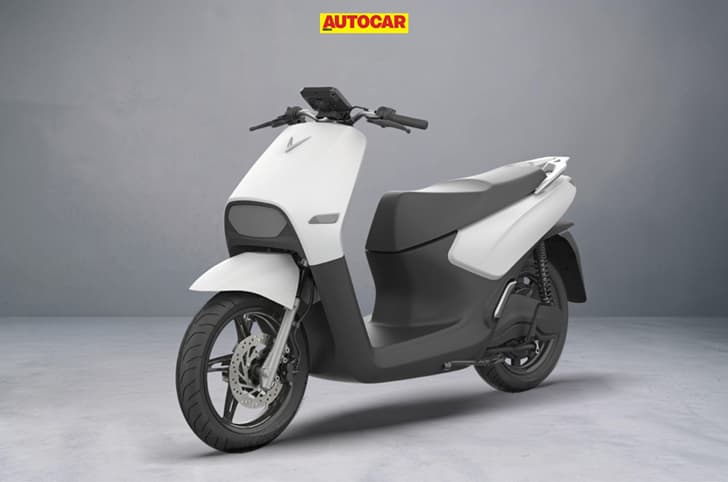

VinFast has patented a fifth India-specific electric scooter design (filed April 2026) featuring 14-inch wheels and a hub motor, while signing LOIs with 50+ dealers — marking a concrete push into India's EV two-wheeler segment.
VinFast's latest India patent, filed in April 2026 and reported by Autocar India on 21 October 2026, covers an electric scooter that bears no resemblance to any model currently sold in Vietnam. This marks the Vietnamese brand's most explicit signal yet that it intends to engineer products specifically for Indian roads, Indian price expectations, and Indian commuter habits.
This is the fifth two-wheeler design VinFast has patented in India since June 2026. The others include the Viper e-scooter, an electric motorcycle apparently based on the Sulad concept, the Rasad maxi-scooter, and an earlier unnamed scooter. Each successive filing has added detail to what is shaping up to be one of the more ambitious two-wheeler EV market entries India has seen from an overseas brand.
Before diving into what each patent reveals, here is a snapshot of how VinFast's known and likely India-bound two-wheelers stack up against the closest domestic rivals on the specs that matter most to entry-level and mid-range buyers:
| Model | Wheel Size | Motor Type | Battery (known/estimated) | Likely Segment | Status in India |
|---|---|---|---|---|---|
| VinFast India-specific scooter (patented Oct 2026) | 14-inch (both ends) | Rear hub motor | Not disclosed | Entry-level commuter | Patent filed April 2026 |
| VinFast Viper (patented Jul 2026) | Alloy, 5-spoke | Hub-mounted | 4.8 kWh | Mid-range sporty | Patent filed Jun 2026 |
| Ather Konarc | 14-inch | Mid-drive | ~3.7 kWh | Mid-range | On sale |
| TVS Orbiter | 14-inch | Hub motor | ~3.0 kWh | Entry-level | On sale |
| Maruti Suzuki e Vitara (EV SUV, for context) | N/A | Permanent magnet sync | 49 kWh / 61 kWh | Family EV SUV | Launched 2026 |
The Maruti Suzuki e Vitara is included here not as a two-wheeler rival but as a reference point for how established OEMs are simultaneously pushing electrification across vehicle segments. While buyers choosing between a commuter scooter and a family SUV are rarely the same person, the broader EV adoption curve that products like the e Vitara are accelerating is precisely the environment in which a new two-wheeler entrant like VinFast wants to arrive.
What exactly did VinFast patent in October 2026?
The patent drawings, as analysed by Autocar India, show a scooter with a clean, restrained front fascia featuring the VinFast logo prominently at the top, a horizontally mounted headlight flanked by integrated turn indicators, an exposed handlebar, and what appears to be either an LCD or TFT instrument cluster. The suspension setup — telescopic fork at the front, twin hydraulic shock absorbers at the rear — is conventional and cost-effective, consistent with entry-level positioning.
The 14-inch wheel diameter at both ends is a meaningful detail. In the Indian electric scooter market, 14-inch wheels are preferred for urban commuter models because they offer a balance between stability, ground clearance, and tyre availability. Currently, only two electric scooters in India come close to this specification: the Ather Konarc and the TVS Orbiter. VinFast's new model would enter that same bracket.
The bottom-view patent drawing reveals a thickly cladded floorboard, which Autocar India interprets as a likely battery housing location. If the battery sits under the floorboard rather than in the boot, the scooter could offer meaningful under-seat storage — a practical consideration that Indian buyers consistently rank highly. The raked tail design, however, will limit the depth of any boot space regardless of where the battery sits.
One detail worth noting: the patent drawings show a conventional key, not a keyless ignition system. As Autocar India points out, only a handful of electric scooters currently offer keyless entry — the Suzuki e-Access being one of the rare examples — so this is not a drawback unique to VinFast. It does suggest the brand is prioritising cost containment over feature differentiation on this particular model.
How does this differ from VinFast's Vietnam line-up?
This is the most consequential aspect of the October 2026 patent. VinFast's existing Vietnamese scooter portfolio — which includes the Flazz, Evo, Feliz II, and Viper — is built around battery-swapping infrastructure provided by strategic partner V-Green. The India-specific patented design, by contrast, appears to be a conventional fixed-battery scooter, which aligns with how the Indian market currently operates. Battery-swapping is a model where a depleted battery pack is exchanged for a charged one at a swap station, rather than waiting for an onboard charge, but the infrastructure for this remains nascent outside of specific operators like Sun Mobility and Bounce Infinity.
BikeWale notes that the new patent "doesn't bear a resemblance to anything currently in VinFast's native Vietnamese portfolio or any concept models showcased," a significant departure from the brand's earlier India filings, most of which were adaptations of existing Vietnam-market products. Designing from scratch — or at least adapting to the point of non-recognition — for a specific geography is expensive and time-consuming. The fact that VinFast has done so suggests the company has concluded that a direct import of its Vietnam line-up would not be competitive enough on design or price in India.
What is VinFast's broader India two-wheeler strategy?
VinFast's India two-wheeler ambitions combine existing models adapted for Indian conditions with at least one purpose-built design. The full picture, assembled from patent filings and official announcements, looks like this:
On 31 January 2026, VinFast's parent Vingroup announced a global e-scooter expansion strategy identifying India as one of five priority markets alongside the Philippines, Indonesia, Thailand, and Malaysia. The announcement confirmed four models for initial consideration — the Flazz, Evo, Feliz II, and Viper — alongside "additional new models to be launched in due course." The October 2026 patent is almost certainly one of those additional models.
By July 2026, VinFast had patented both the Viper e-scooter and an electric motorcycle in India. The Viper patent closely matches the production model sold in Vietnam, featuring angular styling, five-spoke alloy wheels, and a hub-mounted motor paired with a 4.8 kWh battery and a 3 kW motor. The electric motorcycle patent is more speculative — Autocar India reports that Vietnamese media suggests it could produce up to 50 kW and reach 130 kph, though VinFast has released no official specifications.
The dealer network piece is equally important. VinFast has signed letters of intent with over 50 dealers across 15 states, according to BikeWale. This is not a token presence — 50 dealers across 15 states represents a credible Tier 1 and Tier 2 city footprint at launch, comparable to what several established Indian EV brands operated in their first year of sales. The Vingroup announcement targets "hundreds of retail outlets" across its five priority markets by 2027, implying aggressive dealer expansion in India through the next 12 months.
In October 2026, VinFast India was named 'EV Manufacturer of the Year' at the HT Auto Leaderboard Awards 2026, according to Vingroup — a recognition that carries weight even before a formal two-wheeler launch, likely reflecting the brand's car sales momentum and overall EV commitment in the country.
Who are the real competitors VinFast will face?
The Indian electric two-wheeler market is not a blank slate. Ola Electric, TVS, Ather, Bajaj (Chetak), Hero Vida, and Ampere have collectively built a market that sold over 1 million electric two-wheelers in FY2025, with FY2026 tracking higher. VinFast is entering a segment where incumbents have already navigated the painful early phases of range anxiety management, service network buildout, and consumer education.
For the India-specific patented scooter — which appears to be an entry-level model — the primary rivals would be:
TVS Orbiter is TVS Motor Company's entry into the accessible electric scooter space, with 14-inch wheels and a hub motor configuration that mirrors what VinFast's patent shows. TVS's service network of thousands of touchpoints across India is a structural advantage that VinFast will take years to match.
Ather Konarc sits in a similar wheel-size bracket but is positioned slightly higher on features and performance. Ather's software ecosystem and fast-charging network are differentiators that a new entrant would struggle to replicate quickly.
Bajaj Chetak and Hero Vida V1 occupy the mass-market commuter space where price sensitivity is highest and brand trust matters enormously. VinFast's challenge here is not product — the patent drawings suggest a competent, conventional scooter — but brand recognition and after-sales confidence.
For the Viper, which is a sportier, more premium proposition, the competition shifts toward the Ather 450X and Ola S1 Pro territory. The Viper's 4.8 kWh battery and 3 kW motor, as confirmed by Autocar India, would need to be priced aggressively to compete with Ather's established brand equity in that segment.
The electric motorcycle, if it does arrive with anything close to 50 kW output, would be in a category that barely exists in India today — an early-mover opportunity rather than a crowded fight.
Does VinFast's Vietnam success translate to India?
VinFast delivered 406,453 e-scooters in Vietnam in 2025, according to the Vingroup announcement, officially claiming the leading market share position in Vietnam's scooter segment. That is a genuine manufacturing and distribution achievement. The company simultaneously launched seven new models in the premium and sport categories at the start of 2026, demonstrating product development velocity that few two-wheeler brands outside Japan and India can match.
Vietnam's two-wheeler market is structurally different from India's, however. Scooters are the primary personal transport mode for the majority of the Vietnamese population, with Honda dominating through decades of brand building. VinFast's rise there was partly enabled by strong domestic brand sentiment (Vingroup is one of Vietnam's largest conglomerates) and government support for local EV adoption. Neither of those tailwinds applies in India.
What does apply is VinFast's manufacturing cost structure. Building scooters at scale in Vietnam, where labour costs are lower than in India, could allow VinFast to price aggressively — particularly if it imports CKD (completely knocked-down) kits and assembles locally to meet localisation requirements for FAME or PM E-Drive subsidies. The company has not confirmed its India manufacturing strategy, so this remains speculative.
What does the battery-swapping angle mean for Indian buyers?
VinFast's global e-scooter strategy, as outlined in the Vingroup January 2026 announcement, is built around battery-swapping in partnership with V-Green. Battery-swapping eliminates the charging wait entirely — a rider pulls into a swap station, exchanges a depleted battery for a fully charged one in under two minutes, and continues riding.
In India, battery-swapping has been piloted by Sun Mobility (partnered with Hero Electric and Bajaj), Bounce Infinity, and a handful of fleet operators. The government's FAME II and PM E-Drive schemes have provisions supporting swap infrastructure, but the network density required for consumer confidence — swap stations within 5 km of any urban rider — does not yet exist at scale outside a few cities.
If VinFast brings its V-Green swap space to India, it would need to either build that infrastructure itself or partner with an existing operator. The India-specific patented scooter appears to use a fixed battery (floorboard-mounted), which suggests VinFast may be hedging — offering swap-compatible models from its Vietnam line-up (Flazz, Evo, Feliz II, Viper) while also developing fixed-battery models tuned to Indian charging habits.
This dual approach, if confirmed, would be strategically sensible. It mirrors what the Battery as a Service (BaaS) model discussion in India has shown: buyers want flexibility, and brands that offer only one energy replenishment model risk alienating a segment of the market.
What should Indian buyers watch for before VinFast launches?
Several unknowns remain, and buyers should treat the current patent activity as a strong signal of intent rather than a confirmed product roadmap.
Launch timeline: VinFast has not announced when its two-wheelers will go on sale in India. The company had indicated a second-half 2026 target for scooter launches, per Autocar India's July 2026 report, but as of October 2026, no launch event has been confirmed. The year is nearly over, which means either a very late 2026 launch or a slip into early 2027.
Pricing: This is the variable that will determine whether VinFast is a genuine mass-market contender or a niche player. Entry-level electric scooters in India cluster between ₹80,000 and ₹1.2 lakh (ex-showroom, post-subsidy). Mid-range models like the Ather 450X and Ola S1 Pro sit between ₹1.2 lakh and ₹1.5 lakh. VinFast will need to land within these bands to be relevant.
After-sales network: Fifty dealer LOIs is a start, not a finish. Indian buyers — particularly those considering a brand with no prior two-wheeler presence in the country — will want assurance that spare parts, service technicians trained on VinFast's specific motor and battery architecture, and warranty support are genuinely accessible. This is an area where established players like TVS and Bajaj have an almost insurmountable head start in the short term.
Localisation and subsidies: Whether VinFast qualifies for PM E-Drive subsidies will depend on the degree of local manufacturing or assembly. This is a detail the company has not addressed publicly, and it will materially affect the effective price to the buyer.
Software and connectivity: Modern Indian EV buyers — especially in the ₹1 lakh-plus segment — expect connected features: app integration, over-the-air updates, navigation, and ride analytics. The patent drawings show a digital instrument cluster, but whether the underlying software platform is competitive with Ather's or Ola's is unknown.
How does this fit into India's broader EV two-wheeler market in 2026?
India's electric two-wheeler segment is the fastest-growing EV category in the country by volume, outpacing electric cars by a wide margin. The segment is defined by intense domestic competition, with Ola Electric, TVS, Ather, Bajaj, and Hero Vida collectively accounting for the vast majority of sales. Foreign brands have historically struggled to break into this market — Honda, Yamaha, and Suzuki have all launched electric scooters in India with limited commercial success relative to their ICE dominance.
VinFast's approach — multiple patent filings, a dedicated dealer network buildout, and at least one India-specific design — suggests the company has studied those failures and is attempting to avoid the trap of simply rebadging a Vietnam product for Indian sale. Whether that is enough remains to be seen.
India's four-wheeler EV segment is seeing significant momentum, with products like the Maruti Suzuki e Vitara bringing mass-market credibility to electric mobility at the family car level. That rising EV awareness among Indian consumers is a tailwind for two-wheeler EV adoption as well — buyers who see electric vehicles as a mainstream, reliable choice for family transport are more likely to consider an electric scooter for daily commuting. VinFast, arriving into this environment with a purpose-built India product, has chosen its moment carefully.
The competitive pressure VinFast's entry creates is also worth acknowledging for existing players. Ather and TVS, in particular, will face a new variable in their pricing and feature decisions once VinFast's actual products and prices are known. Competition from a brand with VinFast's manufacturing scale and global ambitions is not something the Indian EV two-wheeler market has encountered before at this level of seriousness.
For now, the October 2026 patent is the clearest evidence yet that VinFast's India two-wheeler plans are real, detailed, and moving forward. The next milestone to watch is an official launch announcement — and the price tag that comes with it.
Sources
- VinFast patents India-specific electric scooter | Autocar India
- VinFast patents Viper e-scooter and new electric motorcycle in India | Autocar India
- VinFast Announces Global Expansion Strategy for Electric Scooters | Vingroup
- VinFast Patents New Electric Scooter in India | BikeWale
- Which Electric Cars Offer Battery as a Service (BaaS) in India and Are They Worth Buying? | EV Index India