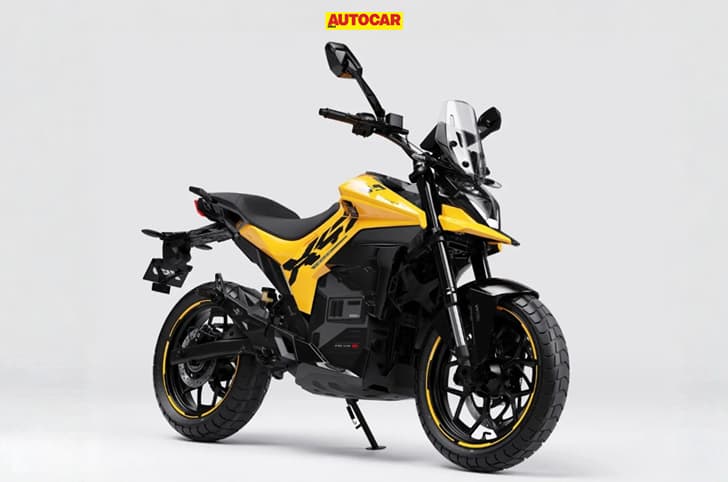

Ultraviolette's X-47 Venom starts at ₹2.65 lakh on a new 100V VX-100 platform, offering up to 343km range, 155km/h top speed, and 17kg weight savings over its predecessor.
The Ultraviolette X-47 Venom is the first production motorcycle built on Bengaluru-based Ultraviolette Automotive's new VX-100 high-voltage platform, launched on 22 October 2026 at an introductory starting price of ₹2.65 lakh (ex-showroom, Bengaluru) for the base 7.5kWh variant. The range tops out at ₹4.12 lakh for the 11kWh Recon+ in the new Afterburner Yellow colour. These introductory prices are valid for the first 5,000 customers, after which all variants increase by ₹35,000.
For buyers evaluating the X-47 Venom against the broader two-wheeler and even entry-level electric four-wheeler market, the table below puts the key numbers in perspective:
| Model | Starting Price (ex-showroom) | Battery / Range | Key Platform Highlight |
|---|---|---|---|
| Ultraviolette X-47 Venom (base) | ₹2.65 lakh | 7.5kWh / 227km (IDC) | New VX-100 100V architecture, 180kg kerb weight |
| Ultraviolette X-47 Venom Recon+ | ₹4.12 lakh | 11kWh / 343km (IDC) | 20% higher energy density, 12kW fast charging |
| Triumph Bonneville T40 (petrol) | ₹2.80 lakh | — / ~35km/l | 350cc parallel-twin, retro-modern positioning |
| Honda CB500 (petrol) | ₹2.75 lakh | — / ~25km/l | 471cc parallel-twin, A2-licence friendly |
| Maruti Suzuki e Vitara (electric SUV) | ~₹17.49 lakh | 49kWh / ~500km (claimed) | Four-wheeler alternative for buyers stepping up from two-wheelers |
The Maruti Suzuki e Vitara sits in a different category entirely, but it is worth flagging for buyers who are weighing whether to invest in a premium electric motorcycle or stretch their budget toward an entry-level electric SUV — a decision that is increasingly common as EV financing matures in India. For daily urban commuters who need more cargo space or family utility, the e Vitara represents the next rung; for performance and solo-riding enthusiasts, the X-47 Venom is a far more focused proposition at a fraction of the cost.
What exactly is the VX-100 platform, and why does it matter?
Ultraviolette's proprietary VX-100 is a 100-volt high-voltage electric vehicle architecture that will underpin all future UV products. The shift from lower-voltage systems to 100V matters because higher system voltage allows more power delivery at lower current, which reduces heat generation, enables faster charging, and permits more compact wiring and motor-controller designs.
The VX-100 improves three core components simultaneously: the battery, the motor, and the motor controller. All three are lighter than their predecessors while packing more energy and cooling down faster. The motor control unit is reportedly half the size of the outgoing unit while delivering three times the power density, per Team-BHP's coverage.
For a buyer, this translates into two concrete benefits that are easy to overlook in spec-sheet comparisons: sustained high performance and wider regen availability. UV's Ballistic ride mode — the brand's most aggressive performance setting — is now accessible down to 10% battery charge, compared to 30% on the outgoing X-47. That means you are not penalised with a neutered riding experience for the last third of your range. Regenerative braking now activates from 99% state of charge rather than 90%, giving the system more opportunity to recover energy on every ride.
A first-in-class safety feature worth noting is the pyro-fuse, which can isolate the high-voltage circuit in microseconds upon detecting a critical fault. This architecture-level safety measure is absent from most electric two-wheelers currently on sale in India, and it signals that UV is designing the VX-100 with long-term platform scalability — not just the X-47 — in mind.
How does the X-47 Venom compare to the outgoing X-47 on specs?
The weight savings are the headline improvement. The base 7.5kWh variant now weighs 180kg, down 17kg from the previous 7kWh model. The top Recon variant with the 11kWh battery comes in at 195kg, a 13kg reduction from the outgoing 10.3kWh Recon. These are meaningful reductions on a motorcycle — 17kg is roughly the weight of a full tank of petrol on a mid-size ICE bike.
The battery itself has grown: 7.5kWh (up from 7kWh) for the base, and 11kWh (up from 10.3kWh) for the top. The 11kWh pack boasts 20% higher energy density and twice the cooling performance compared to its predecessor. This yields a 20km range gain on the top variant (343km vs 323km IDC-claimed) and a 16km gain on the base (227km).
Performance figures are broadly similar but with one standout improvement: the 0–100km/h time drops from 8.1 seconds to 5.9 seconds — a 2.2-second improvement that UV attributes primarily to the weight savings rather than any increase in peak power. Peak power on the Recon variant is actually marginally lower at 40hp (down 0.2hp), and peak torque is 90Nm (down 10Nm), with rear-wheel torque at 550Nm versus 610Nm previously. The top speed, however, increases by 10km/h to 155km/h.
Charging times have crept up slightly. With the standard 1.3kW portable charger, a 20–80% top-up now takes 5 hours 30 minutes versus 5 hours before. The X-47+ and Recon+ trims gain a 1.6kW on-board charger, and the motorcycle supports 12kW fast charging — a meaningful addition for long-distance riders.
Here is a direct generation-on-generation comparison:
| Specification | Outgoing X-47 (Recon) | X-47 Venom (Recon+) | Change |
|---|---|---|---|
| Battery capacity | 10.3kWh | 11kWh | +0.7kWh |
| IDC range | 323km | 343km | +20km |
| Kerb weight | 208kg | 195kg | −13kg |
| 0–100km/h | ~8.1 sec | 5.9 sec | −2.2 sec |
| Top speed | 145km/h | 155km/h | +10km/h |
| Ballistic mode available until | 30% charge | 10% charge | More usable |
| Regen available from | 90% charge | 99% charge | Earlier activation |
What are the four variants and what do you get at each price point?
Ultraviolette has structured the X-47 Venom into four variants, with battery size, charger type, and colour choice determining the final price within each band:
- X-47 Venom: ₹2.65 lakh – ₹2.78 lakh (7.5kWh battery)
- X-47 Venom+: ₹3.15 lakh – ₹3.28 lakh (7.5kWh battery, 1.6kW OBC)
- X-47 Venom Recon: ₹3.75 lakh – ₹3.88 lakh (11kWh battery)
- X-47 Venom Recon+: ₹4.00 lakh – ₹4.12 lakh (11kWh battery, 1.6kW OBC, full features)
The base X-47 Venom is the entry point into the platform and makes sense for urban riders who will primarily charge at home overnight. The jump to Venom+ adds the 1.6kW on-board charger, which meaningfully reduces home-charging time and is worth the ₹50,000 premium for anyone doing more than 100km a day.
Cruise control, camera-powered parking assistance, and the larger 7-inch TFT display are exclusive to the top three variants and genuinely useful rather than cosmetic additions. Cruise control on an electric motorcycle is particularly underrated: because there is no engine braking from a throttle lift, maintaining a steady highway speed without constant throttle input is fatiguing. Having cruise control addresses this directly.
The Recon and Recon+ variants also carry the UV Hypersense radar-assisted rider assistance system and an integrated dashcam. Hypersense provides blind-spot monitoring, lane-change assist, overtake alerts, and rear collision warnings — a suite of features more commonly associated with premium cars than motorcycles in this price bracket.
All variants, regardless of price, come standard with dual-channel ABS, traction control, and dynamic stability control. Higher variants add four levels of traction control granularity.
Is the ₹2.65 lakh introductory price a genuine deal or a marketing tactic?
The introductory pricing is a time-limited offer applicable to the first 5,000 customers, after which all variants increase by ₹35,000. Bookings opened on 22 October 2026 with deliveries beginning in November.
₹35,000 is not a trivial discount — it represents roughly 13% of the base variant's price. Whether it constitutes a "genuine deal" depends on how quickly those 5,000 bookings fill. UV has historically had a smaller but loyal customer base, and the X-47 platform has been well-received in enthusiast circles. If you are seriously considering the bike, booking now to lock in the introductory price is rational.
However, buyers should factor in on-road costs. The prices quoted are ex-showroom Bengaluru. Registration, insurance, and any accessories will add to the final number. For context, the Triumph Bonneville T40 launched at ₹2.80 lakh and the Honda CB500 at ₹2.75 lakh — both petrol bikes — sit in a similar ex-showroom bracket but carry significantly higher running costs over time. An electric motorcycle at ₹2.65 lakh with a 227km claimed range starts to look compelling on a total cost of ownership basis, particularly given electricity costs versus petrol at current prices.
Ultraviolette is targeting 10,000 monthly sales by the end of 2027, a significant scale-up from current volumes. The introductory pricing is likely designed to accelerate early adoption and build momentum toward that target.
What does the X-47 Venom's hardware tell us about UV's long-term roadmap?
The VX-100 platform launch is more significant than the X-47 Venom itself. Ultraviolette has explicitly stated that this architecture will underpin all future vehicles — which means the platform investment is being amortised across a product family, not a single model. The upcoming Ultraviolette Shockwave, expected in the ₹1.50–₹2.00 lakh range, is likely to be the next product on this platform, bringing the VX-100's benefits to a more accessible price point.
This strategy mirrors what larger OEMs do with modular platforms — Volkswagen's MEB, Hyundai's E-GMP, and in the Indian context, what Tata Motors has done with its gen2 EV architecture. The difference is that UV is doing this at a fraction of the scale, which makes the engineering achievement more impressive but also means the risk is concentrated.
The pyro-fuse, the radar integration, and the motor controller miniaturisation all suggest UV is building the VX-100 with regulatory and export ambitions in mind. India's electric two-wheeler safety standards are evolving rapidly following the battery fire incidents of 2022–23, and a platform with circuit isolation at the microsecond level is well-positioned for whatever tightening regulations emerge.
For buyers, the practical implication is that buying into the X-47 Venom now means buying into a platform that will have software updates, accessory ecosystems, and service infrastructure built around it for years. That is a different proposition from buying a one-off model that may be discontinued or orphaned.
How does the X-47 Venom fit into the broader Indian electric motorcycle market?
Electric motorcycles are a nascent but fast-growing segment in India. Electric scooters account for close to 20% of new scooter sales, while electric motorcycles make up less than 1% of new motorcycle sales. Ultraviolette's CEO expects electric motorcycle adoption to follow a similar trajectory to e-scooters — slow initial uptake followed by rapid acceleration as more manufacturers enter and consumer confidence builds.
The X-47 Venom at ₹2.65 lakh is not competing with mass-market commuter motorcycles like the Hero Splendor or Honda Shine. It is competing with mid-size petrol motorcycles and positioning itself as a performance-oriented alternative for buyers who are already spending ₹2.5–₹4 lakh on a two-wheeler. In that context, the value is strong: you get performance figures that rival 300–400cc petrol bikes, a claimed range that covers most weekly riding needs without a charge, and a feature set (radar ADAS, dashcam, cruise control) that is genuinely class-leading.
The gap between electric motorcycle penetration (sub-1%) and electric scooter penetration (~20%) is partly explained by range anxiety, partly by the lack of aspirational products, and partly by the higher price points historically associated with electric motorcycles. The X-47 Venom addresses all three: 227–343km claimed range, a genuinely desirable design and performance story, and a starting price that is now within reach of buyers who previously considered the F77 too expensive.
For buyers on the fence between a premium electric motorcycle and an entry-level electric car, the comparison is worth making explicitly. The Maruti Suzuki e Vitara starts at roughly ₹17.49 lakh — about 6.6 times the base X-47 Venom price. If your primary use case is solo commuting and weekend riding, the motorcycle delivers electric mobility at a fraction of the four-wheeler cost, with the added benefit of avoiding urban traffic congestion. If you need to carry passengers or cargo regularly, the e Vitara and its segment are the appropriate comparison.
What are the chassis, suspension, and braking specifications?
The X-47 Venom retains the same chassis architecture as its predecessor: a steel trellis frame with an 820mm seat height, 200mm ground clearance, and a 1,385mm wheelbase. These dimensions are unchanged, which means the ergonomic character of the bike is familiar to existing X-47 owners and test-ride veterans.
Suspension is handled by a 41mm preload-adjustable upside-down fork at the front and a preload-adjustable monoshock at the rear. Neither unit is electronically adjustable, which is a reasonable omission at this price point — fully adjustable electronic suspension typically adds significant cost and complexity. The setup is appropriate for a sport-touring motorcycle that will see a mix of urban and highway use.
Braking is via a 320mm front disc and 230mm rear disc, with dual-channel ABS as standard across all variants. Tyre sizes are 110/70R17 front and 150/60R17 rear — both on 17-inch alloys. The relatively narrow rear tyre (150-section) compared to some competitors is a deliberate choice that prioritises handling agility over straight-line grip, consistent with the X-47's sport-touring character.
There are no major styling updates beyond new colourways, updated graphics, and new shades for the 17-inch alloys. The Afterburner Yellow is the headline new colour for the Recon+ variant.
What should buyers watch out for before booking?
A few caveats are worth stating plainly.
First, the 343km and 227km range figures are IDC (Indian Driving Cycle) claims, not real-world numbers. IDC testing conditions are more favourable than typical riding — lower speeds, controlled temperatures, no headwinds. Real-world range on the Recon+ is likely to be in the 220–270km band at highway speeds, and closer to the claimed figure in urban stop-go conditions where regen is more effective. This is consistent with how IDC figures translate across the industry.
Second, charging infrastructure for 12kW DC fast charging remains sparse outside major metros. The 12kW fast-charging capability is a genuine asset, but its utility depends on the rollout of compatible chargers. For most buyers, home charging via the 1.3kW or 1.6kW OBC will be the primary method, and the 5.5-hour 20–80% charge time is something to plan around rather than ignore.
Third, Ultraviolette's service network, while growing, is not comparable to Hero, Bajaj, or Honda in terms of geographic reach. Buyers in Tier 2 and Tier 3 cities should verify service centre availability before committing. UV has been expanding its network, but this remains a legitimate concern for anyone outside the major metros.
Fourth, the ₹35,000 post-introductory price increase is a real deadline. If you are genuinely interested, the calculus is simple: book now, evaluate the bike during the November delivery window, and make a final decision then. Most manufacturers allow cancellations with a refund of the booking amount.
What is the bottom line for a buyer deciding in October 2026?
The Ultraviolette X-47 Venom represents the most technically sophisticated electric motorcycle available in India at its price point. The VX-100 platform delivers meaningful improvements over the outgoing X-47 — lighter weight, more range, faster acceleration, wider operating windows for performance modes and regen — while the introductory pricing makes the entry variant genuinely competitive against mid-size petrol motorcycles.
For buyers who ride primarily in urban and peri-urban environments, the base 7.5kWh variant at ₹2.65 lakh offers 227km of claimed range and a feature set that includes dual-channel ABS, traction control, and dynamic stability control. That is a strong package.
For buyers who want the full experience — long-distance capability, radar ADAS, dashcam, cruise control, and fast charging — the Recon+ at ₹4.00–₹4.12 lakh is the variant to target. At that price, you are getting a motorcycle that punches well above its weight class in terms of technology and performance.
The broader significance of the X-47 Venom launch is the VX-100 platform itself. As UV brings more products to market on this architecture — including the anticipated Shockwave at a lower price point — the platform's development costs get distributed, service infrastructure deepens, and the ownership proposition improves. Buying the X-47 Venom now means getting in early on a platform that is designed to grow.
For buyers who are also considering electric cars for their next purchase, our guide to the best electric cars to buy in India in 2026 covers the four-wheeler side of the decision in detail, including options like the Maruti Suzuki e Vitara that occupy a different but adjacent space in the EV market.
Sources
- Ultraviolette X-47 Venom launched from Rs 2.65 lakh | Autocar India
- Ultraviolette launches X-47 Venom at ₹2.65 lakh, deliveries in November | The Hindu BusinessLine
- Ultraviolette launches X-47 Venom electric motorcycle at Rs 2.65 lakh | Economic Times
- E-bike startup Ultraviolette targets 10,000 monthly sales by 2027-end | Economic Times
- 2026 Ultraviolette X-47 Venom launched at Rs 2.65 lakh | Team-BHP
- Ultraviolette X-47 Venom Launched at Rs 2.65 lakh With 343 km Range | The Bike Junction
- Ultraviolette Automotive Official Website
- Best Electric Cars to Buy in India in 2026 | EV Index India