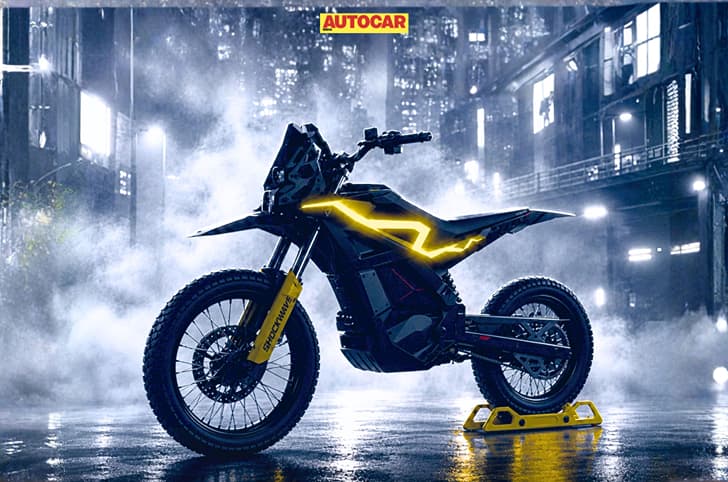

Ultraviolette's Shockwave funduro motorcycle shifts to a 100V architecture and targets Q1 2027 launch at ₹1.75 lakh expected price, after two delivery delays since its March 2025 reveal.
Ultraviolette Shockwave's New 100V Architecture: What India's Next-Gen Electric Motorcycle Means for Two-Wheeler Buyers in 2026
The Ultraviolette Shockwave will arrive in Q1 2027 powered by a new 100V electrical architecture — a significant upgrade from the 60V platform used on the existing F77 — at an expected starting price of ₹1.75 lakh (ex-showroom, Bengaluru), according to Autocar India.
That single number — 100V — is the most consequential detail in the Shockwave story right now. Most electric scooters and motorcycles sold in India today operate on architectures well below that voltage level. Ultraviolette's decision to build an entirely new high-voltage platform, rather than iterate on what already exists, is why deliveries have slipped by a full year, and why the bike's final specifications remain unpublished.
Before diving into what the 100V shift means technically and commercially, here is how the Shockwave stacks up against the key alternatives a buyer in this segment would consider:
| Model | Expected Price | Architecture / Voltage | Key Spec (as announced) | Launch Status |
|---|---|---|---|---|
| Ultraviolette Shockwave | ₹1.75 lakh (expected) | 100V (new platform) | 14.5hp, 165km IDC range (pre-update figures) | Q1 2027 |
| Ultraviolette Tesseract | ₹1.45 lakh (expected) | 100V (same platform) | 15kW peak, 261km IDC, 6kWh battery | Q1 2027 |
| Ather Konarc | From ₹1.00 lakh | Standard EV architecture | Up to 200km IDC range | Launched Aug 2026 |
| Ultraviolette F77 Mach 2 | ₹2.99 lakh | 60V architecture | ~150km IDC range | On sale now |
| Maruti Suzuki e Vitara | ₹17.49 lakh onwards | 400V (car-grade) | 500km+ range (larger format) | On sale 2026 |
The Maruti Suzuki e Vitara sits in a different segment entirely, but it is worth noting for buyers weighing a two-wheeler upgrade against a first EV car purchase: the e Vitara uses a 400V architecture that delivers the kind of fast-charging and sustained performance that Ultraviolette is now trying to bring to the two-wheeler space with its 100V platform. The Shockwave's 100V move is, in that sense, a two-wheeler industry first.
What exactly is the 100V architecture, and why does it matter?
A 100V electrical architecture is defined as a vehicle powertrain system where the nominal operating voltage of the battery pack and associated power electronics runs at or around 100 volts — significantly higher than the 48V to 72V range that characterises most Indian electric two-wheelers today.
Higher voltage is not just a spec-sheet number. In EV engineering, voltage is directly related to how efficiently power can be transferred from battery to motor. At a given power output, a higher voltage system draws proportionally less current. Lower current means less heat, thinner wiring, smaller motor controllers, and a lighter overall electronics package. Autocar Professional's coverage of the Tesseract's architecture shift notes that Ultraviolette claims the new system will allow the Tesseract to deliver 15kW of peak power — approximately three times the current industry average for electric scooters — while also supporting charging speeds up to twice as fast as existing scooter platforms.
For the Shockwave motorcycle, Ultraviolette has not yet published updated power figures following the architecture change. The pre-update spec of 14.5hp and 165km IDC range was quoted before the 100V platform was confirmed for the bike. Given that the Tesseract's specs improved materially when it moved to 100V, the Shockwave's final numbers will likely differ from those early figures — though in which direction remains uncertain.
Narayan Subramaniam, co-founder and CEO of Ultraviolette, has stated that bringing the 100V architecture to the Shockwave is "an important step in realising the company's EV vision," and that the bike will be "an exceptionally engaging motorcycle to ride" when it launches, as reported by HT Auto.
Why has the Shockwave been delayed, and how many times?
The Shockwave has now missed its original delivery window by at least a full year. The timeline reveals a pattern of engineering-driven pushbacks:
- March 2025: Ultraviolette reveals both the Shockwave and Tesseract simultaneously. Starting price for the Shockwave is announced at ₹1.50 lakh. Deliveries are promised in Q1 2026.
- Mid-2026: Deliveries slip. The Tesseract's delay is attributed to the complexity of fitting motorcycle-grade powertrain technology into a scooter's tighter packaging constraints, as explained by Ultraviolette CTO Niraj Rajmohan.
- May 2026: Autocar Professional reports that the Tesseract is being pushed to January 2027 as the company transitions to the 100V platform.
- September 2026: Ultraviolette confirms the Shockwave will also use the 100V architecture. Both vehicles are now targeted for Q1 2027. The Shockwave's expected price has risen from ₹1.50 lakh to ₹1.75 lakh.
The price increase of ₹25,000 since the original reveal is notable. Ultraviolette has acknowledged that further price changes are possible by the time the vehicles actually launch, given the extent of engineering changes both products have undergone. For the Tesseract, the starting price has moved from ₹1.20 lakh to ₹1.45 lakh over the same period.
One reassuring data point: EV Tech News reports that the 70,000 bookings already received for the Tesseract will be honoured at their original booking prices. Whether the same protection applies to Shockwave bookings has not been explicitly confirmed.
What kind of motorcycle is the Shockwave, and who is it for?
The Shockwave is defined as a "funduro" — a portmanteau of "fun" and "enduro" — which positions it as a lightweight, spirited motorcycle designed for riding enjoyment rather than pure utility or long-distance touring. HT Auto describes the design brief as drawing from the character of classic two-stroke motorcycles, particularly their raw, direct feel.
This contrasts sharply with the Tesseract, which is a feature-rich electric scooter aimed at urban commuters and practical daily riders. The Shockwave targets a buyer who wants engagement — someone who might currently ride a petrol-powered 150–200cc single-cylinder motorcycle and is looking for an electric alternative that does not feel like a compromise.
Ultraviolette will offer the Shockwave in both single-seat and dual-seat configurations, which broadens its appeal to both solo riders and those who occasionally carry a pillion. Manufacturing is already underway at Ultraviolette's Hosur facility, which signals that the Q1 2027 timeline is being taken seriously internally.
How does the Shockwave compare to the Tesseract on the same 100V platform?
Both vehicles share the same 100V electrical architecture, but they are engineered for different use cases. The Tesseract is a scooter — step-through format, storage-focused, urban-oriented. The Shockwave is a motorcycle — more exposed riding position, lighter feel, performance-first character.
The Tesseract's specs are more fully disclosed at this point. It carries a 6kWh battery (with 3.5kWh and 5kWh options also available), produces 15kW of peak power, has a top speed of 125kmph, and is rated for 261km of IDC range. Charging is claimed to take under 30 minutes on the new architecture.
The Shockwave's battery capacity has not been revealed. Its pre-update power figure of 14.5hp (approximately 10.8kW) is likely to change once the 100V platform's full potential is factored in. The 165km IDC range figure from the original reveal should also be treated as provisional.
Both vehicles will benefit from the same core advantages of the 100V system: a lighter motor controller, more compact vehicle electronics, improved thermal management under sustained load, and faster charging compared to the 60V architecture on the F77.
How does the Shockwave fit into Ultraviolette's broader product lineup?
Ultraviolette currently sells the F77 Mach 2 and the X47 in India. The F77 is a sport motorcycle priced from ₹2.99 lakh, built on the older 60V architecture. The X47 is a crossover-style motorcycle that sits above the Shockwave in price and positioning.
At ₹1.75 lakh expected, the Shockwave would slot below both of these — making it Ultraviolette's most accessible entry point into the performance electric motorcycle space. This is significant. The Shockwave would compete directly with mid-range petrol motorcycles from Honda, Bajaj, and TVS, as well as with the Ather Konarc, which launched in August 2026 from ₹1.00 lakh with up to 200km of IDC range.
The Ather Konarc's lower price and already-available status make it the more immediate choice for budget-conscious buyers. The Shockwave's funduro character and 100V architecture target a different kind of buyer — one willing to wait and pay a premium for a more engaging riding experience.
The Tesseract, meanwhile, competes in the premium electric scooter space where it will go up against the Ather Rizta, Ola S1 Pro, and TVS iQube ST. Its 261km IDC range and 15kW peak power are substantially higher than most rivals in that segment.
What does the 100V platform mean for charging infrastructure compatibility?
This is a question that does not yet have a complete answer, and buyers should be aware of that uncertainty. Ultraviolette has claimed that the new architecture supports charging speeds up to twice as fast as existing scooter platforms. The Tesseract is said to charge in under 30 minutes. Whether this refers to a DC fast-charge scenario or AC charging is not yet specified in the available information.
India's public EV charging infrastructure for two-wheelers remains fragmented. Most public chargers are designed around four-wheeler standards, and two-wheeler charging is predominantly done at home via standard AC outlets. A 100V architecture does not inherently require a different physical connector, but the charging speeds Ultraviolette is promising will likely require either a dedicated fast charger or a home wallbox capable of delivering higher power.
Ultraviolette has not yet published a charging infrastructure roadmap for the Shockwave or Tesseract. Buyers should watch for this gap to be filled in the detailed spec reveal that the company has promised closer to launch.
What is the significance of Ultraviolette's USD 85 million funding round?
In September 2026, Ultraviolette announced a USD 85 million funding round, with Intel CEO Lip-Bu Tan joining as an investor and advisor. This is material context for buyers evaluating the brand's long-term viability.
For a company that has been building its technology stack entirely in-house — software, embedded systems, batteries, battery management systems, power electronics, and even manufacturing equipment — this level of external investment signals that the 100V architecture push is not a speculative pivot. It is a funded, strategically validated direction.
EV Tech News notes that Ultraviolette has filed over 200 patents across its technology stack and has logged over 15 million kilometres across its fleet with zero battery failures. The funding will also support production capacity expansion at Hosur, which is where both the Shockwave and Tesseract will be manufactured. With 70,000 Tesseract bookings already in hand, the ability to scale production is as important as the technology itself.
Should you book a Shockwave now, or wait?
This decision depends on your risk tolerance and your alternatives.
Reasons to book now:
- The ₹1.75 lakh expected price is compelling for a 100V electric motorcycle with this level of engineering ambition.
- Ultraviolette has a track record of honouring booking prices even after product revisions (as demonstrated with the Tesseract's 70,000 bookings).
- The Q1 2027 timeline is backed by active manufacturing preparations at Hosur.
- The USD 85 million funding round reduces the risk of the company failing to deliver.
Reasons to wait:
- Full specifications — battery size, final power output, charging time, weight — have not been published. You are booking a concept, not a confirmed product.
- The price has already risen once (from ₹1.50 lakh to ₹1.75 lakh) and Autocar India notes it could rise further by launch.
- The Ather Konarc is available now from ₹1.00 lakh with 200km IDC range, a real, deliverable alternative for buyers who cannot wait.
- Two delivery delays have already occurred. A third cannot be ruled out.
For buyers set on a performance-oriented electric motorcycle and comfortable with uncertainty, booking makes sense. For those who need a two-wheeler in the next six months, the Shockwave is not the answer yet.
How does the Shockwave's timeline compare to the broader Indian EV two-wheeler market?
The Indian electric two-wheeler market is moving fast. Electric scooters now account for approximately 20% of total scooter sales in India, according to Ultraviolette CTO Niraj Rajmohan — with 80% of the market still on petrol. The electric motorcycle segment, where the Shockwave will compete, is at an even earlier stage of adoption.
That 80% petrol majority is not a problem — it is an opportunity. Buyers currently riding 150–200cc petrol motorcycles and open to switching to electric are the Shockwave's primary audience. At ₹1.75 lakh, the Shockwave would be priced competitively against the upper end of that petrol segment, especially when factoring in lower running costs.
The Maruti Suzuki e Vitara, which uses a 400V car-grade architecture and offers 500km-plus range, represents the kind of technology benchmark that the four-wheeler segment has already normalised. The Shockwave's 100V platform is Ultraviolette's attempt to bring that same generational leap in voltage and capability to the two-wheeler space — at a fraction of the price and in a format that serves India's two-wheeler-dominant mobility culture.
Whether the Shockwave delivers on that ambition will depend on the final spec sheet, which Ultraviolette has promised to reveal closer to launch. Until then, the 100V architecture is the most concrete signal of intent — and it is a credible one.
What should buyers watch for before the Q1 2027 launch?
Several pieces of information are still missing and will materially affect the Shockwave's value:
- Battery capacity: The Shockwave's battery size has not been announced. This will determine real-world range and charging time.
- Updated power output: The 14.5hp figure is from the pre-100V spec. The new architecture may change this significantly.
- Charging speed and infrastructure: Ultraviolette needs to clarify what charger is required to achieve the claimed fast-charging capability.
- Final price: The expected ₹1.75 lakh could move upward before launch, as it already has once.
- Weight: Funduro motorcycles live or die by their weight. A lighter bike is more engaging; a heavier one undermines the character the Shockwave is designed to deliver.
- Variant pricing: Single-seat and dual-seat versions will likely be priced differently. The gap matters for buyers choosing between them.
Ultraviolette has said it will reveal more details closer to launch. Given the Q1 2027 target, that detailed reveal is likely in the October–December 2026 window. Buyers should track Ultraviolette's official announcements and Autocar India's coverage for those updates.
The Shockwave is one of the most technically ambitious electric motorcycles announced for the Indian market. The 100V architecture is a genuine differentiator. The delay is frustrating but explicable. And the Q1 2027 launch, if it holds, will arrive in a market that is more ready for it than it was when the bike was first revealed in March 2025.
Sources
- Ultraviolette Shockwave to get a new 100V architecture | Autocar India
- Ultraviolette Pushes Tesseract Launch to 2027 With New 100V Scooter Platform | Autocar Professional
- Ultraviolette to launch 100V-powered Shockwave electric motorcycle in Q1 2027 | The Hindu BusinessLine
- Ultraviolette Shockwave set for Q1 2027 launch, gets new 100V platform | HT Auto
- Ultraviolette Rewrites the Tesseract, Opens its Second Chennai Showroom | EV Tech News
- Ultraviolette Automotive — Official Website