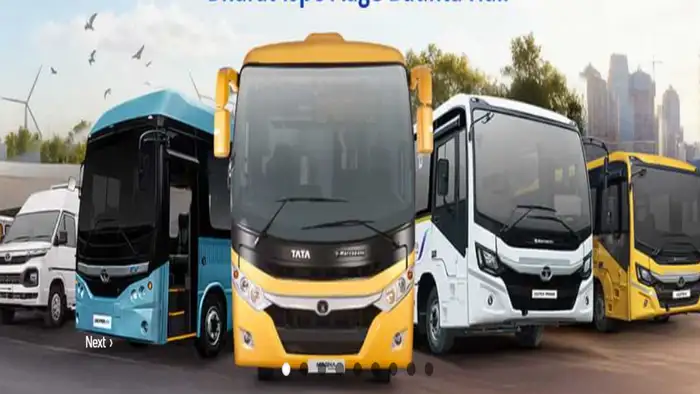

Tata Motors' subsidiary acquired a 26% stake in Mateshwari E-Smart Mobility for ₹2.60 lakh to anchor electric bus operations under TGSRTC, reflecting India's accelerating EV consolidation in 2026.
Tata Motors' subsidiary TML Smart City Mobility Solutions Limited (TSCMSL) acquired a 26% equity stake in Mateshwari E-Smart Mobility (Hyderabad) Private Limited (MEMHPL) for ₹2.60 lakh on September 28, 2026 — a transaction that, while modest in rupee terms, carries outsized strategic weight for India's electric commercial vehicle space.
The deal involved TSCMSL purchasing 26,000 equity shares at ₹10 per share from an existing shareholder of MEMHPL, making the Hyderabad-incorporated entity an associate company — and consequently a related party — of Tata Motors going forward, per the regulatory filing reported by EVreporter.
Here is a snapshot of how this transaction compares with other notable legacy OEM moves in India's electric mobility space in 2025–26:
| Event | OEM / Entity | Stake / Investment | Segment | Strategic Goal |
|---|---|---|---|---|
| TSCMSL acquires stake in MEMHPL (Sep 2026) | Tata Motors (via TSCMSL) | 26% for ₹2.60 lakh | Electric buses (O&M) | Lock in TGSRTC tender, expand urban mobility |
| Tata Motors eCV order book (Jun 2026) | Tata Motors | 3,400+ eCV orders | SCVs, trucks, buses | Scale zero-emission freight & passenger fleet |
| Maruti Suzuki e Vitara launch | Maruti Suzuki / Suzuki | Full product launch | Electric passenger SUV | Enter premium EV four-wheeler segment |
| Tata Sierra.ev launch | Tata Motors | ₹18.79 lakh intro price | Electric passenger SUV | Compete in lifestyle EV SUV segment |
| TSCMSL + Mateshwari Urban Transport Solutions JV | Tata Motors (via TSCMSL) | Tender consortium | Electric bus O&M (Telangana) | Win state-level public transport contracts |
India's legacy OEMs are no longer limiting their EV ambitions to a single vehicle category. Tata Motors is simultaneously pursuing urban bus contracts, heavy freight electrification, and lifestyle passenger EVs. Maruti Suzuki, through the e Vitara, is staking its claim in the four-wheeler EV segment. These strategies complement rather than compete with each other — and together they show how India's EV consolidation in 2026 is being driven by incumbents, not just startups.
What exactly did Tata Motors acquire, and why does it matter?
MEMHPL is a special-purpose entity incorporated on August 11, 2026 under the Companies Act, 2013, with an authorised and paid-up share capital of ₹10 lakh each, created specifically to undertake e-mobility business. Because the company was incorporated only weeks before the transaction closed, it had no historical turnover to disclose — a standard regulatory note in such filings.
TSCMSL, the acquiring entity, is a wholly owned subsidiary of Tata Motors that participates in tenders issued by municipal corporations for the operation and maintenance (O&M) of electric buses. This distinction matters: TSCMSL is not a vehicle manufacturer in the traditional sense, but an O&M operator — the entity that wins government contracts to run and maintain electric bus fleets on behalf of state transport undertakings.
By acquiring 26% of MEMHPL, Tata Motors is cementing its position in a consortium already awarded a tender for the operation and maintenance of electric buses under the Telangana State Road Transport Corporation (TGSRTC). The other consortium partner is Mateshwari Urban Transport Solutions Private Limited, the holding company of MEMHPL.
Why 26% and not a controlling stake? A 26% holding is the classic "blocking minority" threshold in Indian corporate law — it gives the holder veto rights over special resolutions (which require 75% approval) without the obligations of majority ownership. For Tata Motors, this structure keeps MEMHPL off its consolidated balance sheet while still giving TSCMSL meaningful governance influence over how the electric bus O&M contract is executed. It is also a low-capital-commitment way to test a new operating partner before deepening the relationship.
No government or regulatory approvals were required for the transaction, and Tata Motors confirmed it does not constitute a related-party transaction at the time of acquisition — though MEMHPL becomes a related party post-acquisition.
Why is Telangana a strategic market for electric bus O&M?
Telangana has been among the more aggressive Indian states in pushing electric public transport. TGSRTC has been running EV bus pilots and scaling up procurement, and the state's urban agglomeration — anchored by Hyderabad — represents one of India's highest-density intra-city commuter markets. Winning an O&M contract here strengthens Tata's bid credentials for similar tenders in Maharashtra, Karnataka, Tamil Nadu, and Rajasthan.
The O&M model is a service arrangement in which the operator — rather than the state transport undertaking — is responsible for day-to-day running, charging infrastructure management, driver deployment, and maintenance of the electric bus fleet, typically under a per-kilometre revenue contract. This model transfers operational risk to the private operator but also provides that operator with recurring, long-duration revenue streams relatively insulated from vehicle sales cycles.
For Tata Motors, which reported over 3,400 electric commercial vehicle orders across segments as of June 2026 — comprising approximately 2,000 SCVs and pick-ups, 900 trucks, and 500 buses — the O&M business is a logical downstream extension of its vehicle manufacturing dominance. Selling the bus is one revenue event; operating it for 10–12 years is a compounding annuity.
How does this fit into Tata Motors' broader EV commercial vehicle strategy?
Tata Motors (CV), demerged and listed separately in 2025, is India's largest commercial vehicle manufacturer and has been building what it describes as the widest portfolio of electric commercial vehicles in the country. The Tata Motors Corporate Presentation 2026 categorises its "non-cyclical business" as including international business, smart city mobility, non-vehicular business, digital business, and defence — a deliberate signal that the company wants revenue streams that do not move in lockstep with domestic vehicle demand cycles.
Smart city mobility — the segment that TSCMSL operates within — is explicitly named as a non-cyclical pillar. State transport tenders run on multi-year contract cycles, often 8–12 years, and revenue is tied to kilometres operated rather than vehicle sales. In a market where passenger vehicle EV demand can be lumpy, the O&M model provides a predictable cash flow buffer.
The eCV order book as of June 2026 breaks down as follows, per Business Standard:
- Small commercial vehicles and pick-ups (Ace Pro EV, Ace EV, Intra EV): ~2,000 units
- Trucks, including Ultra EV range (7–12T), Prima EV 55T tractor, Prima EV 28T tipper: ~900 units
- Buses (Starbus EV, Ultra EV buses): ~500 units
The bus segment, at roughly 15% of the order count, is the smallest numerically — but it is the segment where O&M contracts create the deepest customer lock-in. Once a state transport undertaking has standardised on Tata's Starbus EV platform and signed a 10-year O&M agreement with TSCMSL, switching costs become prohibitive. The MEMHPL stake acquisition is a competitive moat-building exercise as much as it is a financial transaction.
What does "EV consolidation" actually mean in the Indian context in 2026?
EV consolidation in India is the process by which larger, better-capitalised incumbents — whether legacy OEMs, conglomerates, or well-funded startups — absorb, partner with, or crowd out smaller players through scale advantages, government contract access, and space control.
In the two-wheeler EV space, this has been visible for the past two years: Ola Electric's market share has faced pressure from Bajaj's Chetak and TVS's iQube, while smaller players have struggled with after-sales infrastructure and FAME subsidy compliance. In the commercial vehicle space, consolidation is playing out through the tender space, where only entities with proven O&M track records, balance sheet depth, and OEM relationships can win large state contracts.
The MEMHPL acquisition exemplifies this commercial vehicle consolidation pattern. Mateshwari Urban Transport Solutions brings local operational knowledge, regulatory relationships, and ground-level execution capability in Telangana. TSCMSL brings Tata Motors' brand credibility, vehicle supply chain, and national tender experience. Neither could win the TGSRTC contract as effectively alone. The 26% stake formalises this symbiosis.
This pattern — large OEM taking a minority stake in a regional O&M specialist to jointly bid for state tenders — is likely to repeat across other states and other OEMs. Watch for similar structures from Olectra Greentech, PMI Electro Mobility, and JBM Auto as FAME III and PM e-Bus Sewa scheme tenders roll out through 2026 and 2027.
How does this compare to what's happening in the passenger EV segment?
While Tata Motors is consolidating its position in electric commercial mobility through O&M partnerships, the passenger EV segment is seeing a parallel but distinct consolidation — one driven by product launches rather than tender acquisitions.
The Maruti Suzuki e Vitara is the most consequential new entrant in India's four-wheeler EV market in 2026. Maruti's entry into electric passenger vehicles represents a different kind of consolidation: the country's largest passenger vehicle OEM by volume bringing its distribution network, service reach, and brand trust to a segment that Tata Motors' Nexon EV and Punch EV have dominated. The e Vitara's launch signals that the passenger EV market is graduating from early-adopter territory to mainstream consideration — the same trajectory that electric buses completed two to three years earlier.
Tata Motors is pursuing a dual-track EV strategy: competing in passenger EVs with the Nexon EV, Punch EV, and the newly launched Sierra.ev at ₹18.79 lakh, while simultaneously deepening its commercial EV moat through O&M contracts and minority stake acquisitions like MEMHPL. Maruti Suzuki, by contrast, is focused on the passenger segment with the e Vitara, leaving commercial EV territory largely to Tata, Olectra, and JBM.
For a consumer evaluating the best electric cars to buy in India in 2026, the competitive dynamic between Tata and Maruti in the passenger SUV space is the more immediately relevant story. The MEMHPL deal is a reminder that Tata's EV ambitions extend well beyond the showroom — and that its commercial vehicle O&M business could become a significant earnings contributor as India's public transport electrification scales up.
Is ₹2.60 lakh a meaningful investment, or is this a paper transaction?
The transaction's significance lies entirely in what it enables, not in the capital deployed. For a company with a market capitalisation of over ₹1.55 lakh crore and quarterly revenues of ₹17,626 crore as of June 2026, per Groww's stock data, ₹2.60 lakh is financially negligible.
What it enables is threefold. First, it gives TSCMSL a formal equity relationship with MEMHPL, which is necessary for the two entities to jointly operate under the TGSRTC tender without running into procurement or governance complications. Second, it establishes MEMHPL as an associate company of Tata Motors, which means Tata's auditors and board will have visibility into MEMHPL's operations — a governance safeguard when public money flows through the entity. Third, it creates a template. If the Telangana O&M contract performs well, TSCMSL can deepen its stake in MEMHPL or replicate the structure with other regional partners in other states.
The ₹10 per share face value and the ₹10 lakh paid-up capital of MEMHPL also signal something important: this company was purpose-built for this tender. It is a special-purpose vehicle in the classic infrastructure sense — created to hold a specific contract, ring-fence its liabilities, and allow multiple parties to participate with defined equity stakes. This is standard practice in Indian infrastructure and public transport contracting, and Tata Motors' familiarity with this structure reflects its maturity as an O&M operator.
What should EV buyers and investors watch for next?
Several near-term developments will determine whether this transaction is a one-off or the beginning of a more systematic expansion of Tata's O&M footprint.
First, watch the TGSRTC contract scope. The filing does not specify the number of buses or the contract duration. A 200+ bus, 10-year contract would be a material revenue contributor to TSCMSL. A smaller pilot would have more strategic than earnings value.
Second, watch for similar filings from TSCMSL in other states. The PM e-Bus Sewa scheme, which targets 10,000 electric buses across Indian cities, is generating a steady pipeline of tenders. Each tender is an opportunity for TSCMSL to replicate the MEMHPL playbook — find a credible local O&M partner, take a 26% blocking stake, and jointly bid.
Third, watch Tata Motors' non-cyclical revenue share. The Corporate Presentation 2026 explicitly calls out smart city mobility as a non-cyclical business pillar. If management begins breaking out O&M revenues separately in quarterly disclosures, it will signal that this segment has reached a scale where it warrants standalone investor attention.
For EV buyers, the more immediate implication is service depth. Tata's investment in O&M infrastructure — charging networks, driver training, maintenance protocols — for its commercial fleet eventually benefits its passenger EV customers too. The same technicians who maintain Starbus EV fleets build the institutional knowledge that improves Nexon EV and Punch EV service quality. If you are evaluating which electric SUV has the best after-sales service network in India, Tata's commercial EV depth is part of why its passenger EV service network tends to score well.
What does this mean for India's EV policy space?
The MEMHPL acquisition reflects India's relatively light-touch regulatory framework for minority stake acquisitions in private SPVs, even when those SPVs hold public contracts. No government or regulatory approvals were required for this transaction despite it involving a state transport corporation tender.
This means the consolidation of India's electric bus O&M market can happen quickly and with limited friction. A large OEM like Tata Motors can systematically acquire blocking minorities in regional O&M partners across multiple states without triggering competition commission scrutiny at this scale or requiring state government sign-off. The speed of this consolidation will depend primarily on how fast state governments issue tenders and how many credible regional O&M partners exist.
The Battery as a Service (BaaS) model, which is gaining traction in the passenger EV segment, has a commercial vehicle analogue in the O&M contract structure: in both cases, the customer pays for mobility as a service rather than owning the full asset stack. The MEMHPL deal is Tata's way of positioning itself as the preferred service provider in the commercial segment, just as BaaS providers are positioning themselves in the passenger segment.
The broader consolidation picture: who wins and who gets squeezed?
India's EV consolidation in 2026 is defined by a widening gap between entities that can access government tender pipelines and those that cannot. The TGSRTC tender that TSCMSL and Mateshwari Urban Transport Solutions won required not just a credible vehicle supply chain but also the financial standing, operational track record, and local relationships to satisfy state procurement criteria.
Smaller, independent electric bus operators without an OEM anchor are increasingly finding it difficult to compete. The capital requirements for electric bus O&M — upfront charging infrastructure, battery replacement reserves, working capital for per-kilometre contracts that pay in arrears — are substantial. An OEM-backed entity like TSCMSL can access Tata Motors' balance sheet and supplier relationships in ways that a standalone operator cannot.
This dynamic mirrors what happened in India's solar power O&M market a decade ago, where large conglomerates gradually crowded out smaller operators through scale and financing advantages. The electric bus O&M market appears to be on a similar trajectory, with Tata Motors, Olectra, and JBM Auto emerging as the likely dominant players by 2028.
For India's net-zero mobility goals, this consolidation is broadly positive — larger, better-capitalised operators are more likely to maintain fleet uptime, invest in charging infrastructure, and honour long-term service commitments. The risk is that consolidation reduces competitive pressure on pricing, making electric bus O&M contracts more expensive for state governments over time.
The MEMHPL acquisition, viewed in isolation, is a minor regulatory filing. Viewed in the context of Tata Motors' 3,400+ eCV order book, its explicit non-cyclical business strategy, and India's accelerating public transport electrification, it is a precise, low-cost move to secure a recurring revenue stream in one of India's fastest-growing EV markets — and a preview of the consolidation playbook that will reshape India's electric commercial vehicle space through the rest of the decade.
Sources
- Tata Motors Subsidiary Acquires 26% Stake in Mateshwari E-Smart Mobility • EVreporter
- Tata Motors Corporate Presentation 2026
- Tata Motors secures orders for over 3,400 eCVs across segments | Business Standard
- Tata Motors Share Price – Groww
- Tata Motors acquires stake in electric bus company – Economic Times Tamil
- Tata Motors launches Sierra.ev at introductory price of ₹18.79 lakh – EVreporter