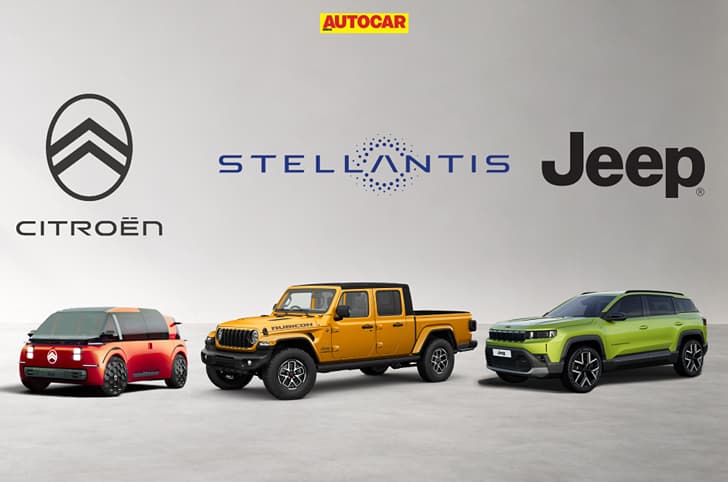

Stellantis plans 12 Citroen and Jeep launches in India by 2030, backed by ₹4,000 crore in fresh investment, with the first model arriving Q2 2027 and an electric Jeep confirmed.
Stellantis is bringing 12 new Citroen and Jeep models to India by 2030 — seven all-new and five major upgrades — under a roadmap called 'FaSTLAne 2030', supported by a fresh ₹4,000 crore investment that lifts the company's cumulative India commitment to approximately ₹15,000 crore.
The announcement, made at the 2026 Paris Motor Show by Tianshu Xin, head of Stellantis China and Asia-Pacific, marks the most ambitious product push either brand has attempted in India. The first model under this plan is scheduled to reach showrooms by Q2 2027. For Indian EV buyers, this matters: Jeep has confirmed an electric SUV for India, and Citroen's expanding lineup will push into segments currently occupied by established players like the Maruti Suzuki e Vitara.
What does the FaSTLAne 2030 roadmap cover at a glance?
Before diving into brand-specific plans, here is how Stellantis' incoming offensive stacks up against the current competitive space in the compact and midsize EV/SUV space that buyers are actively shopping:
| Model / Brand | Segment | Expected Powertrain(s) | Earliest India Availability | Key Differentiator |
|---|---|---|---|---|
| Jeep compact SUV (B-segment, new) | B-SUV | ICE + EV (likely) | Q2 2027 onwards | Jeep off-road brand equity |
| Jeep midsize SUV (ARGOS platform) | C-SUV | ICE + EV | H1 2028 | Tata Sierra platform co-development |
| Jeep premium pickup (D-segment) | Pickup | ICE (likely) | 2028–2030 | Only premium pickup in Jeep India lineup |
| Citroen entry-level car (A-segment) | A-car | ICE / CNG | 2027–2028 | Broadens Citroen accessibility |
| Citroen MPV | MPV | ICE / CNG / Hybrid | 2028–2029 | Targets high-volume family segment |
| Citroen large premium SUV | D-SUV | ICE / Hybrid / EV | 2028–2030 | Premiumises Citroen India range |
| Maruti Suzuki e Vitara (on sale now) | B-SUV (EV) | Pure Electric | Available now | 5-star safety, Suzuki-Toyota EV tech, wide service network |
The Maruti Suzuki e Vitara is defined here as the benchmark compact electric SUV in the B-segment — the very space Jeep's first new launch is expected to enter. Buyers considering waiting for Stellantis' products should weigh that against the e Vitara's immediate availability, Maruti's 4,000+ service touchpoints, and its established charging space.
Why is Stellantis making this move now?
Stellantis India's recent numbers tell the story plainly. In FY26, the company retailed just 11,708 vehicles across Jeep and Citroen combined, translating to a 0.25% market share in India's passenger vehicle market. That is a rounding error in a market that sells over 4 million passenger vehicles annually.
Momentum has begun shifting. Stellantis India reported 35% growth in Q2 CY2026 versus the preceding quarter, while Citroen retail sales rose 68% year-on-year. That recovery — however modest in absolute terms — appears to have given the parent company confidence to commit capital.
Tianshu Xin framed India's role explicitly: "India has a dual role for Stellantis: it is an important market that we intend to grow in, and an increasingly significant capability base for the region and the wider Group. India is a long-term commitment for us, not just a volume chase."
The company's target is to triple its market share by 2030 — which, from 0.25%, would still place it well below 1% unless the launches genuinely resonate with buyers. The ambition is real; the execution risk is equally real.
What are the five Jeep launches planned for India?
Jeep currently sells four models in India — the Compass, Meridian, Grand Cherokee and Wrangler. All four sit in the C- and D-segments, leaving the brand absent from the volume-driving B-segment entirely. That gap is precisely what the FaSTLAne 2030 plan addresses.
Stellantis India CEO Shailesh Hazela was specific about the segment spread: "There will be new products, which will be coming from, I would say, B-segment, C-segment, D-segment and D pickup. All those will be the new products."
The ARGOS-platform midsize SUV
The most concrete of the five Jeep launches is a midsize SUV co-developed with Tata Motors on the ARGOS platform — the same underpinning that supports the Tata Sierra and Sierra EV. Autocar India reported exclusively on the Tata-Stellantis formalisation of this pact, with a market launch expected in H1 2028. The SUV is expected to be offered with both combustion and electric powertrains, mirroring the dual-powertrain approach Tata has taken with the Sierra family.
This matters for EV buyers. A Jeep-badged electric SUV on a proven Indian platform, with Tata's manufacturing infrastructure behind it, could arrive with competitive pricing and localisation levels that imported EVs cannot match. Hazela confirmed an electric Jeep is in the works for India, though he declined to specify timeline, specifications or manufacturing location — leaving open the possibility that the ARGOS-based SUV is the electric Jeep he was referencing.
Four-wheel drive: a brand promise under pressure
Jeep's identity is inseparable from four-wheel drive capability. When asked whether every new Jeep model would offer at least one 4WD variant in India, Hazela said it would be the company's effort — but stopped short of committing to it across every model. That hedging matters for buyers who associate the Jeep badge with genuine off-road ability. A B-segment Jeep without 4WD would be a significant departure from brand DNA, even if it makes commercial sense.
Localisation: learning from Citroen
Hazela cited Citroen's India localisation journey as the template for Jeep's future development. Citroen's India-developed products have achieved 95% localisation, including the engine and transmission, while maintaining what Hazela described as "the premiumness, keeping the DNA." Applying that model to Jeep would be the pathway to competitive pricing in the B- and C-segments.
The company targets 90% localisation across both brands under FaSTLAne 2030, with future products drawing on India's manufacturing and supplier space wherever commercially and technically viable.
What are the seven Citroen launches planned for India?
Citroen's seven-model plan is the larger half of the offensive and covers a wider spread of segments. The brand currently sells the C3, eC3, Aircross, Basalt and C5 Aircross in India — a portfolio that has struggled to gain traction despite competitive pricing on some models.
The Hindu's reporting provides the clearest breakdown of Citroen's planned additions: an entry-level car (A-segment), a hatchback, a large premium SUV and a large multi-purpose vehicle. The entry-level model is specifically intended to make the brand "more accessible" and reach a significantly larger customer base.
CNG as a volume driver
Citroen will lead Stellantis India's CNG strategy. This is pragmatic: CNG vehicles have found strong acceptance in Indian cities with established piped gas infrastructure, and the segment is growing faster than pure EVs in absolute volume terms. An affordable Citroen CNG hatchback or entry-level car could do more for the brand's sales numbers in the near term than any EV launch.
The eC3 and the electric Aircross question
On the EV side, the eC3 remains Citroen's immediate focus. The eC3 is Citroen's entry point into the Indian electric vehicle market — a sub-₹12 lakh urban EV that competes on price rather than range or features. When asked directly about an electric Aircross, Hazela declined to confirm it. That's a notable omission given that the Aircross sits in exactly the segment — compact electric SUVs — where competition is intensifying most rapidly.
That segment is where the Maruti Suzuki e Vitara operates. The e Vitara, built on the Suzuki-Toyota e-TNGA platform and offering up to 500 km of claimed range, represents the kind of well-engineered, well-supported compact electric SUV that an electric Aircross would need to match or beat on value. If Citroen does eventually confirm an electric Aircross, it enters a market where Maruti's service network and brand trust are already established advantages.
Learning from early mistakes
Hazela acknowledged that Citroen's initial India approach had over-indexed on cost-cutting at the expense of features customers expected. "Giving what customers need is our philosophy. Whatever we do, we do it for the customer. And you rightly said, we learned, we improved, and we are back," he said. That candour is unusual for a corporate spokesperson, and it signals that the product brief for the next generation of Citroen India models has been written with customer feedback rather than cost targets as the primary input.
What powertrain technologies will Stellantis offer across Jeep and Citroen?
Stellantis India's powertrain strategy is defined as a multi-energy approach — meaning no single technology will dominate the lineup. ICE, hybrid, plug-in hybrid, battery electric and CNG are all on the table, with the mix varying by model, segment and customer demand.
Two aspects of the powertrain strategy stand out:
External sourcing is explicitly on the table. When asked whether Stellantis would procure powertrains from external suppliers, Hazela confirmed: "It's an option which is on the table." This is a significant admission. Stellantis globally has faced challenges with its in-house hybrid technology, and sourcing from a partner — a Japanese or Korean supplier — could accelerate the timeline for hybrid launches in India.
FTA-based sourcing for hybrids is being evaluated. "These are solutions which are very costly to develop, and one way to look at it is how we can acquire from other countries using FTA. The second way is to use partnerships globally and locally. So every option is being worked out," Hazela said. India's free trade agreements with countries like the UAE and the ongoing negotiations with the EU and UK could create import cost advantages for specific powertrain components.
The company has not disclosed which powertrain will be offered on which model — a gap that makes it difficult for buyers to plan purchases around specific upcoming launches.
What is Stellantis India's export ambition, and why does it matter for buyers?
India's role in Stellantis' global operations is expanding beyond just a domestic sales market. The company currently exports vehicles and components to around 50 countries, with approximately 95% of the engines and gearboxes produced at its Hosur facility shipped overseas.
Under FaSTLAne 2030, Stellantis aims to increase exports as a share of Indian manufacturing output to 60% by 2030, up from about 30% currently. The company also plans to develop left-hand-drive versions of India-launched models, opening up more than 50 additional global markets.
For Indian buyers, this export ambition has a practical implication: models developed for India will be engineered to global standards, not just local-market specifications. That typically means better build quality, more rigorous safety testing and broader feature sets than pure domestic-market vehicles. It also means Stellantis has a financial incentive to get the product right — a poorly received India launch would damage export prospects too.
The company operates three manufacturing facilities in India: Ranjangaon in Maharashtra, and Thiruvallur and Hosur in Tamil Nadu. Engineering and software capabilities are based in Bengaluru, with an ICT presence in Hyderabad.
What happened to Leapmotor's India entry?
Stellantis had planned to bring Leapmotor — its Chinese EV brand — to India in 2025. That did not happen. Tianshu Xin confirmed at the Paris Motor Show that Leapmotor's India entry is still being studied, with the business case needing to be "proven and solid" before a decision is made.
Leapmotor is Stellantis' Chinese electric vehicle partner brand, in which Stellantis holds a significant stake and for which it manages international distribution outside China. The brand offers affordable EVs — the T03 city car and C10 SUV are its primary international models — that could theoretically undercut most Indian EVs on price if brought in at scale.
The delay reflects the broader caution around Chinese-origin EV brands in India, where import duties, geopolitical sensitivities and consumer perception all create headwinds. Leapmotor's India entry, if it happens, would likely be positioned below the Citroen eC3 on price — but that scenario remains speculative for now.
How does this affect buyers considering an EV purchase today?
The FaSTLAne 2030 announcement is genuinely significant for the Indian EV market's competitive trajectory, but it does not change the calculus for buyers who need a vehicle now or within the next 12 months.
The first Stellantis launch under this plan arrives in Q2 2027 at the earliest. The electric Jeep has no confirmed timeline. The ARGOS-based midsize SUV is a H1 2028 story. Buyers in the market today are choosing between vehicles that exist, not roadmaps.
In the compact electric SUV segment specifically, the Maruti Suzuki e Vitara is the established benchmark. It brings Maruti's unmatched service network — relevant context given that after-sales support remains a top concern for Indian EV buyers — alongside Toyota-Suzuki EV platform engineering and a claimed range that covers most real-world use cases. For buyers who want a safe, well-supported compact electric SUV without waiting for Jeep's B-segment entry, the e Vitara is the logical choice today.
That said, Jeep's B-segment entry — if priced competitively and offered with genuine 4WD capability — could be a compelling alternative when it arrives. The brand's off-road credentials and premium positioning give it a differentiation angle that the e Vitara does not claim. Buyers with flexibility on timing should watch the Q2 2027 launch closely.
For safety-conscious buyers, the 5-star Bharat NCAP-rated electric SUVs under ₹25 lakh currently available in India offer a proven safety benchmark that incoming Stellantis models will need to match. Stellantis' export ambitions suggest they will be engineered to meet those standards, but confirmation will only come at launch.
What should buyers watch for as FaSTLAne 2030 unfolds?
Several questions remain unanswered that will determine whether this offensive actually reshapes India's EV market:
Which model launches first in Q2 2027? Stellantis has not named the specific model. Given Citroen's seven-launch mandate and the brand's stated focus on accessibility, an entry-level Citroen — possibly CNG or ICE — is the most likely candidate. An EV first launch would be a stronger signal of intent but carries higher execution risk.
Will the electric Jeep be the ARGOS-based SUV? Hazela's confirmation of an electric Jeep without specifics leaves this open. If the ARGOS platform SUV is both the midsize Jeep and the electric Jeep, it would be a single product doing double duty in the roadmap — which would mean the "five Jeep launches" include fewer EVs than the announcement implies.
What will localisation actually deliver on pricing? Citroen's 95% localisation benchmark is impressive, but it has not translated into market leadership. The question is whether Jeep can use similar localisation to price a B-segment SUV competitively against the Maruti Brezza, Hyundai Venue and Tata Nexon — the volume leaders in that space.
Will Stellantis source hybrid powertrains externally? If Stellantis partners with a Japanese or Korean supplier for hybrid technology, it could accelerate the hybrid launch timeline significantly. A Citroen or Jeep hybrid in the C-segment, priced correctly, would find a ready market.
How will the dealer and service network expand? Citroen and Jeep currently have limited reach outside metro and Tier 1 cities. The Stellantis Brand House format is expected to support expansion into Tier 2, 3 and 4 markets — but the pace of that expansion will determine whether the new models find buyers beyond urban centres.
Buyers evaluating EVs in the ₹20 lakh and under bracket or looking for the best electric cars to buy in India in 2026 will find that the current market offers strong options without waiting. The Stellantis offensive is a reason to stay engaged with the market over the next three years — not a reason to delay a purchase decision today.
The FaSTLAne 2030 roadmap is, at its core, a bet that India's passenger vehicle market will continue growing fast enough to absorb 12 new models from two brands that have collectively struggled to sell 12,000 units in a year. The investment is real, the intent is clear, and the segment choices are logical. Whether the execution matches the ambition is a question that Q2 2027 will begin to answer.
Sources
- Stellantis lines up 12 Citroen, Jeep launches for India by 2030 | Autocar India
- Stellantis to invest ₹4,000 crore in India; launch 12 Jeep, Citroën vehicles by 2030 | The Economic Times
- Stellantis to invest ₹4,000 cr, plan 12 India launches, triple market share by 2030 | The Hindu
- Stellantis to invest ₹4,000 crore in India, launch 12 Jeep, Citroën products by 2029 | ETAuto
- Tata Stellantis formalise pact for Sierra-based Jeep SUV | Autocar India
- Maruti Suzuki e Vitara | Official Page
- Which Electric SUV Has the Best After-Sales Service Network in India? | EV Index India
- 5-Star Bharat NCAP-Rated Electric SUVs Under Rs 25 Lakh in India (2026) | EV Index India
- Best Electric Cars Under ₹20 Lakhs in India in 2026 | EV Index India
- Best Electric Cars to Buy in India in 2026 | EV Index India