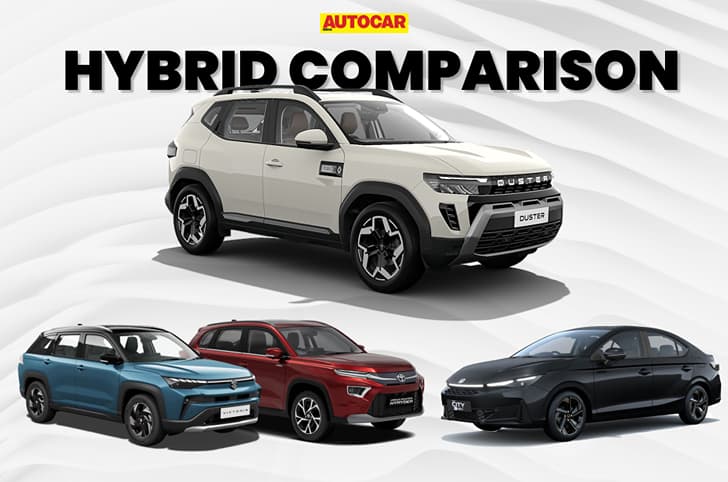

Renault Duster Strong Hybrid E-Tech 160 launched October 17, 2026 at ₹16.99 lakh, delivering 160 PS, 29 km/l ARAI mileage, and 80% electric city driving without a charging plug.
Renault Duster Strong Hybrid Launch in India 2026: How Petrol-Electric Power Reshapes the Mid-Size SUV Market
The Renault Duster Strong Hybrid E-Tech 160 launched in India on October 17, 2026, at a starting price of ₹16.99 lakh — making it the fourth mid-size SUV in India to offer a strong hybrid powertrain, joining the Maruti Grand Vitara, Maruti Victoris, and Toyota Urban Cruiser Hyryder. With a claimed ARAI mileage of 29 km/l and a 0–100 km/h sprint time of 9.61 seconds, it is positioned as the most powerful and fuel-efficient strong hybrid in the segment.
Here is how the Duster hybrid stacks up against every strong hybrid mid-size SUV currently on sale — plus the Maruti Suzuki e Vitara, which takes the segment's all-electric route:
| Model | Hybrid/EV System | Combined Power | Battery Size / Voltage | ARAI Mileage / Range | Starting Price (approx.) |
|---|---|---|---|---|---|
| Renault Duster E-Tech 160 | 1.8L 4-cyl + 2 e-motors | 160 PS | 1.4 kWh / 247V | 29 km/l | ₹16.99 lakh |
| Maruti Grand Vitara (Hybrid) | 1.5L 3-cyl + e-motor | 116 PS | 0.60 kWh / 177.6V | 27.97 km/l | ~₹17.99 lakh |
| Maruti Victoris (Hybrid) | 1.5L 3-cyl + e-motor | 116 PS | 0.60 kWh / 177.6V | 28.65 km/l | ~₹18.49 lakh |
| Toyota Urban Cruiser Hyryder (Hybrid) | 1.5L 3-cyl + e-motor | 116 PS | 0.60 kWh / 177.6V | 27.97 km/l | ~₹19.69 lakh |
| Honda City e:HEV | 1.5L 4-cyl + e-motor | 126 PS | N/A / 172.8V | 27.13 km/l | ~₹20.99 lakh |
| Maruti Suzuki e Vitara | Full Battery Electric | ~144 PS (est.) | ~49 kWh (est.) | ~500 km (est. ARAI) | ~₹19.99 lakh |
Sources: Autocar India spec comparison; Autocar India Duster page; New Indian Express launch report. e Vitara figures are indicative estimates pending official India launch data.
The table reveals a clear pattern: the Duster hybrid enters with more power, a bigger battery, and a higher-voltage architecture than its Toyota-platform rivals — at a price that undercuts them. The Maruti Suzuki e Vitara occupies a different category altogether, offering zero-tailpipe emissions but requiring access to a charging network.
What exactly is the Renault E-Tech strong hybrid system?
A strong hybrid is a powertrain where the electric motor is powerful enough to propel the vehicle independently at low speeds without assistance from the internal combustion engine. This distinguishes it from a mild hybrid, where the electric component only assists the engine and cannot drive the wheels alone.
The Renault E-Tech strong hybrid combines a naturally aspirated 1,789cc four-cylinder petrol engine with two electric machines — a 20 PS high-voltage starter-generator and a 49 PS traction motor — supported by a 1.4 kWh, 247V lithium-ion battery pack. Combined system output is 160 PS, and the traction motor alone produces 208 Nm of peak torque.
What sets the E-Tech architecture apart from the Toyota THS (Thermal Hybrid System) used in the Grand Vitara, Victoris, and Hyryder is the transmission. Renault's multi-mode automatic gearbox uses fixed gear ratios — two gears for the electric motor and four for the petrol engine — creating an 8-speed combination in hybrid mode. Toyota's system uses a continuously variable eCVT with a power-split device for a step-free driving feel. The Duster's gearbox will feel more like a conventional automatic, with perceptible gear changes as the system transitions between six operating modes: all-electric, petrol-only, series hybrid, series-parallel hybrid, and two others managed automatically by the car's control unit.
Renault traces this system's lineage to Formula 1 technology — the multi-mode gearbox concept of managing energy flow through discrete ratios rather than a continuous split is a principle applied from motorsport. The company has sold over one million E-Tech strong hybrid vehicles worldwide since 2020, providing a proven global track record before the India introduction.
The Duster hybrid does not require external charging. The battery replenishes through regenerative braking and via the petrol engine acting as a generator in series-hybrid mode. This is a fundamental distinction from a plug-in hybrid (PHEV), which needs a charging point to maximise electric range.
How does the Duster hybrid's fuel efficiency compare with rivals?
The ARAI-certified mileage of 29 km/l is the highest claimed figure in the mid-size SUV hybrid segment. For context:
- Maruti Victoris hybrid: 28.65 km/l
- Maruti Grand Vitara hybrid: 27.97 km/l
- Toyota Hyryder hybrid: 27.97 km/l
- Honda City e:HEV: 27.13 km/l
This translates to a theoretical fuel cost advantage of roughly ₹1–1.5 per kilometre over the Toyota-platform hybrids at current petrol prices, though real-world numbers will depend heavily on traffic density, ambient temperature, and driving style. ARAI figures are measured under controlled laboratory conditions and typically exceed real-world returns by 20–30% for hybrid vehicles.
Renault claims the Duster hybrid can cover up to 80% of city drives in pure electric mode. In stop-and-go urban traffic, the petrol engine stays off more frequently, regenerative braking recovers energy that would otherwise be lost as heat, and the electric motor handles low-speed acceleration without burning fuel. On highways, where speeds are sustained and the petrol engine is needed continuously, the efficiency advantage over a conventional petrol SUV narrows considerably.
Renault also claims fuel savings of up to 29% compared to diesel — positioning the hybrid directly against diesel buyers, who have historically dominated the ₹17–20 lakh SUV price band. Francisco Hidalgo, Vice President of Sales and Marketing at Renault Group India, noted that nearly half of all diesel vehicles in the Duster's segment are sold in the ₹17–20 lakh band, and that figure rises to over 90% for diesel automatics. The Duster hybrid enters at ₹16.99 lakh, squarely targeting that buyer.
Why does the Duster hybrid's larger battery matter?
Battery size in a strong hybrid determines how long and how often the system can run in pure electric mode before the petrol engine needs to intervene. The Duster's 1.4 kWh, 247V battery is more than twice the capacity of the 0.60 kWh, 177.6V unit used in the Grand Vitara, Victoris, and Hyryder. The higher voltage also means the system can deliver and recover energy more efficiently.
A larger battery buffer allows the Duster's electric motor to handle more of the driving cycle independently — particularly during the initial acceleration phase from a standstill, where the petrol engine is least efficient. It also means the regenerative braking system has more headroom to capture energy during deceleration before the battery reaches full charge and the system has to discard that energy as heat.
The trade-off is packaging. A larger battery takes up more space and adds weight. Renault has managed this within the Duster's 518-litre boot and 212mm ground clearance, though the company has not published the hybrid variant's kerb weight separately.
How does the Duster hybrid's transmission feel compared to the Toyota eCVT?
The Grand Vitara, Victoris, and Hyryder all use Toyota's eCVT — a continuously variable transmission combined with a planetary power-split device that blends engine and motor output smoothly. The result is a smooth, linear acceleration feel with no perceptible gear shifts, though some drivers find the engine's tendency to rev independently of road speed (a characteristic of CVT operation) disconcerting.
The Duster's multi-mode automatic uses fixed gear ratios, which means engine rpm rises and falls more predictably with vehicle speed, similar to a conventional automatic gearbox. Gear changes are perceptible. Renault argues this makes the driving experience feel more intuitive and engaging, particularly for buyers who find the CVT's rubber-band sensation off-putting.
Neither approach is objectively superior — it is a matter of preference. Autocar India notes that real-world driving impressions of the Duster hybrid are yet to be published at the time of launch, so definitive judgements on refinement and smoothness will have to wait for road tests.
Is the Duster hybrid faster than other mid-size SUVs?
Yes, by a significant margin on paper. Renault claims a 0–100 km/h time of 9.61 seconds for the Duster hybrid, which it says makes it the quickest in the segment. The Toyota-platform hybrids in the Grand Vitara, Victoris, and Hyryder produce 116 PS combined — 44 PS less than the Duster's 160 PS system.
The Duster's traction motor alone produces 208 Nm of peak torque, available from zero rpm in the way electric motors deliver power. This means the initial surge from a standstill is strong, even before the petrol engine joins in. Combined torque for the full system has not been officially disclosed by Renault at launch.
For buyers who prioritise driving dynamics alongside fuel efficiency, the Duster hybrid makes a compelling case. The 1.3-litre turbo-petrol Duster (163 PS, 280 Nm) remains available for those who want outright performance without the hybrid system's complexity.
What full-vehicle package does the Duster hybrid offer?
Beyond the powertrain, the Duster hybrid inherits the full-generation Duster's specification sheet, which is competitive for the segment. Key highlights from Autocar India's road test findings:
Practicality: A 518-litre boot is among the largest in the mid-size SUV segment. The 212mm ground clearance is well-suited to Indian road conditions. The 2,657mm wheelbase is adequate for a five-seater, though Autocar India notes the rear cabin is not as spacious as some rivals when three passengers share the back seat.
Safety: Five-star Bharat NCAP crash-test rating, six airbags, electronic stability control, tyre pressure monitoring, and Level 2 ADAS on equipped variants. If safety ratings are a priority in your shortlist, our guide to 5-star Bharat NCAP-rated electric SUVs under ₹25 lakh provides useful context on how the Duster's rating compares across the broader segment.
Technology: 10.1-inch touchscreen with wireless Android Auto and Apple CarPlay, Google built-in services on equipped variants, Arkamys audio system, and a 360-degree camera on higher trims.
Comfort: Panoramic sunroof, ventilated and electrically adjustable front seats, dual-zone climate control, wireless phone charger, and a powered tailgate — all on equipped variants.
One notable omission: a spare tyre is not standard on petrol variants. The hybrid's specification on this point has not been confirmed separately.
How does the Duster hybrid compare with the Maruti Suzuki e Vitara's full-electric approach?
This is the central strategic question for buyers in the ₹17–22 lakh mid-size SUV bracket in late 2026. The Maruti Suzuki e Vitara is a battery electric vehicle (BEV) — it runs entirely on electricity stored in an onboard battery pack, produces zero tailpipe emissions, and requires charging at a home wallbox or public charging station. The Duster Strong Hybrid E-Tech 160 combines petrol and electric power, charges its battery through driving and regenerative braking, and never needs to be plugged in.
The choice between these two powertrain philosophies comes down to three practical variables: charging infrastructure access, daily driving range, and total cost of ownership.
Charging infrastructure: India's public fast-charging network has expanded rapidly, but coverage outside major metros and state highways remains uneven. For buyers in Tier-2 cities, smaller towns, or apartment complexes without dedicated parking, installing a home charger is not always straightforward. The Duster hybrid eliminates this concern entirely — you refuel at any petrol station, exactly as you would with a conventional car. Our article on best electric cars for long trips in India in 2026 explores how BEV range anxiety plays out on intercity routes, which is relevant context for e Vitara buyers.
Daily driving range: The e Vitara's estimated ARAI range of around 500 km (pending official India figures) means most urban buyers would charge once every few days. The Duster hybrid's 29 km/l efficiency with a standard petrol tank translates to a theoretical range of over 700 km per fill, with no range anxiety whatsoever.
Total cost of ownership: Electricity is cheaper per kilometre than petrol in most Indian cities, giving the e Vitara a running-cost advantage for buyers who can charge at home overnight. The Duster hybrid's 29 km/l efficiency narrows this gap significantly compared to a conventional petrol SUV, but it does not eliminate it. On the other hand, the e Vitara carries a higher purchase price premium and potential battery replacement costs over a longer ownership horizon.
The Duster hybrid's appeal is precisely its lack of compromise. It delivers meaningfully better fuel efficiency than a petrol SUV, requires no change in refuelling behaviour, and costs less upfront than a full EV. For buyers who are genuinely interested in reducing fuel bills and emissions but are hesitant about committing to EV infrastructure — whether because of where they live, how far they drive, or simply uncertainty about resale values — the Duster hybrid offers a credible middle path.
This is not a knock on the e Vitara. For buyers with home charging access and predominantly urban driving patterns, a BEV like the e Vitara makes strong financial and environmental sense. The two vehicles represent different answers to the same question: how do you reduce dependence on petrol in a market where EV infrastructure is still maturing?
What is the broader market context for hybrid SUVs in India?
The Duster hybrid arrives at a moment of genuine momentum for strong hybrids in India. Strong hybrid sales more than doubled in the first quarter of FY2026, with 26,460 units sold between April and June 2025 — up 118% year-on-year from 12,111 units. This growth is driven by buyers who want better fuel efficiency than a petrol car but are not yet ready to commit to a full EV.
The mid-size SUV segment is now the most powertrain-diverse in the Indian market. Autocar India notes that the only major powertrain type currently absent from the segment is a plug-in hybrid (PHEV). Petrol, CNG, diesel, strong hybrid, and full electric are all represented. Looking ahead:
- Hyundai Creta is expected to adopt a hybrid powertrain in its next generation, due in 2027.
- Kia Seltos is set to follow with a hybrid option.
- Tata Sierra's ARGOS platform is hybrid-ready, giving Tata the flexibility to introduce a hybrid version in the future.
- Volkswagen and Skoda are working on hybrid mid-size SUVs for India.
The Duster hybrid's launch is therefore part of a broader industry shift. Renault's futuREady India roadmap plans a portfolio of seven models by the end of the decade, spanning compact cars to larger SUVs, with both strong hybrids and full EVs. The company also targets 2 billion euros (approximately ₹25,000 crore) in annual exports from India by 2030, including vehicles, components, and associated services — a signal that India is being positioned as a manufacturing and export hub, not just a sales market.
Who should buy the Renault Duster Strong Hybrid, and who should look elsewhere?
The Duster hybrid is best suited to five buyer profiles:
Diesel switchers: Renault's own data shows diesel automatics dominate the ₹17–20 lakh band. The hybrid's 29 km/l efficiency, smooth automatic gearbox, and ₹16.99 lakh entry price make it a direct and compelling alternative. The claimed 29% fuel saving over diesel is significant if it holds in real-world conditions.
City commuters who want efficiency without a plug: If you cover 40–60 km daily in urban traffic, the Duster hybrid's ability to run in electric mode for up to 80% of city drives could translate to genuinely low fuel bills without any charging infrastructure requirement.
Performance-conscious hybrid buyers: At 160 PS and a claimed 9.61-second 0–100 km/h time, the Duster hybrid is the quickest strong hybrid in the mid-size SUV segment. If you want efficiency and pace, the Toyota-platform alternatives at 116 PS are noticeably slower.
Buyers who want a proven global platform: With over one million E-Tech strong hybrid vehicles sold worldwide since 2020, the powertrain is not a first-generation experiment. Renault has refined it across multiple European models before bringing it to India.
Long-distance travellers who want peace of mind: The combination of high fuel efficiency and conventional petrol refuelling means no range anxiety on highway runs — a genuine advantage over a BEV on routes where fast chargers are sparse.
The Duster hybrid is less suited to buyers who need maximum rear-seat space (the Creta and Seltos offer more room), those who want a diesel engine (Renault has ruled out diesel for India), or those who are ready to go fully electric and have home charging access — in which case the Maruti Suzuki e Vitara or another BEV from our best electric cars to buy in India in 2026 guide may be a better fit.
What are the Duster hybrid's key specifications at a glance?
| Specification | Detail |
|---|---|
| Engine | 1,789cc naturally aspirated 4-cylinder petrol |
| Electric motors | 20 PS starter-generator + 49 PS traction motor |
| System power | 160 PS |
| Traction motor torque | 208 Nm |
| Battery | 1.4 kWh, 247V lithium-ion |
| Transmission | Multi-mode automatic (2 motor gears + 4 engine gears) |
| ARAI mileage | 29 km/l |
| 0–100 km/h | 9.61 seconds (Renault claim) |
| Ground clearance | 212mm |
| Boot space | 518 litres |
| Wheelbase | 2,657mm |
| Safety | 5-star Bharat NCAP, 6 airbags, Level 2 ADAS |
| Starting price | ₹16.99 lakh (ex-showroom) |
| External charging | Not required |
Source: Autocar India; ETAuto; New Indian Express
What should buyers watch for before making a final decision?
Real-world fuel efficiency data is the most important missing piece. ARAI figures are measured under controlled conditions and rarely reflect everyday driving. The Toyota-platform hybrids in the Grand Vitara, Victoris, and Hyryder have been on sale long enough to generate substantial owner data — real-world returns typically fall in the 18–22 km/l range in mixed driving, compared to their 27–28 km/l ARAI claims. If the Duster hybrid follows a similar pattern, its real-world advantage over rivals may be narrower than the certified figures suggest.
The multi-mode gearbox's refinement in real-world traffic is also unverified at launch. Autocar India has not yet published a road test at the time of this article. The gear-shift behaviour under hard acceleration, the smoothness of transitions between electric and petrol modes, and noise levels at highway speeds are all questions that will be answered once independent road tests are available.
Variant-level pricing beyond the ₹16.99 lakh base has not been fully detailed. The Duster range runs from ₹12.17 lakh to ₹22.61 lakh across all powertrain options, and the hybrid's top variant price will determine whether the panoramic sunroof, Level 2 ADAS, 360-degree camera, and ventilated seats are accessible at a reasonable premium.
For buyers evaluating the Duster hybrid against the Maruti Suzuki e Vitara or other EVs, our guide to battery as a service schemes in India is worth reading — it explains how some EV makers are reducing the upfront cost barrier that makes hybrids look more attractive on paper.
The Duster Strong Hybrid E-Tech 160 is a genuinely significant arrival. It brings more power, a larger battery, and a higher-voltage architecture than any existing strong hybrid mid-size SUV in India, at a price that directly targets diesel buyers. Whether its real-world efficiency and refinement match the promise of its specifications will determine whether it reshapes the segment or merely adds another credible option to an already competitive field.
Sources
- New Renault Duster hybrid vs midsize cars spec comparison | Autocar India
- Renault Duster (2026) - Price, Mileage & Expert Reviews | Autocar India
- Renault Duster hybrid launch on October 17 | Autocar India
- Renault opens bookings for Duster hybrid ahead of October 17 launch | ETAuto
- Renault launches Duster Strong Hybrid at Rs 16.99 lakh | New Indian Express
- Best Electric Cars for Long Trips in India in 2026 | EV Index India
- Best Electric Cars to Buy in India in 2026 | EV Index India
- Which Electric Cars Offer Battery as a Service (BaaS) in India? | EV Index India
- 5-Star Bharat NCAP-Rated Electric SUVs Under Rs 25 Lakh in India (2026) | EV Index India