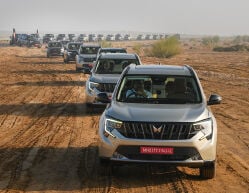

The XUV 7XO scored 30.76/32 (AOP) and 44.97/49 (COP) in Bharat NCAP tests, earning 5 stars — the highest rating available — across all variants.
Mahindra XUV 7XO Earns 5-Star Bharat NCAP Rating in India 2026: What It Means for Premium EV SUV Safety
The Mahindra XUV 7XO earned a 5-star Bharat NCAP safety rating in September 2026, scoring 30.76 out of 32 points in Adult Occupant Protection (AOP) and 44.97 out of 49 points in Child Occupant Protection (COP) — placing it among the highest-scoring mid-size SUVs ever tested under India's national crash assessment programme. Bharat NCAP tested the 7-seater AX7 diesel automatic FWD and AWD variants, but the rating applies to every variant in the XUV 7XO lineup.
For buyers weighing premium mid-size SUV options in 2026, this result matters. It confirms that the XUV 7XO's structural and electronic safety systems hold up under standardised crash conditions — not just on paper. It also sets a concrete benchmark against which rivals, including the Maruti Suzuki e Vitara, must be measured.
Quick Safety Comparison: XUV 7XO vs Key Mid-Size SUV Rivals (2026)
| Model | BNCAP AOP Score | BNCAP COP Score | BNCAP Star Rating | Standard Airbags | Level 2 ADAS | Price Range (ex-showroom) |
|---|---|---|---|---|---|---|
| Mahindra XUV 7XO | 30.76 / 32 | 44.97 / 49 | ⭐⭐⭐⭐⭐ | 6 (7 on higher variants) | Yes — 17 functions with Sense+ | ₹13.99 – ₹25.79 lakh |
| Mahindra Thar ROXX | 31.09 / 32 | 45 / 49 | ⭐⭐⭐⭐⭐ | 6 | Yes — Level 2 | ₹12.99 – ₹22.49 lakh (approx.) |
| Mahindra XUV400 (EV) | 30.38 / 32 | 43 / 49 | ⭐⭐⭐⭐⭐ | 6 | No | ₹15.49 – ₹19.49 lakh (approx.) |
| Maruti Suzuki e Vitara | Not yet rated (BNCAP) | Not yet rated (BNCAP) | Pending | 6 | Yes — basic Level 2 | ₹17.49 – ₹22.49 lakh (approx.) |
The Maruti Suzuki e Vitara is the most direct electric rival to the XUV 7XO in the mid-size SUV space. While it arrives with 6 airbags and a basic Level 2 ADAS suite, it has not yet received a Bharat NCAP crash test rating as of September 2026. Buyers who treat a verified crash test score as a non-negotiable should factor this gap into their decision. For more on which electric SUVs have earned verified 5-star ratings, see our guide to 5-star Bharat NCAP electric cars in India 2026.
What is Bharat NCAP and why does a 5-star rating matter?
Bharat NCAP is India's official new car assessment programme, established under the Ministry of Road Transport and Highways, that evaluates passenger vehicles through standardised crash tests and awards star ratings from 1 to 5 based on occupant protection performance. A 5-star rating represents the highest level of protection achievable under the programme's current assessment criteria.
Under the current BNCAP framework, a 5-star AOP rating requires a minimum of 27 points out of 32, and a 5-star COP rating requires a minimum of 41 points out of 49. The XUV 7XO's scores of 30.76 and 44.97 sit well above both thresholds — not just clearing the bar, but doing so with meaningful headroom.
This distinction matters. A car that scrapes a 5-star rating with 27 AOP points is technically equivalent to one scoring 31 points in terms of the badge it wears, but the underlying protection levels differ significantly. The XUV 7XO's scores place it in the upper tier of 5-star performers, not at the floor.
The programme tests production-specification vehicles purchased from dealerships or supplied by manufacturers, and the rating applies to all variants of the tested model — not just the specific trim that was crash-tested. Bharat NCAP tested the AX7 diesel automatic FWD and AWD variants, confirming that the 5-star result extends across the entire XUV 7XO range.
How did the XUV 7XO perform in each crash test?
Adult Occupant Protection: 30.76 out of 32
The AOP assessment comprises two primary tests: a frontal offset deformable barrier test and a side-movable deformable barrier test, with an additional side pole impact evaluation.
In the frontal offset deformable barrier test, the XUV 7XO scored 14.76 out of 16 points. The driver's head, neck, pelvis, thighs, and feet all received 'good' protection ratings — the highest category. The chest and tibia were rated 'adequate', indicating some load transfer in those regions but within acceptable limits. The co-driver received similarly strong results, with only the tibiae rated 'adequate' rather than 'good'.
The side-movable deformable barrier test produced a perfect score: 16 out of 16 points. Every critical body region — head, chest, abdomen, and pelvis — received 'good' protection. This is the most demanding real-world crash scenario for side impacts, simulating a vehicle being struck laterally at speed. A clean sweep here reflects the quality of the XUV 7XO's side curtain airbags and door structure.
The side pole impact test — which simulates a vehicle striking a narrow fixed object such as a tree or pole — received an 'OK' rating, the middle category in BNCAP's assessment scale.
Child Occupant Protection: 44.97 out of 49
The COP assessment is divided into three components: a dynamic crash score (24 points maximum), a child restraint system (CRS) installation score (12 points maximum), and a vehicle assessment score (13 points maximum).
The XUV 7XO's dynamic child protection score was 23.97 out of 24 — near-perfect. Both the 18-month-old and 3-year-old child dummies were placed in rearward-facing child seats in the second row. The 18-month-old dummy scored 7.97 out of 8 in the frontal crash test (a loss of just 0.03 points), while the 3-year-old dummy achieved a full 8 out of 8. Both dummies scored a perfect 4 out of 4 in the side crash test.
The CRS installation score was a perfect 12 out of 12, reflecting the quality and accessibility of ISOFIX anchor points. The vehicle assessment score was 9 out of 13, with 4 points lost — likely related to labelling, documentation, or specific vehicle-level provisions assessed outside the crash tests themselves.
The net result: 44.97 out of 49, comfortably above the 41-point threshold for a 5-star COP rating.
What safety features does the XUV 7XO offer as standard?
Safety democratisation is the practice of equipping even the base variant of a vehicle with full occupant protection systems, rather than reserving critical safety features for higher-priced trims. The XUV 7XO applies this principle aggressively.
Every XUV 7XO variant ships with 75 standard safety features, including:
- 6 airbags (dual front, side chest/pelvis, and curtain airbags covering all three rows on higher variants — 7 airbags total)
- Electronic Stability Control (ESC) with 17 sub-functions including ABS, EBD, Traction Control, Hill Hold Control, and Hill Descent Control
- ISOFIX child seat anchors with a manual airbag cut-off switch for the front passenger seat (enabling a rear-facing child seat in the front)
- Tyre Pressure Monitoring System (TPMS) with individual tyre readouts
- All four disc brakes
- Seatbelt reminders for all seating positions, including rear passengers
- Reverse camera with dynamic guidelines
- Rear parking sensors
- Speed alert system
Higher variants add a 540-degree camera system with digital video recording, an electronic parking brake with auto-hold, and the full Level 2 ADAS suite.
The front seat-belt pretensioners and load limiters — standard on the tested AX7 variants — are a key structural safety element. These systems tighten the belt at the moment of impact and then release tension progressively to reduce chest load, directly contributing to the strong AOP scores.
For buyers interested in the broader space of electric SUVs with comparable airbag counts, our guide to the best electric SUVs with 6 airbags under ₹20 lakh in India covers the current options.
What is Level 2 ADAS with Sense+ and how does it work on the XUV 7XO?
Advanced Driver Assistance Systems (ADAS) are electronic safety technologies that use sensors, cameras, radar, and computing systems to monitor a vehicle's surroundings and assist the driver in avoiding or mitigating collisions. Level 2 ADAS specifically refers to systems capable of simultaneously controlling both steering and acceleration/braking under defined conditions, while requiring the driver to remain attentive and in control at all times.
The XUV 7XO's Enhanced Level 2 ADAS with Sense+ includes 17 functions, making it one of the most comprehensive packages in the mid-size SUV segment. The core functions include:
Collision avoidance and warning: Automatic Emergency Braking (AEB), Forward Collision Warning (FCW), and Blind Spot Detection cover the most common crash scenarios — rear-end collisions, lane-change conflicts, and low-visibility situations.
Lane management: Lane Keep Assist (LKA) and Lane Departure Warning (LDW) work together — LDW alerts the driver when drifting, while LKA actively applies corrective steering input.
Speed and distance management: Adaptive Cruise Control (ACC) maintains a set speed and adjusts automatically to maintain a safe following distance from the vehicle ahead.
Traffic awareness: Traffic Sign Recognition identifies posted speed limits and displays them on the instrument cluster. The new Front Vehicle Start Alert (FVSA) notifies the driver when the vehicle ahead begins moving in stop-and-go traffic — a practical feature for Indian urban conditions.
Visualisation: The XUV 7XO introduces ADAS Visualisation — a real-time on-screen representation of surrounding vehicles and road elements displayed on the instrument cluster. This is described as India's first ADAS Level 2 with Dynamic Visualisation in an ICE vehicle, powered by the Qualcomm Snapdragon SA8155P chipset.
The practical significance of ADAS in the Indian context is worth acknowledging. Many of these systems were designed and calibrated for highway conditions with clearly marked lanes. In dense urban traffic, AEB and FCW remain highly useful, but ACC and LKA may be less relevant. Buyers should treat ADAS as a supplementary safety layer rather than a substitute for attentive driving.
For a broader look at which electric cars offer the best ADAS packages in India, see our dedicated guide to the best electric cars with ADAS in India in 2026.
How does the XUV 7XO compare to the Maruti Suzuki e Vitara on safety?
This is the question that matters most for buyers choosing between the two most prominent mid-size SUV options in their respective segments in 2026.
The Maruti Suzuki e Vitara is a pure-electric mid-size SUV built on the Suzuki HEARTECT-e platform, jointly developed with Toyota. It arrives with 6 airbags as standard, ESC, hill hold, and a basic Level 2 ADAS suite. On paper, its safety feature list is competitive.
The critical difference is verification. The XUV 7XO now has a verified 5-star Bharat NCAP score with granular test data — buyers can examine exactly which body regions received 'good' versus 'adequate' protection, and how the child restraint systems performed in dynamic crash conditions. The Maruti Suzuki e Vitara has not yet been submitted for Bharat NCAP testing as of September 2026, so its real-world crash performance remains unverified by an independent Indian authority.
This is not a disqualifying factor for the e Vitara — the HEARTECT-e platform's global cousin (the Toyota bZ4X / Suzuki eVX architecture) has performed well in international assessments, and Maruti Suzuki has a track record of building structurally sound vehicles. But for buyers who specifically require a crash-test-verified safety rating, the XUV 7XO is currently the only option in this size class with a confirmed 5-star Bharat NCAP result.
The ADAS comparison also favours the XUV 7XO in terms of feature count. The e Vitara's Level 2 ADAS covers the core functions — AEB, LKA, ACC — but does not match the XUV 7XO's 17-function Sense+ suite, which adds visualisation, FVSA, and Speed Limit Assist on top of the standard package.
Where the e Vitara has a structural advantage is its electric powertrain architecture. EVs inherently benefit from a lower centre of gravity (due to the floor-mounted battery pack), which reduces rollover risk and can improve handling stability in emergency manoeuvres. The XUV 7XO, as an ICE/diesel vehicle, does not share this characteristic — though its ESC system and DAVINCI suspension tuning partially compensate.
For buyers considering the e Vitara specifically as a long-distance family vehicle, our guide to the best electric cars for long trips in India in 2026 provides useful range and charging context.
How does the XUV 7XO's BNCAP result compare to its predecessor and Mahindra's wider lineup?
The XUV 7XO's predecessor, the XUV700, was crash-tested by Global NCAP in 2021 and received a 5-star AOP rating but only a 4-star COP rating. The XUV 7XO improves on this legacy by achieving a full 5-star COP rating under the more demanding Bharat NCAP protocol — a meaningful upgrade for families with young children.
Mahindra's broader BNCAP portfolio is now one of the strongest of any Indian manufacturer. The Thar ROXX scored 31.09/32 in AOP and 45/49 in COP — the highest overall score by any ICE vehicle in BNCAP testing and the first body-on-frame SUV to achieve a 5-star rating. The XUV400 electric SUV scored 30.38/32 in AOP and 43/49 in COP, making it one of the safest electric vehicles tested in India. The XUV 3XO scored 29.36/32 in AOP and 43/49 in COP.
The XUV 7XO's 30.76 AOP score sits between the XUV400 and the Thar ROXX in Mahindra's own lineup — a strong result for a vehicle that also carries seven passengers and a full ADAS suite.
R Velusamy, President of Automotive Technology and Product Development at Mahindra, has noted that the company has been building 5-star-rated vehicles since the XUV700's Global NCAP result, and that safety is treated as a core engineering pillar rather than a compliance exercise. The XUV 7XO's result reinforces that position.
Does the 5-star rating apply to all XUV 7XO variants, including base models?
Yes. Bharat NCAP's protocol applies the rating awarded to the tested variants across the entire model range, provided the tested variants represent the standard safety specification. The AX7 diesel automatic variants tested by BNCAP are equipped with the standard safety package — 6 airbags, ESC, ISOFIX, seatbelt pretensioners — which is shared across all XUV 7XO variants.
This means a buyer purchasing the base AX petrol manual at ₹13.99 lakh benefits from the same structural crash protection as the top-spec AX7L diesel AWD. The ADAS suite and the 7th airbag (curtain protection to the third row) are reserved for higher variants, but the passive safety architecture — the crumple zones, high-strength steel structure, airbag deployment calibration, and seatbelt systems — is consistent across the range.
This is an important distinction for value-conscious buyers. The XUV 7XO's safety democratisation philosophy, as Mahindra describes it, means that the 5-star result is not a premium-variant privilege.
What should buyers consider when evaluating crash test ratings?
Crash test ratings are a useful proxy for structural safety, but they have limits that informed buyers should understand.
First, ratings are test-specific. BNCAP tests a defined set of crash scenarios — frontal offset, side movable barrier, side pole — that represent common real-world collisions but do not cover every possible impact geometry. A vehicle can score well in tested scenarios while having structural weaknesses in untested ones.
Second, ratings reflect the vehicle at the time of testing. Post-launch software updates can improve ADAS performance, but structural changes require physical modifications and retesting. The XUV 7XO's 5-star result reflects its production-specification structure as tested in September 2026.
Third, ADAS effectiveness in real-world Indian conditions varies. Systems calibrated for highway use may behave differently in dense urban traffic, on poorly marked roads, or in adverse weather. The XUV 7XO's 17-function Sense+ suite is among the most capable in the segment, but buyers should not treat it as a substitute for attentive driving.
Fourth, child safety scores depend on correct child seat installation and use. The XUV 7XO's near-perfect CRS installation score reflects the quality of its ISOFIX anchors, but the real-world benefit is only realised when child seats are correctly fitted and used consistently.
For buyers evaluating the XUV 7XO as part of a broader electric or hybrid SUV shortlist, our guide to the best electric cars to buy in India in 2026 provides a wider market perspective.
Is the XUV 7XO a good choice for safety-conscious family buyers in 2026?
The data supports a straightforward answer: the XUV 7XO is currently one of the safest mid-size SUVs available in India by any objective measure. Its 30.76/32 AOP and 44.97/49 COP scores are not marginal 5-star results — they represent genuinely strong crash performance, with near-perfect scores in the side impact and child restraint installation tests.
The combination of a verified 5-star BNCAP rating, 75 standard safety features from the base variant, a 17-function Level 2 ADAS suite, and a price range starting at ₹13.99 lakh makes it a compelling proposition for families prioritising occupant protection without paying a significant premium over the segment average.
The Maruti Suzuki e Vitara remains a strong alternative for buyers who specifically want a pure-electric powertrain, the lower running costs that come with it, and Maruti Suzuki's service network depth. But until the e Vitara submits to Bharat NCAP testing and receives a verified rating, safety-first buyers are making a decision based on incomplete information on that side of the comparison.
The XUV 7XO's 5-star result removes that uncertainty on its side of the ledger entirely.
Sources
- Mahindra XUV 7XO scores 5-star Bharat NCAP safety rating | Autocar India
- Mahindra XUV 7XO gets 5-star Bharat NCAP safety rating, scores 30.76/32 in adult protection | Mint
- How Safe is the XUV 7XO? Safety Features, ADAS & BNCAP Rating Explained | Mahindra Auto
- Mahindra Sets New Safety Benchmarks as Thar ROXX, XUV 3XO and XUV400 Earn 5-Star Bharat NCAP Rating | Mahindra
- Mahindra Premieres XUV 7XO with 5 Pioneering Tech Disruptions | Mahindra Newsroom
- Which 5-Star Bharat NCAP Electric Cars in India Are Worth Buying in 2026? | EV Index India
- Best Electric Cars with ADAS in India in 2026 | EV Index India
- Best Electric SUVs with 6 Airbags Under 20 Lakh in India (2026) | EV Index India
- Best Electric Cars for Long Trips in India in 2026 | EV Index India
- Best Electric Cars to Buy in India in 2026 | EV Index India