
JSW Combat PHEV debuts December 4, 2026, priced ₹40–50 lakh, with 360 hp, 90 km EV range, and 1,100 km combined range — a PHEV rival to the Maruti e Vitara's pure-EV approach.
The JSW Combat is a 5-seat plug-in hybrid electric SUV (PHEV) based on the Chery Jetour T2, set to debut on December 4, 2026, assembled at JSW Motors' Chhatrapati Sambhajinagar facility in Maharashtra. With an expected ex-showroom price of ₹40–50 lakh, it is JSW Motors' first vehicle as a standalone brand — separate from the JSW MG Motor India joint venture — and arrives as one of the most power-dense PHEVs in its segment, producing a combined 360 hp and 610 Nm from a 1.5-litre turbo-petrol engine paired with an 18.4 kWh battery and two front-mounted electric motors.
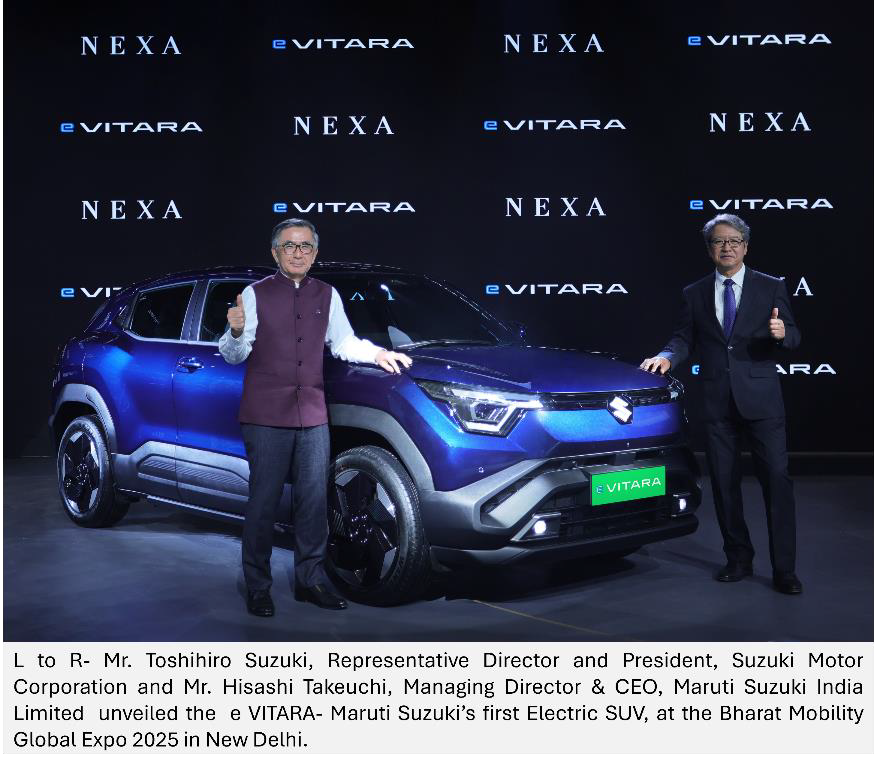
For buyers currently weighing the Combat against pure-EV alternatives, the comparison with the Maruti Suzuki e Vitara is immediate and instructive: the e Vitara commits entirely to battery-electric propulsion, while the Combat hedges with a petrol engine that eliminates range anxiety on long highway runs. Here is how the two vehicles — and a third PHEV rival — stack up on the metrics that matter most at the decision stage.
| Spec / Feature | JSW Combat PHEV | Maruti Suzuki e Vitara (EV) | MG Hector Tomahawk PHEV |
|---|---|---|---|
| Powertrain type | PHEV (1.5T petrol + 2 e-motors) | Pure BEV | PHEV (1.5T petrol + e-motor) |
| Battery capacity | 18.4 kWh | ~49 kWh (larger pack) | 20.5 kWh |
| Electric-only range | 90 km (NEDC) | ~500 km (ARAI est.) | 115+ km |
| Combined range | ~1,100 km | ~500 km (charge-dependent) | 1,100+ km |
| System power | 360 hp / 610 Nm | ~175 hp | ~200 hp |
| Expected price (ex-showroom) | ₹40–50 lakh | ₹18–25 lakh (est.) | ₹25.69–27.79 lakh |
| Seating | 5 | 5 | 7 (PHEV only) |
| Infotainment | 15.6-inch touchscreen | TBC | 15.6-inch touchscreen |
| ADAS level | Level 2 | Level 2 | Level 2 |
| Launch / availability | Dec 4, 2026 | 2026 | Nov 2026 (PHEV deliveries) |
The table makes one tension clear: the Combat's PHEV architecture gives it a decisive combined-range advantage over the e Vitara's pure-EV setup, but the e Vitara undercuts it significantly on price. Buyers who can charge at home or at work daily will find the e Vitara's running costs compelling; those who regularly drive 400+ km intercity without reliable charging infrastructure will find the Combat's 1,100 km combined range far more reassuring.
What exactly is the JSW Combat, and who makes it?
JSW Motors is an independent passenger-vehicle brand owned by the JSW Group — one of India's largest conglomerates — operating entirely separately from JSW MG Motor India, which is the group's joint venture with China's SAIC Motor. Under a licensing and component supply partnership with Chery Automobile, JSW Motors plans to badge and sell Chery-derived vehicles in India, beginning with the Combat.
The Combat is based on the Jetour T2, a rugged PHEV SUV that Autocar India's Saumil Shah drove ahead of the Indian launch. His verdict: "If you're looking for a 5-seat SUV in the Rs 30 lakh to Rs 50 lakh range, we recommend that you wait for JSW's first offering in India." That endorsement carries weight given how crowded that segment has become.
The Combat will be assembled — not imported as a CBU — at JSW Motors' Chhatrapati Sambhajinagar plant, which should help manage duties and keep pricing closer to the ₹40 lakh mark rather than the upper end of the ₹50 lakh band. Originally planned for a Diwali 2026 reveal, the debut was pushed to December 4, 2026, with the launch and pricing announcement expected to follow shortly after.
After the Combat, JSW Motors plans to introduce SUVs derived from the Jaecoo J5 and iCaur V23 in 2027, building out a broader portfolio under the JSW badge.
What is the JSW Combat's powertrain, and how does it work in real-world driving?
The India-spec JSW Combat uses a dedicated hybrid transmission (DHT) architecture — a 3-speed unit — that coordinates a 1.5-litre direct-injection turbo-petrol engine with two electric motors driving the front wheels. The 18.4 kWh battery sits between the axles for a lower centre of gravity. Combined system output is rated at 360 hp and 610 Nm of torque, making it one of the most powerful PHEVs available in India at this price point.
JSW claims 90 km of all-electric range on the NEDC cycle. NEDC figures are typically optimistic — real-world EV range in Indian conditions (AC on, mixed urban-highway) is likely to be 60–70 km, which is still enough to cover most daily commutes in Bengaluru, Mumbai, or Delhi without burning a drop of petrol. Fill the tank and you get a combined range of approximately 1,100 km, which matches the headline figure the MG Hector Tomahawk PHEV also claims with its 20.5 kWh battery.
Autocar India's drive of the China-spec Jetour T2 — which uses a larger 43.24 kWh battery and three motors producing 462 hp — recorded a 0–100 kph time of 6.35 seconds. The India-spec Combat's smaller battery and two-motor setup will be slower, but 360 hp remains substantial. The powertrain's character, as described in the Autocar India review, is "smooth and effortless," with regenerative braking calibrated well enough that the transition between regenerative and friction braking is "almost imperceptible." Eco mode offers the most natural throttle response; Normal and Sport modes can feel aggressive on initial tip-in.
One caveat worth flagging: the India-spec Combat will be front-wheel drive only, despite the rugged Defender-like styling suggesting otherwise. Buyers expecting off-road capability should factor this in — the Combat is a road-biased SUV with 201 mm of laden ground clearance, not a trail-rated 4x4.
How does the JSW Combat's PHEV approach compare to the Maruti Suzuki e Vitara's pure-EV strategy?
This is the central question for buyers in the ₹20–50 lakh electrified SUV space in late 2026. The Maruti Suzuki e Vitara is a battery-electric SUV — it carries no petrol engine, relies entirely on grid-charged electricity, and targets buyers who have home charging infrastructure and primarily drive within city limits or on well-served highway corridors.
The Combat takes the opposite philosophical position: it is a PHEV, meaning it can run on electricity for short trips, switch to petrol-assisted hybrid mode for longer runs, and be refuelled in three minutes at any petrol station in the country. For buyers in Tier-2 and Tier-3 cities where public DC fast chargers remain sparse, this flexibility is genuinely valuable rather than a marketing talking point.
The trade-offs are real, however. A PHEV is mechanically more complex than either a pure EV or a conventional hybrid — it carries both a petrol engine and a meaningful battery pack, which adds weight and maintenance touchpoints. The Combat's 18.4 kWh battery is large enough to deliver useful EV range but small enough that DC fast charging is unlikely to be a priority feature (most PHEVs in this battery range charge via AC). The e Vitara, by contrast, can accept DC fast charging to recover significant range in 30–45 minutes at a highway charger.
On running costs: if you charge the Combat daily and drive mostly within its 60–70 km real-world EV range, your per-kilometre cost approaches that of a pure EV. If you regularly exceed that range and run on the petrol engine, fuel costs climb. The e Vitara's cost-per-km on electricity is lower in all scenarios — but only if you can charge it.
For buyers currently considering the e Vitara, the Combat sits in a different price bracket (₹40–50 lakh versus the e Vitara's estimated ₹18–25 lakh), so they are not direct head-to-head rivals in the strictest sense. The Combat's real competition is the MG Hector Tomahawk PHEV (₹25.69–27.79 lakh, 7-seat PHEV), the Kia Sorento, and — on ruggedness perception — the Toyota Fortuner. But for buyers who were considering the e Vitara and want to step up to a larger, more powerful electrified SUV with intercity range flexibility, the Combat is the most relevant PHEV option in the market.
If you're researching the broader EV space, our guide to best electric cars for long trips in India in 2026 covers how pure EVs handle highway range in detail.
What does the JSW Combat look like, and how big is it?
The Combat's design is derived from the Jetour T2 with targeted revisions. Expect revised headlights, a new front grille with 'Combat' lettering replacing 'Jetour,' and modified front and rear bumpers. The core silhouette — boxy, upright, with a tailgate-mounted spare wheel — remains unchanged, and it is this silhouette that gives the Combat its strongest visual argument: it looks like a proper SUV rather than a crossover wearing SUV clothing.
Key design elements carried over from the T2 include 20-inch alloy wheels with generous wheel-arch cladding, roof rails with neon green design accents, a spare wheel mounted on the boot door, vertically oriented LED tail-lights, and sturdy side steps with grab handles.
In terms of dimensions, the T2 is longer, wider, and taller than the Toyota Fortuner — which gives the Combat genuine visual presence in traffic. Ground clearance is rated at 201 mm in laden condition (the Autocar India review noted 190 mm in a slightly different measurement context; the Autocar India specs page cites 201 mm laden). The 580-litre boot is accessed via a side-hinged tailgate — practical once you're used to it, but worth noting if your parking space is tight on the left side.
The international Jetour T2 recently received a facelift, but spy shots in India confirm JSW will launch the pre-facelift model. This pragmatic decision keeps tooling costs down, though it does mean the Combat will look slightly dated relative to the global T2 within a year or two of launch.
What features and technology does the JSW Combat offer?
The JSW Combat's cabin is centred on a 15.6-inch infotainment touchscreen — the same screen size as the MG Hector Tomahawk — paired with a 10.25-inch digital driver's display and a four-spoke steering wheel. The dashboard design is distinctive, with an illuminated pattern across the fascia and multiple layers of dimpled leatherette padding.
Feature highlights expected on the India-spec Combat, based on the international T2's equipment list, include a 12-speaker Sony sound system (a genuine differentiator at this price point), a 540-degree camera system with underbody view and surround view for navigating tight urban parking, Level 2 ADAS with adaptive cruise control, lane keep assist, and automatic emergency braking, 6 airbags as standard, 6-way powered driver's seat with ventilation and memory functions, 4-way powered co-driver's seat with ventilation, wireless Android Auto and Apple CarPlay, and a panoramic sunroof.
One area where the T2 drew criticism in Autocar India's review was the infotainment interface — described as not particularly "slick or responsive." JSW may address this with localised software for the Combat, but buyers should factor in the possibility that the touchscreen experience lags behind what Hyundai, Kia, and Tata currently offer in India.
The air-conditioning also "struggled to cool the large cabin quickly in hot conditions" during the review — a significant concern for Indian summers. JSW will need to recalibrate the HVAC system for Indian ambient temperatures, and it is unclear at this stage whether that work has been completed.
For buyers who prioritise safety ratings, our guide to 5-star Bharat NCAP electric cars in India provides context on how ADAS-equipped vehicles have performed in Indian crash tests.
How is JSW Motors pricing the Combat, and who does it compete with?
JSW Motors is understood to be targeting an aggressive price of ₹40–50 lakh (ex-showroom), with Autocar India's expected on-road price for Delhi at ₹44.28 lakh. At this price, the Combat's primary rivals are:
Kia Sorento — a 7-seat SUV with hybrid and petrol options, positioned in a similar price band and offering Kia's established service network as a key advantage over a new entrant like JSW.
Toyota Fortuner — the benchmark rugged SUV in India, with a loyal owner base, proven reliability, and Toyota's extensive dealer network. The Fortuner's diesel powertrain offers long-distance efficiency, but it cannot match the Combat's electric-mode running costs for daily urban use.
MG Hector Tomahawk PHEV — priced at ₹25.69–27.79 lakh, the Tomahawk PHEV undercuts the Combat significantly, offers 7 seats, and comes from an established brand with an existing dealer and service network. Its 115+ km electric range also exceeds the Combat's 90 km NEDC claim. The Combat's counter-argument is 360 hp versus the Tomahawk PHEV's ~200 hp, and a more distinctive design.
MG Majestor — mentioned by Autocar India as a rugged SUV against which the Combat's underpinnings will be compared.
The pricing strategy reflects JSW's awareness that it is a new brand asking buyers to pay a premium price. To justify ₹40+ lakh, the Combat needs to deliver on road presence, powertrain performance, and features — and on paper, it does. The real test will be after-sales service network depth, which JSW Motors has not yet detailed publicly. Buyers considering the Combat should ask hard questions about service centre locations before committing. Our guide on which electric SUV has the best after-sales service network in India provides a useful framework for evaluating this.
What are the JSW Combat's known limitations, and what should buyers watch out for?
Autocar India's review of the Jetour T2 — the closest proxy for the Combat — identified several areas of concern that buyers should weigh carefully:
Ride quality is rated 6/10. The suspension prioritises comfort on smooth roads but bounces over speed breakers and undulations, and the tall body exhibits noticeable roll through quick corners. High-profile tyres help absorb smaller imperfections, but the overall ride is described as "unsettled" at higher speeds. Indian roads, with their variable surface quality, will expose this limitation regularly.
Air-conditioning performance was flagged as a weakness — the cabin took longer than expected to cool in hot conditions. For a vehicle targeting Indian buyers, this is a meaningful drawback that JSW needs to address in the India-spec calibration.
Infotainment responsiveness — the 15.6-inch screen is large and feature-rich but not as fluid as competitors from Korean or domestic brands.
FWD only — the rugged styling implies off-road capability that the drivetrain cannot deliver. The Combat is a road-biased PHEV, not a 4x4.
New brand risk — JSW Motors has no track record in India as a standalone brand. Warranty support, spare parts availability, and service network quality are unknowns that will only become clear after the launch. Buyers who prioritise peace of mind may prefer to wait 12–18 months for owner feedback to accumulate.
NEDC range claims — the 90 km electric range is measured on the NEDC cycle, which is less stringent than WLTP or ARAI. Real-world EV range is likely to be 60–70 km in Indian conditions with air-conditioning running.
What comes after the Combat in JSW Motors' India roadmap?
JSW Motors has confirmed that the Combat is the first of at least three models planned for India. Following the Combat's December 2026 debut, the brand will introduce SUVs based on the Jaecoo J5 and the iCaur V23 in 2027. The iCaur V23 is expected to be priced between ₹17–20 lakh, positioning it in a much more accessible segment than the Combat.
This product roadmap suggests JSW Motors is building from the top down — establishing the brand with a high-visibility, high-specification PHEV flagship before moving into volume segments. It mirrors what MG Motor did with the Hector and ZS EV before expanding downmarket.
The JSW Group's automotive ambitions now run on two parallel tracks: JSW MG Motor India (the SAIC JV, which launched the Hector Tomahawk EV at ₹19.49 lakh and the PHEV at ₹25.69 lakh in August 2026) and JSW Motors (the standalone Chery-partnership brand, launching the Combat in December 2026). The two entities operate independently, but together they give the JSW Group a presence across a wide price spectrum of electrified vehicles.
Should you buy the JSW Combat, wait, or consider an alternative?
The honest answer depends on your use case, charging access, and risk tolerance toward a new brand.
Buy the Combat if you regularly drive 300–500 km intercity, live in a city or town with limited public charging infrastructure, want a powerful and distinctive-looking SUV, and are comfortable being an early adopter of a new brand. The 1,100 km combined range genuinely solves the range anxiety problem that still affects pure-EV buyers on long runs.
Consider the Maruti Suzuki e Vitara instead if your daily driving is under 60 km, you have home charging, and you want a lower purchase price with Maruti's unmatched service network behind you. The e Vitara's pure-EV running costs will be lower than the Combat's in daily use, and Maruti's 3,500+ service touchpoints across India are a meaningful ownership advantage. For buyers researching the broader EV market, our best electric cars to buy in India in 2026 guide covers the full space.
Consider the MG Hector Tomahawk PHEV instead if you want PHEV flexibility, need 7 seats, and want to save ₹15–20 lakh versus the Combat. The Tomahawk PHEV's 115+ km electric range is better than the Combat's 90 km NEDC claim, and MG's existing dealer network reduces new-brand risk.
Wait if you want to see real-world owner feedback on the Combat's ride quality, air-conditioning performance, and JSW Motors' service network before committing ₹44+ lakh to a brand-new brand. The Combat's December 4 debut will be followed by a launch and delivery timeline that likely extends into early 2027 — giving you time to read first-owner reviews.
The JSW Combat arrives at a moment when India's PHEV market is genuinely taking shape. The MG Hector Tomahawk PHEV has already launched, the Renault Duster hybrid is entering the market, and the Maruti Suzuki e Vitara is expanding the pure-EV consideration set. For buyers who want the best of both worlds — EV efficiency in the city, petrol range on the highway — the Combat's 360 hp PHEV powertrain and 1,100 km combined range make it one of the most compelling new entries of 2026. The unknowns around brand support and ride quality mean it rewards careful evaluation rather than impulse purchase.
Sources
- JSW Combat to debut on December 4 | Autocar India
- JSW Motors Combat – Expected Price, Launch Date & Specs | Autocar India
- Jetour T2 Review: Is JSW Ready for Combat? | Autocar India
- MG Hector Tomahawk EV and PHEV Unveiled in India: Prices Start at ₹19.49 Lakh | Mint
- JSW MG Motor Launches Hector Tomahawk EV at ₹19.49 Lakh, PHEV at ₹25.69 Lakh | ETAuto
- JSW Motors Chery iCAR V23 | Autocar India