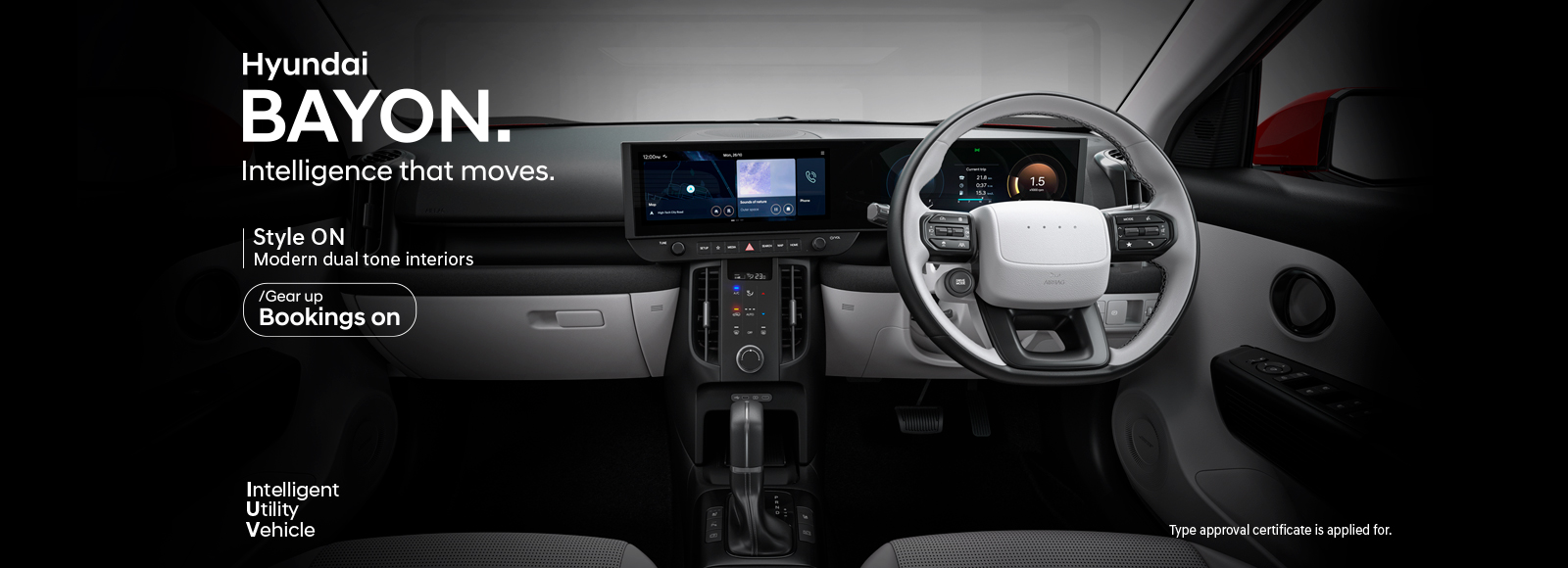

The Hyundai Bayon launches October 26, 2026 at Rs 9–14 lakh with a 1.5-litre petrol engine, generative AI voice assistant, and dual 12.3-inch displays — taking on Maruti's Victoris and e Vitara.
Hyundai Bayon Launch October 26, 2026: How India's New Mid-Size SUV Challenges Maruti Vitara and Maruti e-Vitara
The Hyundai Bayon is a 4.2-metre mid-size Intelligent Utility Vehicle (IUV) positioned between the Venue and Creta in Hyundai's India SUV lineup, with prices expected between Rs 9 lakh and Rs 14 lakh (ex-showroom) on October 26, 2026. Bookings opened on September 23, 2026 at a token amount of Rs 11,000. The SUV enters a segment already contested by the Maruti Victoris, Maruti Grand Vitara, and the battery-electric Maruti Suzuki e Vitara — each representing a distinct philosophy on how to power and price a modern family SUV.
Here is how the Bayon stacks up against its closest rivals at a glance:
| Feature / Spec | Hyundai Bayon | Maruti Grand Vitara | Maruti Suzuki e Vitara |
|---|---|---|---|
| Length | 4.2 m | ~4.34 m | ~4.28 m |
| Powertrain | 1.5L petrol (115 PS), CNG later | 1.5L petrol + strong hybrid | Pure electric |
| Transmission | 6-speed MT / IVT | MT / AT / e-CVT (hybrid) | Single-speed automatic |
| Expected price (ex-showroom) | Rs 9–14 lakh | Rs 11–20 lakh (approx.) | Rs 17.49 lakh onwards |
| Key tech highlight | Generative AI voice assistant (Perplexity + SoundHound) | Suzuki Connect, hybrid efficiency | Bluelink EV, zero-emission running |
| Safety platform | Global K Enhanced Platform (5-star target) | TECT platform | HEARTECT-e platform |
| Infotainment | Dual 12.3-inch curved displays | 9-inch touchscreen | 10.25-inch touchscreen |
| OTA updates | Yes (19 controllers) | Limited | Yes |
| CNG option | Planned (post-launch) | No | No |
The table reveals the strategic divide: the Bayon enters the lower-to-mid band with a petrol-first approach, the Grand Vitara straddles petrol and hybrid, and the Maruti Suzuki e Vitara occupies the EV-only upper tier. These represent three different answers to what a modern Indian family SUV should be.
What exactly is the Hyundai Bayon, and where does it fit in the market?
The Hyundai Bayon targets urban Indian buyers who want authentic SUV proportions, advanced in-cabin technology, and everyday fuel efficiency without stretching their budget to Creta territory. Hyundai Motor India Limited (HMIL) describes it as an "Intelligent Utility Vehicle" built around five pillars: Intelligence ON, Safety ON, Comfort ON, Performance ON, and Style ON.
At 4.2 metres, the Bayon sits just below the 4.3-metre Creta and comfortably above the sub-4-metre Venue. Hyundai has watched Maruti succeed with a two-pronged approach — the Victoris at the entry end and the Grand Vitara higher up — and is now replicating that playbook. The Bayon handles the entry-to-mid band; the next-generation Creta, expected to offer a wider powertrain lineup including a hybrid, will move upmarket.
The name carries meaning. Hyundai's official product page explains that Bayon draws inspiration from Bayonne, a city in the French Basque region known for its distinctive character and spirit of exploration — a nod to the global design philosophy that shaped the vehicle.
What does the Bayon look like, and is the design competitive?
The Bayon adopts Hyundai's evolving 'Art of Steel' design language, which HMIL's design press release describes as "embracing the artistry of shaping steel into forms that convey strength, movement and character." Simon Loasby, Senior Vice President and Head of Hyundai Design Center, put it plainly: "A high-tech interior within a tough exterior."
Up front, the Bayon gets a split headlamp setup. The LED DRLs sit in a slim black trim on the leading edge of the bonnet and are shaped to evoke Hyundai's 'H' motif — a signature the brand calls H-Edge lighting. Main headlamp units are housed lower in the bumper, which gets chunky cladding in black and silver. Autocar India notes that from certain angles the Bayon resembles a scaled-down Tucson, which is a compliment in this segment.
In profile, flared wheel arches, sharp character lines, and petal-style alloy wheels add visual muscle. Traditional pull-type door handles replace flush-fitting units — a practical choice that avoids reliability concerns some buyers associate with flush handles. Gloss-black pillar treatment creates a floating roof effect. Slim tail lamps sit in a black band at the rear, 'BAYON' is spelt out in bold centre lettering on the tailgate, and a pronounced roof spoiler rounds off the crossover-ish silhouette.
The overall aesthetic is more urban crossover than boxy SUV — exactly the right call for a vehicle targeting young, city-dwelling buyers.
What technology does the Bayon bring to the segment?
The Bayon makes its strongest case here. ETAuto reports that the Bayon is the first Hyundai in India to feature a generative AI voice assistant, combining intelligence from Perplexity with voice AI technology from SoundHound AI. Unlike conventional voice assistants that rely on predefined commands, the system understands conversational requests — a driver can ask "find me a good biryani place near the next highway exit" rather than phrasing queries in rigid format.
The assistant handles travel itinerary planning, real-time weather, hotel and restaurant discovery, nearby shopping, and sports updates. This represents a meaningful step beyond what most rivals in this price band offer.
The cockpit is powered by NVIDIA and integrates Hyundai's Connected Car Navigation Cockpit (ccNC), bringing together navigation, connected services, and vehicle controls through a unified digital interface. Dual 12.3-inch curved panoramic displays — one for the instrument cluster, one for infotainment — connect and support split-screen functionality, personalised control panels, and smartphone-like quick controls.
OTA updates support up to 19 vehicle controllers, meaning the Bayon can receive software enhancements remotely — a feature more commonly associated with EVs like the Maruti Suzuki e Vitara than with petrol SUVs in this price bracket.
Hyundai Bluelink connected tech brings 70-plus features including remote engine start/stop, vehicle information, remote controls, smartwatch connectivity, and safety functions. The system supports 10 regional and 2 international languages, with over 500 embedded voice commands working offline in English, Hindi, Hinglish, Tamil, Bengali, and Telugu.
Physical controls remain important — a band of shortcut buttons sits below the touchscreen, steering-mounted controls and haptic buttons occupy the centre console, and the steering wheel houses a standalone pod for the drive mode selector, borrowed from the Venue.
What engine and gearbox options are available?
At launch, the Bayon uses the 1.5-litre, four-cylinder naturally aspirated MPi petrol engine that also powers the Creta. It produces 115 PS (84.4 kW) and 144 Nm of peak torque — adequate for urban commuting and highway cruising, if not exciting. Gearbox choices are a 6-speed manual transmission and Hyundai's Intelligent Variable Transmission (IVT), the brand's name for a CVT-type unit tuned for smoothness in stop-start traffic.
A CNG variant is expected to follow at a later stage. If confirmed, Autocar India notes this would make the Bayon the first Hyundai model over four metres long to be offered with CNG — likely with an underbody tank to preserve boot space. This detail carries weight: CNG versions of mid-size SUVs are rare, and if Hyundai executes it well, the Bayon CNG could carve out a distinct niche among fleet buyers and high-mileage private owners.
The powertrain strategy is deliberately conventional and proven. Hyundai is not experimenting — the 1.5-litre petrol is a known quantity with established service infrastructure across India. The bet is that buyers in the Rs 9–14 lakh band prioritise reliability and low running costs over electrification.
How safe is the Bayon, and what platform does it use?
The Bayon is built on Hyundai's Global K Enhanced Platform, which HMIL's official press release describes as "engineered for 5-star Indian safety standards." This claim carries weight in the context of Bharat NCAP, which has become an increasingly important purchase criterion for Indian buyers. A 5-star Bharat NCAP rating would join the Bayon to a short list of vehicles that have earned that distinction — you can see which EVs have already cleared that bar in our guide to 5-star Bharat NCAP electric cars in India.
Specific active and passive safety features have not been fully detailed ahead of launch, but Hyundai's track record with the Creta and Venue suggests the Bayon will include multiple airbags, ESC, hill-start assist, and likely some ADAS features on higher trims. Full details will emerge at the October 26 price announcement.
How does the Bayon's petrol strategy differ from the Maruti Suzuki e Vitara's EV approach?
This is the central strategic question for buyers considering both vehicles, and the answer hinges on what problem each car solves.
The Maruti Suzuki e Vitara is a battery-electric SUV built on Suzuki's HEARTECT-e platform, designed to offer zero-emission urban mobility with the practicality of a mid-size SUV body. It starts at approximately Rs 17.49 lakh — well above the Bayon's expected ceiling of Rs 14 lakh. The e Vitara targets buyers ready to commit to EV ownership, with access to home charging or reliable public infrastructure, and willing to pay a premium for lower running costs over time.
The Bayon targets a different buyer: someone who wants a feature-rich, tech-forward SUV in the Rs 9–14 lakh band, is not yet ready to make the EV leap, and may consider CNG as a future option. These vehicles do not directly compete for the same wallet — but they do compete for the same consideration set. A buyer thinking "mid-size SUV, modern features, reasonable price" will likely shortlist both, and the decision hinges on charging infrastructure access, budget headroom, and appetite for new technology.
The e Vitara wins on zero fuel cost per kilometre for city driving, OTA updates, and long-term cost-of-ownership. The Bayon wins on lower entry price, no charging anxiety, wider service network familiarity, and — at launch — a more aggressive technology package for the money (generative AI, NVIDIA cockpit, 70-plus Bluelink features).
For buyers wanting to understand the EV ownership experience before committing, our guide to the best electric cars to buy in India in 2026 is a useful starting point.
How does the Bayon compare to the Maruti Grand Vitara and Victoris?
Hyundai has explicitly positioned the Bayon to take on the Maruti Victoris, which occupies the entry-to-mid band of Maruti's mid-size SUV lineup. The Grand Vitara, with its strong hybrid option, sits higher. This mirrors Hyundai's own two-car strategy: Bayon at the bottom, Creta at the top.
The Victoris competes on price and Maruti's unmatched service network — over 4,000 touchpoints across India. The Bayon counters with a significantly more advanced technology package: generative AI voice assistant, NVIDIA-powered cockpit, and OTA updates for 19 controllers are not features found in the Victoris's price band. Hyundai is betting that younger buyers will pay a modest premium for tech differentiation within the same broad price bracket.
The Grand Vitara's strong hybrid offers near-EV fuel efficiency without charging infrastructure requirements. If the Bayon's CNG variant materialises, it will offer comparable running-cost arguments for buyers covering high annual mileage, but the hybrid's refinement and smooth operation are harder to replicate with CNG.
What is the expected price, and which variants should buyers consider?
The Bayon is expected to be priced between Rs 9 lakh and Rs 14 lakh (ex-showroom), with exact variant-wise pricing announced on October 26, 2026. Bookings are open at Rs 11,000 through Hyundai's official website (hyundai.co.in) and all authorised dealerships.
Based on Hyundai's typical variant structure, expect three to four trims: a base variant with the manual gearbox and essential safety features, a mid variant adding connected features and larger displays, a top variant with the full generative AI suite and IVT, and possibly a limited edition or special variant at launch. The IVT will likely carry a premium of Rs 80,000–1 lakh over the equivalent manual trim, consistent with Hyundai's pricing on other models.
Buyers prioritising technology should target the top-spec IVT variant, expected around Rs 13–14 lakh. Those wanting the lowest entry point into the Bayon's safety platform and design should look at the base manual, expected around Rs 9–10 lakh.
Should you wait for the Bayon or buy a rival now?
The answer depends on three factors: timeline, technology priority, and fuel preference.
If you need a car before October 26, the Maruti Grand Vitara (with discounts of up to Rs 3.10 lakh reported in September 2026) or the Hyundai Creta remain strong choices. If you can wait two weeks, the Bayon's technology package — particularly the generative AI assistant and NVIDIA cockpit — deserves evaluation in person before committing.
If you are open to an EV and have home charging access, the Maruti Suzuki e Vitara deserves serious consideration despite its higher starting price. Total cost of ownership over three to five years can be competitive once fuel savings are factored in, and the e Vitara's after-sales network is backed by Maruti's unparalleled reach. Our analysis of which electric SUV has the best after-sales service network in India covers this in detail.
If long-distance travel is a priority and charging infrastructure in your route is patchy, the Bayon's petrol powertrain — and eventual CNG option — makes more practical sense than an EV for now. See our guide to the best electric cars for long trips in India in 2026 for context on where EVs currently stand on highway usability.
What does the Bayon's launch mean for the mid-size SUV segment overall?
The Bayon's arrival is significant for three reasons.
First, it validates the sub-4.3-metre mid-size SUV as a distinct category. Hyundai is not launching a sub-4-metre car or a full-size SUV — it is deliberately filling the 4.0–4.3-metre band with a product that has global DNA and India-specific calibration. This will pressure Maruti to respond, either through the Victoris's feature set or through pricing adjustments.
Second, the Bayon brings generative AI to a price point where it has not existed before in India. At Rs 9–14 lakh, a Perplexity-powered, SoundHound-enabled voice assistant is a genuine first. If the technology works as advertised, it raises the bar for every competitor in this segment — including the Maruti Suzuki e Vitara, which will need to match or exceed this level of AI integration in future updates.
Third, the planned CNG variant signals that Hyundai sees alternative fuels — not just electrification — as part of India's mid-term mobility mix. This is a pragmatic reading of the market: India's EV charging infrastructure is improving but remains uneven, and CNG availability in tier-2 and tier-3 cities often exceeds fast-charging availability. A CNG Bayon over four metres long would be a genuinely new product type.
For buyers tracking the EV space, the Bayon's launch is a reminder that the transition to electric mobility in India is not linear. Petrol, CNG, hybrid, and electric will coexist in this segment for several years, and the right choice depends on individual usage patterns, infrastructure access, and budget — not on a single technology narrative. If you are weighing EV options in the broader Rs 15–25 lakh band, our guide to 5-star Bharat NCAP-rated electric SUVs under Rs 25 lakh provides a useful shortlist.
Key takeaways before October 26
- The Hyundai Bayon launches October 26, 2026 at an expected price of Rs 9–14 lakh (ex-showroom).
- It is 4.2 metres long, powered by a 1.5-litre petrol engine (115 PS/144 Nm), and available with a 6-speed MT or IVT.
- The headline technology is a generative AI voice assistant — the first in any Hyundai in India — powered by Perplexity and SoundHound, running on an NVIDIA-accelerated cockpit.
- Dual 12.3-inch curved displays, 70-plus Bluelink features, OTA updates for 19 controllers, and 500-plus offline voice commands round out the tech package.
- The Bayon is built on the Global K Enhanced Platform, targeting 5-star Bharat NCAP safety ratings.
- A CNG variant is planned post-launch, which would make the Bayon the first Hyundai over four metres to offer CNG.
- Against the Maruti Suzuki e Vitara, the Bayon offers a lower entry price and no charging dependency; the e Vitara counters with zero-emission running and lower per-kilometre fuel costs for city drivers.
- Bookings are open at Rs 11,000 on hyundai.co.in and at all Hyundai dealerships.
Sources
- Hyundai Bayon revealed ahead of October 26 launch | Autocar India
- Hyundai Motor India Limited Announces Bookings ON for Hyundai BAYON | Hyundai India Official
- Hyundai BAYON Highlights | Hyundai India Official
- HMIL Unveils First Design Sketches of Hyundai BAYON | Hyundai India Official
- Hyundai unveils India-spec Bayon SUV with generative AI voice assistant | ETAuto