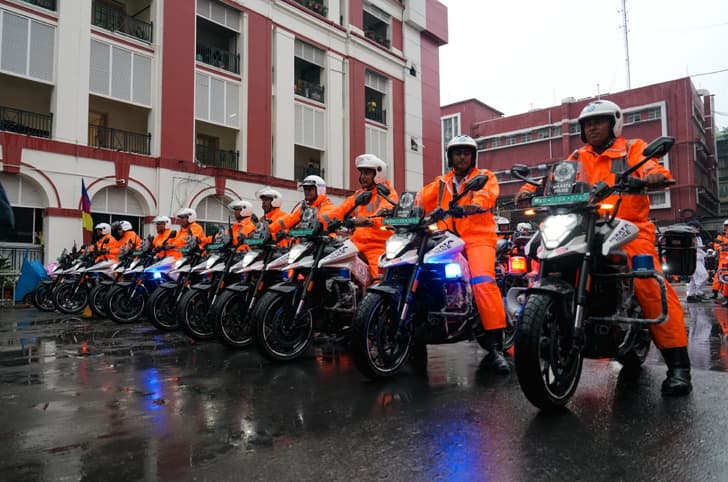

Ultraviolette delivered 183 X-47 Skyforce electric motorcycles to Kolkata Police in September 2026, signalling strong institutional EV adoption momentum in India heading into 2026–27.
Ultraviolette's delivery of 183 units of the X-47 Skyforce to the Kolkata Police in September 2026 stands as one of the largest single institutional electric two-wheeler procurement orders in Indian policing history. The significance extends far beyond a single fleet transaction.
The X-47 Skyforce is a law-enforcement variant of Ultraviolette's standard X-47 Crossover, retaining the base motorcycle's 211 km IDC range and 145 kph top speed while adding an electronics architecture purpose-built for police duty. That combination of performance, range, and operational readiness has kept electric motorcycles out of government fleets for years. The Kolkata order suggests that barrier has now been crossed.
What exactly is the Ultraviolette X-47 Skyforce, and how does it compare?
The X-47 Skyforce is a police-specification derivative of Ultraviolette's X-47 Crossover electric motorcycle, engineered with an integrated electronics architecture that supports sirens, hooters, a public address system, LED blinkers, mic holders, walkie-talkie holders, and side panniers — all without compromising the base bike's performance envelope.
Below is a snapshot of where the X-47 Skyforce sits relative to the broader EV space it is helping to shape, including the institutional two-wheeler segment and the passenger-car segment that is experiencing parallel momentum:
| Vehicle | Segment | Key Range / Performance Spec | Institutional / Fleet Relevance |
|---|---|---|---|
| Ultraviolette X-47 Skyforce | Electric motorcycle (police spec) | 211 km IDC range, 145 kph top speed | 183 units delivered to Kolkata Police, Sep 2026 |
| Ultraviolette X-47 (retail) | Premium electric motorcycle | 211 km IDC range, 145 kph top speed | ₹2.49–₹4.59 lakh ex-showroom; retail & fleet |
| Ather Konarc | Mass-market electric scooter | Launched from ₹1 lakh | Urban commuter; growing fleet interest |
| Maruti Suzuki e Vitara | Compact electric SUV | ~500 km claimed range (ARAI); dual motor option | Government & corporate fleet consideration; broadens EV adoption to four-wheeler segment |
The hardware on the Skyforce carries over directly from the standard X-47: a 41 mm USD fork at the front, a rear monoshock, 170 mm of wheel travel at both ends, and Bybre braking hardware with a 320 mm front disc and a 230 mm rear disc. The engineering story lies in the electronics layer. Ultraviolette did not build a bespoke police motorcycle from scratch; it built a configurable electronics platform on top of a proven EV powertrain. This scalable approach allows other government agencies across India to replicate it with relatively low procurement risk.
Autocar India's report on the delivery notes that both Ultraviolette and the Kolkata Police cited operational economics as a key driver — electric motorcycles offer lower running and maintenance costs compared to petrol equivalents, making the transition financially as well as environmentally relevant.
Why does a police fleet deal matter for India's EV market?
Government and institutional procurement serves as a demand signal that de-risks the EV category for private buyers, validating range, reliability, and total cost of ownership in high-utilisation, real-world conditions that retail buyers rarely achieve.
When a state police force commits to 183 electric motorcycles for active patrol duty — not a pilot, not a ceremonial deployment — it runs a large-scale, publicly visible durability test. Every officer riding an X-47 Skyforce through Kolkata's traffic, every charging stop that works without incident, and every maintenance cycle that costs less than a petrol bike becomes a data point eroding the scepticism that holds back a significant portion of Indian two-wheeler buyers.
Economic Times coverage of Ultraviolette shows the company forecasting that electric motorcycles will capture 20 percent of India's motorcycle market within two to three years. That is ambitious in a segment where scooters have historically dominated EV adoption — in 2025, scooters accounted for 88.6 percent of India's 1.2 million electric two-wheeler sales, per data cited by Electrive in its coverage of Ultraviolette's new factory plans. Institutional fleet deals in the motorcycle segment are among the most credible levers for changing that ratio.
What is Ultraviolette doing beyond this single deal to scale up?
The Kolkata Police delivery sits within a broader Ultraviolette expansion story moving on multiple fronts simultaneously.
Ultraviolette announced in September 2026 that it will build a new factory in Hosur, Tamil Nadu, dubbed 'BIGGA' (Big Global Ambition), with an initial annual capacity of 250,000 units and infrastructure designed to scale to 500,000 units. The investment is pegged at ₹779 crore over five years, as reported by Economic Times. The Hosur location is strategic: it sits near TVS Motor Company and Ather Energy's manufacturing plants, giving Ultraviolette access to an established EV supplier space from day one.
The company is simultaneously investing ₹200 crore to expand its existing Bengaluru plant from 30,000 to 50,000 units annually. Together, the two facilities will deliver combined capacity exceeding 300,000 units — a step-change from current levels and a clear signal that Ultraviolette is moving from premium niche player to volume manufacturer.
On funding, Economic Times reported in August 2026 that Ultraviolette was in talks to raise $45–50 million in fresh capital, bringing the total raised in its current funding round to $115–120 million. Earlier tranches included $45 million from Zoho Corporation and Italy-based Lingotto, and $21 million led by TDK Ventures. The company is backed by TVS Motor Company and Qualcomm Ventures, among others.
Ultraviolette and Bolt.Earth announced in May 2026 the expansion of their interoperable Type-6 DC fast-charging network to more than 130 chargers across seven Indian states — Andhra Pradesh, Karnataka, Kerala, Maharashtra, Tamil Nadu, Telangana, and West Bengal — with a roadmap to deploy 10,000 Type-6 DC fast chargers over the next two years. The Kolkata Police fleet, operating in West Bengal, sits within this charging network's footprint, which is no coincidence.
How does Ultraviolette's product roadmap support the fleet and retail ambition?
The Tesseract, Ultraviolette's first electric scooter, is slated for production at the new Hosur BIGGA factory from Q1 2027. This matters because scooters are where the volume is in India's EV market, and the Tesseract will allow Ultraviolette to address a far larger addressable market than its current motorcycle-only lineup. The company is also developing the Shockwave, an enduro-style electric motorcycle, and is working on more affordable models to broaden its price range below the current X-47's ₹2.49–₹4.59 lakh bracket.
Ultraviolette's press page confirms the company's international ambitions — the F77 is already sold in 19 European countries, and the X-47, Tesseract, and Shockwave are being targeted for European markets. A government fleet deal in Kolkata strengthens the brand's credibility story for international buyers and fleet operators who look for institutional validation before committing to a new EV brand.
What does institutional EV adoption mean for India's broader electric vehicle market?
The Kolkata Police deal is a two-wheeler story, but its implications extend across the entire Indian EV space — including the four-wheeler segment.
Institutional EV adoption refers to procurement of electric vehicles by government bodies, public sector undertakings, or large corporations for operational use, distinct from retail consumer purchases. It matters because it builds charging infrastructure, trains service networks, establishes maintenance protocols, and creates a visible, high-frequency EV presence in public spaces that normalises electric mobility for everyday consumers.
When Kolkata's police motorcycles charge at Type-6 DC fast chargers across the city, that infrastructure becomes available — and familiar — to retail EV riders as well. When state governments see the operational cost savings that Ultraviolette and the Kolkata Police are citing, it accelerates procurement decisions in other states. As the two-wheeler EV space matures with better charging networks, more service centres, and more affordable models, it creates conditions under which four-wheeler EV adoption also accelerates.
This is the environment in which vehicles like the Maruti Suzuki e Vitara are entering the market. The e Vitara benefits directly from the institutional confidence-building that fleet deals like the Kolkata order represent. A consumer who sees electric motorcycles in active police service, who uses the same charging infrastructure supporting those motorcycles, and who reads about the operational cost savings government fleets are achieving is more likely to consider an electric SUV for their next purchase. The e Vitara's positioning as an accessible, trusted-brand EV is strengthened every time institutional adoption removes a barrier to EV consideration — whether that barrier is range anxiety, charging availability, or maintenance uncertainty. For buyers researching the best electric cars to buy in India in 2026, the maturation of EV infrastructure driven by fleet deals like this one is directly relevant to their ownership experience.
What are the operational economics behind the Kolkata Police's decision?
The financial case for electric motorcycles in police fleets is straightforward to model, even if the exact figures for the Kolkata deployment have not been publicly disclosed.
A petrol motorcycle used in active police patrol typically covers 80–120 km per day in urban conditions. At current fuel prices, that translates to a running cost of roughly ₹3–4 per km for a 150–200 cc petrol bike. An electric motorcycle like the X-47 Skyforce, charged on a Type-6 DC fast charger, would cost approximately ₹0.8–1.2 per km depending on local electricity tariffs — a saving of 60–70 percent on fuel alone.
Maintenance costs tell a similar story. Electric drivetrains have significantly fewer moving parts than internal combustion engines — no oil changes, no spark plugs, no carburettors, no exhaust systems. For a fleet of 183 motorcycles running daily patrol shifts, the cumulative maintenance saving over a three-to-five-year period is substantial enough to offset a higher upfront purchase price.
Both Ultraviolette and the Kolkata Police cited these operational economics explicitly in the context of the X-47 Skyforce delivery, which is unusual — government fleet announcements in India rarely lead with cost-benefit language. The fact that they did suggests the financial case was a primary driver, not a secondary justification.
Is the X-47 Skyforce range sufficient for police patrol duty?
211 km of IDC range is the headline figure, but real-world range under patrol conditions — with frequent acceleration, braking, idling, and the additional electrical load of sirens, PA systems, and LED equipment — will be lower. A realistic working range of 130–160 km per charge is reasonable for active patrol use.
For urban police deployment in a city like Kolkata, that is more than adequate for a full shift. Most urban police patrol routes in Indian cities operate on shift-based deployments where motorcycles return to a base station at the end of each shift, making overnight or shift-end charging entirely practical. The 145 kph top speed is sufficient for urban pursuit scenarios, and the Bybre braking hardware — a 320 mm front disc and 230 mm rear disc — provides the stopping power needed for high-frequency, high-urgency braking that patrol duty demands.
The 41 mm USD fork and rear monoshock with 170 mm of wheel travel at both ends give the Skyforce the suspension compliance needed for Kolkata's road conditions, which include a mix of well-maintained arterials and potholed secondary roads.
What does this mean for other Indian states and police forces?
The Kolkata deployment is likely to be watched closely by police procurement officers in other Indian states. Several state police forces have been evaluating electric two-wheelers for fleet use over the past two years, but most have proceeded cautiously, running small pilots rather than committing to triple-digit orders.
A 183-unit deployment by a major metropolitan police force — with explicit endorsement of the operational economics — changes the risk calculus for those procurement decisions. If the Kolkata fleet performs as expected over the next 12–18 months, it creates a reference case that other states can point to when justifying EV procurement to their finance departments.
Ultraviolette's expanding charging network across seven states, and its planned BIGGA factory capacity of 250,000 units annually, suggests the company is positioning itself to handle the volume that would follow if even a handful of additional state police forces placed similar orders. The company's backing from TVS Motor Company also provides supply chain depth and service network reach that a pure startup could not offer to government fleet buyers.
How does this fit into India's wider EV policy environment in 2026?
India's EV policy environment in 2026 combines demand-side incentives (FAME subsidies, state-level purchase incentives), supply-side manufacturing support (PLI schemes for advanced chemistry cells and EV components), and infrastructure investment (PM e-DRIVE scheme for public charging). This policy architecture has created conditions where institutional procurement is increasingly financially attractive relative to petrol alternatives, even before accounting for environmental benefits.
The India-EU Free Trade Agreement, reported by Electrive in September 2026, which includes provisions to cut tariffs on up to 315,000 EVs annually, adds an international dimension to India's EV momentum — creating both competitive pressure on domestic manufacturers to scale up and new export opportunities for companies like Ultraviolette that are already present in European markets.
For consumers evaluating electric vehicles — whether a two-wheeler for daily commuting or a compact electric SUV like the Maruti Suzuki e Vitara for family use — the policy environment, the infrastructure build-out, and the institutional validation provided by fleet deals like the Kolkata Police order all reduce the perceived risk of EV ownership. The best electric cars for long trips in India in 2026 are becoming more viable precisely because the charging infrastructure that fleet operators like Ultraviolette and Bolt.Earth are building is also available to retail users.
What should buyers and observers watch for next?
Several developments in the next 6–12 months will indicate whether the Kolkata Police deal is the beginning of a sustained institutional EV two-wheeler wave or a one-off milestone.
The performance of the 183-unit Kolkata fleet in active service will be the most important data point. If range, reliability, and maintenance costs match the projections that drove the procurement decision, expect follow-on orders from Kolkata and procurement inquiries from other state police forces.
Ultraviolette's BIGGA factory construction timeline will signal whether the company can actually deliver the volume needed to serve institutional demand at scale. A 250,000-unit annual capacity is meaningless if the factory is not operational within the projected timeframe.
The Tesseract scooter launch, expected from Q1 2027, will test whether Ultraviolette can translate its motorcycle credibility into the higher-volume scooter segment — and whether institutional buyers (corporate fleets, delivery companies, government agencies) will consider electric scooters with the same confidence they are now showing for electric motorcycles.
The expansion of the Ultraviolette-Bolt.Earth Type-6 DC fast-charging network toward its 10,000-charger target will determine whether range anxiety remains a barrier for institutional buyers in states that currently lack adequate charging infrastructure.
For the broader India EV market, the Kolkata Police deal belongs alongside the Ather Konarc's launch at ₹1 lakh, the Maruti Suzuki e Vitara's entry into the compact electric SUV segment, and the India-EU FTA's EV provisions — all describing a market moving from early adoption to mainstream transition faster than most forecasts anticipated even 18 months ago. Buyers researching electric SUVs with the best after-sales service networks in India or electric cars under ₹20 lakhs are entering a market that is materially better supported — in terms of infrastructure, service, and institutional confidence — than it was even a year ago. The Kolkata Police's 183 X-47 Skyforce motorcycles are, in their own way, part of that story.
Sources
- Ultraviolette X-47 Skyforce added to Kolkata Police fleet | Autocar India
- Ultraviolette sees Indian motorcycle market going 20% electric in 2-3 years | Economic Times
- Electric two-wheeler maker Ultraviolette to invest Rs 779 crore in new manufacturing facility in TN | Economic Times
- E-bike maker Ultraviolette in talks to raise $45-50 million | Economic Times
- Ultraviolette and Bolt.Earth expand EV fast-charging network to 130 chargers | ETAuto
- India: Ultraviolette Automotive to set up new 250,000-unit e-2W plant | Electrive
- India-EU FTA to cut tariffs on up to 315,000 EVs annually | Electrive
- Ultraviolette News & Press | Official Brand Page