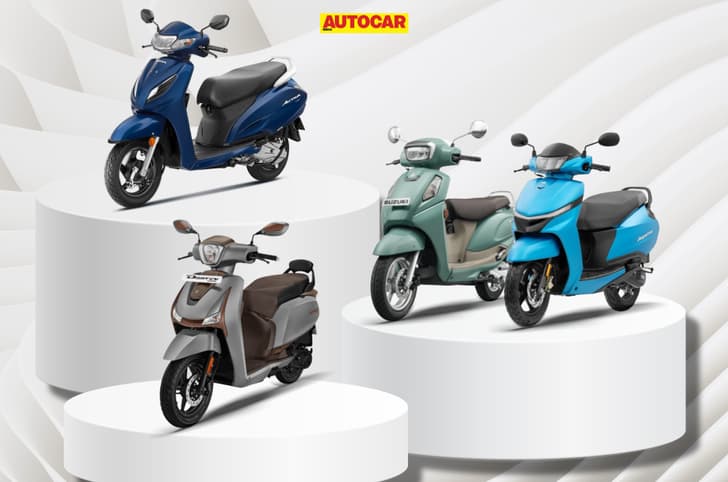

Honda retook India's scooter sales crown in August 2026 with 2.85 lakh units, beating TVS's 2.56 lakh, as the market hit a record 8.55 lakh monthly units with EVs surging across all brands.
Honda Motorcycle & Scooter India (HMSI) reclaimed the top position in India's scooter market in August 2026 with 2.85 lakh units dispatched — a 6% year-on-year increase — after TVS had briefly seized the lead in July for the first time in history. The August number is more than a bounce-back story: it arrived against a backdrop of record-breaking industry volumes, an accelerating EV transition, and a structural shift in who is winning India's two-wheeler market and why.
The month's total of 8.55 lakh scooter units across the top 10 manufacturers beats the previous all-time high of 8.24 lakh set in October 2025. For EV buyers watching the two-wheeler space, the data reveals something important: electric scooters are no longer a niche — they are now a decisive competitive weapon for every serious OEM in the segment.
August 2026 Scooter Market: Brand-by-Brand Snapshot
| Manufacturer | Aug 2026 Units | Aug 2025 Units | YoY Growth | Market Share (Aug 2026) | Key EV model(s) |
|---|---|---|---|---|---|
| Honda (HMSI) | 2,85,527 | 2,69,923 | +6% | 33.36% | Activa e:, QC1, QC3 |
| TVS Motor Co. | 2,56,442 | 2,06,598 | +24% | 29.96% | iQube, Orbiter |
| Suzuki Motorcycle India | 1,01,267 | 91,065 | +11% | 11.83% | eAccess |
| Hero MotoCorp | 72,150 | 48,304 | +49% | 8.43% | Vida range |
| Bajaj Auto | 53,748 | 14,164 | +279% | 6.28% | Chetak, Yulu |
| Yamaha | 34,279 | 27,944 | +23% | 4.00% | EC-06 |
| Ather Energy | 29,694 | 22,757 | +30% | 3.47% | Rizta, 450 range, Konarc |
| Greaves Electric Mobility | 12,439 | 5,804 | +114% | 1.45% | Ampere range |
| River Mobility | 6,567 | 2,229 | +195% | 0.76% | Indie |
| Piaggio (Aprilia/Vespa) | 3,602 | 2,602 | +38% | 0.42% | — |
Data: Society of Indian Automobile Manufacturers (SIAM), via Autocar India
Why Did Honda Lose the Lead to TVS in July — and Win It Back in August?
The July 2026 episode marked the first time in recorded Indian automotive history that TVS Motor Company outsold Honda in monthly scooter wholesales. TVS dispatched 2,56,675 units in July, up 40% YoY, while Honda fell 12% to 2,33,337 units — a swing of over 23,000 units. TVS's market share jumped to 32% from 28% a year earlier; Honda's crashed from 41% to 29%.
The July dip for Honda appears to have been a supply-side blip rather than a demand collapse. HMSI's overall two-wheeler sales for August 2026 rose 8% YoY to 5.79 lakh units, with domestic volumes up 8% to 5.17 lakh and exports up 15% to 61,833 units. The company's April–August FY27 cumulative total reached 27.33 lakh units, up 13% from the same period in FY26.
Yet Honda's market share in scooters has structurally declined. In August 2026 it held 33.36% — down from 39.02% in August 2025. A decade ago, Honda commanded 57% of the scooter market; that has fallen to the mid-30s as TVS, Hero, and Bajaj have all grown faster, largely on the back of electric models.
The root cause is straightforward: Honda's EV transition has lagged behind rivals. In July, the Activa e: and QC1 combined for just 1,264 units — while TVS's iQube and Orbiter reached 59,386 units in the same month. Honda unveiled its third electric scooter, the QC3, on July 24, signalling urgency, and sold its highest-ever monthly EV tally in August 2026, though absolute numbers remain small relative to its ICE base.
What Is Driving the Broader Scooter Market Boom?
India's scooter segment comprises sub-segment of two-wheelers characterised by step-through frames, automatic transmissions, and engine displacements typically ranging from 110cc to 160cc for ICE models, or equivalent electric powertrains. The segment is growing faster than the overall two-wheeler market.
Cumulative scooter wholesales for January–August 2026 reached 60.72 lakh units, up 31% from 46.48 lakh units in the same period of 2025. The segment is now on course to cross 90 lakh annual units for the first time in a calendar year. Scooters now account for 39% of all two-wheeler sales in India — their highest-ever share.
HMSI's CEO Tsutsumu Otani attributes the expansion to multiple structural tailwinds: improving road infrastructure, rising participation of women in the workforce, and growing demand for convenient family mobility supporting scooter adoption in rural and semi-urban markets. Premiumisation is also a factor — customers are trading up to 125cc and higher-displacement models, and increasingly considering EVs as a serious alternative.
The festive season, which runs from September through November, is expected to push monthly volumes even higher. August's 8.55 lakh units may itself be eclipsed before the year ends.
How Are Electric Scooters Reshaping the Competitive Order?
Electric scooters are two-wheelers powered entirely by battery-electric drivetrains, with no internal combustion engine, qualifying for FAME II and PM E-DRIVE subsidies in India. Their role in the August 2026 data is impossible to overstate.
In July 2026, electric scooter wholesales reached 1,70,243 units — 21% of total scooter sales — up 168% YoY from 63,560 units in July 2025. A year earlier, EVs were just 10% of the market. That doubling of EV penetration in 12 months is the single most important structural fact in the August data.
TVS Motor Company is the clearest winner. Its iQube and Orbiter contributed 57,523 units in August, up 135% YoY. In H1 2026, TVS's EVs accounted for 19% of its total scooter sales, up from 15% a year earlier. One in every five TVS scooters sold in August was electric. The iQube's MillionR Special Edition, which saw 100-plus deliveries in Pune alone on a single day, illustrates the brand's growing EV momentum.
Hero MotoCorp is the fastest-growing large OEM in percentage terms, with August scooter sales up 49% YoY. Its Vida EV range sold 25,558 units in August, up 108% YoY. Vida now accounts for 30% of Hero's scooter sales, up from 21% in H1 2025 — the highest EV share of any large ICE-heritage manufacturer.
Bajaj Auto posted the most dramatic growth: up 279% YoY to 53,748 units in August. The company attributes this to recovery from supply chain disruptions that had suppressed Chetak production in 2025. With Chetak and Yulu models now flowing freely, Bajaj's scooter market share has risen from 2% to 6.28% in a single year.
Ather Energy sold 29,694 units in August, up 30% YoY, holding a 3.47% market share. The company launched its mass-market Konarc on August 29 — priced from ₹1 lakh — which is expected to significantly expand Ather's addressable market from September onwards.
River Mobility dispatched a record 6,567 Indie units in August, up 195% YoY and 9% over July. River remains a single-product company but its trajectory is steep.
Greaves Electric Mobility (Ampere brand) reported 12,439 units, up 114% YoY, having recently joined SIAM as a reporting member.
Yamaha dispatched just 475 EC-06 units in August — the last Japanese manufacturer to enter the EV segment — but the direction of travel is clear.
Suzuki sold 668 eAccess units in August, modest but consistent.
Honda recorded its highest-ever monthly EV sales in August, though the absolute number remains undisclosed in the SIAM data. The company's QC3, unveiled in July, is expected to add meaningful volume from Q4 2026.
What Is Honda Doing to Defend Its Position Long-Term?
Honda's response to competitive pressure spans three dimensions: capacity expansion, EV product launches, and export growth.
On capacity, HMSI is investing approximately ₹2,400 crore to expand manufacturing. The Vithalapur plant in Gujarat will add approximately 6.5 lakh units of annual capacity (investment: ₹920 crore), while the Tapukara facility in Rajasthan will add 6.7 lakh units (₹1,500 crore). These expansions are intended to support domestic demand, exports, and new product categories including EVs.
On exports, HMSI shipped 6,20,459 units in FY26, reinforcing India's role as a global manufacturing hub for Honda. August exports rose 15% YoY to 61,833 units. India is increasingly the base from which Honda serves emerging markets across Asia, Africa, and Latin America.
On technology, HMSI's CEO has articulated a deliberately multi-pathway stance: "Our role is not to promote one technology over another, but to provide the most appropriate mobility solution for each customer". This means Honda is hedging across ICE, E20-compatible engines, and electric — a pragmatic approach given that its ICE scooters still account for the vast majority of its volumes and its EV infrastructure is nascent compared to TVS or Ather.
What Does This Mean If You Are Buying an Electric Scooter Right Now?
The August data carries several practical implications for buyers in the market for an electric two-wheeler.
Brand stability matters. The EV scooter market is consolidating rapidly. Okinawa, once a top-10 player, reported zero units in August 2026 — down from 40 units in August 2025. Buyers who purchased from smaller, undercapitalised EV brands in 2022–24 are now facing service and parts challenges. The brands posting strong August numbers — TVS, Hero, Bajaj, Ather — have the scale and backing to support long-term ownership.
EV penetration is accelerating, not plateauing. At 21% of scooter wholesales in July and likely higher in August, electric scooters have crossed the early-adopter threshold. This means charging infrastructure, service networks, and resale values are all improving at a faster rate than two years ago. If you have been waiting for the "right time" to switch, the market data suggests that time is now.
Price points are dropping. Ather's Konarc at ₹1 lakh is the clearest signal that mass-market electric scooters have arrived. TVS's Orbiter and Hero's Vida range have also expanded downward in price over the past 12 months. The entry cost to EV ownership in the scooter segment is lower than it has ever been.
The ICE-to-EV transition is uneven across brands. Honda, despite being the market leader by volume, has the lowest EV penetration among the major OEMs. If you value the widest service network and the most established resale market, Honda's ICE scooters remain the benchmark. But if you want EV-specific advantages — lower running costs, smoother ride, connected features — TVS, Ather, and Hero are currently better-positioned.
For buyers considering the broader electric mobility space, the same EV momentum visible in two-wheelers is playing out in four-wheelers. The Maruti Suzuki e Vitara, for instance, represents a similar dynamic: a legacy ICE giant entering the EV space with the weight of its distribution network behind it, competing against more EV-native players. The question of whether brand trust or EV-first engineering matters more is one that buyers across both segments are navigating simultaneously.
How Does the 2026 Scooter Boom Compare to Previous Years?
The scale of 2026's growth is historically unusual. H1 2026 scooter wholesales of 44.2 lakh units were up 33% YoY and 11 lakh units higher than H1 2025. The segment crossed 7 lakh monthly units in five of the first six months of 2026 — something that had never happened before. August's 8.55 lakh units is the highest single month ever recorded.
The January–August 2026 cumulative of 60.72 lakh units represents 31% growth over the 46.48 lakh units sold in the same period of 2025. At this pace, the full-year 2026 total is on course to exceed 90 lakh units — a milestone the segment has never previously reached.
Several factors are converging: post-pandemic pent-up demand has not fully exhausted itself; rural incomes have improved; women's workforce participation is rising; and EV subsidies have made electric scooters genuinely cost-competitive on a total-cost-of-ownership basis. The festive season (September–November) typically adds a further 10–15% uplift to monthly volumes, suggesting October or November 2026 could set yet another monthly record.
Which Electric Scooter Brands Are Worth Watching Through the Festive Season?
Based on August 2026 data and trajectory, five brands stand out for EV buyers evaluating their options ahead of the festive season:
TVS is the most complete EV scooter manufacturer in India right now. The iQube has a proven track record, the Orbiter extends the range downward in price, and TVS's service network is second only to Honda's in breadth. The 135% YoY growth in EV volumes is not a one-month spike — it reflects consistent execution over 18 months.
Ather has the strongest EV-native engineering credentials. The Rizta and 450 range have loyal followings, and the Konarc at ₹1 lakh opens a new price tier. Ather's fast-charging network (Ather Grid) is the most developed proprietary charging infrastructure in the segment.
Hero MotoCorp (Vida) is the dark horse. The 108% YoY growth in August, combined with Vida's 30% share of Hero's scooter sales, shows that the brand's distribution muscle is now working in favour of its EV range. Hero's 10,000-plus dealer touchpoints give Vida a service reach that pure-play EV brands cannot match.
Bajaj (Chetak) is recovering strongly from its supply chain difficulties. The Chetak's retro styling and Bajaj's financing space (Bajaj Finance) make it a compelling option for buyers who want an EV with the backing of a large conglomerate.
River Mobility remains a watch-and-wait proposition. The 195% YoY growth is impressive, but River is still a single-product, limited-network company. Buyers in cities where River has established service presence may find the Indie compelling; others should be cautious.
For buyers who want deeper context on evaluating EVs across safety, range, and after-sales support, our guides on the best electric cars for long trips in India and which electric SUV has the best after-sales service network apply many of the same evaluation frameworks to the four-wheeler segment — useful reading if you are deciding between upgrading a scooter or making a first EV purchase in a car.
The Bottom Line: What August 2026 Actually Tells Us
Honda's return to the top of the scooter sales chart in August is real, but it should not obscure the more important trend: the competitive gap between Honda and TVS is narrowing structurally, and the primary reason is EVs. Honda's 33.36% market share in August 2026 is six percentage points lower than its 39.02% share in August 2025. TVS's 29.96% share is essentially unchanged from 29.87% a year ago — meaning TVS held its ground even as the market grew 24%.
The brands gaining share are the ones with the strongest EV portfolios: Hero (up from 6.98% to 8.43%), Bajaj (up from 2.04% to 6.28%), Ather (up from 3.29% to 3.47%), Greaves (up from 0.83% to 1.45%), and River (up from 0.32% to 0.76%). Every single brand with a credible EV offering gained share in August. Every brand without one — or with a nascent one — either held flat or lost ground.
HMSI's investment of ₹2,400 crore in capacity expansion and its multi-EV product push (Activa e:, QC1, QC3) signal that the company understands the urgency. Whether it can execute fast enough to prevent further share erosion through 2027 is the defining question for India's largest two-wheeler market.
For EV buyers, the August 2026 data is unambiguously positive: more brands, more models, more competitive pricing, and a market growing fast enough to support the infrastructure investment that makes EV ownership practical. The scooter segment's EV transition is not coming — it is already here, and accelerating.
Sources
- Honda becomes scooter sales topper again in August, overtakes TVS | Autocar India
- TVS overtakes Honda for the first time in July scooter sales | Autocar India
- Honda Motorcycle & Scooter India eyes sustainable growth as 2W market expands | The Hindu
- Honda Motorcycle & Scooter India Sales Rise 8% to 5.79 Lakh in August | Autocar Professional
- Scooter industry posts best-ever first-half sales in 2026 | Autocar India
- Honda Motorcycle & Scooter India – Official Site
- Best Electric Cars to Buy in India in 2026 | EVIndex India
- Which Electric SUV Has the Best After-Sales Service Network in India? | EVIndex India
- Best Electric Cars for Long Trips in India in 2026 | EVIndex India